Google's Knowledge Graph holds over 500 billion facts about 5 billion entities. If your brand, person, or organization isn't in it, you're invisible to a growing set of zero-click experiences, entity disambiguation, and AI-powered answer engines. This article doesn't cover basics — it covers the architecture of entity recognition, the signals Google uses to resolve and reconcile entity identity, and the precise technical interventions that move the needle.
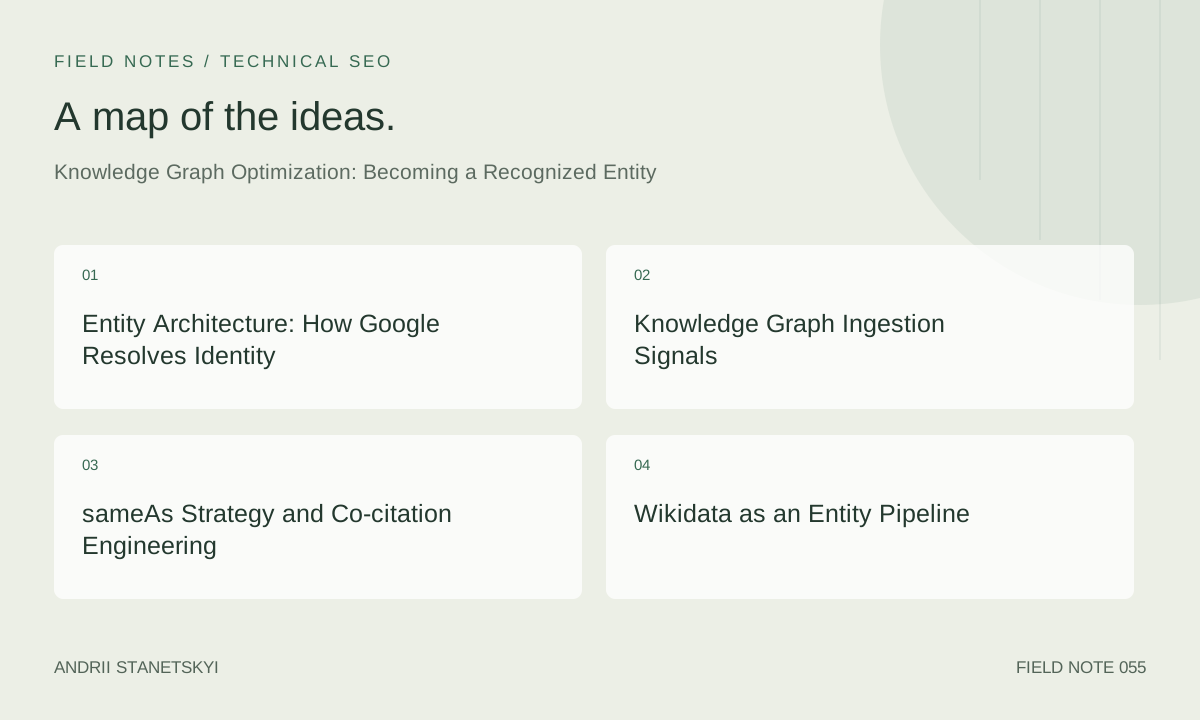
Entity Architecture: How Google Resolves Identity
Google's entity resolution process is a multi-stage pipeline that begins with string matching and ends with probabilistic reconciliation across knowledge bases. The foundational patent here is Gabrilovich & Markovitch's "Computing Semantic Relatedness using Wikipedia-based Explicit Semantic Analysis" combined with the original Freebase acquisition papers. Modern Google KG operates on what Bill Slawski documented as "Entity Salience" — not just whether an entity is mentioned, but whether it's central to the document's topical intent.
The Knowledge Graph doesn't ingest your schema markup directly. It uses markup as a corroborating signal against an existing entity resolution pipeline that queries Wikidata, Wikipedia, CIA World Factbook, and licensed databases. The mechanism is closer to entity reconciliation than entity creation.
Entity Types in the KG Hierarchy
| Entity Type | Primary Ingestion Source | Schema.org Type | Reconciliation Difficulty |
|---|---|---|---|
| Organization | Wikidata, Crunchbase, LinkedIn | Organization / Corporation | Medium |
| Person | Wikipedia, VIAF, ISNI | Person | High (disambiguation) |
| Local Business | Google Business Profile, Yelp | LocalBusiness | Low |
| Creative Work | MusicBrainz, IMDB, ISBNdb | Book / Movie / MusicAlbum | Low (strong IDs) |
| Concept/Topic | Wikipedia categories, WordNet | Thing (broad) | Very High |
Knowledge Graph Ingestion Signals
Google's KG ingestion is not a passive crawl. It's an active reconciliation that weights signals by source authority, consistency across sources, and temporal stability. The following signals have been reverse-engineered from patent literature and empirical testing.
Signal Hierarchy by Weight
- Wikipedia article existence — highest weight, direct ingest. Notability threshold enforced.
- Wikidata Q-item with sameAs assertions — machine-readable, extremely high trust.
- Google Business Profile completeness — for local entities, this is tier-1.
- Consistent NAP across authoritative directories — Acxiom, Neustar, InfoUSA feed Google.
- Structured data on official site with sameAs URIs — corroborating signal only.
- Co-citation with known entities in quality content — entity salience scoring.
The critical misunderstanding practitioners make: adding JSON-LD to your site does not create a KG entity. It tells Google "I claim to be this entity." Google then cross-references that claim against its existing entity graph. If no corroborating node exists, the markup is largely ignored for KG purposes (though it still affects rich results).
Measuring Entity Salience with Python
You can proxy Google's entity salience scoring using the Natural Language API:
import os
from google.cloud import language_v1

def analyze_entity_salience(text: str) -> list[dict]:
    """
    Returns entities sorted by salience score.
    Salience > 0.1 indicates topical centrality.
    KG entities will have a 'metadata' dict with 'wikipedia_url' and 'mid'.
    """
    client = language_v1.LanguageServiceClient()
    document = language_v1.Document(
        content=text,
        type_=language_v1.Document.Type.PLAIN_TEXT
    )
    response = client.analyze_entities(
        request={"document": document, "encoding_type": language_v1.EncodingType.UTF8}
    )

    results = []
    for entity in sorted(response.entities, key=lambda e: e.salience, reverse=True):
        entry = {
            "name": entity.name,
            "type": language_v1.Entity.Type(entity.type_).name,
            "salience": round(entity.salience, 4),
            "in_knowledge_graph": bool(entity.metadata.get("mid")),
            "mid": entity.metadata.get("mid", None),
            "wikipedia_url": entity.metadata.get("wikipedia_url", None),
        }
        results.append(entry)

    return results

# Usage: audit your own page content
with open("page_content.txt") as f:
    content = f.read()

entities = analyze_entity_salience(content)
kg_entities = [e for e in entities if e["in_knowledge_graph"]]
print(f"KG-recognized entities: {len(kg_entities)} / {len(entities)}")
for e in kg_entities[:10]:
    print(f"  {e['name']} ({e['type']}) — salience: {e['salience']} — MID: {e['mid']}")
sameAs Strategy and Co-citation Engineering
The sameAs property in Schema.org is the single most powerful signal you can deploy for entity disambiguation. It explicitly tells Google's reconciler "this entity node equals this external identifier." The architecture of a robust sameAs cluster should target:
- Wikidata Q-item URI (e.g.,
https://www.wikidata.org/entity/Q12345) - Wikipedia article URL (if exists)
- VIAF ID (for persons:
https://viaf.org/viaf/NNNNN) - ISNI (for persons:
https://isni.org/isni/0000000000000000) - Crunchbase organization URL (for companies)
- LinkedIn company/person URL
- DBpedia URI (auto-derived from Wikipedia)
- Schema.org identifier from Open Corporates (for legal entities)
The reciprocal side matters equally: these external sources must also point back to your entity. A Wikidata Q-item with a P856 (official website) pointing to your domain creates a bidirectional assertion that carries significantly more weight than a one-way claim from your site.
Co-citation Engineering
Co-citation is when two entities appear in the same document with contextual proximity. Google's patent "Ranking Search Results Based on Entity Associations" (US9,141,683) describes how co-citation patterns between known and unknown entities can elevate the unknown entity's knowledge graph confidence score.
Practical application: if your brand is consistently mentioned alongside known KG entities in high-authority content — not links, just mentions — this increases your entity confidence score. This is why PR coverage in authoritative publications that naturally mention your competitors or industry leaders is more valuable for entity recognition than thin directory listings.
Wikidata as an Entity Pipeline
Wikidata is the most direct path to Knowledge Graph recognition for entities that don't meet Wikipedia's notability threshold. Google explicitly uses Wikidata as a tier-1 reconciliation source, as documented in the KG API responses which return Wikidata Q-IDs in their entity metadata.
SPARQL Query: Audit Your Entity's Wikidata Completeness
# Run against https://query.wikidata.org/
# Replace Q12345 with your entity's Q-ID

SELECT ?property ?propertyLabel ?value ?valueLabel WHERE {
  BIND(wd:Q12345 AS ?entity)

  # Check for critical SEO-relevant properties
  VALUES ?property {
    wd:P856   # official website
    wd:P18    # image
    wd:P112   # founded by
    wd:P571   # inception date
    wd:P17    # country
    wd:P159   # headquarters location
    wd:P154   # logo image
    wd:P31    # instance of (entity type)
    wd:P452   # industry
    wd:P2002  # Twitter username
    wd:P2003  # Instagram username
    wd:P4264  # LinkedIn company ID
  }

  OPTIONAL {
    ?entity ?prop ?value.
    ?property wikibase:directClaim ?prop.
  }

  SERVICE wikibase:label { bd:serviceParam wikibase:language "en". }
}
ORDER BY ?propertyLabel
Python: Automated Wikidata Property Completeness Checker
import requests

CRITICAL_PROPERTIES = {
    "P856": "official_website",
    "P18": "image",
    "P571": "inception_date",
    "P17": "country",
    "P159": "headquarters",
    "P31": "instance_of",
    "P452": "industry",
    "P154": "logo",
}

def check_wikidata_completeness(q_id: str) -> dict:
    url = f"https://www.wikidata.org/wiki/Special:EntityData/{q_id}.json"
    r = requests.get(url, timeout=10)
    r.raise_for_status()
    data = r.json()

    claims = data["entities"][q_id].get("claims", {})
    labels = data["entities"][q_id].get("labels", {})
    descriptions = data["entities"][q_id].get("descriptions", {})
    sitelinks = data["entities"][q_id].get("sitelinks", {})

    missing = []
    present = []
    for prop_id, prop_name in CRITICAL_PROPERTIES.items():
        if prop_id in claims:
            present.append(prop_name)
        else:
            missing.append(prop_name)

    return {
        "q_id": q_id,
        "has_english_label": "en" in labels,
        "has_english_description": "en" in descriptions,
        "has_wikipedia_article": "enwiki" in sitelinks,
        "completeness_score": len(present) / len(CRITICAL_PROPERTIES),
        "missing_properties": missing,
        "present_properties": present,
    }

result = check_wikidata_completeness("Q12345")
print(f"Completeness: {result['completeness_score']:.0%}")
print(f"Missing: {result['missing_properties']}")
Knowledge Graph Search API: Measuring Your Position
The Knowledge Graph Search API (https://kgsearch.googleapis.com/v1/entities:search) is your primary diagnostic tool. It returns entity match scores, types, and descriptions — exactly what Google uses in its disambiguation layer. Most practitioners don't realize this API reflects near-real-time KG state, making it a reliable audit instrument.
import requests
import json

def query_knowledge_graph(query: str, api_key: str, entity_types: list = None, limit: int = 10) -> dict:
    """
    Query Google's Knowledge Graph Search API.
    Returns entity details including resultScore (confidence), types, and descriptions.
    """
    params = {
        "query": query,
        "key": api_key,
        "limit": limit,
        "indent": True,
    }
    if entity_types:
        params["types"] = ",".join(entity_types)

    url = "https://kgsearch.googleapis.com/v1/entities:search"
    r = requests.get(url, params=params, timeout=10)
    r.raise_for_status()
    return r.json()

def parse_kg_results(response: dict) -> list[dict]:
    results = []
    for item in response.get("itemListElement", []):
        result = item.get("result", {})
        entry = {
            "name": result.get("name"),
            "mid": result.get("@id", "").replace("kg:", ""),
            "types": result.get("@type", []),
            "description": result.get("description"),
            "detailed_description": result.get("detailedDescription", {}).get("articleBody", "")[:200],
            "url": result.get("url"),
            "result_score": item.get("resultScore"),
        }
        results.append(entry)
    return results

# Audit your brand's KG presence
API_KEY = "your_api_key"
response = query_knowledge_graph("YourBrandName", API_KEY, entity_types=["Organization"])
entities = parse_kg_results(response)

if not entities:
    print("CRITICAL: Brand not found in Knowledge Graph")
elif entities[0]["name"].lower() != "yourbrandname".lower():
    print(f"WARNING: Top result is '{entities[0]['name']}' — disambiguation issue")
else:
    print(f"CONFIRMED: Brand found with score {entities[0]['result_score']}")
    print(f"  MID: {entities[0]['mid']}")
    print(f"  Description: {entities[0]['description']}")
On-Page Entity Markup Architecture
Once you've established your external entity signals, on-page markup serves as a corroborating assertion layer. The architecture must be consistent across your entire site — not just the homepage. Every authoritative page about the entity should reinforce the same @id URI.
The @id in JSON-LD is your entity's canonical URI within your own knowledge graph. It must resolve to a meaningful page and must be consistent across all markup instances. Google uses this to build an internal entity graph from your site, which it then reconciles against the external graph.
<script type="application/ld+json">
{
  "@context": "https://schema.org",
  "@graph": [
    {
      "@type": "Organization",
      "@id": "https://yourdomain.com/#organization",
      "name": "Your Brand Name",
      "legalName": "Your Brand Name Inc.",
      "url": "https://yourdomain.com",
      "logo": {
        "@type": "ImageObject",
        "@id": "https://yourdomain.com/#logo",
        "url": "https://yourdomain.com/logo.png",
        "width": 600,
        "height": 60
      },
      "description": "Precise, fact-dense description matching Wikipedia phrasing if applicable.",
      "foundingDate": "2015",
      "numberOfEmployees": {
        "@type": "QuantitativeValue",
        "value": 250
      },
      "sameAs": [
        "https://www.wikidata.org/entity/Q12345",
        "https://en.wikipedia.org/wiki/Your_Brand_Name",
        "https://www.crunchbase.com/organization/your-brand",
        "https://www.linkedin.com/company/your-brand",
        "https://viaf.org/viaf/NNNNN",
        "https://dbpedia.org/resource/Your_Brand_Name"
      ],
      "contactPoint": {
        "@type": "ContactPoint",
        "contactType": "customer service",
        "email": "[email protected]",
        "availableLanguage": ["English", "Spanish"]
      },
      "address": {
        "@type": "PostalAddress",
        "streetAddress": "123 Main St",
        "addressLocality": "San Francisco",
        "addressRegion": "CA",
        "postalCode": "94105",
        "addressCountry": "US"
      }
    }
  ]
}
</script>
Person Entity Architecture
Person entities require additional disambiguation signals because name collisions are common. The knowsAbout property is particularly valuable — it establishes topical authority and feeds Google's expertise modeling.
<script type="application/ld+json">
{
  "@context": "https://schema.org",
  "@type": "Person",
  "@id": "https://yourdomain.com/author/jane-doe#person",
  "name": "Jane Doe",
  "givenName": "Jane",
  "familyName": "Doe",
  "url": "https://yourdomain.com/author/jane-doe",
  "image": {
    "@type": "ImageObject",
    "url": "https://yourdomain.com/images/jane-doe.jpg"
  },
  "jobTitle": "Senior Technical SEO Specialist",
  "worksFor": {
    "@type": "Organization",
    "@id": "https://yourdomain.com/#organization"
  },
  "knowsAbout": [
    "Technical SEO",
    "Knowledge Graph Optimization",
    "Structured Data",
    "Crawl Budget Management"
  ],
  "alumniOf": {
    "@type": "CollegeOrUniversity",
    "name": "MIT",
    "sameAs": "https://www.wikidata.org/entity/Q49108"
  },
  "sameAs": [
    "https://www.linkedin.com/in/jane-doe",
    "https://twitter.com/janedoe",
    "https://www.wikidata.org/entity/Q9999999",
    "https://orcid.org/0000-0000-0000-0000"
  ]
}
</script>
Monitoring Entity Panel Changes with Regex
# Monitor Knowledge Panel description changes via API
import re
import hashlib

def extract_entity_fingerprint(kg_response: dict) -> str:
    """Create a hash of entity attributes to detect changes."""
    entity = kg_response.get("itemListElement", [{}])[0].get("result", {})
    fingerprint_data = {
        "name": entity.get("name", ""),
        "description": entity.get("description", ""),
        "types": sorted(entity.get("@type", [])),
        "url": entity.get("url", ""),
    }
    return hashlib.sha256(json.dumps(fingerprint_data, sort_keys=True).encode()).hexdigest()

# Run daily, alert on change
# Store hashes in BigQuery or a simple file
Entity Confidence Scoring and the Reconciliation Loop
Google's internal entity confidence score is not a single number but a probability distribution across potential entity identities for a given string. When Google encounters "Apple" in a document, it doesn't immediately resolve to the company — it runs a disambiguation model that weighs context signals to produce a probability distribution: 87% Apple Inc., 8% apple (fruit), 5% Apple Records. The entity with the highest contextual probability gets attributed the salience score for that mention.
Practitioners can influence this disambiguation process through topical context engineering — ensuring that the entities co-mentioned with your brand entity on your own and third-party pages are semantically consistent with your intended entity type. A technology company that is consistently co-mentioned with terms like "SaaS," "enterprise software," and "API" in quality contexts will have those context signals reinforce its entity type classification over time.
The Three-Layer Confidence Stack
Google's entity confidence for any given entity operates across three distinct layers that compound multiplicatively:
- Identity confidence — Does this entity string uniquely resolve to a single KG node? Measured by the inverse of the disambiguation entropy across candidate entities. A unique brand name has near-perfect identity confidence; a generic term like "Apple" has low identity confidence without context.
- Property confidence — How reliably can Google attribute properties (description, type, attributes) to this entity? Driven by cross-source consistency of those properties. A brand whose Wikipedia description, Wikidata properties, and website About page all describe the same business function has high property confidence.
- Freshness confidence — Are the entity's properties current? An entity node with a founding date of 2010 and a last-crawled Wikidata record from 2023 has lower freshness confidence than one updated in the past 90 days. This explains why stale Wikidata entries reduce Knowledge Panel accuracy.
Practical Interventions by Confidence Layer
| Confidence Layer | Diagnostic Signal | Intervention | Timeline |
|---|---|---|---|
| Identity | Wrong entity returned top in KG API for brand name query | Strengthen sameAs cluster; add unique identifiers (ISNI, ORCID); increase co-citation distinctiveness | 3–6 months |
| Property | Knowledge Panel description doesn't match official About page | Align Wikipedia, Wikidata, and on-site description text; use Feedback mechanism to suggest corrections | 4–12 weeks |
| Freshness | Panel shows outdated information (old logo, old description) | Update Wikidata item directly; update Wikipedia article if applicable; update structured data with current information | 1–4 weeks |
Python: Automated Confidence Proxy Monitor
import requests
import json
from datetime import datetime
import hashlib

def compute_entity_confidence_proxy(
    brand_name: str,
    kg_api_key: str,
    expected_type: str = "Organization",
    expected_description_keywords: list = None
) -> dict:
    """
    Proxy for entity confidence using KG Search API response characteristics.
    Returns a confidence proxy score 0-100 based on:
    - Is brand top result? (40 pts)
    - Does type match? (20 pts)
    - Does description contain expected keywords? (20 pts)
    - Is result score above threshold? (20 pts)
    """
    url = "https://kgsearch.googleapis.com/v1/entities:search"
    params = {"query": brand_name, "key": kg_api_key, "limit": 5, "indent": True}
    r = requests.get(url, params=params, timeout=10)
    r.raise_for_status()
    data = r.json()

    items = data.get("itemListElement", [])
    if not items:
        return {"confidence_proxy": 0, "status": "not_found", "details": {}}

    top_result = items[0].get("result", {})
    top_name = top_result.get("name", "").lower()
    top_types = top_result.get("@type", [])
    top_desc = top_result.get("description", "").lower()
    top_score = items[0].get("resultScore", 0)

    score = 0
    details = {}

    # Name match (40 pts)
    name_match = brand_name.lower() in top_name or top_name in brand_name.lower()
    score += 40 if name_match else 0
    details["name_match"] = name_match

    # Type match (20 pts)
    type_match = any(expected_type.lower() in t.lower() for t in top_types)
    score += 20 if type_match else 0
    details["type_match"] = type_match
    details["actual_types"] = top_types

    # Description keyword match (20 pts)
    if expected_description_keywords:
        kw_matches = sum(1 for kw in expected_description_keywords if kw.lower() in top_desc)
        kw_score = min(20, int(20 * kw_matches / len(expected_description_keywords)))
        score += kw_score
        details["keyword_match_score"] = kw_score
    else:
        score += 20 if top_desc else 0

    # Result score threshold (20 pts — normalized, 1000+ = full score)
    result_score_normalized = min(20, int(top_score / 50))
    score += result_score_normalized
    details["result_score"] = top_score

    return {
        "brand": brand_name,
        "confidence_proxy": score,
        "status": "found" if name_match else "wrong_entity_top",
        "checked_at": datetime.utcnow().isoformat(),
        "details": details,
    }

# Daily monitoring run
result = compute_entity_confidence_proxy(
    brand_name="YourBrandName",
    kg_api_key="your_key",
    expected_type="Organization",
    expected_description_keywords=["software", "enterprise", "SaaS"]
)
print(f"Confidence proxy: {result['confidence_proxy']}/100 — {result['status']}")
FAQ
Q: Can I create a Knowledge Graph entity just by adding JSON-LD to my site?
No. JSON-LD markup is a corroborating signal, not a creation mechanism. The KG ingests entities primarily from Wikidata, Wikipedia, and licensed data providers. Your markup helps Google reconcile your site with an existing entity node, but it cannot create one from scratch. Start with Wikidata.
Q: How long does it take for a new entity to appear in the Knowledge Graph?
Empirically, 3–9 months for new Wikidata-based entities assuming a complete property set and at least one Wikipedia article. Google's KG update cycle for Wikidata is not publicly documented but is significantly faster than its Wikipedia crawl cycle. Entities with existing high-authority co-citations may appear faster.
Q: What is the "resultScore" in the KG Search API, and what score indicates strong recognition?
The resultScore is a relevance score specific to your query, not an absolute entity confidence metric. It will vary based on query specificity. What matters is: (1) does your brand appear at all for its exact name query, (2) is it the top result, (3) does the description match your intended positioning. A resultScore above 1000 for an exact-name query indicates strong recognition.
Q: Does having a Wikipedia article guarantee a Knowledge Panel?
No. Wikipedia existence is necessary but not sufficient. The panel generation requires additional signals: a verified official website connection, sufficient entity type classification, and disambiguation from other entities with similar names. Brands that exist on Wikipedia but lack a verified GBP or a confirmed official website in Wikidata often don't get panels.
Q: How does entity salience differ from entity recognition?
Entity recognition is binary — Google either identifies an entity mention or it doesn't. Entity salience is a 0–1 score indicating how central the entity is to the document's meaning. High salience on your target entity means that page contributes strongly to co-citation signals. You want your brand's salience score above 0.3 on your core pages.
Q: Can sameAs links from low-authority sources harm entity reconciliation?
Technically no — sameAs is additive in the entity graph. However, sameAs links pointing to clearly incorrect entities (wrong Q-item, wrong Wikipedia article) can create conflicting assertions that reduce reconciliation confidence. Audit your sameAs cluster for accuracy before scaling.
Key Takeaways
- Knowledge Graph entity creation is driven by Wikidata and Wikipedia, not by your JSON-LD markup. Build external entity nodes first.
- The
sameAsproperty cluster should span Wikidata, Wikipedia, VIAF/ISNI, Crunchbase, and LinkedIn at minimum — with reciprocal links from those sources back to your domain. - Use the Natural Language API to measure entity salience on your pages; entities with MIDs in the response are already KG-recognized.
- The KG Search API is a real-time diagnostic: run it daily against your brand name as part of a monitoring pipeline.
- Co-citation with known KG entities in authoritative content is an underutilized signal — targeted PR outreach in relevant verticals compounds KG confidence.
- Person entity disambiguation requires
knowsAbout,alumniOf, andworksForproperties alongside ORCID/VIAF IDs for maximum KG confidence.
Conclusion
Knowledge Graph optimization is a long-cycle, infrastructure-level investment. It doesn't move rankings overnight, but it reshapes how Google's entire system interprets your brand across every touchpoint — from entity disambiguation in search to AI Overview citations. The practitioners winning this game aren't those adding more schema markup; they're the ones systematically building the external entity infrastructure that makes Google's reconciler confident in what you are, who you are, and why you matter.
Next: Schema.org Beyond the Basics — Building Your Own Knowledge Graph Google's Knowledge Graph: The Next Generation of Search (Official)