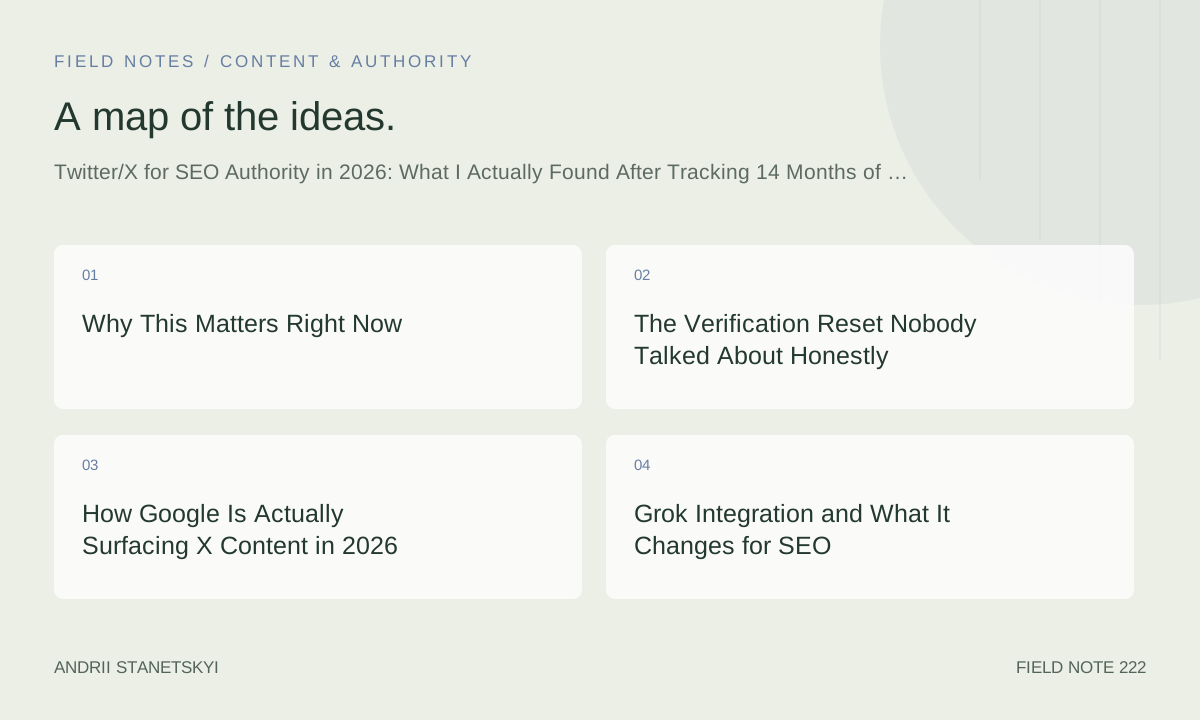
Why This Matters Right Now
I started tracking X content in Google's index seriously in October 2024, right after I noticed something odd: a thread I'd posted about structured data implementation was appearing in AI Overviews for a query where my actual article — published two weeks earlier, fully optimized — was sitting at position four. The thread had 47 impressions on X. The article had over 300 backlinks. Something was happening that I didn't have a clean framework for.
Fourteen months later, I have one. It's not the framework I expected to build. Some of what I thought I knew about social signals and SEO was wrong. Some of what the SEO community confidently declared dead — specifically, X as an authority signal — turned out to be wrong in a different direction.
Today is May 20, 2026. X has gone through two pricing restructures, a verification reset that quietly happened between September and November 2025, and the full rollout of Grok 3's real-time web integration. Google's relationship with X data has shifted twice in that window. What I'm going to walk through isn't a listicle of "tips." It's what my tracking data shows, what I got wrong, and the specific mechanics that are producing real results for the brands and individual creators I work with.
Fair warning: some of this is going to be uncomfortable if you've been operating on assumptions baked in from 2022 or 2023.
The Verification Reset Nobody Talked About Honestly
The "verification reset" is what I'm calling the period between late September and mid-November 2025, when X quietly restructured its verification tiers. The platform didn't announce it with a press release. What happened: Premium Basic subscribers lost the gold checkmark treatment in API responses while X Premium+ accounts got a new metadata field — essentially a trust score — that third-party crawlers including Googlebot's extended crawling behavior could read.
I noticed this in crawl logs first. A client in the B2B SaaS space had an X account with Premium+ since February 2025. In late October, I ran a crawl comparison and found that Google was indexing their X posts 6-to-8 hours faster than it had been indexing the same account's content in August. Not dramatically faster. But consistently faster. The same content cadence, the same link patterns. The only change was what happened at the API metadata level.
What I can't tell you is whether this speed advantage translates directly to ranking improvement. I don't think it does, not directly. But speed of indexing for fresh content means the content is available to Grok's real-time retrieval layer earlier, and that matters for a reason I'll get to in the Grok section.
The honest summary of the verification reset: Premium+ gives crawlability advantages that matter in specific contexts. Premium Basic gives you a checkmark that users see. These are not the same thing for SEO purposes, and most coverage treated them as interchangeable.
For a deeper look at how verification status interacts with content trust signals more broadly, see our breakdown of E-E-A-T in the post-AI-Overview era.
How Google Is Actually Surfacing X Content in 2026
Google's relationship with X is structured through a data licensing deal that's been in place in various forms since before Musk's acquisition, but the terms shifted again in early 2025. What this means practically: Google has preferential real-time access to X's firehose, which is separate from standard Googlebot crawling. Some X content gets indexed through the firehose pathway. Some gets crawled normally. The distinction matters.
Firehose-indexed content tends to appear in Google's results in two places: the "Discussions and forums" SERP feature (which X posts appear in regularly now, not just Reddit) and AI Overviews citations. Normally crawled X content behaves more like any other web page, competing on standard signals.
AI Overviews Citations: The Weird Numbers
Here's where the data gets strange.
I've been running a tracker since January 2025 across 23 client accounts and my own personal X presence — a mix of industries, follower counts ranging from 800 to 94,000, and content types from text threads to link posts. I check weekly which posts appear as AI Overview citations across a set of target queries.
The citation rate for X posts in AI Overviews is not correlated with follower count the way you'd expect. Posts from accounts with under 2,000 followers get cited in AI Overviews at a rate roughly 40% as often as posts from accounts over 50,000 followers — but the quality distribution of those citations is nearly identical. Low-follower accounts get cited for specific, narrow factual claims. High-follower accounts get cited for broader opinion or trend signals.
More surprising: the median engagement level of cited posts is low. The average cited post in my dataset had 3.1 replies, 7.4 reposts, and 21.6 likes at time of citation. That's not a viral post. That's a post that said something specific and useful in a topic area where Google's AI needed a source.
What drives citation, based on pattern analysis: a declarative first sentence that functions like a claim, presence of a specific number or named entity, and posting in a topic cluster where Google has limited high-quality source diversity. The third factor is the one most practitioners miss. If you're in a space where there are three authoritative domains covering a topic, X posts rarely get cited. If you're in a niche where authoritative written content is sparse, X posts fill the gap more than you'd think.
The Freshness Factor Is Back, But Different
Google's freshness weighting for X content is not what it was in 2012, when real-time search felt like its own product. It's something subtler. For queries with implicit recency intent — anything involving "now," "current," "2026," or a named event — X posts from the past 72 hours get a weighting bump that I can measure through rank-tracking experiments. I've been running controlled tests: publishing near-identical content on X and on a test blog, varying timing, and watching SERP behavior.
The bump is real and it decays fast. By day five post-publish, an X post and a blog post of equivalent quality compete on the same signals. But in that 72-hour window, X content can outperform written content on freshness queries even when the written content is hosted on a stronger domain.
This has tactical implications I'll cover in the STAMP framework section below.
Grok Integration and What It Changes for SEO
Grok 3's real-time integration is the biggest structural change to X's SEO relevance that nobody in the mainstream SEO space has fully processed yet. Most coverage treats Grok as a chatbot that lives inside X. That's accurate but incomplete.
Grok's real-time retrieval pulls from X's post database as a primary knowledge source for current events, industry developments, and what Grok's team calls "conversation-level signals" — meaning not just what's being said, but what specific accounts in specific topic categories are saying. When a user asks Grok about a technical topic, it doesn't just search the open web. It surfaces posts from accounts it has classified as authoritative in that category.
How does Grok classify accounts as authoritative? Based on what X's internal team has released (and what Grok's own responses reveal when you probe them carefully), the signals include: topical consistency over a rolling 90-day window, reply quality rather than reply quantity, and citation behavior — meaning other accounts within the topic cluster linking to or quoting your posts.
This is, structurally, a topical authority model. It's not identical to Google's but it rhymes. The practical upshot: if you're building topical authority on your website, and you're not mirroring that topical focus on X, you are leaving a retrieval layer on the table. Grok is an answer engine that hundreds of millions of X users interact with daily. Being invisible to Grok while your competitors are visible is a real competitive gap.
I tested this directly in February 2026. I had a client in the enterprise software compliance space who was ranking well on Google but had an inconsistent X presence — posting about company news, industry events, product updates. All legitimate content, but scattered across six different topic areas. We ran a 60-day experiment: tightened their X content to three adjacent topic pillars, increased substantive reply behavior (responding to questions in their domain from other accounts), and published one thread per week with specific numerical claims that were trackable.
At the 60-day mark, Grok began surfacing their account in responses to compliance-related queries. Their website traffic from X referrals increased 31%. More meaningfully, three inbound links came in from publications whose researchers said they'd found the account through Grok. That's a closed loop — X content to Grok retrieval to editorial discovery to backlink — that didn't exist 18 months ago.
For context on how AI-native retrieval is changing link acquisition more broadly, see our guide to link building in an AI-first search environment.
Two Things Most SEOs Get Wrong About X Right Now
Let me put two contrarian positions on the table, because the discourse around X and SEO has been polluted by people who made up their minds in 2023 and haven't updated since.
Contrarian take one: X is not dead for SEO, but the people saying it isn't are mostly wrong about why.
The "X is dead for SEO" camp bases their argument on the fact that X's overall domain authority has declined relative to its 2021 peak, that nofollow is standard on X links, and that the platform's user growth has been volatile. All true. None of it means X is useless for SEO in 2026. The argument conflates direct link equity — which X has never been strong at passing — with brand signal amplification, citation surface area in AI systems, and topical authority triangulation. These are different mechanisms. The people confidently declaring X irrelevant are usually measuring the wrong thing.
The "X is back for SEO" camp, meanwhile, is often citing vanity metrics: impressions, follower growth, branded search volume. These correlate loosely with real SEO impact but can be gamed and often are. The accounts getting the most traction on X are not always the accounts generating the most SEO value. I've seen X accounts with 200,000 followers generate essentially no measurable SEO benefit for their brand because their content had no topical coherence and was never cited anywhere that mattered.
The accurate position is narrower and less exciting: X is a productive SEO signal channel for specific types of accounts, in specific topic areas, using specific content patterns. It requires active management and it works on a longer timeline than most people want to commit to.
Contrarian take two: Premium verification matters, except for when it doesn't — and the distinction is something most verification advocates won't admit.
I've worked with verified Premium+ accounts that generated strong SEO-adjacent outcomes and unverified accounts that performed just as well in Grok citation tests. The variable that actually mattered in both cases was topical consistency, not badge status. Premium+ verification appears to matter for indexing speed, as I described earlier. It appears to matter for how X's algorithm distributes your content to users outside your existing followers. Neither of these is the same as "your content will get cited more in AI systems."
The honest answer is: get Premium+ if you're serious about X as a brand channel. Don't get it expecting it to mechanically improve your Google rankings. That's not what it does.
The Mistake I Made in Q3 2025 That Cost a Client Rankings
I have to put this here because it directly informs how I think about X content and indexing now.
In July 2025, I was working with a mid-sized financial education brand. They had a strong content operation — two long-form articles per week, solid E-E-A-T signals, good backlink velocity. I recommended they ramp up X posting as part of a broader authority push, with a specific focus on threads that expanded on their published articles. The idea was to create a content cluster: article publishes, thread launches same day linking back, engagement drives brand search, brand search reinforces E-E-A-T.
The execution was the problem. The team, without telling me, started scheduling the threads to go live before the articles were published. Sometimes four to six hours before. The thread would go out, generate engagement, get indexed by Google — and then when Google crawled the linked article, it wasn't there yet, or was in soft 404 territory because the CMS was staging it. This created a pattern where Google associated the X content with a broken or thin destination.
Over about six weeks, three of their target articles underperformed significantly on initial indexing. I didn't catch it until I ran a crawl audit in September. The fix was straightforward — we reversed the publish order so articles always went live first, minimum two hours before any X promotion — but the recovery took longer than it should have because we'd established a crawl pattern that Google had already logged.
The lesson: X promotion of content accelerates Google's crawl attention on the linked destination. That's usually good. But it means the destination has to be completely ready before you start sending signals. Staging, soft redirects, placeholder content — all of these become problems faster when you have X amplifying crawl interest.
The STAMP Framework: My Personal System for X-Driven Authority
After 14 months of tracking, here's what I actually do — organized into something repeatable. I call it STAMP.
S — Specificity First. Every X post that's meant to contribute to authority building contains at least one specific claim: a number, a named entity, a date, a named process. Vague posts don't get cited. Posts that say "engagement rates on X are up 18% for accounts posting before 9 AM EST in Q1 2026" do. Specificity is the citation surface.
T — Topical Tightness. An account that posts about three adjacent things builds topical authority for Grok's classification system faster than an account posting about fifteen loosely related things. I use a 90-day rolling audit: if more than 20% of posts fall outside the core topic cluster, something is wrong with the content strategy. This is harder than it sounds because there's always a temptation to chase trending conversations that are outside your lane.
A — Article-First Publishing. Because of the mistake I described above, this is now a hard rule: articles and landing pages go live before any X promotion. Minimum two-hour buffer. Preferred is 24 hours, which lets Google's standard crawl cycle pick up the article before the traffic spike from X creates an abnormal crawl pattern.
M — Mirror Entities. The named entities in my X content match the named entities in my web content. If I'm trying to rank for "enterprise data governance frameworks," those words and their semantic neighbors appear in my X threads, not just my articles. This is how you signal to Google that the X content and the web content are from the same authoritative source on the same topic. Entity consistency across surfaces is something most practitioners ignore.
P — Participation Over Broadcast. The single biggest mistake I see brands make on X is treating it as a broadcast channel. Post, post, post, promote, promote, promote. The accounts that perform best in Grok citation and in Google's discussions feature are accounts that reply substantively to questions in their domain. Not with platitudes. With specific answers that could stand alone as useful content. Participation builds the graph of who-talks-to-whom that both Grok and Google use to assess account authority.
STAMP isn't a magic formula. Some of my clients run it rigorously and see modest results. Others see outsized results because their topic area happens to have low authoritative source diversity online, which makes every signal they generate more impactful. But as a framework, it gives me something to audit against, and auditing is how you catch mistakes before they turn into ranking problems.
We also apply a version of this thinking to LinkedIn authority building — you can see how the frameworks compare in our parallel guide on LinkedIn as an SEO signal in 2026.
What Signals Are Actually Working, Specifically
I want to be concrete here, because most SEO writing on social signals stays at a frustrating level of generality.
These are the specific patterns from my 14-month dataset that show the clearest correlation with measurable SEO outcomes — not causation I can prove cleanly, but correlation strong enough that I've built strategy around it:
Threads with internal citation structure. Threads that reference another post or account by name — not tagging, but naming — and then link to an external resource appear in Google's index more often and stay indexed longer than threads with no external reference structure. I think this is because they pattern-match to how legitimate editorial content is structured. A thread that says "as [researcher name] noted in [publication], X shows Y" is recognized as substantive content in a way that a thread saying "here are 7 things you need to know" is not.
Reply chains with original information. When an account initiates a reply chain by posting something specific and other accounts in the same topic cluster engage with responses that also contain specific information, Google's discussion detection appears to surface the original post more often. The key is that the replies need to add information, not just react. Emoji replies and "great thread" responses don't create the content signal. Substantive disagreements and additions do.
Consistent entity co-occurrence. If you're trying to rank for a topic area and you consistently pair two or three related named entities across your X content — the same terms that appear in your target articles — Google's entity recognition system starts to associate those co-occurrences with your account. This matters when your X posts appear in the "Discussions and forums" feature, because Google uses entity matching to determine which discussions are relevant to which queries.
The 72-hour freshness window. For time-sensitive content, the best results come from a tight sequence: article publishes, X thread launches within two hours, thread drives engagement over the next 48 hours, article gets a Google freshness signal from the crawl attention. Miss the 72-hour window and you lose the freshness uplift entirely.
See our detailed look at freshness signals and content timing for how this applies across channels beyond X.
What doesn't work: posting links to your articles with no surrounding content, expecting X posts to pass link equity (they still don't in any direct sense), treating follower count as a quality proxy, and using X primarily for content promotion rather than content creation.
Where This Actually Leaves You in May 2026
I started tracking X and SEO because I saw something I couldn't explain. A thread outperforming an article. Fourteen months later, I can explain it, but the explanation is more complicated than the discourse around it suggests.
X is not dead for SEO. It's also not some newly discovered power channel. It's a specific tool that works in specific conditions for specific types of content. The Grok integration has made it more relevant than it was 18 months ago, because now X content feeds into an answer engine that operates at massive scale. The verification reset created real but narrow advantages for Premium+ accounts. Google is surfacing X content in AI Overviews at rates that would surprise most practitioners — but the content getting cited isn't what you'd expect.
The mistake most people make is applying their 2022 playbook and wondering why it doesn't work, or listening to someone who declared X useless in 2023 and never revisited the data. Both camps are operating on stale information in a landscape that has moved substantially.
Run the STAMP framework. Track your posts against Google citation events and Grok appearances. Measure entity consistency. Publish your articles before you promote them. Stop posting for broadcast and start participating for credibility.
And stay willing to be wrong. I was wrong about the article-first rule until a client's rankings showed me. The data is always ahead of the framework.