Programmatic SEO has a reputation problem it partly deserves. The technique — generating thousands of pages from structured data templates — was weaponized in the early 2020s to flood Google with thin, auto-generated content that served no one. Google's Helpful Content updates and spam policies have since drawn sharper lines. In 2026, programmatic SEO done right remains one of the highest-leverage content strategies available. Done wrong, it triggers site-wide quality suppression that can take years to recover from. This guide is the practitioner's map through that minefield.
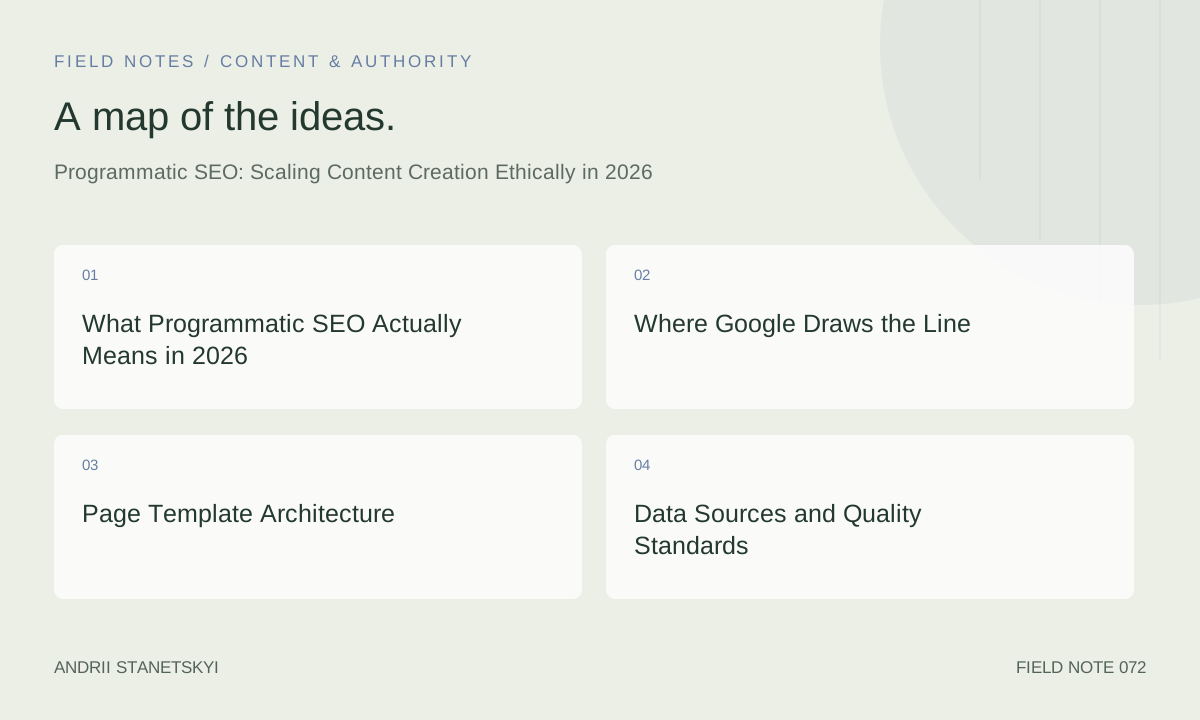
What Programmatic SEO Actually Means in 2026
Programmatic SEO is the systematic generation of landing pages by combining a template structure with variable data inputs. The classic example is Tripadvisor: one template, millions of destination + category combinations ("restaurants in Austin," "hotels near Heathrow"). The template provides structure; the database provides differentiation.
In 2026, "programmatic" has expanded beyond pure database-driven generation to include AI-assisted content layers — generated summaries, dynamic FAQ sections, synthesized comparison tables — that sit on top of structured data. This hybrid model raises the quality ceiling dramatically but also requires more rigorous quality controls to avoid the exact spam patterns Google penalizes.
The core ethical test has not changed: does each page provide meaningfully unique value to a user, or are you publishing near-duplicate content at scale hoping to capture long-tail queries? If your honest answer is the latter, you are building a liability, not an asset.
Where Google Draws the Line
Google's spam policies explicitly prohibit "scaled content abuse" — producing content at scale, whether through automation, AI, or human efforts, primarily to manipulate search rankings rather than help users. The Helpful Content system adds a site-level quality dimension: a domain with a large percentage of low-quality programmatic pages can see its higher-quality editorial content suppressed in rankings.
The 2024–2025 core updates hit programmatic SEO particularly hard in the affiliate, travel, and local categories. Sites that recovered shared common characteristics: their pages had genuinely unique data points unavailable elsewhere, users spent time on the pages, and conversion rates (bookings, sign-ups, clicks to real services) were meaningful.
Google has explicitly stated that automation and AI are acceptable if the primary purpose is to serve users. Google's spam policies documentation frames the test as intent and quality, not mechanism. This gives ethical practitioners room to operate — but narrows it significantly for content farms.
Page Template Architecture
A well-architected programmatic page separates into four layers:
Layer 1: Structural HTML (Static)
The scaffold — navigation, header, footer, schema markup structure, breadcrumbs, internal navigation. Identical across all pages. Changes here propagate at scale; treat it as you would application code with version control and testing.
Layer 2: Primary Data (Dynamic, Unique)
The core differentiating data for each page variant. This is what makes the page unique. Examples: actual property listing data, verified business hours and ratings, government-sourced statistics by region, real pricing data from an API. This layer must contain information that cannot be found in the same format elsewhere.
Layer 3: Contextual Enrichment (Hybrid)
Additional context that adds user value: a paragraph explaining why this city's rental market is different, a comparison table pulling from your database, a chart visualizing trends. This layer is where AI-assisted content can add genuine value — synthesizing your own data into narrative — rather than regurgitating publicly available information.
Layer 4: User-Generated or Expert Content (Optional)
Reviews, expert commentary, community answers. This layer is what separates the programmatic pages that dominate (Tripadvisor, Zillow, Glassdoor) from those that plateau. Even thin user signals — a verified rating, a single expert sentence — can meaningfully improve perceived quality.
<h1>{{ modifier }} in {{ location.city }}, {{ location.state }}</h1>

<section aria-label="Overview">
  <p>{{ location.generated_intro }}</p>
  <!-- Layer 3: AI-synthesized from our own DB data -->
</section>

<section aria-label="Data table">
  <table>
    {% for item in location.items %}
    <tr>
      <td>{{ item.name }}</td>
      <td>{{ item.price }}</td>
      <td>{{ item.rating }}</td>  <!-- Layer 2: Primary data -->
    </tr>
    {% endfor %}
  </table>
</section>

<section aria-label="FAQ">
  {% for faq in location.faqs %}
  <h3>{{ faq.question }}</h3>
  <p>{{ faq.answer }}</p>
  {% endfor %}
</section>
Data Sources and Quality Standards
The programmatic SEO ecosystem lives or dies on data quality. The most defensible sources in 2026:
| Tier | Source Type | Examples | Google Risk Level |
|---|---|---|---|
| 1 (Best) | Proprietary first-party data | Your own transaction data, user reviews, API integrations with direct partners | Minimal — uniqueness is inherent |
| 2 | Licensed third-party data | MLS feeds, government APIs, financial data providers | Low if licensed exclusively or enriched |
| 3 | Public APIs with enrichment | Wikipedia API + your own editorial layer, OpenStreetMap + proprietary ratings | Moderate — depends on enrichment depth |
| 4 (Avoid) | Scraped or recycled web content | Competitor data re-published, aggregated from public sources without transformation | High — spam policy violation risk |
Keyword Research at Scale
The keyword model for programmatic SEO is modifier × entity. You need both a comprehensive modifier list and a clean entity database. The keyword research question is not "what keywords should I target?" but "which modifier × entity combinations have sufficient search volume to justify page creation?"
Extracting the Modifier Set
Pull your industry's head terms into Ahrefs Keyword Explorer. Export all phrase-match variations. Strip the entity-specific part (city names, product names, company names) to isolate modifier patterns. These are your template variable slots: "best," "near me," "vs," "review," "price," "how to use," "alternative to."
Entity Database Construction
Your entity list defines your page count. Build it from your first-party data first. Supplement with public entity databases (Wikidata, Google's Knowledge Graph via API) for geographic or categorical coverage. Apply a minimum volume threshold — if a modifier × entity combination shows fewer than 50 monthly searches in Ahrefs, deprioritize or exclude. Publishing pages for zero-volume combinations wastes crawl budget and signals thin content to Google.
# Python: Cross-reference modifiers × entities and filter by volume
import pandas as pd

modifiers = pd.read_csv("modifiers.csv")  # col: modifier, avg_monthly_searches
entities = pd.read_csv("entities.csv")    # col: entity_name, entity_type

# Cross join
from itertools import product
combos = pd.DataFrame(
    list(product(modifiers["modifier"], entities["entity_name"])),
    columns=["modifier", "entity"]
)

# Merge with volume data from Ahrefs export
volumes = pd.read_csv("ahrefs_volume.csv")  # col: keyword, volume
combos["keyword"] = combos["modifier"] + " " + combos["entity"]
combos = combos.merge(volumes, on="keyword", how="left")
combos = combos[combos["volume"] >= 50].sort_values("volume", ascending=False)
print(f"Viable programmatic pages: {len(combos)}")
Differentiation: What Makes a pSEO Page Earn Rankings
The single biggest mistake in programmatic SEO is assuming that combining a template with data automatically creates a rankable page. Google evaluates these pages against the same quality criteria as editorial content. The pages that rank share these characteristics:
1. Data unavailable elsewhere in this format. If a user can get the same information from five other sites, your page offers nothing. Your differentiator must be visible immediately: a proprietary rating system, pricing data updated daily, a visualization, or expert annotations on raw data.
2. A real task is completed. The best programmatic pages are tools, not documents. A page that lets a user compare mortgage rates across 50 lenders, filter by credit score range, and download a PDF saves 30 minutes of research. That kind of utility earns time-on-page, return visits, and links — the organic signals that push rankings.
3. The intent match is precise. Build separate templates for separate intents. Do not force informational searchers ("what is X") and transactional searchers ("buy X near me") onto the same template. The SERP signals for each intent differ; one template cannot satisfy both without diluting both.
See: Writing for Featured Snippets — intent precision at the page level
Case Study: Travel SaaS at 45,000 Pages
A travel booking SaaS built a programmatic section targeting "things to do in [city]" across 1,200 cities in the US and EU. Initial launch (2023): 45,000 pages, template-generated descriptions from Wikipedia, thin review aggregation from public APIs. Result: near-zero rankings after six months; pages excluded from index by Google's quality systems.
The team rebuilt with a different approach. They leveraged their own booking transaction data — 4 million bookings across 12 years — to create genuinely proprietary content: real booking frequency by activity category, seasonal demand curves, price percentile charts, and average review sentiment scores calculated from verified purchaser reviews. Wikipedia text was replaced with analyst-written intros (one per entity type, not one per city — modular writing at scale). The new FAQ sections were generated by an LLM but grounded exclusively in the platform's own data, with each answer verified for factual accuracy before publication.
Relaunch (Q2 2025): 18 months later, the section drives 2.3 million monthly organic sessions. Page count was reduced to 22,000 — cities without sufficient booking data were excluded. Thinner coverage, better quality, dramatically better results.
Ethical Guardrails and Quality Controls
Build a quality gate into your programmatic pipeline before any page goes live:
# Quality gate pseudocode for programmatic page validation
def validate_page(page_data):
    checks = {
        "has_unique_data_points": len(page_data["proprietary_fields"]) >= 3,
        "word_count_minimum": page_data["total_words"] >= 400,
        "no_placeholder_text": "[INSERT" not in page_data["body"],
        "entity_data_complete": all(page_data[f] for f in ["name", "location", "category"]),
        "faq_answers_unique": len(set(page_data["faq_answers"])) == len(page_data["faq_answers"]),
        "internal_links_present": len(page_data["internal_links"]) >= 2,
    }
    passed = all(checks.values())
    failed_checks = [k for k, v in checks.items() if not v]
    return {"passed": passed, "failures": failed_checks}
Any page failing quality gates should not be published — not noindexed, not published-and-monitored, not published. The default for borderline pages should be exclusion. Publish conservatively; scale deliberately.
Related: Content Audit on a 10,000-Page Website — managing index health at scale
FAQ
Is AI-generated content allowed in programmatic SEO?
Yes, provided it genuinely helps users and is not produced primarily to manipulate rankings. Google's policies focus on intent and quality, not the mechanism of production. AI-generated content grounded in your proprietary data, reviewed for accuracy, and serving a clear user need is compliant. AI-generated content that regurgitates publicly available information at scale to capture keyword volume is spam.
How many programmatic pages is too many?
There is no universal ceiling. Zillow has hundreds of millions of indexed pages. What matters is the ratio of quality pages to total pages. If your quality gate filters out 60% of potential pages, publish only the 40% that pass. A smaller, higher-quality index consistently outperforms a large, mixed-quality one.
How do I handle crawl budget with 50,000+ pages?
Prioritize your highest-value pages in the XML sitemap with accurate lastmod timestamps. Use crawl-delay directives judiciously. Segment your programmatic section under a clear URL path (/location/, /compare/) so you can monitor Googlebot's crawl behavior in GSC's Crawl Stats report specifically for that section. Pages with zero impressions after 6 months in the index are candidates for noindex or removal.
What's the role of internal linking in a programmatic site?
Critical. Your editorial hub pages should link to the most important programmatic pages. Programmatic pages should link to each other via logical taxonomy (a city page links to neighborhood pages; a category page links to subcategories). Breadcrumbs are non-negotiable for programmatic architectures — they establish hierarchy for both users and Googlebot.
How do I measure whether my programmatic pages are helping or hurting the domain?
Segment your GSC and GA4 data by URL path. Compare the organic performance (clicks, impressions, click-through rate) of your programmatic section against your editorial section. If your programmatic section has an average CTR below 0.5% at positions 1–10 (a sign of poor title/meta relevance or low-quality content) and your editorial section's rankings are flat while competitors grow, the programmatic section may be creating a site-level quality drag. Run a controlled experiment: noindex a sample of the weakest programmatic pages for 90 days and measure any uplift in the editorial section.
Should I use subdomains or subdirectories for programmatic content?
Subdirectories are strongly preferred in 2026. Google treats subdomains as separate sites for many quality signals; the authority from your main domain does not flow to a subdomain the way it flows to a subdirectory. The only case for a subdomain is when the programmatic content is genuinely a different product (a separate tool or service) that warrants brand differentiation.
Key Takeaways
- Programmatic SEO is ethical and effective when each page delivers unique value unavailable elsewhere — and it is spam when it does not.
- Four-layer architecture (structural, primary data, contextual enrichment, user content) gives you a quality blueprint for any programmatic build.
- Tier 1 data — your own first-party transaction and review data — is the most defensible foundation. Scraped content is a spam policy violation risk.
- Apply a minimum volume threshold (50+ monthly searches) and a hard quality gate before any programmatic page goes live.
- Publish conservatively: a smaller, higher-quality index outperforms a large mixed-quality one every time under the Helpful Content system.
- Monitor your programmatic section's GSC performance separately from editorial; use it as an early-warning system for site-level quality drag.
Conclusion
Programmatic SEO in 2026 rewards practitioners who treat it as a data engineering problem as much as an SEO problem. The template is the easy part. The defensible moat is your data — its uniqueness, its freshness, and its utility to real users completing real tasks. Build your quality controls into the pipeline before you launch, not after you get a manual action. The teams scaling content ethically are outpacing those chasing volume, and the gap is widening with every Helpful Content update.