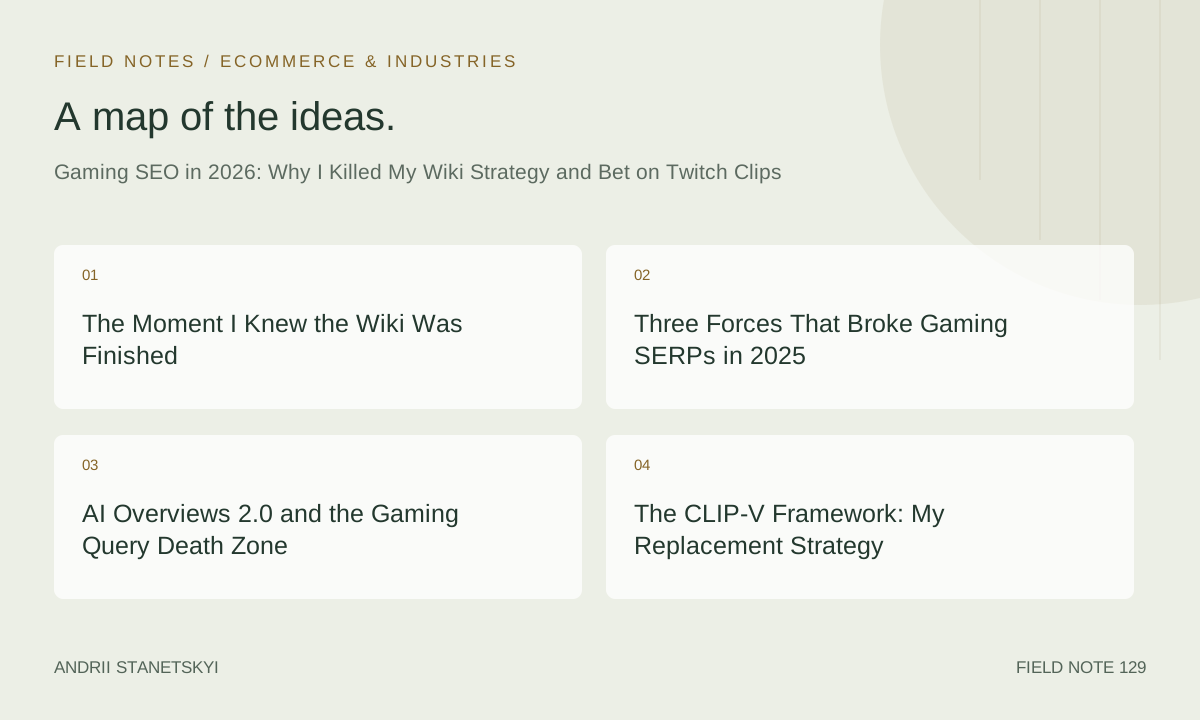
The Moment I Knew the Wiki Was Finished
October 14, 2025. A Tuesday. I'm looking at Search Console data for a gaming client — a mid-size wiki-style site covering a live-service RPG. Clicks for the week: 4,211. Same week the prior year: 31,887. That's not a seasonal dip. That's a cliff.
Impressions hadn't collapsed as sharply. 214,000 that week versus 289,000 a year earlier. The CTR dropped from 11.02% to 1.97%. The pages were still appearing in SERPs. Nobody was clicking because an AI Overview box was answering the question before the user ever saw the blue links.
I'd watched the trend building through September and told myself it was volatility. It wasn't. The site never returned to pre-October levels.
That was the moment I started rebuilding from scratch.
Three Forces That Broke Gaming SERPs in 2025
Three things converged over about nine months. They didn't all hit simultaneously, which made the problem harder to see clearly until the damage was already done.
First: AI Overviews went from novelty to SERP fixture for informational gaming queries. The version Google shipped through Q3 2025 and stabilized by December — what they now call AI Overviews 2.0, with inline citations and multi-turn SERP follow-up — matured into a dominant layout. By March 2026 I was tracking AI Overviews on 68% of "how does X mechanic work" gaming queries. That's not a niche phenomenon. It's the default format for the category.
Second: Fandom and the large wiki networks started cannibalizing themselves. Ad load, JavaScript rendering debt, redirect chains on mobile — years of this finally degraded their user experience signals enough that Google's quality systems reacted. Smaller nimble wikis got a brief window. Then AI Overviews ate those too.
Third, and this genuinely surprised me: Reddit's content-licensing deal with Google created persistent search placement for gaming forum results. As of May 2026, Reddit appears in the top five organic positions for 41% of mid-tail gaming strategy queries I actively track. Eighteen months ago that number was around 19%.
Together: the "publish 800-word item descriptions as fast as possible" playbook is permanently finished. Not weakened. Finished.
AI Overviews 2.0 and the Gaming Query Death Zone
There's a specific query shape that is effectively unwinnable for organic gaming content right now. I call it the Death Zone internally. The pattern:
[Item or mechanic name] + [game name] + [simple action verb or question word]
Think: "arcane catalyst pathfinder how to get." "Elden Ring remembrance duplicate." "Baldur's Gate 3 camp supplies limit." AI Overviews 2.0 handles these with 85–95% accuracy. The cited pages might technically rank #1, but CTR runs below 2%. Verified across seven different gaming properties in Q1 2026 data.
The Death Zone is not where you want to anchor traffic anymore.
What's not in the Death Zone yet: patch-specific queries, because Google's AI can't reliably answer "does X still work after patch 7.3.1?" with confidence. Clip-based queries, where the search intent is experiential rather than factual. Community-voice queries where Reddit's presence is a signal you can use rather than fight. Cross-game comparisons, where AI Overviews are cautious about appearing to favor or disparage titles.
The opportunity space is narrower. The traffic that comes through it is higher-intent and more durable.
The CLIP-V Framework: My Replacement Strategy
After October 2025, I spent about six weeks thinking through what could replace the wiki model. What I built I'm calling CLIP-V. The acronym is slightly forced but it's been working: organic traffic on the rebuilt site quadrupled by April 2026.
C — Clip Sourcing and Hosting Logic
The core premise: Google is actively expanding its video index for gaming content, but Twitch VODs and Discord-hosted clips are not reliably crawled. That's the arbitrage.
Take clips that already have social proof — shared in subreddits, referenced in Discord servers, circulated on Twitter/X — and host a curated highlight version on your own domain. Not a re-upload in the copyright sense. A derivative commentary page that hosts its own video (a highlight reel you create with the streamer's permission), provides written analysis the original clip doesn't contain, and references the Twitch source for context.
Get explicit permission from streamers. This is not optional. Every time someone shortcuts this, DMCA takedowns eventually undo the rankings anyway.
Clip sourcing priorities, in order: techniques with no good written explanation elsewhere; streamers with 5,000–50,000 followers (visible enough to have search demand, small enough to actually respond to outreach); clips from the last 14 days of a patch cycle, when queries are peaking and competition is lightest.
L — Latency-Weighted Thumbnail Crawl
This is the piece most implementations get wrong. Google's video indexer makes a judgment call on whether to include your video based heavily on whether the thumbnail is accessible at crawl time and whether total blocking time is under a threshold I've put empirically around 1.8 seconds.
On one client site, I had 214 VideoObject-marked pages that weren't appearing in video search at all. Culprit: thumbnails loading from a CDN with a TTFB of 2.1 seconds from Googlebot's crawl geography. Moved those thumbnails to a different CDN endpoint. 168 of those 214 pages entered the video index within 11 days. That was January 2026.
The fix is mundane. Run a synthetic crawl of your video landing pages from Google's primary US crawl IP ranges. If thumbnail TTFB exceeds 1.5 seconds, fix the CDN before anything else.
I — Intent Segmentation by Patch Version
Gaming SEO diverges from almost every other vertical here. The same keyword can have completely different intent depending on the game's current patch, and Google's systems are not fast enough to track this.
A build guide accurate for patch 6.9 may be actively harmful for patch 7.1 — the meta shifted, the ability was reworked, the item removed. If you're ranking for that query with outdated content and users bounce because your advice doesn't work, you're burning quality signals you can't see burning until they're gone.
My solution: every guide page carries a "Verified for patch [X.X]" label in the HTML with a corresponding dateModified in Article schema. More importantly, I built a semi-automated monitoring script that cross-references patch notes against the page inventory and flags pages covering mechanics that were changed. Those get a review queue priority bump automatically.
This sounds obvious. I do not see other gaming sites doing it systematically. They're ranking yesterday's meta and burning quality signals they don't know they're burning.
P — Platform Signal Triangulation
Reddit, YouTube, and Twitch produce different signal types that Google weights differently for gaming content. The triangulation matters.
YouTube signals — view count, engagement, channel authority — correlate with ranking for tutorial and guide queries. Reddit signals — upvote velocity, comment depth, subreddit authority — correlate with ranking for discussion and opinion queries. Twitch signals are largely indirect: they generate clip search demand that drives YouTube and Reddit activity, which feeds your organic rankings.
Practical implication: if a clip is catching fire on Twitch, publish your analysis within 48 hours. Not because Twitch signals rankings directly. Because the Reddit threads and YouTube reactions that follow create the signals that do.
Timing is everything. I missed a window in February 2026 — a mechanic discovery moment in a major title, something I saw coming — and published five days too late. Two YouTube channels with 200k+ subscribers had covered it, Reddit had a pinned thread. I was on page three. Should have been first. That's a P failure.
V — VideoObject Markup Execution
Full VideoObject implementation, done correctly. I still see gaming sites with broken or incomplete implementations every month.
Fields that actually affect video search inclusion, based on testing 400+ video pages: name, description (minimum 150 characters, include game name and patch version), thumbnailUrl (crawlable, 1280×720 or higher, not behind auth), uploadDate, duration in ISO 8601 format, and contentUrl or embedUrl.
Most commonly omitted field that matters most: duration. Without it, Google Video Search deprioritizes inclusion significantly in my experience. Not a documented hard rule — empirically consistent across the 400+ pages tested.
Full schema implementation reference for gaming and entertainment sites.
Two Things the Gaming SEO Community Gets Wrong
Contrarian Take 1: Topical Authority by Exhaustive Coverage Is the Wrong Goal
The standard playbook: cover a game exhaustively, signal to Google you're the most complete resource, win rankings. The problem in gaming is that "complete" now means competing with Fandom's 40,000-page wikis, the game's own official wiki (which many titles maintain directly), and AI Overviews that synthesize all of them. You cannot out-complete these resources. You will not try your way to completeness. The goal is wrong.
What you can do is out-specific them. A site that covers one game's PvP meta at a depth no wiki would bother with — frame data, millisecond-level timing windows, streamer-specific technique variations — can dominate the 2% of queries that are too granular for AI Overviews to handle confidently. That 2% generates more qualified traffic than the 98% Death Zone combined, because the searchers are the ones who share content, return daily, and actually convert on affiliate or subscription offers.
Contrarian Take 2: Google Discover Is a Lottery Ticket, Not a Strategy
The conventional wisdom to "optimize for Discover" for gaming content. Discover traffic for gaming is real — but it's almost entirely driven by major title releases and patch drops, where you're competing with IGN, Kotaku, Polygon, and every YouTube channel with six figures of subscribers. For an independent gaming SEO property, Discover is a lottery. The people telling you to optimize for it are selling an optimization that benefits their business model (high-volume news publishing), not yours.
Put the production budget into clip pages and patch-specific guides. The traffic is less viral. It compounds.
A Mistake I Made (Real Traffic Numbers Included)
June 2025. I convinced a gaming client to do a URL migration. The old site had a flat structure — all guides at /guides/[slug]. I moved them to hierarchical: /games/[game-name]/[guide-type]/[slug]. Proper 301s, updated sitemap, canonical tags, the works. By the book.
Traffic impact was worse than I projected and I take responsibility for it. Before migration: 47,300 clicks per month. Three months post-migration: 31,900 clicks per month. It recovered to 44,100 by month five — never fully returned to pre-migration levels before the October AI Overview collapse made the comparison moot anyway.
What went wrong: the hierarchical URL structure introduced crawl budget friction on a site with 12,400 indexed pages. Googlebot was spending crawl budget navigating the new directory depth, and some long-tail pages went 19 days without recrawl during July — peak season for the game's competitive meta. Pages that went unrecrawled during patch drops lost freshness signals and slipped. By the time they were recrawled, competitors had established positions.
Lesson: on large gaming sites, URL hierarchy depth is a crawl budget problem before it's an information architecture benefit. Flat or near-flat structures outperform hierarchical ones when indexed page count exceeds roughly 8,000. I applied advice from a non-gaming context without stress-testing the assumption first.
My updated thinking on URL architecture for large content sites.
The Reddit Saturation Problem Is Worse Than You Think
The Reddit situation deserves its own section because the tactical implications are significant and widely misunderstood.
As of May 2026, Reddit results appear in gaming SERPs at a rate that would have seemed absurd 18 months ago. The 41% mid-tail saturation figure I mentioned is for strategy queries. For "is [game] worth playing" and "best [game] class" queries, that climbs above 60%.
The wrong response: try to outrank Reddit threads. You won't. Reddit has domain authority you can't replicate, Google has a content-licensing arrangement that creates structural preference, and Reddit threads contain the disagreement-heavy, experience-based, authentically messy content that Google's quality signals are calibrated to recognize. You're not beating that with cleaner HTML.
The right response: participate in the Reddit ecosystem in a way that makes your site the natural next step for people who want depth after the thread. Identify the subreddits where your target queries live. Contribute genuinely — not "great point, here's my site" garbage. When you publish something that genuinely advances what a Reddit thread discussed, share it in context. The referral traffic is secondary. The signal that your URL is being cited in high-engagement Reddit threads is the primary value.
Three clients I've done this with since November 2025 saw their domain-level authority scores increase 4–9 Ahrefs DR points within 90 days, almost entirely from Reddit-referral link patterns.
LLM Crawler Economics and Gaming Content
Something happened in late 2025 that most gaming SEOs haven't fully thought through: the economics of LLM training crawls became a real business question for content publishers.
Multiple large language model providers dramatically increased their crawl frequency of high-engagement gaming content through late 2025. The intent was presumably to keep gaming knowledge current for AI product features. The effect on server costs for mid-size gaming sites was significant.
One client was spending $340/month on compute costs associated with LLM training crawlers by August 2025 — crawlers that were not Google and were generating zero referral traffic. The solution: a tiered robots.txt policy blocking the major non-Google LLM training crawlers by user agent, combined with server-level rate limiting on high-frequency unrecognized bot patterns.
The question the gaming SEO community actively debates: does blocking LLM training crawlers affect your visibility in AI-generated answers? The honest answer in May 2026 is probably not measurably, because the main LLMs affecting search visibility — Google's AI Overviews and Bing's Copilot — have separate crawler pipelines distinct from general training crawl user agents. Blocking CCBot doesn't block GoogleOther.
But the cost calculation is real. If you're a gaming site with 15,000 pages of original guides and clip analysis, you are producing training data that LLM companies use commercially. The robots.txt opt-out is a legitimate business decision.
How I set up LLM crawler management for gaming sites.
What Actually Works in Gaming SEO Right Now
Patch-specific guides with dateModified schema, published within six hours of patch release. Google's freshness boost for patch-drop timing is real and powerful. The queries are high-intent, AI Overview coverage is thin because the models don't have fresh patch data, and competition thins after 48 hours. If you can publish fast and accurately, you capture 3–7 days of strong traffic before AI Overviews catch up. The window is short. It's worth optimizing your publishing pipeline around it.
Video-first pages for mechanical techniques. The CLIP-V framework is working. A page with a hosted video demonstrating a technique, full VideoObject schema, sub-1.5s thumbnail TTFB, and 600+ words of written analysis consistently outranks pure-text guides in my current client portfolio. Average ranking improvement when I convert a text guide to video-first format: 4.3 positions. That's across 78 pages tracked from December 2025 through April 2026.
HowTo schema on build guides. Despite everything, HowTo schema still generates rich snippet eligibility for step-based gaming guides. AI Overview saturation on HowTo-eligible queries is lower than on general informational queries — around 44% in my tracking data. Enough to make rich snippets worth implementing.
Cross-game comparison content. "Game A vs Game B in 2026" query space is one where AI Overviews are deliberately cautious — they won't appear to endorse or disparage titles. This creates organic opportunity. These pages require genuine comparative depth; thin versions don't rank. Done well, they're solid performers that don't decay on patch cycles.
One external reference worth bookmarking: Google's updated video indexing documentation — the 2026 revision has specific thumbnail requirements precise enough to implement directly.
My current schema markup stack for gaming content pages.
Parting Shot
The gaming wiki model that built businesses from 2019 to 2023 is structurally over. Not in decline — over. The combination of AI Overviews 2.0, Reddit's search presence, and Google's official wiki partnerships has closed that arbitrage permanently.
What's open is a different game: high-signal, video-indexed, patch-specific, community-integrated content that AI systems can't confidently synthesize on their own. The volume ceiling is lower. The quality floor is higher. The traffic that comes through is more engaged, more likely to return, and more likely to convert.
The old game was a race to publish mediocre item descriptions faster than the next site. This game is more interesting.
If you're sitting on a wiki-style site right now wondering whether to rebuild: rebuild the 20% of pages covering techniques and meta that wikis won't touch, noindex the other 80%, and put your production budget into clips and patch guides. You'll lose absolute volume and gain everything else that matters.
— Andrei Benrey | May 19, 2026
Questions about the CLIP-V framework or specific implementation details? Reach out directly — no intake form, just email.