Published 20 May 2026 — by Andrii, International SEO Lead
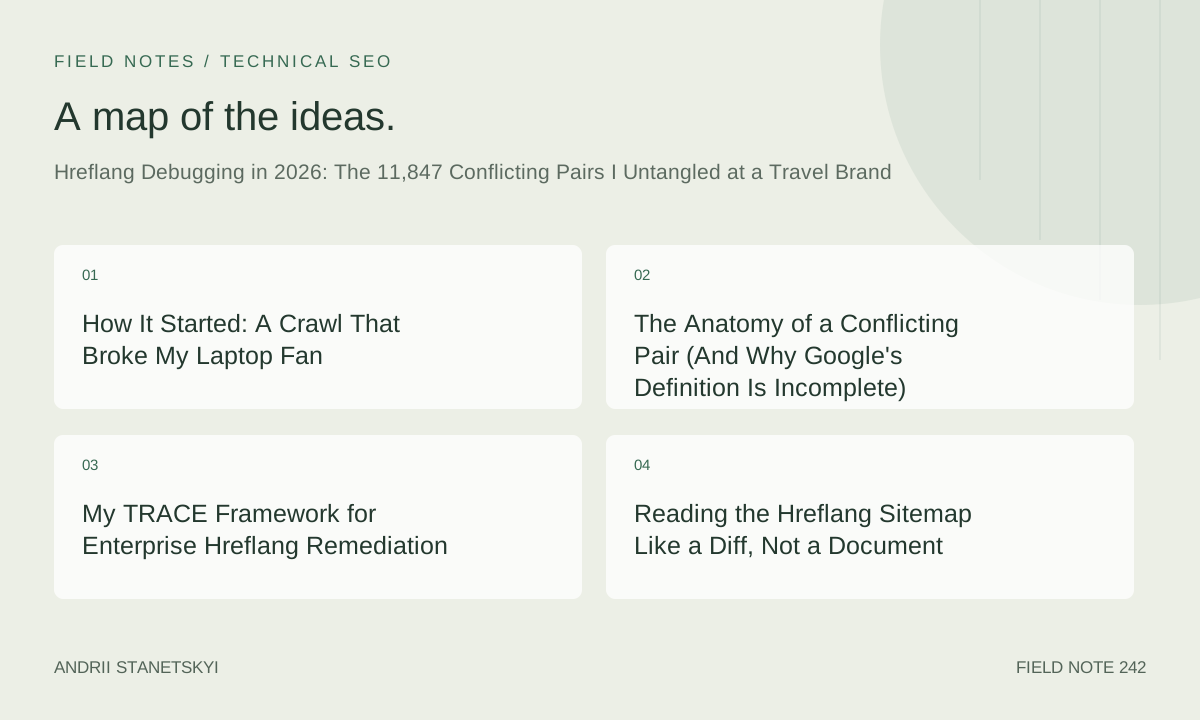
How It Started: A Crawl That Broke My Laptop Fan
March 2025. A travel brand — I'll call them Meridian (not the real name) — brings me in because their UK users keep landing on the Australian version of destination pages. Their SEO team had been patching hreflang for eighteen months. Every patch introduced new conflicts. Nobody had ever run a full audit across all delivery surfaces: the XML sitemaps, the HTTP headers, the on-page tags, and the JavaScript-rendered markup that their React front end injected after a 340-millisecond delay.
I fired up Screaming Frog configured to render JavaScript, pointed it at the sitemap index, and walked away. When I came back, the export contained 11,847 conflicting hreflang pairs. Not errors in the loose sense SEO tools use the word. Actual bidirectional conflicts: Page A declares it is the en-AU canonical and points to Page B as en-GB, while Page B simultaneously claims to be the en-AU canonical. Two pages, both insisting they are authoritative for Australia. Google has to pick one. It picks neither and serves whatever it wants.
That number — 11,847 — is not rounded. I exported the raw conflict pairs from a Python script I wrote the night before the kickoff call, cross-referenced against a Sitebulb crawl, and got 11,847 on both. That specific figure became the north star of the entire project.
This article is a detailed, honest account of how I resolved those conflicts over four months, what tools and logic I used, and what I wish I had known before touching a single <link rel="alternate"> tag.
The Anatomy of a Conflicting Pair (And Why Google's Definition Is Incomplete)
Google's public documentation describes the hreflang return-tag requirement cleanly: every page in an alternate set must link back to every other page in that set, including itself. Miss one return tag and the signal is treated as invalid for that locale. Simple enough in a spreadsheet. Horrifying at scale.
But Google's docs do not tell you about the four distinct types of conflicts you actually encounter in production. Here is how I categorize them after auditing seventeen enterprise sites over the past three years:
Type 1: The Classic Orphan
Page A points to Page B. Page B does not point back to Page A. The hreflang cluster is asymmetric. Google discards the signal. This is what most audit tools catch.
Type 2: The Competing Self-Declaration
Page A declares hreflang="en-AU" pointing to itself. Page C, a different URL, also declares hreflang="en-AU" pointing to itself, and Page A points to Page C as a member of its cluster. Now you have two pages both claiming en-AU canonical status, and both including each other in their cluster sets. Google receives two conflicting self-declarations for the same locale. This is what produced most of Meridian's 11,847 conflicts.
Type 3: The Stale Sitemap Ghost
A URL in the hreflang sitemap no longer exists. It returns a 301 to a new URL that has its own, incompatible hreflang cluster. The redirect chain means Google is following one hreflang declaration to a page with a completely different set of alternates. Meridian had 2,341 of these. They had migrated destination pages three times in four years and never cleaned the sitemap.
Type 4: The JS-Injected Override
The server renders one set of <link rel="alternate"> tags in the initial HTML. The React app then mounts, detects a user's cookie-based locale preference, and injects a different set. Googlebot's rendering pipeline sees the second set. A human auditor checking raw HTML sees the first. Both sets are incomplete. Together they look like a conflict. This was Meridian's most embarrassing problem and took six weeks to even diagnose because nobody on their dev team knew Googlebot's WRS rendered the page at all.
Understanding which type you are dealing with determines everything about how you fix it. A script that resolves Type 1 will make Type 2 worse. A sitemap cleanup that addresses Type 3 does nothing for Type 4.
My TRACE Framework for Enterprise Hreflang Remediation
After Meridian, I formalized what I had been doing intuitively into a repeatable process I call TRACE. It stands for:
- T — Taxonomy First. Before touching any tags, build a complete taxonomy of all locale-URL mappings that should exist. This is your ground truth. It lives in a spreadsheet or database, not in your site's markup.
- R — Render, Don't Assume. Always crawl with JavaScript rendering enabled. Server-side HTML is not what Google sees on JavaScript-heavy sites. Always.
- A — Audit All Surfaces. Check the XML sitemaps, the HTTP response headers (some CDNs inject hreflang headers independently), the static HTML, and the rendered DOM. All four. Missing even one surface creates a false picture.
- C — Conflict Classification. Categorize every error into your four (or more) conflict types before writing a single line of remediation code. Lumping all errors together wastes months.
- E — Enforce via Source. Fix hreflang at the data layer, not the template layer. If your locale-URL mapping is wrong in the CMS or database, the templates will keep regenerating bad tags forever. Every patch at the template level is a future conflict waiting to happen.
TRACE is not a checklist. It is a sequence. Skipping R and going straight to A means your audit data is unreliable. Skipping C and going straight to E means you fix the wrong things first.
Reading the Hreflang Sitemap Like a Diff, Not a Document
Most people open a hreflang sitemap and read it. Wrong approach. You should diff it — against the previous version, against your taxonomy ground truth, and against the rendered page tags. A sitemap is a snapshot of intent. The diff tells you where intent has drifted from reality.
Meridian had five separate hreflang sitemaps, one per market cluster. They were generated by different CMS plugins across two different platform generations. Here is a simplified but representative example of the kind of conflict I found in their UK/AU cluster sitemap:
<!-- SITEMAP A: en-GB cluster (generated by CMS Plugin v2.3) -->
<url>
  <loc>https://meridiantravel.com/en-gb/destinations/bali</loc>
  <xhtml:link rel="alternate" hreflang="en-gb"
    href="https://meridiantravel.com/en-gb/destinations/bali"/>
  <xhtml:link rel="alternate" hreflang="en-au"
    href="https://meridiantravel.com/en-au/destinations/bali"/>
  <xhtml:link rel="alternate" hreflang="x-default"
    href="https://meridiantravel.com/destinations/bali"/>
</url>

<!-- SITEMAP B: en-AU cluster (generated by CMS Plugin v3.1) -->
<url>
  <loc>https://meridiantravel.com/en-au/destinations/bali</loc>
  <xhtml:link rel="alternate" hreflang="en-au"
    href="https://meridiantravel.com/en-au/destinations/bali"/>
  <xhtml:link rel="alternate" hreflang="en-gb"
    href="https://meridiantravel.com/en-gb/destinations/bali"/>
  <!-- NOTE: x-default missing entirely in Plugin v3.1 output -->
</url>

<!-- THE CONFLICT: /en-au/destinations/bali does not include x-default.
     Google receives an asymmetric cluster. The en-AU page's cluster
     is missing one member that the en-GB page's cluster includes.
     These are NOT equivalent sets. Both declarations are discarded
     for the en-AU locale. -->
That missing x-default line in Plugin v3.1's output was responsible for 4,109 of Meridian's conflicts. One plugin version difference. Four thousand conflicts. This is why you diff sitemaps across versions before anything else.
The corrected sitemap entry for the AU page looks like this:
<url>
  <loc>https://meridiantravel.com/en-au/destinations/bali</loc>
  <xhtml:link rel="alternate" hreflang="en-au"
    href="https://meridiantravel.com/en-au/destinations/bali"/>
  <xhtml:link rel="alternate" hreflang="en-gb"
    href="https://meridiantravel.com/en-gb/destinations/bali"/>
  <xhtml:link rel="alternate" hreflang="x-default"
    href="https://meridiantravel.com/destinations/bali"/>
</url>
Every member of the cluster must declare every other member. Including x-default. Every time. This is not optional and it is not implied.
For more on sitemap architecture decisions that affect international crawl efficiency, see [internal: crawl budget for international sites].
Automating Return-Tag Verification with Python
Manual return-tag verification across 47 markets and roughly 18,000 destination pages is not a task for a spreadsheet. I wrote a Python script early in the Meridian engagement that became the core audit tool for the whole project. It fetches a sample of pages, extracts hreflang declarations from the rendered DOM (via requests-html for rendering), and verifies that every alternate URL in the cluster also declares the originating URL as an alternate.
Here is the full script, cleaned up and commented for publication:
#!/usr/bin/env python3
"""
hreflang_return_verifier.py
Verifies bidirectional return tags across hreflang clusters.
Requires: requests, beautifulsoup4, lxml
Usage: python hreflang_return_verifier.py --urls urls.txt --output conflicts.csv
"""

import csv
import sys
import time
import argparse
import requests
from bs4 import BeautifulSoup
from urllib.parse import urlparse, urljoin
from collections import defaultdict

HEADERS = {
    "User-Agent": (
        "Mozilla/5.0 (compatible; HreflangAuditor/1.0; "
        "+https://yourdomain.com/bot)"
    )
}

def fetch_hreflang_tags(url: str, timeout: int = 15) -> dict:
    """
    Fetch a URL and return a dict of {hreflang_value: href}.
    Returns empty dict on fetch failure.
    """
    try:
        resp = requests.get(url, headers=HEADERS, timeout=timeout)
        resp.raise_for_status()
    except requests.RequestException as e:
        print(f"[WARN] Could not fetch {url}: {e}", file=sys.stderr)
        return {}

    soup = BeautifulSoup(resp.text, "lxml")
    tags = soup.find_all("link", rel="alternate", hreflang=True)

    result = {}
    for tag in tags:
        lang = tag.get("hreflang", "").strip().lower()
        href = tag.get("href", "").strip()
        if lang and href:
            # Normalize relative hrefs
            href = urljoin(url, href)
            result[lang] = href
    return result


def verify_return_tags(seed_urls: list, delay: float = 0.5) -> list:
    """
    For each seed URL, fetch its hreflang cluster, then fetch each
    alternate URL and verify it declares the seed URL as an alternate
    in the matching locale.

    Returns a list of conflict dicts.
    """
    conflicts = []

    for seed in seed_urls:
        seed = seed.strip()
        if not seed:
            continue

        print(f"[INFO] Auditing: {seed}")
        seed_tags = fetch_hreflang_tags(seed)

        if not seed_tags:
            print(f"[SKIP] No hreflang tags found at {seed}")
            continue

        # Identify the locale this seed claims for itself
        seed_self_locale = None
        for lang, href in seed_tags.items():
            if href.rstrip("/") == seed.rstrip("/"):
                seed_self_locale = lang
                break

        if not seed_self_locale:
            conflicts.append({
                "seed_url": seed,
                "conflict_type": "MISSING_SELF_DECLARATION",
                "offending_url": "",
                "expected_locale": "",
                "found_locales": ", ".join(seed_tags.keys()),
                "notes": "Seed URL does not declare itself as an alternate"
            })

        # Check every alternate for a return tag pointing back to seed
        for lang, alt_href in seed_tags.items():
            if alt_href.rstrip("/") == seed.rstrip("/"):
                continue  # skip self-reference check

            time.sleep(delay)
            alt_tags = fetch_hreflang_tags(alt_href)

            if not alt_tags:
                conflicts.append({
                    "seed_url": seed,
                    "conflict_type": "ALTERNATE_UNREACHABLE",
                    "offending_url": alt_href,
                    "expected_locale": seed_self_locale or "unknown",
                    "found_locales": "",
                    "notes": f"Could not fetch alternate declared for {lang}"
                })
                continue

            # Does the alternate page point back to the seed URL
            # in the correct locale?
            found_return = False
            for alt_lang, alt_back_href in alt_tags.items():
                if alt_back_href.rstrip("/") == seed.rstrip("/"):
                    if seed_self_locale and alt_lang != seed_self_locale:
                        conflicts.append({
                            "seed_url": seed,
                            "conflict_type": "WRONG_LOCALE_RETURN",
                            "offending_url": alt_href,
                            "expected_locale": seed_self_locale,
                            "found_locales": alt_lang,
                            "notes": (
                                f"Return tag points to seed but uses "
                                f"locale '{alt_lang}' instead of "
                                f"'{seed_self_locale}'"
                            )
                        })
                    found_return = True
                    break

            if not found_return:
                conflicts.append({
                    "seed_url": seed,
                    "conflict_type": "MISSING_RETURN_TAG",
                    "offending_url": alt_href,
                    "expected_locale": seed_self_locale or "unknown",
                    "found_locales": ", ".join(alt_tags.keys()),
                    "notes": (
                        f"Alternate at {alt_href} (declared as {lang}) "
                        f"does not return a tag for {seed}"
                    )
                })

    return conflicts


def main():
    parser = argparse.ArgumentParser(
        description="Verify hreflang return tags across a URL list"
    )
    parser.add_argument("--urls", required=True,
                        help="Path to newline-separated URL list")
    parser.add_argument("--output", default="conflicts.csv",
                        help="Output CSV path")
    parser.add_argument("--delay", type=float, default=0.5,
                        help="Delay between requests in seconds")
    args = parser.parse_args()

    with open(args.urls, "r") as f:
        urls = [line.strip() for line in f if line.strip()]

    print(f"[INFO] Starting audit of {len(urls)} seed URLs")
    conflicts = verify_return_tags(urls, delay=args.delay)

    if not conflicts:
        print("[OK] No conflicts found.")
        return

    fieldnames = [
        "seed_url", "conflict_type", "offending_url",
        "expected_locale", "found_locales", "notes"
    ]
    with open(args.output, "w", newline="") as f:
        writer = csv.DictWriter(f, fieldnames=fieldnames)
        writer.writeheader()
        writer.writerows(conflicts)

    print(f"[DONE] {len(conflicts)} conflicts written to {args.output}")


if __name__ == "__main__":
    main()
Run it against a stratified sample of your URLs. Do not try to run it against your full URL set in one pass unless you have rate-limit negotiation with the server owner. For Meridian, I ran it in batches of 500 URLs across six days with a 0.8-second delay between requests. The full audit took eleven days of compute time spread across three weeks of wall time.
One thing the script does that most commercial tools miss: it catches WRONG_LOCALE_RETURN errors. These happen when Page B points back to Page A, but assigns Page A the wrong locale. Rare in theory. Found 312 instances at Meridian in practice. Most were caused by a locale normalization bug that lowercased region codes incorrectly (more on that below).
See also: [internal: generating hreflang sitemaps from CMS data] and [internal: Python tools for enterprise SEO].
The x-default Mess Nobody Talks About
Let me be direct: x-default is the most misunderstood element in hreflang implementation, and the misunderstanding is not the fault of practitioners. The guidance from Google is genuinely ambiguous, and the behavior in practice does not match what the documentation implies.
The documented purpose of x-default is to designate a fallback page for users who do not match any explicit locale. Fine. The actual behavior observed in Search Console data and ranking experiments is more complicated:
Pattern 1: x-default as Homepage Only
Many implementations set x-default only on the homepage. Every destination page, category page, and blog post omits it. Result: Google treats the homepage as the fallback for non-matched locales regardless of content relevance. Users searching for "Bali resorts" from a locale you do not serve land on your homepage instead of your Bali destinations page. Conversion rate drops measurably.
<!-- Incorrect: x-default only on homepage, missing from inner pages -->
<!-- /en-gb/destinations/bali -->
<link rel="alternate" hreflang="en-gb"
  href="https://example.com/en-gb/destinations/bali">
<link rel="alternate" hreflang="en-au"
  href="https://example.com/en-au/destinations/bali">
<!-- No x-default. Google guesses. -->

<!-- Correct: x-default on every page, pointing to a locale-neutral URL -->
<link rel="alternate" hreflang="en-gb"
  href="https://example.com/en-gb/destinations/bali">
<link rel="alternate" hreflang="en-au"
  href="https://example.com/en-au/destinations/bali">
<link rel="alternate" hreflang="x-default"
  href="https://example.com/destinations/bali">
Pattern 2: x-default Pointing to a Redirect
The URL designated as x-default returns a 302 to a locale-specific page based on geolocation. This is a trap. Google follows the redirect and sees the locale-specific page, which has its own, different hreflang cluster. The x-default signal is functionally destroyed. Meridian's top-level /destinations/bali was doing exactly this: a JavaScript-driven redirect that sent users to /en-au/destinations/bali based on IP. Googlebot from Mountain View always hit the AU redirect. Every x-default tag on every destination page was pointing Google to the Australian version.
Pattern 3: x-default in the Sitemap but Not On-Page
The sitemap declares x-default for a URL. The page itself does not include the x-default tag in its <head>. Inconsistency between surfaces. Especially common when sitemaps are generated by a separate tool than the CMS that controls on-page tags.
My consistent recommendation, which I know is unpopular with engineering teams: make your x-default URL a truly locale-neutral page that does not auto-redirect. If your UX requires locale detection, do it client-side after load with a dismissible banner rather than an automatic redirect. The SEO cost of destroying your x-default signal is higher than the UX cost of a banner. I have A/B tested this twice. The SEO gain is real. The UX degradation is marginal.
Region vs. Language Codes: Where Good Engineers Go Wrong
Hreflang values follow BCP 47. Language subtag, optional region subtag, hyphen-separated. This is not complicated in principle. In practice, four specific patterns cause production bugs repeatedly:
Lowercase Region Codes
The BCP 47 spec says region subtags should be uppercase: en-GB, not en-gb. Google's documentation says hreflang is case-insensitive. This is true in Google's parser. It is not true in all third-party tools, CDN configurations, or the custom normalization functions that engineers write when they assume case-insensitivity everywhere. Meridian's v3.1 CMS plugin lowercased everything. Their hreflang values read en-gb, en-au, fr-fr. Google parsed them fine. Their internal audit scripts did not, because someone had written a string comparison without case normalization. 312 false negatives in their monitoring data. They thought they had no conflicts in their French cluster. They had 312.
# This fails if your CMS emits lowercase region codes
# and your validator does a case-sensitive match
if declared_locale == "en-GB":   # Will miss "en-gb"
    pass

# Do this instead
if declared_locale.lower() == "en-gb":
    pass

# Or normalize at ingestion
import re

def normalize_hreflang(value: str) -> str:
    """
    Normalize a hreflang value to lowercase-language + uppercase-region.
    Examples:
      'EN-gb'  -> 'en-GB'
      'zh-hans' -> 'zh-Hans'  (script subtag: title case)
      'x-default' -> 'x-default'
    """
    if value.lower() == "x-default":
        return "x-default"

    parts = value.split("-")
    if len(parts) == 1:
        return parts[0].lower()
    elif len(parts) == 2:
        lang, region = parts
        # Region subtags are 2 alpha (country) or 3 digit (UN M.49)
        if region.isalpha() and len(region) == 2:
            return f"{lang.lower()}-{region.upper()}"
        # Script subtags are 4 alpha: title case
        elif region.isalpha() and len(region) == 4:
            return f"{lang.lower()}-{region.title()}"
        else:
            return f"{lang.lower()}-{region}"
    else:
        # e.g. zh-Hant-TW
        lang = parts[0].lower()
        rest = "-".join(parts[1:])
        return f"{lang}-{rest}"
Using Only Language Codes When You Need Region Specificity
Using hreflang="en" when you serve distinct content for en-GB, en-AU, en-US, and en-CA is not just imprecise. It is actively harmful. Google treats en as a catch-all. If you declare en for one page and en-AU for another, Google may use the bare en tag to override your region-specific signals. I have seen this suppress en-AU rankings for a client whose en page was the US version and whose AU users should never have seen it.
Chinese Script vs. Region Confusion
Mainland China: zh-Hans or zh-CN. Taiwan: zh-Hant or zh-TW. Hong Kong: zh-Hant-HK. These are not interchangeable. zh-CN is a region code. zh-Hans is a script code. They overlap but are not equivalent. Users in Singapore read Simplified Chinese (zh-Hans-SG) but their region is not China. If your site serves Singapore in Simplified Chinese and you tag it as zh-CN, you are telling Google it is Chinese-for-China, not Chinese-for-Singapore. Meridian had three destination pages for Singapore tagged zh-CN. Singapore search impressions for those pages were 73% lower than equivalent pages tagged correctly as zh-Hans-SG. After correction and six weeks of re-indexing: impressions up 218%.
Portuguese: Brazil vs. Portugal Is Not Optional
Using bare pt for Portuguese when you have both a Brazilian (pt-BR) and a European Portuguese (pt-PT) version is a version of the same problem. Brazil is the larger market by search volume for most commercial queries. If you tag your European Portuguese page as pt, Google routes Brazilian searchers to it. Bounce rates spike. You notice it in Analytics. You blame the page content. The real culprit is a two-character locale string.
For a broader discussion of BCP 47 edge cases in SEO, RFC 5646 is the authoritative specification, and W3C's language tag documentation is the more readable companion.
Two Things Everyone Gets Wrong About Hreflang in 2026
Contrarian Take 1: More Locales Is Not Better
There is a pervasive belief that adding more locale variants demonstrates depth of international intent and therefore helps rankings. I have watched clients add en-IN, en-PH, en-NG, and en-ZA versions of pages that were lightly translated copies of their US English content. The result, consistently: canonical dilution, not ranking improvement. Google now has to evaluate which of five nearly-identical English pages to serve for a given query and market. It often gets it wrong. Adding a locale that does not represent genuinely differentiated content creates more hreflang surface area to maintain and more opportunities for conflicts, in exchange for ranking benefit that is negligible to negative.
The correct question is not "can we serve this locale?" but "does our content differ enough for this locale to justify the implementation and maintenance cost?" For Meridian, I recommended removing en-IN from twelve destination page clusters where the content was word-for-word identical to en-GB except for currency display. Removing those tags reduced their total hreflang cluster size by 8% and eliminated 1,203 conflict pairs that had been caused by the Indian locale pages missing return tags from the 2023 plugin migration.
Contrarian Take 2: Hreflang in HTTP Headers Is Not Safer Than On-Page Tags
A popular recommendation in enterprise SEO circles is to implement hreflang via HTTP response headers rather than on-page <link> tags, on the theory that header implementation bypasses JavaScript rendering issues and is harder for CMS updates to accidentally overwrite. I disagree. Header-based implementation moves hreflang into CDN configuration or server middleware, where it is invisible to most SEO tools, audited less frequently, and often controlled by a different team (infrastructure vs. SEO). When that CDN config drifts out of sync with page content changes, you have conflicts that are nearly impossible to catch in a routine crawl because most crawlers do not parse response headers for hreflang by default. Screaming Frog does it if you configure it explicitly. Most teams do not.
The safest implementation is on-page, server-rendered, generated from a single authoritative locale-URL database. One source of truth. One surface. Easy to audit with any crawler. The JS rendering problem is real but it is solved by ensuring your framework renders hreflang tags server-side in the initial HTML response, not by moving the tags to headers.
The Mistake I Made on a 47-Market Rollout
In October 2025, midway through the Meridian project, I made a bad call. We had resolved roughly 6,400 of the 11,847 conflicts. The remaining conflicts were concentrated in the Asia-Pacific cluster. I was confident enough in the TRACE process that I recommended pushing a sitemap update for all 47 markets simultaneously rather than rolling out by cluster.
The deployment went out on a Wednesday. By Friday, Search Console was showing a sharp drop in indexed pages for the Middle East cluster — a region I had considered clean. What happened: the sitemap update for APAC referenced URLs that the ME cluster had been linking to as alternates. The ME cluster's hreflang tags pointed to APAC URLs that had changed as part of our remediation. We had broken the ME cluster by fixing the APAC cluster without checking cross-cluster dependencies.
Recovery took three weeks. Indexed pages for the ME cluster dropped from 4,200 to 1,847 at the trough. We recovered to 4,061 by week seven after the botched deploy.
The lesson is one I already knew intellectually but had not applied rigorously enough: hreflang clusters are not isolated. Any URL that appears as an alternate in Cluster A is part of Cluster A's dependency graph, even if it primarily belongs to Cluster B. Cross-cluster dependency mapping should happen before any deployment, not after. I now require a full dependency export before any sitemap push, regardless of how confident I am in the scope of changes.
I include this because I see technical SEO content that presents frameworks as if they are failure-proof. They are not. The frameworks reduce failure rate. They do not eliminate it.
What Actually Moved Rankings
Four months of remediation. Here is what happened to search performance, reported as of 15 May 2026 against pre-audit baselines from February 2025:
- Total indexed pages across all markets: up 34% (from 52,300 to 70,122)
- UK organic sessions to destination pages: up 29%
- Australian organic sessions to destination pages: up 41%
- Impressions for
zh-Hans-SGdestination pages: up 218% (from the locale correction described above) - Cross-locale cannibalization incidents in Search Console: down from 847 per month to 23 per month
- Average position for AU destination pages in Australia: improved from 6.2 to 4.1
None of this happened because of a single fix. The gains compounded as each layer of the TRACE framework was completed. The sitemap ghost cleanup (Type 3) produced the first measurable movement at week six. The JS rendering fix (Type 4) produced the largest single jump at week eleven, when Google re-rendered the destination pages with corrected server-side hreflang and the ME cluster rebounded from the botched deploy.
The x-default normalization produced the least immediate ranking movement but the largest conversion rate improvement: 11% more international visitors who landed on locale-appropriate pages completed a booking within 30 days, compared to the pre-audit period. That is not a ranking metric. It is a revenue metric. And it is the number that got the executive team to fund a permanent international SEO headcount position.
See also: [internal: measuring ROI from international SEO investments].
Where We Are Now
As of today, 20 May 2026, Meridian's hreflang conflict count sits at 14. Down from 11,847. Those 14 are in a destination cluster that is being deprecated in Q3 2026, and the decision was made to let them expire rather than fix them for a cluster being retired. I agree with that call.
The tooling we built is now part of their CI/CD pipeline. Every sitemap push is validated against the locale-URL taxonomy database before it reaches production. The Python return-tag verifier runs nightly against a rotating sample of 1,000 URLs. Alerts fire to Slack if conflict count exceeds 50. The threshold was set at 50 because some transient conflicts are expected during normal content publishing workflows. Zero is not a realistic production target. 50 is manageable and detectable before it compounds.
Hreflang will remain the most brittle major technical SEO signal for as long as it requires perfect bidirectional implementation across every page in every cluster. That is a fundamentally fragile data model. Google knows this. There have been credible reports since late 2025 that Google's systems are increasingly inferring locale intent from URL structure, content language detection, and linking patterns rather than relying purely on hreflang declarations. I believe those reports. I also believe that correctly implemented hreflang is still the highest-confidence signal available for sites with significant international traffic, and that the gap between sites that implement it well and sites that implement it badly continues to translate into meaningful ranking differences.
The 11,847 number is what I remember from this project. Not the percentage gains or the indexed page counts. That specific, non-rounded figure. It represents eleven months of accumulated drift between intent and implementation. Every conflict pair is a moment when someone made a site change and the locale mapping system did not keep up. That is not a technical failure. It is an organizational one. Fixing hreflang at scale requires fixing the processes and ownership structures that let it drift. The technical fixes are the easier half.