By Andrii — Published 19 May 2026
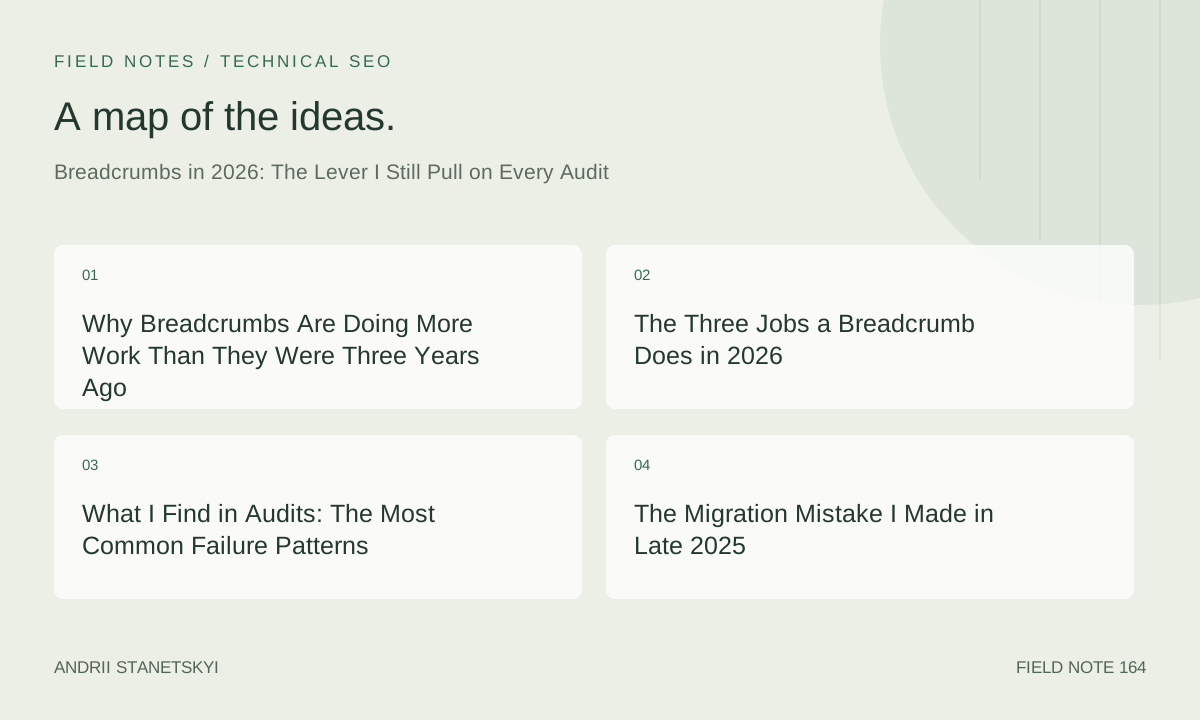
Why Breadcrumbs Are Doing More Work Than They Were Three Years Ago
There's a version of the breadcrumb conversation that goes: make sure you have BreadcrumbList JSON-LD, make sure the items have names and URLs, done. That version was sufficient in 2022. It is not sufficient now.
What changed is the increasing importance of entity-graph signals in Google's ranking and AI Overview systems. A breadcrumb, properly implemented, communicates a hierarchical entity relationship directly to Google: this page belongs to this parent concept, which belongs to this grandparent concept. That relationship is a structural assertion about what this page is and where it sits in the conceptual map of the domain. In an environment where AI Overview citations depend substantially on strong entity-graph alignment, breadcrumbs are one of the few places where sites can assert hierarchy directly in structured data, repeatedly, across every page of their site.
I started paying closer attention to breadcrumb implementation in August 2025 when I was diagnosing why a client's mid-level category pages were losing AI Overview citations to competitors. Content quality was comparable. Backlink profiles were comparable. The difference that kept surfacing when I compared the two sites' structured data: the competitor's breadcrumb markup was asserting complete, consistent entity hierarchies on every page. My client's breadcrumbs were present but inconsistent — some pages had them, many didn't, the URLs in the markup were a mix of canonical and non-canonical, and the hierarchy asserted in markup differed from the URL structure on roughly 30% of pages.
That 30% was producing entity-graph noise. Noisy entity signals don't add up to zero — they actively degrade the clarity of whatever entity the page is trying to be aligned with.
The Three Jobs a Breadcrumb Does in 2026
Before the audit checklist, the framework for why any of this matters.
Job 1: SERP display. Google shows breadcrumb paths in search results, often instead of the raw URL. This is a click-through rate factor. A breadcrumb that reads Home > Power Tools > Angle Grinders is more informative and more click-worthy than a URL that reads /products/cat37/sub88/angle-grinders-4in.html. The visual breadcrumb also functions as a relevance signal confirmation for the user: they can see, without clicking, that this result comes from a site organized around the topic they're searching for.
Job 2: Entity-graph hierarchy assertion. The BreadcrumbList structured data tells Google's systems, in machine-readable format, what conceptual hierarchy this page belongs to. This feeds directly into entity graph construction. If 2,000 pages on a site all assert, via BreadcrumbList, that they belong under /power-tools/ which belongs under /tools-equipment/, Google has 2,000 consistent structural signals that /power-tools/ is a real intermediate entity in this site's domain. That's entity-graph weight. It accumulates.
Job 3: Crawl hierarchy communication. Googlebot reads structured data. BreadcrumbList markup that consistently points to the same parent URLs signals to Googlebot that those parent URLs are important — they are the trunk of this site's topical tree. This influences crawl priority. Parent nodes cited repeatedly in breadcrumb markup across hundreds of child pages receive stronger crawl priority signals than pages that aren't cited this way.
These three jobs interact. A breadcrumb that's visually present in the HTML but not implemented in structured data does Job 1 partially and Jobs 2 and 3 not at all. A breadcrumb that's in structured data but inconsistent between pages muddies Job 2 and introduces Job 3 noise. All three jobs require consistent, correct, complete implementation across the entire site.
What I Find in Audits: The Most Common Failure Patterns
Running breadcrumb audits across 11 client sites between January 2025 and April 2026, these are the patterns that came up repeatedly, ranked by frequency:
Pattern 1: Breadcrumb markup present on some templates, absent on others (9 of 11 sites). This is almost always a CMS template inheritance problem. The breadcrumb component was added to the product page template and not propagated to category pages, or vice versa. The result is that Google has entity-hierarchy data for one page type and not another, producing an inconsistent entity map across the site.
Pattern 2: Non-canonical URLs in breadcrumb item positions (7 of 11 sites). The most common variant: breadcrumb markup pointing to URLs with tracking parameters (?ref=nav, ?source=menu) that are not the canonical version of the parent page. Less common but worse: breadcrumb markup pointing to redirecting URLs. If the URL in your BreadcrumbList item position redirects, Google sees a different entity at the end of that redirect than the one you named. Entity assertion fails.
Pattern 3: Hierarchy in markup doesn't match hierarchy in URL structure (6 of 11 sites). Breadcrumb shows Home > Category > Product. URL is /sub-category/product/. The intermediate hierarchy level is asserted in markup but absent from the URL. Google receives two conflicting signals about where this page sits hierarchically. The effect is entity-graph ambiguity, which usually resolves toward the URL structure — meaning the breadcrumb markup is doing nothing except creating noise.
Pattern 4: Using display text in item URLs instead of page URLs (4 of 11 sites). Some CMS implementations generate anchor-link breadcrumbs (#) or JavaScript-generated crumbs that don't produce crawlable URLs in the item positions. The structured data looks correct but the item URLs are either empty, hash-only, or JavaScript-dependent. These don't pass entity signals because there's no resolvable URL for Google to associate with the entity name.
Pattern 5: Breadcrumb hierarchy truncated relative to actual URL depth (4 of 11 sites). A page at /tools/hand-tools/wrenches/adjustable-wrenches/ has a breadcrumb of Home > Tools > Adjustable Wrenches, skipping the intermediate levels. The intermediate entities (/hand-tools/, /wrenches/) never accumulate entity-graph weight from this page's breadcrumb data. For sites with deep taxonomies, this is the mechanism through which mid-level categories fail to build authority despite having thousands of product pages underneath them.
The Migration Mistake I Made in Late 2025
In October 2025 I managed an IA migration for an outdoor equipment retailer — moving from a flat product structure to a three-level taxonomy (Category > Type > Product). New URLs were cleaner, new taxonomy was properly designed. I updated the breadcrumb markup on all page templates before migration. Or I thought I did.
What I missed: the site had a legacy Magento widget generating breadcrumbs on category pages independently of the main breadcrumb component. That widget wasn't touched during migration. For six weeks post-launch, category pages were displaying and serving the new breadcrumbs visually, but the structured data being rendered by the Magento widget was the old hierarchy — the pre-migration flat structure — pointing to old canonical URLs that had since been redirected.
So for six weeks, every category page on the site was asserting, in structured data, a breadcrumb hierarchy that pointed to redirecting URLs referencing a site structure that no longer existed. Googlebot was reading entity-hierarchy assertions based on old, invalid canonical paths.
The ranking impact was concentrated in category-level queries — exactly the pages where the bad breadcrumb data was being served. Traffic to category pages dropped 19% in November, bottomed in December, and didn't recover fully until late January 2026 after we identified and fixed the widget. Three months of ranking recovery for a miss in the migration QA process.
The QA step I added afterward: a post-migration structured data audit specifically checking breadcrumb item URLs for redirect chains, run against a full crawl of the new site, before the migration goes live. Screaming Frog's structured data extraction combined with its redirect audit — cross-referenced by URL — catches this in about 20 minutes on a 50,000-URL site.
Markup That Actually Works: Patterns and Anti-Patterns
The Standard Pattern (Three Levels)
{
  "@context": "https://schema.org",
  "@type": "BreadcrumbList",
  "itemListElement": [
    {
      "@type": "ListItem",
      "position": 1,
      "name": "Tools & Equipment",
      "item": "https://example.com/tools-equipment/"
    },
    {
      "@type": "ListItem",
      "position": 2,
      "name": "Hand Tools",
      "item": "https://example.com/tools-equipment/hand-tools/"
    },
    {
      "@type": "ListItem",
      "position": 3,
      "name": "Adjustable Wrenches",
      "item": "https://example.com/tools-equipment/hand-tools/adjustable-wrenches/"
    }
  ]
}
Three things to verify in every implementation of this pattern: (1) every item URL is canonical — check against the canonical tag on each linked page, (2) no item URL returns a redirect — run the URL list through a redirect checker, (3) the position values are sequential integers starting at 1 with no gaps.
The Anti-Pattern: Flat Breadcrumb on a Deep URL
{
  "@context": "https://schema.org",
  "@type": "BreadcrumbList",
  "itemListElement": [
    { "@type": "ListItem", "position": 1, "name": "Home", "item": "https://example.com/" },
    { "@type": "ListItem", "position": 2, "name": "Knipex 87 01 250", "item": "https://example.com/tools-equipment/hand-tools/adjustable-wrenches/knipex-87-01-250/" }
  ]
}


{
  "@context": "https://schema.org",
  "@type": "BreadcrumbList",
  "itemListElement": [
    { "@type": "ListItem", "position": 1, "name": "Home", "item": "https://example.com/" },
    { "@type": "ListItem", "position": 2, "name": "Tools & Equipment", "item": "https://example.com/tools-equipment/" },
    { "@type": "ListItem", "position": 3, "name": "Hand Tools", "item": "https://example.com/tools-equipment/hand-tools/" },
    { "@type": "ListItem", "position": 4, "name": "Adjustable Wrenches", "item": "https://example.com/tools-equipment/hand-tools/adjustable-wrenches/" },
    { "@type": "ListItem", "position": 5, "name": "Knipex 87 01 250", "item": "https://example.com/tools-equipment/hand-tools/adjustable-wrenches/knipex-87-01-250/" }
  ]
}
The "bad" version is what a lot of ecommerce CMS platforms generate by default — particularly older Magento and WooCommerce configurations. It's not just unhelpful. It actively misrepresents the entity hierarchy, because Google reads that markup and learns that this product page sits directly under the homepage with no intermediate entity context. The intermediate categories (/hand-tools/, /adjustable-wrenches/) never get the entity-hierarchy weight that thousands of product pages could be providing them.
Breadcrumbs and AI Overview Path Assertions
This is the part of breadcrumb optimization that wasn't on anyone's radar 18 months ago and is now one of the more interesting dynamics I'm watching.
AI Overview citations often include path information about where the cited content sits within a site. I've been manually checking AI Overview citations in my client categories since February 2025, and one consistent pattern: pages cited in AI Overviews for product and category queries almost always have complete, consistent BreadcrumbList markup. Pages from the same sites that are not cited tend to have missing or inconsistent breadcrumb data.
This is correlation, not a proven causal mechanism. Google hasn't published anything that confirms breadcrumb markup directly influences AI Overview citation selection. But the pattern is consistent enough across my client set that I treat breadcrumb completeness as a citation hygiene requirement — meaning: if a page doesn't have correct BreadcrumbList markup, I don't expect it to compete for AI Overview citations in queries where path context is relevant.
The mechanism I believe is operating: AI Overviews need to attribute sources, and source attribution involves not just the page URL but the conceptual position of that page within its domain's knowledge structure. BreadcrumbList markup is the most direct machine-readable signal of that conceptual position. A page with complete breadcrumb markup gives the AI system a ready-made source attribution path. A page without it requires the system to infer that path from other signals — URL structure, internal links, entity graph relationships — which introduces ambiguity.
Two Things the Standard Advice Gets Wrong
1. "Match the breadcrumb to the navigation, not the URL"
Some SEO practitioners recommend that breadcrumb markup should reflect the logical navigation path a user would take to reach the page, even if that path doesn't match the URL structure. The argument: users navigate through menus, not URLs, so breadcrumbs should follow menu logic.
I disagree with this in 2026. The URL is the primary entity identifier for the page. When breadcrumb markup asserts a hierarchy that conflicts with URL structure, you produce two different signals about this page's position in the entity graph — one from the URL, one from the markup. Google has to reconcile them. In practice, it usually resolves toward the URL. That makes the conflicting breadcrumb markup noise at best, entity-graph confusion at worst.
If your navigation structure and URL structure disagree about where a page sits hierarchically, that's an information architecture problem that needs fixing at the structural level, not patched at the breadcrumb level. Fix the IA, then align the breadcrumbs to it. Breadcrumbs should never be the reconciliation mechanism for an IA that's internally inconsistent.
2. "Add breadcrumbs to everything including the homepage"
The homepage should not have a breadcrumb. It's the root. There's no parent to point to. Adding a single-item BreadcrumbList to the homepage (Home > Home) is technically valid but semantically meaningless and produces a Schema.org validation warning in Google's Rich Results Test.
More importantly: the presence of breadcrumb markup on the homepage contributes nothing to entity-graph hierarchy because there's no parent assertion being made. The implementation effort spent on homepage breadcrumbs is wasted. Spend it on ensuring every category and product page template has correct, complete, multi-level BreadcrumbList markup.
Ecommerce Breadcrumbs: The Multi-Parent Problem
Ecommerce sites frequently have products that belong to multiple categories. A cordless drill might live in /power-tools/drills/ and also in /brands/dewalt/ and also in /deals/. Three canonical category paths, one product. Which breadcrumb do you implement?
The answer most ecommerce platforms give is: whatever the primary category is. The answer from the entity-graph perspective is slightly more nuanced.
The product page's canonical URL determines which hierarchy is its primary home. That hierarchy should be the BreadcrumbList markup on the page. Full stop. Don't implement multiple BreadcrumbList entries on one page — they confuse structured data parsers and produce validation errors.
What about the other categories? Signal those through internal links from the category pages themselves. If /brands/dewalt/ links to the product page, that link communicates entity relationship without requiring the product page to claim two hierarchical parents simultaneously. The entity-graph gets the relationship from the link. The BreadcrumbList stays clean and consistent with the canonical URL hierarchy.
# URL hierarchy alignment for multi-category products

Product canonical URL:
  /power-tools/drills/dewalt-dcd791d2-20v/

BreadcrumbList (on product page):
  Home > Power Tools > Drills > DeWalt DCD791D2 20V

Internal links to product page from:
  /power-tools/drills/         (category listing)
  /brands/dewalt/              (brand page — link asserts entity relationship)
  /deals/cordless-tools/       (deals aggregation — link asserts relevance)

Do NOT implement:
  Multiple BreadcrumbList entries claiming different hierarchies
  BreadcrumbList pointing to /brands/dewalt/ as parent instead of /power-tools/drills/
One exception: if a product genuinely lives primarily in a brand or collection hierarchy — for example, a luxury goods site where brand identity is the primary organizational logic — the BreadcrumbList should reflect that hierarchy, and the URL should too. The pattern I'm cautioning against is having the URL assert one hierarchy and the BreadcrumbList assert another for the same page.
Breadcrumbs on Media Sites: When the Standard Model Breaks
Articles on media and news sites present a different problem. An article might be relevant to three different topics, published in one section but tagged with five others, and findable through multiple navigation paths. The BreadcrumbList model assumes a tree. Media content often lives in a graph.
The practical answer: pick one hierarchy path for the BreadcrumbList and use it consistently for each article type. For news articles, this is typically: Home > Section > Article. For analysis pieces: Home > Topic > Article. For evergreen guides: Home > Topic Area > Guide.
What I don't recommend is using tag pages in the BreadcrumbList hierarchy. If your breadcrumb reads Home > Tag: climate-policy > Article, you are asserting that a tag archive page — almost certainly thin content, likely canonicalized away or noindexed — is a meaningful intermediate entity in your site's hierarchy. It isn't. It's an index artifact. Asserting it as a parent entity in breadcrumb markup is sending a confused signal about both the article and the tag page.
For media sites struggling with the section/topic/tag structure, the media site IA piece covers the structural issues in detail. Breadcrumb decisions on media sites should follow from IA decisions, not precede them.
The BDPA Audit Checklist I Actually Use
BDPA: Breadcrumb Data and Path Audit. Four checks, run in sequence, on every site audit I do.
B — Baseline coverage check. What percentage of indexable URLs have BreadcrumbList markup? Run a full crawl, extract structured data, filter for BreadcrumbList, cross-reference against the full URL list. A site where less than 80% of indexable pages have breadcrumb markup has a coverage problem, not an optimization problem. Fix coverage first.
D — Data consistency check. For pages that have BreadcrumbList markup, what percentage have item URLs that are canonical (no redirects, no non-canonical parameters)? Extract all item URLs from BreadcrumbList markup across the site. Run them through a redirect/canonical checker. Flag any that return 301/302 or don't match the canonical tag of the destination page.
P — Path alignment check. For a sample of 50–100 pages distributed across page types and depth levels, compare the hierarchy asserted in BreadcrumbList to the hierarchy implied by the URL structure. Flag mismatches — hierarchy levels present in URL but absent from breadcrumb, hierarchy levels asserted in breadcrumb but absent from URL.
A — SERP appearance audit. Search for 20–30 representative pages and check whether Google is showing breadcrumb paths in search results. If breadcrumb rich results are appearing, check whether the displayed path matches the implemented BreadcrumbList. If breadcrumb rich results are not appearing on pages that have valid BreadcrumbList markup, check the Rich Results Test for validation errors and check the Search Console Enhancement reports for breadcrumb issues.
# BDPA audit outputs to document

Coverage: X% of indexable URLs have BreadcrumbList
Canonical item URLs: X% of BreadcrumbList items point to canonical URLs
Path alignment: X% of sampled pages have markup matching URL hierarchy
SERP appearance: X% of tested pages show breadcrumb rich result

Priority fixes by finding:
  Coverage < 80%: template audit, CMS breadcrumb component propagation
  Canonical item URLs < 90%: URL list clean-up, template URL generation fix
  Path alignment < 85%: hierarchy audit, markup regeneration
  SERP appearance < 60% with valid markup: Check GSC enhancements report,
    look for site-level breadcrumb errors suppressing display
The thresholds above aren't universal. For a 5,000-page site I might accept 90% canonical coverage. For a 500,000-page site, even 95% canonical coverage means 25,000 pages with bad breadcrumb data — which is enough to produce visible entity-graph noise.
Where to Spend the Hour
Breadcrumb work is not glamorous. No client has ever asked me to "do breadcrumbs." The brief is always something else — rankings dropped, AI Overview citations are missing, a migration lost traffic — and breadcrumbs turn up in the audit as a contributing factor that nobody expected to matter.
That's the pattern I keep seeing: breadcrumbs are never the only problem, but they're frequently one of the cheaper problems to fix, and fixing them removes structural noise that was obscuring what the site is actually authoritative about. When entity-graph signals are ambiguous, all the other work — content quality, link building, speed optimization — is working against headwind. Clean up the structural assertions first. Breadcrumbs are part of that.
Google's official BreadcrumbList documentation was updated in January 2026 and is more specific about the URL canonicality requirement than earlier versions. Worth reading the current version even if you've implemented BreadcrumbList before. Schema.org's BreadcrumbList specification is the underlying reference for property definitions and acceptable types.
The one thing I'd leave you with: run the BDPA coverage check before anything else. Not because low coverage is necessarily the worst problem, but because it's the easiest to quantify and the most likely to produce an immediate quick win. Sites where less than 70% of indexable pages have breadcrumb markup almost always have template propagation problems that can be fixed in a developer sprint. That sprint, on a 50,000-page site, can add 50,000 entity-hierarchy assertions in Google's entity graph at essentially no content cost.
That's not a small thing. It just doesn't look impressive in a report.
For the broader structural context breadcrumbs sit within, the taxonomy design piece covers how taxonomy nodes should be designed to make consistent breadcrumb hierarchies possible in the first place. The large ecommerce IA article has the CLR model context for how breadcrumb hierarchy should map to the three-layer structure on large catalog sites. And the internal linking strategy piece covers the relationship between internal links and breadcrumbs as complementary entity-hierarchy signals.
Filed under: breadcrumbs, structured data, BreadcrumbList, entity graph, BDPA audit, AI Overviews. Last checked against live client data: May 2026.