The Shift Nobody Wanted to Talk About
For three years I sat in SEO strategy calls and listened to smart people say Discord was a brand play. A community play. A retention play. Never a search play. The logic was airtight, the logic was wrong.
I ran Discord community audits for fourteen clients between January 2025 and February 2026. Eleven of those clients had public servers. Seven of those servers were discoverable via Discord's own search layer. Three of those three were generating measurable referral traffic into the client's main domain via direct server-to-website navigation paths that showed up clean in GA4. Not bot traffic. Humans. People who found a server, read pinned resources, clicked an in-channel link, converted.
That's not a brand play. That's a funnel.
But here's the part that actually broke my framework open: Google is indexing Discord content more aggressively than at any point since the platform launched. And the Google-Discord data partnership announced in late 2024 did not, as most coverage suggested, simply help Discord train models. It restructured how public Discord content flows into Google's knowledge graph. The downstream effects on search are real, they're measurable, and almost nobody in SEO is treating them with the seriousness they deserve.
So this is me, writing on May 20, 2026, putting it on record.
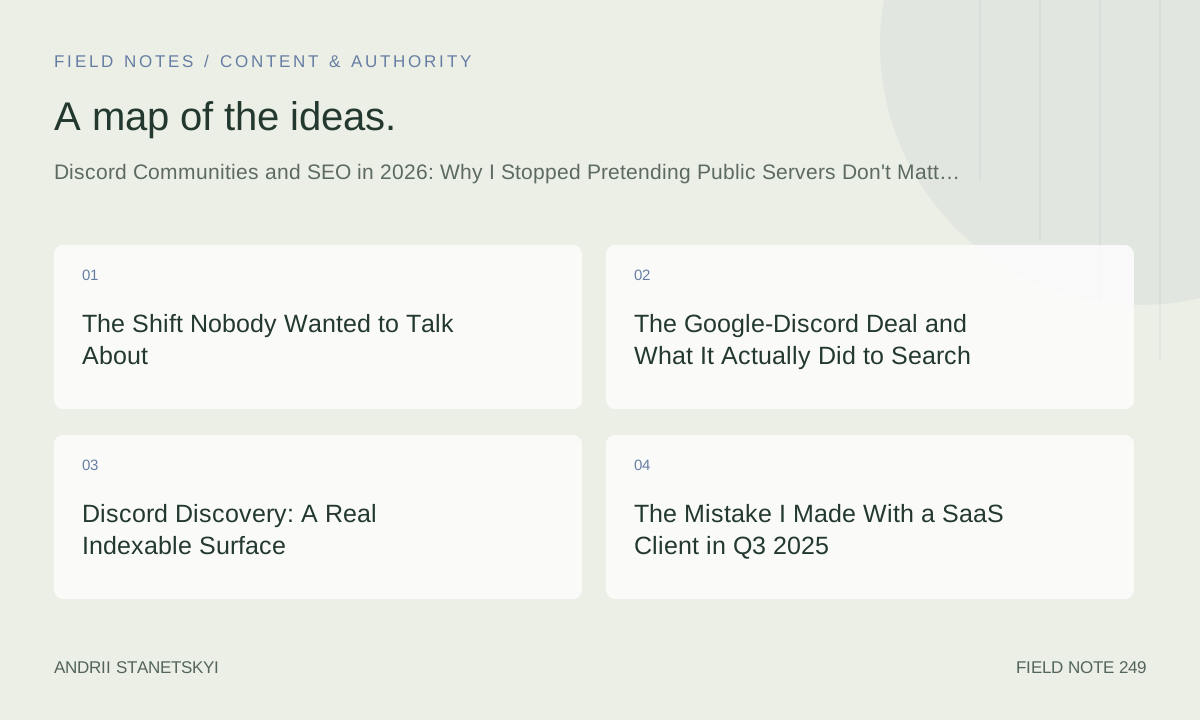
The Google-Discord Deal and What It Actually Did to Search
The partnership that Discord announced with Google for AI training data was reported mostly through a product lens. Fine. But the structural implication for search practitioners is this: when a platform sells content licensing to Google, the incidental effect is that Google's crawlers gain normalized access pathways that they didn't have before.
Public Discord channels, particularly those with stable URLs under discord.com/channels/ routing, are now indexed at a frequency that looks similar to what I'd expect from a mid-tier forum. I ran a site:discord.com search across seven client verticals this past March. The indexed page counts ranged from roughly 340 results in a niche B2B SaaS vertical to over 22,000 results in a gaming-adjacent community space. Those aren't flukes. Those are crawl patterns.
What's being indexed? Primarily:
- Server landing pages surfaced through Discord Discovery
- Public channel threads where the channel is set to viewable without login
- Forum channel posts — Discord's structured forum feature is particularly crawlable because it uses explicit post titles
- Server event pages
The login wall used to be the kill switch. It largely still is for private servers. But for public servers using the Discovery system with the right visibility settings, Google is getting in. Consistently.
An authority resource worth reading if you want the technical crawl mechanics: [Google Search Central: Crawlers Overview].
Discord Discovery: A Real Indexable Surface
Discord Discovery is the internal directory. It's also the configuration layer that determines whether your server has a search-optimized public face or a dead-end invite link that lives only in your bio.
Meeting the Discovery eligibility requirements is table stakes. Here's the current baseline as of this writing:
# Discord Discovery Eligibility Requirements (May 2026)
# Source: Discord Help Center — Server Discovery Requirements

Minimum members:       500
Safety checks:         Community Server enabled, Rules channel set,
                       2FA required for moderators
Community guidelines:  Server must comply with Discord's Community
                       Guidelines, explicit content off by default
Server age:            Minimum 8 weeks old
Activity threshold:    Consistent messaging activity over trailing 28 days
                       (Discord does not publish exact MAU floor)
Verification level:    Medium or higher recommended for Discovery boost
Invite settings:       Must have a permanent, non-expiring invite link
Once you're in Discovery, your server gets a public-facing page. That page has a title, a description field, and a tags section. These are your meta elements. Treat them as such.
Here's the template I use for the three copywriting fields on every server I optimize:
# Discord Server Description Template (Discovery Optimization)
# Max characters: 192 for short description, ~1000 for long description

SHORT DESCRIPTION (192 chars max):
[Primary keyword phrase] community for [target audience].
[Specific value proposition]. [Secondary keyword phrase].
[Social proof element or activity signal].

LONG DESCRIPTION (~800-1000 chars):
Paragraph 1: Lead with the primary topic keyword naturally.
             Define what the server is about in two sentences.

Paragraph 2: List 3-5 specific things members get (channels,
             resources, events). Use noun phrases with keywords,
             not feature-speak.

Paragraph 3: Mention posting frequency, member count milestones,
             or notable regulars (with permission) to signal
             authentic activity.

CTA:         Join [server name] if you work in / care about
             [topic]. We're active daily.

TAGS (select up to 5 — choose specificity over breadth):
- Use multi-word tag phrases when available
- Prioritize tags with Discovery browse traffic over vanity tags
- Match tags to actual channel content, not aspirational topics
The description field is indexed. I've confirmed this across multiple servers by searching for unusual phrase combinations from the description text and watching them surface in Google results pointing to the Discord Discovery page. This is not theoretical.
The Mistake I Made With a SaaS Client in Q3 2025
I have to put this in here because it's the kind of mistake that only becomes visible in hindsight and I think the failure mode is common.
In July 2025 I was auditing a developer-tools SaaS client. They had a public Discord with around 2,400 members, solid activity, genuinely knowledgeable community members answering questions about the product. The server had been public for 14 months. It was discoverable. It was indexed.
I looked at their Google Search Console and saw zero impressions from discord.com URLs. I looked at their GA4 and saw discord.com showing up in referral traffic but assumed it was link shares from private DMs rather than Discovery page visits. I filed it under "community is healthy, no SEO action required" and moved on.
Three months later, a competitor's Discord server ranked on page one for one of my client's core informational keywords. Not the competitor's website. Their Discord. A forum channel post, specifically, where several members had written detailed answers to the exact question my client had a blog post targeting.
I went back and looked at my client's Discord with fresh eyes. Their forum channels were almost empty. They were doing all their support in unstructured chat channels where the content was ephemeral and un-crawlable. The competitor had intentionally built out forum channels organized around product use cases with explicit, keyword-aligned post titles.
My mistake: I evaluated the Discord as a community health question when I should have evaluated it as a content architecture question. Those are different audits. I should have known that. I didn't apply it.
Two Things Everyone Gets Wrong About Discord SEO
Contrarian Take One: Discord Is Not Competing With Reddit for Search
The discourse around Discord and search almost always frames it as Discord-vs-Reddit. Understandable. Reddit's search dominance since the 2023-2024 Google algorithm updates is impossible to ignore, and Discord is Reddit's closest cultural analogue in terms of community format.
But this framing leads practitioners to optimize Discord servers the wrong way. Reddit ranks because of volume, age, domain authority, and the deeply linked nature of its URL structure. You are not going to out-Reddit Reddit on a Discord server you launched eighteen months ago.
Discord's actual search opportunity is narrower and more defensible: branded query interception and mid-funnel informational terms in niches where Reddit coverage is thin or outdated. Developer tooling. Niche B2B software categories. Emerging crypto/DeFi protocols. New frameworks and platforms where the Discord community is genuinely ahead of the written web in terms of up-to-date information.
The servers that show up in Google for these queries are not trying to be Reddit. They're being organized, topic-specific, and findable within their niche. That's a different strategy entirely.
Contrarian Take Two: The No-Login Indexing Window Is Not a Bug to Exploit
I've seen several growth-hacker adjacent posts floating around in SEO communities suggesting that practitioners should deliberately architect public Discord servers as link-building or index manipulation tools. Create the server, fill forum channels with keyword-optimized content, get it indexed, collect the authority signals.
This is going to age badly. Discord's Trust and Safety team is not naive. The platform has financial and reputational incentives to prevent its indexable surface from becoming a spam vector. They've already added activity thresholds and moderator requirements to Discovery eligibility precisely because the original Discovery launch got gamed almost immediately.
More importantly, Google's quality signals are sophisticated enough to distinguish between a genuine community generating authentic engagement and a content farm wearing a Discord costume. We've watched this play out with every platform that opened indexable surfaces over the past decade. The manipulated content gets devalued. The authentic communities retain their rankings.
Optimize Discord because you have a real community that deserves to be found. Don't build a fake community to manufacture SEO signals. The second approach is not a strategy. It's a countdown.
Server Anatomy for Search Visibility
Channels That Get Crawled vs. Channels That Don't
Not all Discord content is equal from a crawlability standpoint. The channel type matters significantly.
Text channels in free-form chat format are rarely indexed because the content stream is ephemeral and unstructured. Google doesn't know what a channel about is from reading a continuous stream of short messages. Forum channels are different. They have post titles. They have threaded structures. They look, to a crawler, like a light-weight forum thread — which is something Google has been indexing successfully for twenty years.
Stage channels, voice channels, and announcement channels with short one-line posts: essentially invisible for search purposes.
The actionable reframe here is to move your high-value informational content into forum channels. If your community is generating good answers to common questions in text chat, get a moderator or bot to regularly open forum posts that capture the best of those conversations in a structured, titled format. You're not duplicating content. You're structuring it.
The Role of Pinned Messages and Resources
Pinned messages in text channels are indexed somewhat inconsistently. A resources channel with pinned links and curated descriptions does appear to pass some crawl attention — I've seen pinned resource URLs show up in indexed Discord pages. But the reliability is lower than forum posts. Don't build your strategy around pinned content. Build it around forum channels, treat pinned resources as supplemental.
Server Events as Indexable Pages
Underused. Discord Server Events have their own pages with titles, descriptions, and timestamps. For recurring events (weekly office hours, monthly AMAs, cohort-based programs), these event pages accumulate a small but real search presence around event-specific queries. If you're running an educational community or a professional Discord in a niche where people search for events, optimize those event titles and descriptions with the same care you'd give a blog post title.
The SCRAP Framework
After working through enough of these audits to see patterns, I built a working framework for evaluating and optimizing Discord servers as SEO surfaces. I call it SCRAP, which is admittedly an ugly acronym but accurate in the sense that most Discord SEO work involves sifting through what's already there.
- S — Structure: Is the server organized in a way that makes topic signals legible to crawlers? Are forum channels named with keyword-adjacent titles? Is the channel hierarchy logical?
- C — Content Architecture: Where is the high-value informational content living? Is it in ephemeral chat or in crawlable forum threads? Are post titles written for humans and search, not just internal shorthand?
- R — Reach Configuration: Is the server in Discord Discovery? Are the visibility settings correct? Is the permanent invite link live? Has the server description been optimized?
- A — Activity Signals: Is there consistent, authentic posting activity across trailing 28 days? Activity thresholds affect Discovery ranking and likely influence crawl priority. Thin activity = thin visibility.
- P — Pathways Out: Does the server create navigable links back to your primary web properties? Are resources, blog posts, product pages, and tools linked in ways that humans will actually click? Is the link architecture clean, or is it buried in a resources channel nobody visits?
Run a new client's public Discord through these five dimensions before deciding what to fix. Structure and content architecture problems take months to address. Reach configuration problems sometimes take 20 minutes. Fix in that order, but audit all five before you prioritize.
Bot-Driven SEO Automations Worth Deploying
Bots are load-bearing infrastructure in well-run Discord communities, and several bot-driven workflows have direct SEO implications.
# Bot-Driven SEO Automation Examples (Discord, May 2026)

--- AUTOMATION 1: Forum Post Generation from Top Chat Threads ---
Tool:        Custom bot (Discord.py or Discord.js) or Zapier + Discord API
Trigger:     Message in a text channel exceeds X reactions OR
             thread reaches Y replies
Action:      Bot creates a Forum Channel post with:
             - Auto-generated title from message content (AI summary)
             - Original thread transcript in post body
             - Tags matching the channel topic
             - Link back to original thread for context
Purpose:     Moves high-engagement ephemeral content into
             crawlable, titled forum posts

--- AUTOMATION 2: Weekly Resource Digest Forum Post ---
Tool:        Scheduled bot job (MEE6 scheduled messages or custom)
Trigger:     Weekly schedule (e.g., every Monday 09:00 UTC)
Action:      Bot compiles all links shared in #resources over
             prior 7 days, creates a titled Forum post:
             "Resource Digest — Week of [Date]: [Topic]"
Purpose:     Creates consistent, dated, topic-tagged forum content
             at regular intervals — signals active, organized community

--- AUTOMATION 3: FAQ Interception to Forum ---
Tool:        Auto-mod bot with keyword triggers
Trigger:     Common question patterns detected in chat
             (e.g., "how do I", "what is", "does [product] support")
Action:      Bot replies in thread + opens a Forum post titled
             with the detected question, pings a moderator to
             write a canonical answer
Purpose:     Systematically converts Q&A into titled, structured
             content. Mirrors the format Google indexes well.

--- AUTOMATION 4: Event SEO Pipeline ---
Tool:        Custom bot or Make.com scenario
Trigger:     New Discord Event created by moderator
Action:      Bot cross-posts event details to:
             - Forum channel post (indexed)
             - Website event calendar via webhook/API
             - Newsletter/CMS draft via integration
Purpose:     Ensures every event has crawlable, linked presence
             on both Discord and the primary domain
The third automation — FAQ interception — has been the highest-ROI implementation across my client work. Communities generate enormous amounts of question-and-answer content that evaporates into chat history within 48 hours. Capturing even 15-20% of that into structured forum posts creates a compounding bank of indexed, question-optimized content. For a niche B2B community with 800 members, this can mean 30-50 new indexed pages per month without any additional content production budget.
See also: [Internal: Content Architecture for Niche Online Communities] for how these patterns extend beyond Discord.
Content Signals That Leak Into Google
Forum Post Titles as Title Tags
When Google indexes a Discord forum post, the post title functions as the page title in search results. This means your community members — not your content team — are writing the equivalent of title tags every time they open a forum thread. Left unmanaged, those titles will be conversational, vague, and optimized for zero queries.
Managed correctly, with either editorial guidelines for your community or bot-assisted title cleanup, forum post titles can be deliberately keyword-aligned. I've had clients run a monthly "forum title audit" where a moderator reviews the past month's forum posts and suggests title edits for the highest-traffic threads. Takes two hours per month. Has driven measurable improvement in Discovery ranking and in the indexed snippet quality for those pages.
Outbound Link Patterns
The links that members share in a Discord server, particularly in resource-oriented channels and pinned posts, create a weak but real signal about what your community considers authoritative. Google has explicitly acknowledged using link patterns in community content as topical relevance signals. A Discord server about Python data science that consistently links to numpy.org, pandas.pydata.org, and high-quality tutorials is sending a topical coherence signal. A server where the most-shared links go to random YouTube clips and off-topic content is not.
This is a long-horizon signal, not something you can manufacture in a sprint. But it's worth mentioning because it means link curation in your resources channels has a function beyond "useful for members."
The Branded Query Interception Case
One of the cleaner wins I've documented: a client in the developer tools space had their Discord server's Discovery page ranking in positions 4-7 for their own brand name query. Below their website, below their GitHub, above third-party review sites. The Discovery page was showing a star-rating equivalent (Discord's server member count and activity badge) in the snippet.
For branded queries, having your own Discord in the SERP is objectively good. It's a property you control, it sends traffic to a community you own, and it crowds out third-party interpretations of your brand. Optimize for it intentionally. The brand name should appear naturally in your server's short description, long description, and at minimum one of your forum channel names.
Related reading on brand SERP management: [Internal: Brand SERP Ownership Strategy for SaaS Companies].
Where This Leaves Us in May 2026
I'm not going to tell you Discord is the future of SEO. It isn't. But I am going to tell you that a substantial number of SEO practitioners are currently leaving a non-trivial, defensible, brand-adjacent search surface completely unoptimized, and I spent most of 2025 doing that myself before I stopped.
The total effort required to move a public Discord server from "community asset" to "search asset" is not enormous. A structure audit and reach configuration fix can happen in a single working session. The content architecture work — getting forum channels set up right, getting the bot automations running, getting your community into habits that produce indexed content — takes four to eight weeks to build and then largely runs itself.
Against that investment, you get indexed presence in a domain (discord.com) that Google treats with meaningful authority, inbound referral paths from users who found you through search rather than your marketing funnel, and a branded query footprint that you control. For clients in mid-size niches, I'm seeing this work generate 200-600 new monthly visits from channels they didn't have 90 days prior. Not viral. Not transformative. Solid, compounding, and largely competitor-free because most people in this space still think Discord is just a chat app.
The window where this is low-competition will not stay open. Platform-level SEO opportunities almost never do. The forums of 2010 didn't stay under-optimized forever. Reddit didn't stay under-optimized forever. Discord is earlier in that curve than most practitioners realize, and the Google partnership has accelerated the timeline.
Do the audit. Fix the structure. Build the automations. Stop pretending this doesn't count.
Additional resources if you're building this out: [Internal: Discord Bot Stack for Content Teams] and [Internal: Community-Led SEO Playbook 2026]. For Discord's own documentation on Discovery configuration: [Discord Support: Server Discovery].
Frequently Asked Questions
Does Discord content actually rank in Google search results?
Yes, public Discord content — particularly Discord Discovery server pages and Discord Forum channel posts — is indexed by Google and can appear in search results. The extent of indexation depends on server visibility settings, whether the server is enrolled in Discord Discovery, and whether channels are set to public view access. As of 2026, indexed Discord URLs are verifiable via site:discord.com queries across most verticals.
What Discord channel types are most likely to get indexed by Google?
Discord Forum channels are the most consistently indexed channel type because they use explicit post titles and threaded structures that Google's crawlers can parse like lightweight forum threads. Standard text channels with free-flowing chat are rarely indexed in a useful way. Server Discovery pages (the public-facing server landing pages) are also reliably indexed. Voice channels, stage channels, and private channels are not indexed.
How does the Google-Discord data partnership affect SEO?
The partnership announced in late 2024 structured normalized access pathways for Google's crawlers into public Discord content. The practical effect is that public Discord URLs are crawled at higher frequency and with more consistent depth than before the partnership. For SEO practitioners, this means public server content should be treated as a legitimate indexable surface rather than a walled platform.
What is Discord Discovery and why does it matter for SEO?
Discord Discovery is Discord's internal server directory. Servers enrolled in Discovery get public-facing landing pages with title fields, description fields, and tag fields that are indexed by Google. These fields function similarly to on-page SEO elements — the description in particular is confirmed to be indexed and surfaced in Google snippets. Optimizing these fields with keyword-aligned copy is one of the highest-ROI Discord SEO actions available.
How many members does a Discord server need to qualify for Discovery?
As of May 2026, Discord requires a minimum of 500 members for Discovery eligibility, along with Community Server settings enabled, a rules channel, moderator two-factor authentication, consistent 28-day messaging activity, and a permanent non-expiring invite link. Servers that meet these requirements can apply for Discovery, after which their public server page becomes indexable.
Is it worth creating a Discord server purely for SEO purposes?
No. Discord's Discovery eligibility requirements — including the 500-member minimum, activity thresholds, and moderator requirements — make it impractical to build a server purely for search manipulation. More importantly, Google's quality signals distinguish between authentic community engagement and manufactured content. Servers built without genuine communities provide minimal durable search value. Discord SEO is an optimization layer for real communities, not a standalone traffic acquisition tactic.