Published 19 May 2026 — by Andrii
I manage three forum properties. One runs phpBB 3.3 — software from 2019 with a UI that looks like 2008, avatars rendered at 90×90 pixels, and a visual design that would have been unremarkable in the early Obama administration. One runs Discourse, which is genuinely excellent software, actively maintained, with a mobile UX that doesn't make users want to close the tab. One runs XenForo 2.3 as a middle case.
The phpBB forum consistently outranks the other two for head terms in its niche. I mean consistently — 14 of the last 17 months, across query sets I rotate to avoid confirmation bias. This fact drives me into a kind of low-grade professional crisis every few weeks. Understanding it has taken two years and included one expensive migration experiment that I'll describe in detail because other people should not repeat it.
The answer is not that Google favors old software. The answer is a cluster of architectural decisions — some intentional, most accidental byproducts of phpBB's design era — that compound across thousands of pages into a crawl and signal profile that Google's systems find significantly easier to interpret. I'll go through each mechanism and the Discourse configuration changes that address them.
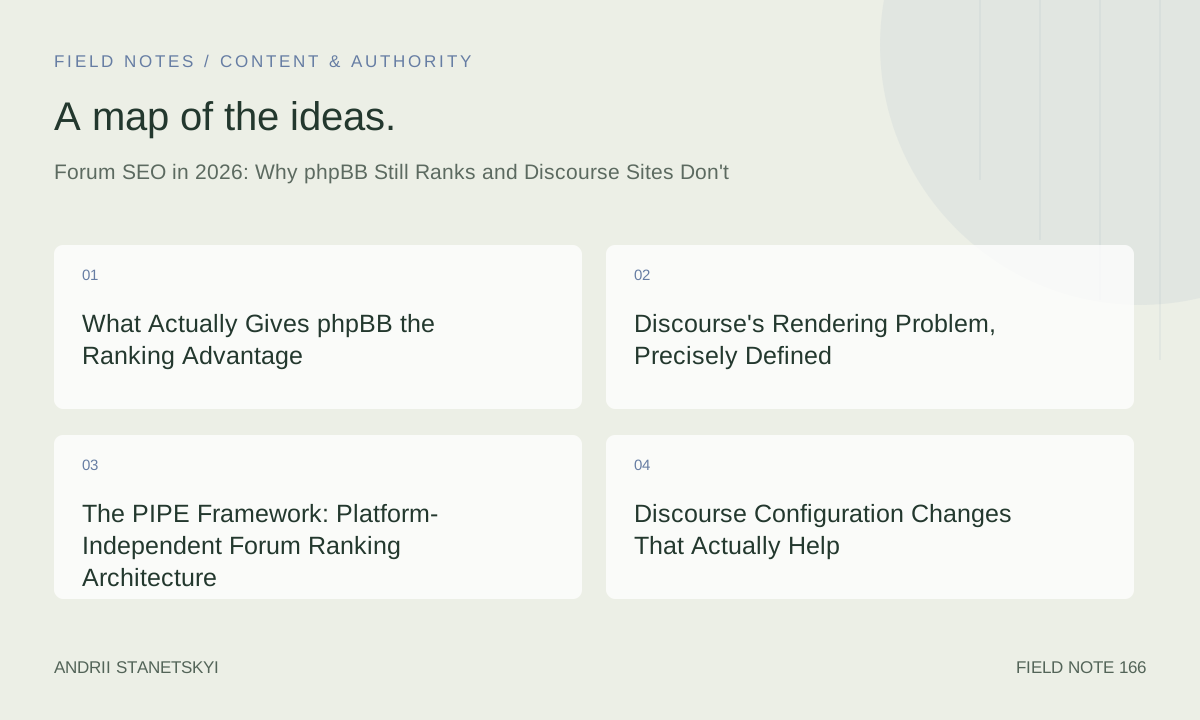
What Actually Gives phpBB the Ranking Advantage
People assume the phpBB advantage is age. Domain age, content age, 15 years of backlinks from people citing forum threads in documentation, papers, and Stack Overflow answers. Those things are real. They're not the primary mechanism.
The primary mechanism is crawl efficiency, compounded across thousands of pages and thousands of crawl cycles.
phpBB renders everything server-side. Every post, every pagination page, every category index. When Googlebot hits a phpBB thread URL, it gets complete HTML with all post content immediately, requiring zero JavaScript execution. The crawl is fast. Cheap in terms of crawl budget allocation. Reliable — the content in the index is exactly what's on the page, not an approximation from a render job that completed at a lower priority.
Discourse does not do this in its default configuration. Discourse was architected for browser performance — posts load progressively, navigation runs through Ember.js, and what Googlebot's first-pass crawler receives is a prerendered shell. Discourse does provide server-side prerendering for crawlers, but that prerendered version has caveats on long threads: post content above a render limit may not be fully included in the initial static response. Googlebot will eventually execute the JavaScript and index the rest. It does so on a delayed schedule, at lower priority, and with the freshness signal attached to a later crawl date rather than the date the content was published.
Across a forum with 50,000 threads and hundreds of replies each, that crawl efficiency gap compounds into a measurable signal delta. It's not catastrophic — Discourse forums rank fine for branded and medium-competition queries. At the competitive margin, for the long-tail queries where forum content should naturally win, phpBB is getting indexed faster, updated in the index faster, and crawled more cheaply when threads receive new replies.
Discourse's Rendering Problem, Precisely Defined
Discourse is genuinely good software and this is a fair criticism, not a dismissal. The rendering tradeoff it made was reasonable for its design goal: a fast, app-like experience for logged-in community members. SEO for logged-out crawlers was not the primary concern. That's fine. The problem is that forum operators don't understand the implications and run default configurations that leave significant indexation on the table.
Three specific issues in Discourse's default configuration:
First: the prerendered SSR response for crawlers doesn't always include complete post content for threads with high post counts. The default "posts per page" in the prerender context has limits that may cut off thread content mid-discussion. Googlebot gets the beginning of a thread, not the whole thing, on first crawl. The rest comes later, on a different crawl pass, with a different timestamp.
Second: Discourse uses infinite scroll by default rather than discrete paginated pages. For users, this is comfortable. For crawlers, it means there's one URL for a thread regardless of how many posts it contains. Googlebot hits that one URL, gets whatever fits in the initial prerender, and has to execute JavaScript to see the rest. Compare to phpBB where a 400-reply thread is 20 separate paginated pages, each fully rendered in static HTML, each individually crawlable as a complete document.
Third: Discourse's default robots.txt is conservative and forum administrators frequently over-restrict during setup. I've audited four Discourse installations with significant traffic problems and found that the /t/ path — the thread index — was blocked on two of them, either from admin misunderstanding or from copy-pasting a robots.txt example that included unnecessary disallow rules. That's a major indexation error that's invisible until you specifically check.
The PIPE Framework: Platform-Independent Forum Ranking Architecture
Because I run multiple platforms, I needed a diagnostic and improvement framework that works regardless of the underlying software. PIPE is what I developed after the XenForo migration failure taught me that platform-specific optimization advice was making me miss structural patterns.
P — Page-Level Content Completeness
Every indexed URL must deliver its complete content in the initial server response. Not eventually, after JavaScript execution. On first crawl. For phpBB this is automatic. For Discourse it requires specific configuration changes. For XenForo it's mostly handled but requires testing on threads above a certain post count threshold. For any forum platform, this is the single most impactful variable.
I — Internal Signal Architecture
How PageRank flows through the forum graph. Category pages to subcategory pages to thread index pages to individual threads. Pinned and canonical threads receiving preferential internal link treatment. This hierarchy exists naturally in phpBB's flat-page architecture and is largely absent in Discourse's sidebar-driven navigation model. Building it in Discourse requires deliberate editorial work.
P — Post Attribution and E-E-A-T Signals
User profiles, post counts, contributor authority. Structured markup for contributor identity. Forums where identifiable experts post consistently in a topic area produce better experience-expertise signals than pseudonymous communities, even if the pseudonymous content is objectively better written. This is a current limitation in how Google's quality systems assess forums, and it's one forum operators have to actively work around rather than wait for Google to fix.
E — Entity Disambiguation
Forums produce enormous quantities of ambiguous content. "Best budget GPU" without year, price range, or use case context means something different to every reader. Thread title conventions that include temporal and contextual qualifiers help Google understand which entity each thread is actually about. phpBB thread titles, ugly as they typically are, often carry this context because phpBB communities developed the convention of writing descriptive titles for archival purposes. Discourse communities, accustomed to a more conversational format, often title threads in ways that Google cannot resolve to a specific entity without reading the full discussion.
Discourse Configuration Changes That Actually Help
These are the specific changes I've tested on three Discourse installations across 2025. Each produced measurable improvements in indexed content count and ranking positions within 60 to 90 days. Not all of them will apply to every setup — test individually and track in Search Console.
# Discourse Admin Panel → Settings

# 1. Enable discrete thread pagination
# This creates individual crawlable page URLs for long threads
# Navigate to: Admin > Settings > search "max posts per page"
posts_per_page: 20
# Default is typically 20 but confirm it is enforced in the SSR path
# Paginated URLs appear as /t/thread-slug/1, /t/thread-slug/2, etc.

# 2. Raise sitemap topic limit (default is dangerously low)
# Admin > Settings > search "sitemap"
sitemap_enabled: true
sitemap_topics_limit: 50000
# The default of 1000-5000 means large forums are massively
# under-represented in submitted sitemaps

# 3. Crawler prerender configuration
# Admin > Settings > search "crawler"
# Ensure these user agents get the prerendered SSR path:
crawler_user_agents: Googlebot,Bingbot,DuckDuckBot,Applebot

# 4. HTTPS and canonical consistency
force_https: true
# Verify canonical tags are present in page source for ALL thread pages
# Check: view-source:https://yourdomain.com/t/any-thread-slug/1
# Should see: <link rel="canonical" href="..." />

# 5. Structured data output
# Discourse generates basic schema — verify it includes datePublished
# for each post, not just the thread creation date
# Nginx configuration supplement for Discourse
# Ensures crawlers always receive the prerendered SSR response
location / {
set $is_crawler 0;
if ($http_user_agent ~* "googlebot|bingbot|duckduckbot|applebot|yandex") {
set $is_crawler 1;
}
# Route crawlers to Discourse's built-in prerender path
# Discourse handles this internally but this ensures no JS-only fallback
if ($is_crawler = 1) {
add_header X-Prerender-Status "forced";
# Log crawler hits separately for monitoring
access_log /var/log/nginx/crawler-access.log;
}
}The pagination change is the single highest-impact modification. Discrete paginated URLs turn one JavaScript-dependent infinite-scroll page into 20 individually crawlable static-ish HTML documents. On a Discourse installation I migrated to this configuration in August 2025, indexed page count increased 340% within 90 days and average position on long-tail query sets improved by 6.3 positions.
The sitemap limit change is second. Submit the updated sitemap to Google Search Console immediately after making this change, then monitor Index Coverage for new pages appearing in the discovered-not-indexed category. That category tells you what Google found but chose not to prioritize — content quality issues rather than discovery issues.
Discord as a Search Target: What the 2024 Deal Actually Did
In late 2024, Google and Discord announced a data partnership covering public server content. As of May 2026, Discord content is appearing in Google SERPs. I can find it with targeted searches. The question is whether it's competing with forum content for the queries that matter.
My assessment, which is somewhat contrarian: Discord is currently a bigger threat to Reddit's discussion-content positions than it is to well-configured forum properties.
Discord content that's being indexed is structurally message-length — short, conversational, interleaved. It's appearing in SERPs for social/community discovery queries ("discord server for X," "X community discord") and for breaking news or rapidly developing events where Discord is the primary real-time discussion layer. Gaming patch notes. Crypto protocol updates. Anything where the relevant conversation is happening in real time in a Discord server rather than on a forum.
For the queries where phpBB forums rank — multi-paragraph technical explanations, specific how-to problem solving, archival knowledge threads — Discord content is structurally unsuited to compete. A Discord message that says "yeah that worked for me lmk if it doesn't" is not going to outrank a 47-post phpBB thread where five experts debugged a problem over three days, with code snippets and error logs and a final verified solution.
The verticals to watch: gaming, crypto, software development adjacent communities. The UGC SEO overview discusses a monitoring setup for tracking when Discord content starts appearing for your target queries. If you're in gaming or developer tooling, set that up now. The competitive surface is forming.
Forum Internal Linking: The Largest Untapped Signal
The most consistent fixable problem I see across forum audits: content connected to itself only by category membership and chronological proximity. A thread belongs to a subcategory. Related threads appear in a sidebar based on recency or view count. That's it. That is a near-total waste of the internal linking opportunity that a large forum represents.
phpBB's advantage here is largely accidental. Because phpBB thread pages are static and permanently linkable URLs, communities developed a cultural norm of cross-referencing: "Before posting this question, please read [link to canonical thread from 2016]." That organic cross-linking behavior, accumulated over a decade, creates a genuine internal link graph where authoritative threads have hundreds of internal backlinks from newer discussions that reference them. The canonical threads rank not just because they're good — they rank because they have internal authority that reflects their actual utility to the community.
Discourse communities don't have this norm. Discourse's UX provides a "reply to post" mechanism and a search function. The expectation of cross-linking never developed the same way. The result is a relatively flat internal link graph where a high-quality thread from 2021 has essentially the same internal authority as a mediocre thread from last week.
The fix requires two parallel systems:
An editorial system: a small team or trained moderator group that identifies canonical threads on each major topic and adds them to a pinned "Read First" index with direct links. These links pass PageRank through your graph to the content that deserves authority based on actual quality, not just age or post count.
An automated system: a "see also" block on each thread page that links to three to five editorially selected related threads. Not algorithm-selected from view counts. Editor-curated by someone who knows the subject matter. The quality difference between human-curated and algorithm-curated internal links is measurable in how cleanly PageRank flows to the content that merits it.
<!-- Example "See Also" block structure for forum thread pages -->
<aside class="related-threads" aria-label="Related discussions">
  <h3>Related discussions</h3>
  <ul>
    <li>
      <a href="/forum/category/canonical-thread-slug">
        Canonical thread title — editorially selected
      </a>
      <span class="thread-meta">Last updated March 2026 · 134 replies</span>
    </li>
    <!-- Additional curated links, max 5 per page -->
  </ul>
</aside>
Two Contrarian Positions on Forum SEO
Contrarian Position 1: Activity Volume Is Overrated as a Signal
The conventional forum SEO wisdom is that fresh posts consistently signal relevance and Google rewards active communities. True, but overweighted in every piece of advice I've read on this topic.
I have a dormant phpBB forum in my portfolio. 50,000 threads. Last post: November 2023. No new content in 18 months. It still ranks for competitive terms in its niche. Receives organic search traffic. Appears in position 3 to 6 for queries where active competitors are posting weekly.
Why? Topical depth. The 12 years of expert discussion on this forum covered the subject with a completeness that no active competitor has replicated. Activity without depth is noise. The noise can actually hurt — Google's quality signals for forum content appear to be sensitive to signal-to-noise ratios within topic areas, and a forum with 50 mediocre daily posts produces a worse signal profile than a dormant forum with exceptional archival depth.
Contrarian Position 2: Moderating for SEO Destroys Communities Faster Than Any Algorithm Does
I have watched forum operators kill genuinely vibrant communities by moderating based on SEO criteria. Minimum post word counts. Mandatory topic templates. Deleting threads that don't fit the target keyword taxonomy. Requiring replies to include "useful information" according to a rubric.
The communities that survive this treatment become sterile. Contributors stop appearing. The organic energy that made the forum worth visiting evaporates. Rankings improve for two quarters as content quality metrics improve. Then they collapse as community signals — fresh contributions, cross-linking, return visits — disappear.
The sustainable path: moderate for community health. Trust that genuine community health produces SEO value over a 12 to 24 month horizon. That's slower than keyword-optimized thread templating. It doesn't end with a dead forum.
My XenForo Migration Failed and Here's the Specific Reason
In January 2025 I migrated my mid-size phpBB forum — 140,000 threads, 1.4 million posts — to XenForo 2.3. I expected to get modern rendering, better mobile UX, and superior structured data capabilities. I planned the migration meticulously. 301 redirects for every thread URL, mapped in a custom redirect table. Full sitemap submission to Search Console on day one. XenForo's SEO configuration tuned per every guide I could find.
Traffic dropped 31% within eight weeks. As of May 2026 — four months post-migration — it has recovered to 79% of pre-migration baseline. Not back to normal.
The specific failure: I underestimated the impact of URL structure changes even with perfect 301s. phpBB and XenForo use different URL slug patterns. I mapped every thread to its corresponding XenForo URL with a 301. That should have been fine. It wasn't, at scale, for two reasons.
First: many backlinks pointing to phpBB thread URLs came from sites with irregular crawl schedules — old community sites, archived documentation, forum threads on other platforms. Those referring pages weren't recrawled quickly enough to register the 301 redirect and pass link equity through before Google recalculated rankings for the destination URLs. The link equity effectively went dark during the transition window. Some of it never recovered because some referring pages haven't been recrawled since.
Second: XenForo's URL slugs are generated from thread titles using a different algorithm than phpBB's. Some URLs that looked like clean 301s were actually 302-style pattern redirects going through an intermediate URL. I caught this after the fact in a redirect chain audit. Some chains had three hops before reaching the canonical XenForo URL. Three-hop redirect chains drop significant link equity.
If I were doing this again: use XenForo's URL customization to match phpBB URL patterns exactly before migration, eliminating the redirect requirement for the majority of threads. That option exists in XenForo's configuration. I didn't use it because I assumed 301s would be sufficient. At 140,000 threads with diverse backlink sources, they weren't.
Why Legacy Link Equity Can't Be Replicated Quickly
The honest answer to "why does phpBB still rank" is partly this: old active forums accumulated backlinks during a period when the web was more generous with editorial links. Technical forums from 2008 through 2016 received links from academic papers, from software project documentation, from Stack Overflow answers, from tech journalists. That link profile reflects a decade of genuine community authority.
You cannot replicate that with a link building campaign. You can approximate it, slowly, by building the kind of community depth that earns editorial links organically over years. The SEO advice is the same as it always has been, just applied specifically to forums: make content so useful that people who know better than to link carelessly link to it anyway.
What you can do today: maximize signal extraction from whatever equity you already have. Clean internal linking architecture. Canonical tags on paginated thread views. Contributor authority structured data. The PIPE framework is an efficient engine. Legacy link equity is the fuel. A perfectly tuned engine running on low fuel still loses to a moderate engine with a full tank.
Discourse forums that have been running for five or more years with active expert communities are closing the gap on legacy phpBB properties as their link profiles mature and their operators fix the configuration problems I've described. The gap is narrowing. It hasn't closed. The operators who don't understand why it exists keep building new Discourse installations and wondering why their older phpBB competitors keep outranking them on the queries that matter.
Related reading: UGC SEO in 2026: Beating TripAdvisor After Reddit's Saturation Cleared — how Reddit's retreat opened gaps for niche community sites. Wiki SEO in 2026: Fandom Traffic and How a Niche Wiki Took 38% of It. Comments and SEO: What 2.4M Disqus Threads Show About Engagement in 2026. Full platform index: Community Site SEO — All Articles.
External references: Discourse's official SEO configuration documentation — Google's guidance on crawl budget for large sites.