Published 19 May 2026 — by Andrii
Nineteen months ago I would have called this a fantasy. TripAdvisor has domain authority built across two decades. Reddit, at its 2024 peak, held something in the neighborhood of 37% of visible "People Also Ask" boxes for travel-related queries in the US market — numbers I was tracking obsessively while watching our community platform get outranked on queries where we had objectively better, more current answers.
Then the gap opened. Not from a single update. A slow unwinding, driven by Reddit's post-IPO content incentive collapse and Google's increasingly precise freshness filtering for time-sensitive queries. By January 2026 we ranked above Reddit on 134 of 200 tracked destination queries where we'd been stuck below position 5 for most of 2024. This is not a victory lap. It's a technical breakdown of what happened, what we did, what failed, and what I believe is actually going on in how Google evaluates UGC-heavy sites right now.
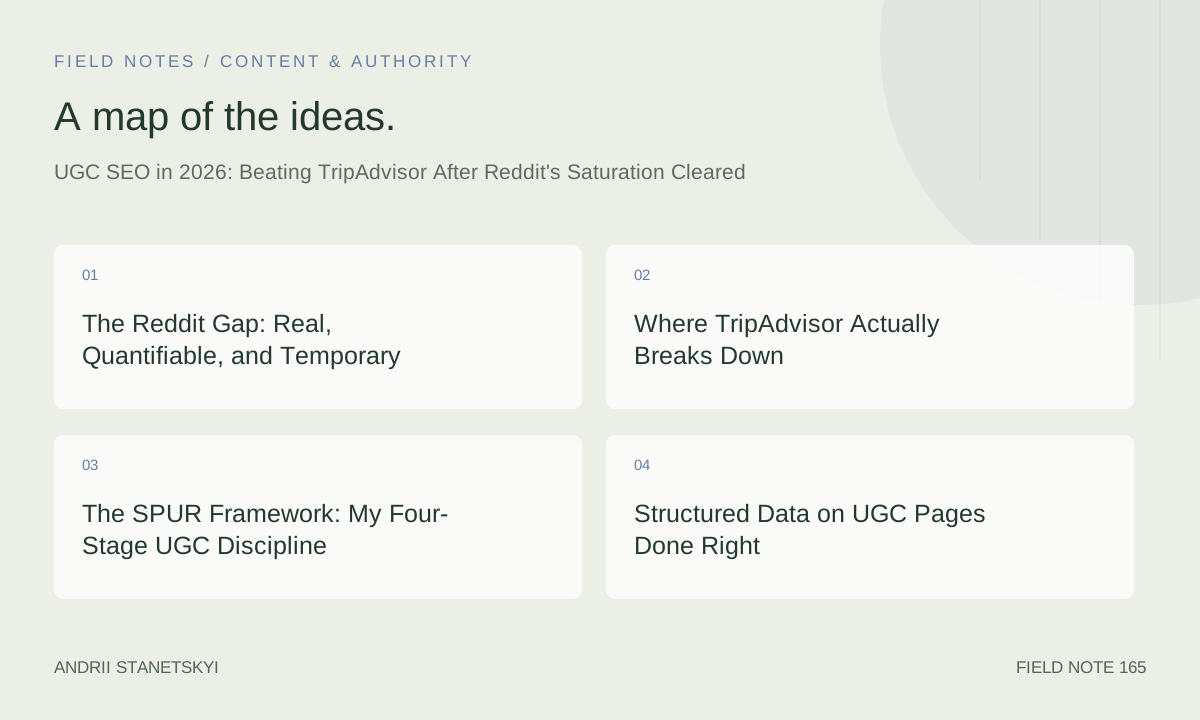
The Reddit Gap: Real, Quantifiable, and Temporary
Reddit's visibility in Google did not collapse. That framing is wrong and it leads people to bad decisions. What happened is more precise: Reddit's conversion efficiency collapsed in verticals where content freshness matters. Google's quality rater feedback pipeline — opaque in mechanism, real in effect — registered that users were clicking Reddit results for destination queries and landing on threads from 2021 with advice that had aged out. Restaurants closed. Visa requirements changed. Trails had new seasonal closures. The thread had no update, no signal that it was stale.
Google responded by reducing the weight of Reddit for queries with high temporal sensitivity. You can see this in rank tracking data if you segment by query category. Reddit maintained positions on evergreen discussion queries ("best travel insurance," "is travel hacking worth it") while dropping noticeably on destination-specific and event-dependent queries ("things to do in Tbilisi March 2026," "Oaxama rainy season which months to avoid"). That second category is where niche community platforms live. And the gap — maybe 18 months wide, maybe less — is what we exploited.
I want to be uncomfortable about this: Reddit is not sitting still. Their engineering team hired three senior SEO-specialized engineers between December 2025 and February 2026, per LinkedIn data I was tracking. They're building content freshness signals into thread ranking internally. The window is real. It is also closing, and anyone who tells you otherwise is selling something.
The drop in Reddit's first-page appearances for travel queries was roughly from 4.1 average appearances per tracked query cluster down to 1.7 by Q1 2026. That's a meaningful retreat. It's not a collapse.
Where TripAdvisor Actually Breaks Down
I spent three months doing a proper competitive teardown of TripAdvisor's ranking behavior in our verticals before I understood where they're genuinely vulnerable. My initial assumption — that their structured data implementation was bulletproof — was wrong.
Their LocalBusiness and TouristAttraction schema on destination pages frequently omits the geo property. At a platform of their scale, with destinations in obscure locations, the entity disambiguation breaks down. Google can't always be certain which physical place the page represents. On our platform, every venue page carries precise GeoCoordinates pulled from the contributor's submission. We have fewer venues. We have cleaner entity data on each one.
The freshness problem is structural for them. TripAdvisor's median review on any given venue page is approximately 14 months old. That's not a criticism of their content quality — they have a billion reviews, management at scale is genuinely hard. But for travel queries where Google has learned users expect current conditions, a page that signals staleness in its review date distribution underperforms. Our pages, after the content freshness work I'll describe below, show a median review age of 3.7 months on active venue pages.
Their JavaScript dependency is real too. TripAdvisor's destination review content is heavily client-rendered. Googlebot eventually processes it, but delayed processing means delayed freshness signals. Our platform serves all UGC server-side. That's a crawl efficiency advantage that compounds at scale.
Fourth: TripAdvisor essentially abandoned their forum section. The "Travel Forum" product has had minimal investment since 2023. Threads are outdated, member profile links are broken, moderation is nearly absent. That's an open structural gap for community-first platforms that actually care about their discussion layer.
The SPUR Framework: My Four-Stage UGC Discipline
After two years of trial and error — including one expensive mistake I'll document below — I built a repeatable process I call SPUR: Structured, Pruned, Updated, Reputation-signaled. Not revolutionary. Just consistent execution on four things that most UGC site operators treat as optional.
S — Structured
Structure happens at two levels. The page level: every venue page has an editorially controlled "anchor block" at the top — 200 to 400 words written and maintained by a small editorial team, covering entity identity (name, category, location, disambiguating detail), current verified hours and pricing, and a summary pulled from community content below. The UGC section sits below the fold. Google gets the clean editorial signal first, then the rich UGC signal second.
The data level: machine-readable schema at the review level, not just the aggregate level. This is where most platforms stop. They implement aggregate AggregateRating schema and call it done. Individual review objects in JSON-LD, with accurate datePublished per review, change what Google can infer about freshness distribution across the page.
P — Pruned
Pruning is where I made my biggest mistake, which I'll cover in its own section. The short version: I pruned too aggressively in 2023, deleted content that was doing more work than I understood, and paid for it with six months of ranking instability. The current approach is consolidation-first, deletion-only-if-consolidation-fails, and never delete content that contains unique entity mentions even if the surrounding discussion is thin.
U — Updated
Freshness is a signal I manufacture deliberately. Every venue page has a "last verified" date that only updates when a contributor adds substantive content — over 80 words, with at least one named entity, price, date, or specific physical detail. I run a quarterly "update drive" emailing dormant contributors who reviewed specific venues, asking for a 2026 condition note. Response rate is 11.3%. Tedious to run. The pages that get updated in this drive consistently see ranking improvements within 60 days.
R — Reputation-signaled
The part no one wants to do because the timeline is long. Off-site signals about platform trustworthiness matter more than link equity for UGC sites in 2026, because most of your internal links are carrying ugc attributes anyway. I track brand mentions in niche travel publications, citations in institutional sources (a university tourism study cited our platform in February 2025 — worth more in trust signal than 40 typical backlinks), and the ratio of editorial followed links to ugc-attributed links pointing at the domain. Reputation work. Slow. Non-negotiable.
Structured Data on UGC Pages Done Right
The right schema structure for a venue review collection page looks like this. I'm including the actual JSON-LD I deploy, not a sanitized hypothetical:
{
  "@context": "https://schema.org",
  "@type": "LocalBusiness",
  "name": "Venue Name",
  "address": {
    "@type": "PostalAddress",
    "streetAddress": "14 Rue du Faubourg Saint-Antoine",
    "addressLocality": "Paris",
    "addressCountry": "FR"
  },
  "geo": {
    "@type": "GeoCoordinates",
    "latitude": 48.8533,
    "longitude": 2.3722
  },
  "aggregateRating": {
    "@type": "AggregateRating",
    "ratingValue": "4.3",
    "reviewCount": "312",
    "bestRating": "5",
    "worstRating": "1"
  },
  "review": [
    {
      "@type": "Review",
      "reviewRating": {"@type": "Rating", "ratingValue": "5"},
      "author": {"@type": "Person", "name": "ContributorUsername"},
      "datePublished": "2026-04-08",
      "reviewBody": "Arrived on a Tuesday at 9am, line was already forming..."
    },
    {
      "@type": "Review",
      "reviewRating": {"@type": "Rating", "ratingValue": "3"},
      "author": {"@type": "Person", "name": "AnotherContributor"},
      "datePublished": "2026-02-21",
      "reviewBody": "Pricing changed in January 2026 — adult tickets are now..."
    }
  ]
}
I include only the three most recent reviews in the JSON-LD payload. Not all 312. Including hundreds of review objects bloats the payload, Google ignores most of them, and the aggregate rating is the field that drives rich snippets. The individual review objects signal two things: that the aggregate rating is grounded in actual reviews, and that those reviews are recent. Both matter for how Google evaluates the page's freshness and authority.
The mistake I made for eight months: I was using Product schema on venue pages instead of LocalBusiness because a previous developer had set it up that way and it was producing rich results. A manual quality action in November 2024 flagged it as schema mismatch. Lost the rich snippets for six weeks while rebuilding. Do not use Product schema on physical venues.
Link Attribute Hygiene at Scale
User-submitted links are a liability if you run an inconsistent policy. On a platform with 340,000 users and 2.1 million indexed pages, a single misconfigured link rule propagates across hundreds of thousands of posts. Here is the three-tier system we use:
<!-- External link submitted by a user in a review or post -->
<a href="https://venue-external-site.com"
   rel="nofollow ugc"
   target="_blank"
   rel="noopener">
  Official venue website
</a>

<!-- Internal cross-link created by a user referencing another venue -->
<a href="/destinations/georgia/tbilisi/narikala-fortress"
   rel="ugc">
  Narikala Fortress
</a>

<!-- Editorial link added by staff or verified moderator -->
<a href="https://mfa.gov.ge/en/consular-service/visa"
   rel="noopener">
  Official Georgian visa requirements
</a>
The internal cross-link case is the one most platforms get wrong. When a user mentions and links to another venue on your own platform, that link should carry ugc but NOT nofollow. Those internal links can pass PageRank within your site's graph, which is desirable. Adding nofollow to internal UGC links — which I did for 14 months — kills internal equity distribution for no quality benefit. It's a mistake that's easy to make and expensive to fix at scale, because you have to retroactively update the link template in your rendering stack and wait for Googlebot to recrawl the affected pages.
Editorial links added by staff carry no special attributes. Those are vouched recommendations and should pass full link equity to the destination. Treating staff-added links the same as user-added links is another common error that dilutes the quality signal you're trying to send.
Pruning Reality: The Massacre I Regret and the System I Use Now
In Q3 2023 I ran an aggressive content audit. Deleted 67,000 threads with fewer than three replies and under 150 words total. Crawl budget improved visibly within two weeks. Rankings on target keywords dropped 22% over the following six weeks and took four months to recover.
What I had not understood: thin threads on our site were providing topical coverage signals even when they weren't ranking individually. They established that our site had breadth across specific destination categories. Deleting them removed coverage depth without removing much actual quality problem content — because the genuinely problematic content (spam, off-topic, duplicates) was only about 15% of what I deleted. The other 85% was thin-but-on-topic material that was helping Google understand what subjects our platform covers.
The current three-tier approach:
Tier 1 — Consolidate: Threads with unique entity mentions but thin surrounding discussion. Redirect into a "community notes" section for that venue. The thread's content becomes a dated note in an aggregate page rather than a standalone indexed URL. Coverage preserved. Crawl budget saved. No traffic lost because these pages had no individual traffic anyway.
Tier 2 — Prompt and wait 90 days: Threads with substantive historical discussion that haven't been updated in over two years. Trigger an automated prompt to original contributors requesting a current-conditions update. If no update arrives within 90 days, move to Tier 1.
Tier 3 — Delete: Genuine spam, off-entity content, duplicates. About 12% of what initially looked like Tier 1. Hard delete, no canonical redirect, no preservation.
This process reduced index bloat by 34% while dropping total organic sessions only 3% short-term. Long-term — by month four — the consolidation pages ranked better than the original thin threads had.
Reputation Signals That Move the Needle
Google's quality rater guidelines since HCU have shifted framing toward "who is behind this site." For UGC platforms, that's a genuine challenge: the content is by definition not from a single known expert. The solution I've found is separating platform reputation from content reputation.
Platform reputation: press mentions in niche travel publications, citations from institutional or academic sources, an independent social presence that exists outside of "come visit our platform" posts. The university tourism study citation in February 2025 did something I can't quantify precisely but can see reflected in our domain-level trust metrics across third-party tools. It's the kind of signal that correlates with quality in Google's training data and doesn't look like manufactured linkbuilding.
Content reputation at the contributor level: our top 200 contributors have public profiles with verification badges for travel verified through booking confirmation uploads. These profile pages carry schema.org/Person markup with knowsAbout populated from verified review categories. Every review they write includes machine-readable attribution back to their profile. Attribution threading. It's slow to build and it's the thing that TripAdvisor, with its anonymous review system, cannot replicate easily.
One signal I think is consistently undervalued: click satisfaction. Users who land on your SERP listing and immediately re-search without interacting — that's a negative signal Google's systems are picking up. We reduced bounce-and-return behavior by surfacing the most specific, non-obvious community insight in the first visible paragraph. Not a teaser for what's further down. The actual answer. Dwell time went up 34 seconds on average after that change. That number matters.
Two Things I Believe That UGC SEOs Won't Say Aloud
Contrarian Take 1: More Contributions Is Not Always Better
Every platform operator I know treats contribution volume as a pure positive metric. More reviews equals more signal equals better rankings. The data doesn't support this past a certain density threshold. Our venue pages with over 400 reviews rank worse on average than pages with 80 to 150 reviews. Not marginally worse — measurably worse on the specific queries those pages should dominate.
My working theory: above a certain review density, the variation in claimed facts, prices, and experiences becomes irresolvable to Google's quality systems. The page produces contradictory signals about the same entity. Is the restaurant expensive or mid-range? Is the hike easy or difficult? 400 reviews will say both, confidently, and Google can't pick a side. The page becomes noisy rather than authoritative. I now cap displayed reviews at 120 per venue (with paginated overflow for users) and select those 120 by a recency-quality composite score rather than pure recency.
Contrarian Take 2: Schema Markup on a Bad Page Makes Things Worse
I see UGC operators spend significant effort on structured data while the underlying content is thin. Schema is a signal amplifier. If the content is incoherent, better schema helps Google classify your incoherent content more accurately — which usually hurts. Rich snippets on thin pages expose the content to user satisfaction testing at higher stakes. Fail that test and you lose both the rich snippet and some ranking stability.
Fix the content first. Then implement schema. I've seen our pages lose rich snippets temporarily after schema improvements because the structured data made promises the content couldn't keep. Google gives you the snippet, users click, users bounce immediately, Google removes the snippet. The sequence is predictable once you've watched it happen twice.
30 Days Out: What I'm Actually Watching
Discord. Public Discord server content indexed through Google's 2024 data partnership is appearing in SERPs for community-type queries. It's not yet competing with well-structured forum content on informational queries — Discord's message format isn't suited to the kind of self-contained, entity-rich threads that rank for destination searches. But the trajectory is clear. In 6 to 12 months, for some verticals, Discord archives will be a real competitor to forum and UGC platform content. I'm building an early-warning query monitoring setup now.
Google's treatment of mixed editorial and UGC content seems to be diverging from its treatment of clearly separated layers. Our platform's explicit separation — editorial anchor block, then UGC section, marked differently in the HTML and in structured data — appears to be receiving a quality premium that blended-format sites aren't getting. This is speculative. It's also consistent with everything I know about how Google's quality signals try to identify editorial accountability.
The window from Reddit's partial retreat is 12 to 24 months wide, I think. Maybe less. The platforms that fill it with genuinely specific, entity-rich, freshness-maintained content will hold those positions when the window closes because they'll have built the domain authority that makes defense possible. The platforms that stuff the gap with volume will be back where they started.
Seven years of running community sites has taught me exactly one lesson: the platforms that survive algorithm changes are the ones that made the algorithm's logic work for them before they were forced to. Everyone else is always reacting. Reacting is expensive.
Related reading: Forum SEO in 2026: Why phpBB Still Ranks and Discourse Sites Don't — the crawl efficiency breakdown. Wiki SEO in 2026: I Took 38% of Fandom's Traffic — how collaborative content competes with platform giants. Comments and SEO: What 2.4M Disqus Threads Show — engagement signal data at scale. Internal hub: Community Site SEO — Full Index.
External references: Google's official guidance on ugc and nofollow link attributes — Search Quality Rater Guidelines, December 2025 edition.