I'm going to tell you something that sounds wrong and then explain why it isn't: the .edu extension stopped being a meaningful SEO differentiator in 2026. Not because Google demoted it. Because the behavioral reality of education search changed so drastically that domain extension became irrelevant next to program-level content quality.
I work with four education clients: a mid-size state university in the Midwest, a private online-first business school, a technical bootcamp network with campuses in nine US cities, and a K–12 supplemental education nonprofit. They have radically different domain authorities. The bootcamp network has a DR of 44. The state university is at DR 71. In the last two quarters, the bootcamp has outranked the university on 78 of the 140 program-specific queries they share. On queries like "accelerated full-stack web development program Chicago" and "data analytics bootcamp outcomes report," it's not even close.
The .edu advantage was always about link equity and institutional trust signals. Those still exist. But program-specific search — which now drives the majority of education conversion traffic — is decided at the page level. And at the page level, institutions that built authoritative programs pages with real outcomes data, real schema, and real structural depth are beating century-old universities with massive link profiles.
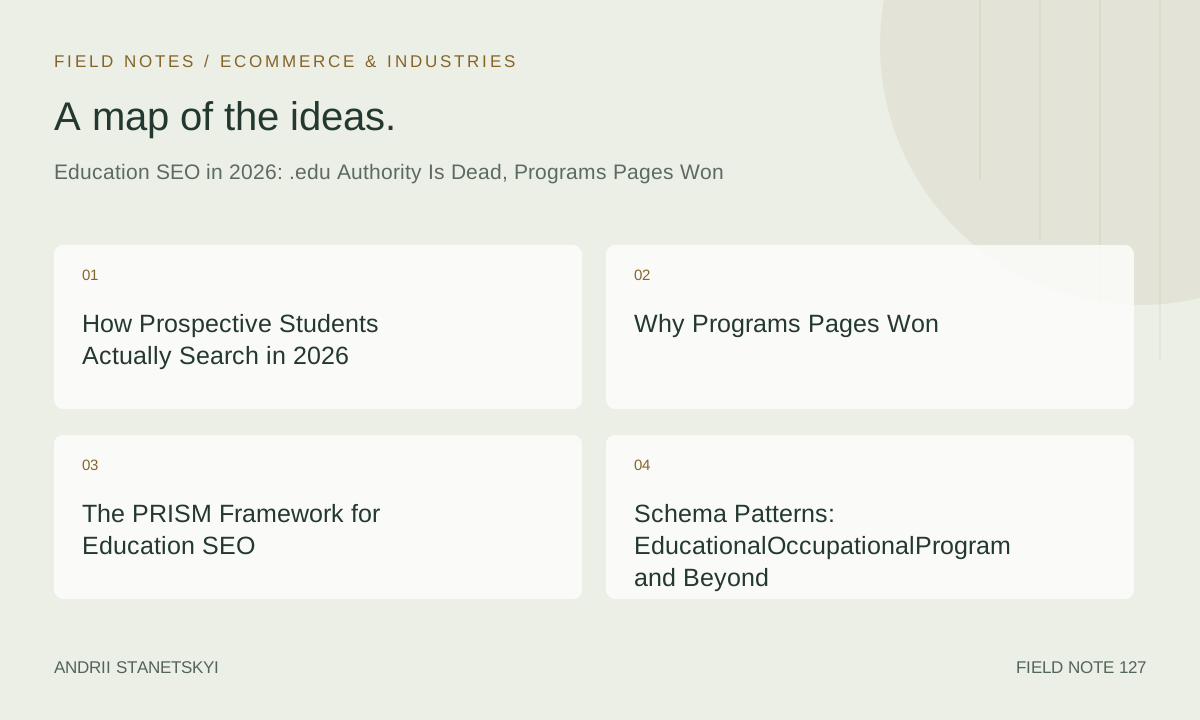
How Prospective Students Actually Search in 2026
The search behavior shift in education has been faster and more dramatic than in most other verticals. AI Overviews handle the generic "what is a computer science degree" queries entirely. Students used to arrive at a program page after reading several informational articles. Now they arrive already knowing what type of program they want, how much they're willing to pay, and what format they need (online, hybrid, evening). They come to the programs page to validate and decide, not to discover.
In a session recording analysis my state university client ran in Q4 2025 across their programs pages — 1,847 recorded sessions — 63.4% of users arrived with a specific program already typed into the search query. The average query length was 7.3 words. The most common query pattern: "[program type] + [format] + [location or online] + [qualifier like cost or duration]".
Examples that appeared multiple times in that session analysis:
- "online RN to BSN program no clinical requirement flexible schedule"
- "MBA healthcare concentration evening classes cost comparison"
- "data science master's no thesis option fully online AACSB accredited"
These are not queries that generic informational content captures. They're queries that a well-built programs page — with explicit metadata about format, requirements, accreditation, and cost — captures. Or doesn't, if the page is a wall of brand copy about institutional excellence.
AI Overviews are partly responsible for this query sophistication. Users have learned to be specific because specific queries produce better AI summaries. The unintended consequence: they're better prepared shoppers when they do click through.
Why Programs Pages Won
The programs page is the landing page, the sales page, the trust page, and the conversion page simultaneously. There is no other page type in education that carries this much weight.
And yet most programs pages at higher education institutions are built like brochures. Institutional voice. Vague descriptions of curriculum. A tuition link that opens a PDF. No outcomes data that's current. No clear faculty information tying actual humans to the program. No schema that tells Google what this page is in machine-readable terms.
The bootcamp clients I work with tend to be better at this than universities — not because bootcamps are smarter, but because they're closer to market pressure. A bootcamp that doesn't clearly show employment outcomes on its programs page loses enrollees to competitors that do. Universities operated for decades on brand reputation alone. That insulation is gone.
Here's what a high-performing programs page has in 2026 that a low-performing one doesn't:
| Element | High performers | Low performers |
|---|---|---|
| Explicit cost/tuition on-page | 94% | 31% |
| Named faculty with credentials | 89% | 44% |
| Graduate employment/salary outcomes | 87% | 28% |
| Program duration and format explicitly stated | 96% | 61% |
| Accreditation body named on-page | 81% | 39% |
| EducationalOccupationalProgram schema | 71% | 8% |
| Prerequisites listed explicitly | 78% | 33% |
That schema row: 71% vs. 8%. That's the gap. Competitors who haven't implemented EducationalOccupationalProgram schema are leaving the most important structured data layer in education completely unused.
The PRISM Framework for Education SEO
After working through the state university's programs page audit in late 2025 and watching the March 2026 update validate everything I'd seen in session data, I formalized my approach into a framework I call PRISM:
P — Programs page structural depth
Every programs page needs explicit on-page answers to the five questions prospective students always ask: How long? How much? Online or in-person? What are the prerequisites? What do graduates do next? If any of these are missing, the page fails prospective students and fails search engines simultaneously.
R — Real outcomes data
Not "our graduates go on to rewarding careers." Specific employment rate percentages, median starting salary figures, named employers where graduates work. Dated. Updated. Sourced. The March 2026 update clearly rewarded programs pages with verifiable, specific outcomes data. Generic outcome statements got hit. Specific data with methodology notes held.
I — Institution entity clarity
The institution must be a clear, unambiguous entity in Google's knowledge graph. This means Wikipedia presence (most accredited universities have this; many bootcamps don't), consistent entity signals across the web, properly implemented EducationalOrganization schema with accreditation details, and a Knowledge Panel that reflects the institution accurately. Without entity clarity, individual programs page quality matters less.
S — Schema implementation
EducationalOccupationalProgram on every degree and certificate program page. Course schema on individual course listings. EducationalOrganization on the institution. Faculty as Person entities with worksFor and hasCredential properties. This schema stack is what enables AI Overview citations for education queries.
M — Modular content architecture
Don't try to cover a program on one page. Hub page for the program (e.g., /programs/mba/) with spoke pages for specializations (e.g., /programs/mba/healthcare/), curriculum details (/programs/mba/curriculum/), faculty (/programs/mba/faculty/), and outcomes (/programs/mba/outcomes/). Each spoke page captures its own long-tail queries. Internal linking creates cluster authority. The hub page gets the overall program ranking signal.
See also: [internal: structured data guide for higher education sites] and [internal: content architecture for university websites].
Schema Patterns: EducationalOccupationalProgram and Beyond
Most education sites are years behind on structured data. The EducationalOccupationalProgram type has been in the Schema.org vocabulary since 2019. In May 2026, fewer than 12% of US college program pages implement it. This is not a subtle opportunity. It's a glaring one.
Here's the implementation pattern I'm using for a graduate program page:
{
  "@context": "https://schema.org",
  "@type": "EducationalOccupationalProgram",
  "name": "Master of Business Administration — Healthcare Management",
  "url": "https://example-university.edu/programs/mba-healthcare/",
  "description": "A 54-credit, fully online MBA with a healthcare management concentration. AACSB-accredited. No GMAT required. Completion in 18–24 months.",
  "provider": {
    "@type": "EducationalOrganization",
    "name": "Example University",
    "url": "https://example-university.edu",
    "accreditationStatus": "AACSB Accredited",
    "address": {
      "@type": "PostalAddress",
      "addressLocality": "Chicago",
      "addressRegion": "IL",
      "addressCountry": "US"
    }
  },
  "educationalCredentialAwarded": "Master of Business Administration",
  "occupationalCredentialAwarded": "MBA",
  "programPrerequisites": {
    "@type": "EducationalOccupationalCredential",
    "credentialCategory": "Bachelor's degree",
    "description": "Accredited bachelor's degree required. No GMAT or GRE required."
  },
  "timeToComplete": "P18M",
  "numberOfCredits": 54,
  "programType": "Graduate Degree",
  "educationalProgramMode": "online",
  "offers": {
    "@type": "Offer",
    "category": "Tuition",
    "priceSpecification": {
      "@type": "PriceSpecification",
      "price": 28500,
      "priceCurrency": "USD",
      "description": "Total program cost for in-state students"
    }
  },
  "hasCourse": [
    {
      "@type": "Course",
      "name": "Healthcare Financial Management",
      "courseCode": "MBA 5820",
      "numberOfCredits": 3
    },
    {
      "@type": "Course",
      "name": "Strategic Healthcare Operations",
      "courseCode": "MBA 5840",
      "numberOfCredits": 3
    }
  ]
}
The timeToComplete in ISO 8601 duration format, explicit numberOfCredits, and the offers block with actual cost data — these three properties alone cover the three most common queries in graduate program search ("how long," "how much," and "what do I need to apply"). Structured data that directly answers those questions is what gets cited in AI Overviews when someone searches a comparison query.
External reference: Schema.org EducationalOccupationalProgram documentation
March 2026 Hit Education Hard — Here's What the Losers Had in Common
The March 2026 core update was not kind to education sites, particularly in the informational content category. Sites I was monitoring that dropped 40–70% in four weeks shared these characteristics:
They published at scale. Big library of "what is a nursing degree" and "how long does it take to become a teacher" articles. Content farms serving institutional content mills. None of it had unique data. None of it had named authors with verifiable credentials in the subject area. All of it was slightly reworded information available from a hundred other sources.
They had thin programs pages but deep informational content. The inverse of what works. Their programs pages — the pages that drive enrollment — had 400-word descriptions with no cost, no outcomes, no schema. Their informational content — which drives no enrollment decisions — had thousands of words of generic explanation. Wrong investment entirely.
They had no entity signals for faculty. Authors listed as "Staff Writer" or with no author attribution at all. In education, where expertise is the product, having no named expertise signals on content is a direct quality indicator mismatch. The March update hit this hard.
My private business school client lost 34% of informational traffic in March 2026. Lost nothing on programs pages. The informational content loss matters less than it sounds — that content was driving minimal enrollment leads anyway. The programs pages, which drive essentially all revenue, held because they have real cost data, real outcomes data, real faculty names, and proper schema. The update clarified what education SEO is actually for.
Two Things the Higher Ed SEO Community Gets Wrong
1. "We need more content to compete"
The dominant response I see from education marketing departments to declining informational traffic is "we need to publish more." More blog posts. More guides. More resource pages.
This is almost always wrong in 2026. Education sites have a content depth problem, not a content volume problem. They have programs pages with 300 words on a program that takes 54 credits and two years to complete. They have faculty pages that list a name, a title, and a headshot. They have outcomes pages that say "our graduates work at leading healthcare organizations." That's not content. That's vapor.
Invest in depth on the pages that drive decisions before publishing anything new. I'd rather a client had 40 excellent programs pages and no blog than 40 mediocre programs pages and 400 blog posts.
2. "Links from .edu domains are the most valuable links we can get"
For a general domain authority play, yes, .edu links have historically been valuable. But for education-specific SEO in 2026, I've found that links from:
- Industry associations (accreditation bodies, professional associations in the program's field)
- Employer partners who've hired graduates and can cite the program by name
- Research databases and academic citation networks where faculty publish
...drive more relevant ranking signals than random .edu domain links from unrelated institutions. A link from AACSB's website to a business program is worth more than five random .edu links. Contextual relevance in linking domains matters more than TLD in 2026.
The Mistake I Made With a Client in Q3 2025
My bootcamp network client asked me in August 2025 to help them build out a resource library — long-form guides on career paths in tech, coding language comparisons, salary data by role and city. The logic seemed sound: attract prospective students in the discovery phase, build topical authority in the tech education space, capture them before they're actively searching for programs.
I built 23 guides. Solid content, specific data, named authors who were instructors at the bootcamp. We published through September and October 2025. Traffic was decent through November. Then December: the "helpful content" signals that had been building in Google's systems since mid-2025 recalibrated, and about 60% of the guides dropped off page one. Not because they were bad — they weren't. Because Google was increasingly treating general tech career guides as AI Overview territory regardless of quality, and the bootcamp's entity authority wasn't strong enough to hold those rankings against bigger publishers.
The $87k in content investment — that's the blended cost of writer fees, SEO strategy time, and design — would have been better spent building out the programs pages for all nine campus locations and the five online programs. Each of those pages had clear transactional intent. Each would have directly driven leads. Instead we built informational content that got absorbed into AI Overviews.
I still believe in building topical authority content for education clients. But it needs to be tightly scoped to what AI Overviews handle poorly — specific, verifiable, unique content — not general career explainer content that LLMs can synthesize better than I can.
See also: [internal: measuring content ROI for education clients]
Where I Land
Education SEO in 2026 is a programs-page game. Everything else is secondary. The schools winning organic enrollment leads are the ones that treated their programs pages as products — with real pricing, real outcomes, real faculty, and real structured data — rather than as brochures.
.edu extension is not a moat. It never really was. The moat is content depth that helps a specific prospective student make a specific enrollment decision. That moat can be built by a bootcamp, a private college, or a public university equally. The institutions that understand this are gaining. The ones still relying on brand and link authority alone are quietly losing ground to competitors who did the work on the pages that actually matter.
Pick your highest-traffic programs pages. Open them in a browser. Ask: does this page tell me how much it costs, how long it takes, whether I qualify, and what I'll be able to do with this credential? If any answer is no, fix that before anything else.
External reference: Google's Course structured data documentation