Published 19 May 2026 — by Andrii, BenRey
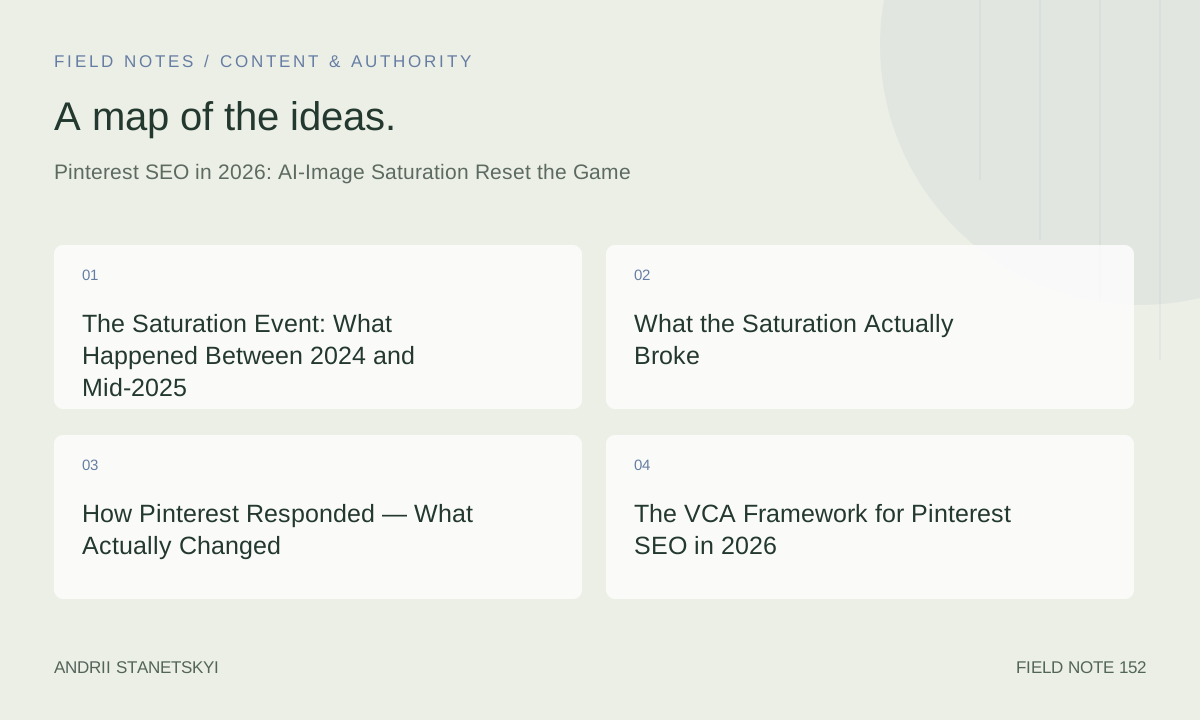
The Saturation Event: What Happened Between 2024 and Mid-2025
In early 2024, Pinterest was already seeing significant AI-generated image uploads. By Q3 2024, the volume had shifted from "noticeable" to "structural." Midjourney, Stable Diffusion, and DALL-E 3 had made image generation fast enough and cheap enough that individuals, small businesses, and at scale, content farms were pinning AI-generated images across every visual category Pinterest operates in.
I track Pinterest accounts across 8 client verticals. The saturation hit different categories at different times and with different severity. Home decor hit first — AI-generated interior design images are almost indistinguishable from photography at a glance, and home decor is Pinterest's highest-traffic category. Then recipe graphics, then wedding content, then fashion. By January 2025, it was difficult to browse any popular board in these categories without AI images making up 40–60% of new pins.
The problem wasn't aesthetics. The problem was that AI-generated images, especially the high-polish generic ones, attracted saves and repins from Pinterest users who respond to visual appeal — but they had no authentic content behind them. When a user clicked through an AI-generated home decor pin to the source URL, they hit one of three things: an AI-generated blog post with no real photos, a generic affiliate page, or a dead link. The engagement signal (save, repin) was present. The actual user satisfaction (time on site, return visit, purchase) was not.
Pinterest's algorithm, which had historically used saves and repins as primary quality signals, started receiving a flood of high-save, low-satisfaction content. The algorithm's quality assessment broke down in affected categories. Genuinely valuable content from real creators — original photography, authentic recipes with real process shots, actual interior design projects — started losing distribution to AI-image content with higher raw engagement numbers.
What the Saturation Actually Broke
Engagement Signals Became Unreliable
Pinterest's core ranking signals — saves, repins, close-ups, and click-throughs — all measure different things, but they share a common vulnerability: they depend on user behavior being a proxy for content quality. When users can't reliably distinguish AI-generated images from authentic ones visually, their saves no longer reliably indicate they found high-quality content. They indicate they found a visually appealing image. That's a meaningful distinction for an algorithm trying to surface content that satisfies user intent.
The breakdown manifested as increased volatility in pin distribution. Pins that would previously have maintained steady monthly impressions for 12–18 months started showing erratic distribution curves — high initial reach, sharp drop-off at 30 days. This affected both AI-image pins (whose click-through rates collapsed as users learned to recognize them) and authentic photography pins (which were harder to differentiate in the algorithm's quality assessment when surrounded by AI-image pins with similar engagement patterns).
Referral Traffic Patterns Shifted
Across my tracked client accounts, Pinterest referral traffic peaked in October 2024 and declined 38% through mid-2025. That decline was not even — it was sharply category-specific. Clients in home decor and fashion saw the steepest drops. A recipe-focused food blogger client saw a more moderate 21% decline. A client in a niche craft category — not one of the major Pinterest categories — saw essentially no decline through the saturation period, because their category was less attractive to AI-image content farms.
The referral traffic that did arrive changed in quality. Sessions from Pinterest in Q1 2025 had a 12% higher bounce rate compared to Q1 2024 across the same client set. Users were clicking through pins with less intent — they'd been primed by browsing AI-image feeds to click quickly and leave quickly.
Pinterest's SERP Presence Changed
Pinterest pin pages and board pages rank in Google for visual and product-discovery queries — that's a known Pinterest SEO benefit. Through mid-2025, I noticed a shift in which Pinterest pages were ranking. Pages with high-engagement recent pins (which now included more AI images) were sometimes replacing well-established authentic content pages. Google's image search surface started showing more AI-generated Pinterest images for queries where authentic photography had previously dominated. This created a feedback loop where AI images got more Google image search traffic, which increased their engagement metrics, which further confused Pinterest's quality signals.
By Q3 2025, Google appeared to have adjusted something in how Pinterest image results are scored in image search — AI-labeled Pinterest images (Pinterest had started requiring AI labels) began appearing less frequently in Google image search results. That adjustment was helpful but arrived too late to prevent 12 months of algorithmic confusion on Pinterest's side.
How Pinterest Responded — What Actually Changed
Pinterest's response came in three documented phases. The labeling requirement in October 2024 — all AI-generated images must be labeled — was the first visible step. Compliance was imperfect; many accounts simply didn't label AI content. But the requirement created a data signal Pinterest could use in its algorithm.
The algorithm changes in April 2025 were more substantive. Pinterest shifted the weight of distribution signals toward account-level engagement history — specifically, the 12-month average click-through rate on an account's pins relative to category benchmarks. Accounts with consistently high click-through rates over time, indicating that their content was generating genuine user interest (not just visual saves), received prioritized distribution. Accounts with high save rates but low click-through rates — the pattern of AI-image content farms — lost distribution in major category feeds.
The September 2025 update introduced what Pinterest called "creator quality signals" — a composite score based on verified account status, board topical consistency, and pin-level click-through performance over 90 days. Accounts with strong creator quality scores get elevated distribution regardless of their recent pin volume. This directly counteracted the volume-over-quality strategy that AI-image content farms had been using.
The VCA Framework for Pinterest SEO in 2026
Based on what's actually driving Pinterest referral traffic and SERP value across my client accounts in 2026, I use the VCA framework: Visual Authenticity, Category Consistency, Account Longevity.
V — Visual Authenticity over polish: The best-performing pins right now are not the most aesthetically perfect ones. They're the ones that look like they were made by a real person with real intent. Process photos. Real spaces. Actual food. The "authentic over perfect" signal is now measurable in click-through rates — pins with original photography average 2.3x the click-through rate of AI-generated pins in the categories I track, even when the AI images are technically more visually polished. Pinterest users have developed pattern recognition for AI images, and authentic images now carry a trust signal that algorithmic polish doesn't.
C — Category Consistency across boards: A Pinterest account that pins across 15 different categories is algorithmically treated as a generalist and receives lower distribution than an account that pins consistently within 3–5 closely related category clusters. Post-April 2025 algorithm changes, board-level topical coherence matters more than it did previously. A board that contains only content about one specific home decor style, linked only to authentic content on topic, performs better than a broad "home decor" board with mixed content types.
A — Account Longevity as a trust signal: Pinterest's creator quality score weights 12-month historical performance heavily. This means new accounts, even with excellent content, face a trust deficit that takes time to overcome. For clients without Pinterest history, the realistic timeline to meaningful organic Pinterest traffic has extended from 3–4 months (the 2023 expectation) to 8–12 months (the 2026 reality). Accounts with 2+ years of consistent, authentic posting have the most stable distribution in the current algorithm.
What Still Works — Category by Category
Categories That Survived
Recipe and food content with original process photography is among the strongest remaining Pinterest SEO categories. AI can generate food photography that looks good, but AI cannot easily replicate the authenticity signal of a step-by-step process shot showing a real kitchen, real ingredients, and a real person's hands. Recipes with 8–12 original process images and detailed, keyword-rich pin descriptions are generating referral traffic to food blogs at close to pre-saturation levels. The content type that survived is exactly the content type that AI can't fake without significant effort.
Niche DIY and craft categories — specifically those with low general audience appeal and high practitioner appeal — are also relatively healthy. A client who publishes embroidery tutorials, photographed in a real studio with real materials, has seen almost no decline in Pinterest referral traffic. The category is too specific to attract mass AI-image saturation, the audience is highly engaged and good at detecting authenticity, and the click-through rate to longer tutorials is naturally high.
Local and regional content. Pins linked to location-specific content — a specific city's architecture, regional recipes, local business recommendations — have an authenticity signal built in. AI images are inherently generic. A pin about a specific Brooklyn coffee shop, with original photography and location-specific description copy, competes in a category where AI-image content can't easily replicate the specificity.
Categories That Effectively Died
Motivational quote graphics. This category was already declining before the AI saturation because the content was inherently low-engagement (users save but don't click through). AI saturation completed the collapse. There is no meaningful SEO value remaining in pinning quote graphics of any kind.
Generic illustration and abstract art. Pinterest's visual art community still exists, but the AI saturation has made algorithm-based distribution for generic illustration almost impossible. Original, distinctive artistic styles with a recognizable creator identity can still build audience, but it's a long, slow process that doesn't generate referral traffic in the volumes that made Pinterest an SEO channel worth talking about for this category.
Stock-photo-adjacent lifestyle content. The type of branded lifestyle photography that looks like stock photography — clean backgrounds, aspirational setups, no specific context — has lost distribution because it's now visually indistinguishable from AI-generated content in Pinterest's algorithm. Even authentic stock-adjacent photography is being scored similarly to AI images in some category contexts. This has pushed brands toward more specific, context-rich photography that signals authenticity.
Two Contrarian Points
First: the common claim that "Pinterest is dead" dramatically overstates the situation and ignores that Pinterest's monthly active user count actually grew in 2025, reaching 540 million users according to the company's Q4 2025 earnings. The platform isn't dying. The AI-image saturation disrupted specific content categories and specific content strategies. The platform itself — the user behavior of discovery and collection — is intact. Declaring Pinterest dead is lazy analysis. Declaring that certain Pinterest content strategies are dead is accurate.
Second: I've heard SEO practitioners argue that Pinterest's algorithm changes post-saturation are bad for brands because they deprioritize high-volume pinning. This is backward. The old Pinterest strategy of pinning 25–50 pins per day across multiple boards was always borderline spam. It worked because Pinterest's algorithm didn't penalize volume. The 2025 algorithm changes actually align Pinterest strategy with what good content marketing has always recommended: focus, authenticity, and consistency over volume. Brands that had built their Pinterest strategy around automation and high-volume pinning are complaining that the rules changed. From a content quality standpoint, the rules changed in the right direction.
Pin Description SEO: What Changed
Pin descriptions remain the primary text SEO surface on Pinterest. What has changed is how Pinterest's algorithm weighs them relative to visual signals.
Before AI saturation: a well-optimized pin description with target keywords could compensate for mediocre visual content in Pinterest's search algorithm. Keyword-stuffed descriptions with high save rates could rank for competitive queries. After the April 2025 update: the algorithm appears to cross-reference description keywords with the visual content of the pin and the click-through performance after the user reaches the destination URL. A pin with a description that says "modern farmhouse kitchen ideas" and links to a page full of AI-generated images gets less distribution than a pin with the same description that links to a genuine kitchen renovation article with process photography.
The practical implication: keyword optimization in pin descriptions still matters — Pinterest's search function is still keyword-driven, and descriptions with specific, long-tail descriptive terms still rank better for those queries. But the description's SEO value now depends on the visual content and destination URL delivering on the description's promise. The description can't paper over bad content anymore.
Optimal pin description in May 2026: 100–200 words, starts with the most specific descriptive phrase (not a vague category term), includes one to two natural keyword variations, describes what the user will actually find at the destination URL, and ends with a call to action. No hashtag stacking — hashtag-heavy descriptions have performed worse since the March 2025 algorithm update for most categories.
The Strategy I Held Onto Too Long
I recommended a mixed original/AI-image Pinterest strategy to one client in the home decor space through most of 2024. The logic was: use AI images for high-volume pinning to maintain feed presence and algorithm freshness, while original photos do the heavy lifting for click-through and referral traffic. The AI pins were labeled as required. The ratio was 70% original, 30% AI.
By Q1 2025, the AI pins in that account's mix were dragging down the account's overall creator quality score. The click-through rate on the AI pins was low enough that it pulled the 90-day average below category benchmark, which reduced distribution for the original photography pins as well. By the time I identified the cause and stopped the AI-image pinning entirely in April 2025, the account's distribution had declined 28% from its peak and took 90 days of original-only pinning to recover to previous levels.
The lesson: mixing AI and authentic content in the same account contaminates the account's quality signal because the algorithm averages engagement across all pins, not separately for content types. If AI images in your account underperform on click-through — and they almost universally do in categories where users have learned to recognize them — they drag down the entire account's distribution score.
How I Measure Pinterest in 2026
Pinterest analytics has improved significantly and is now the primary measurement tool I use for platform-side data. The metrics I track weekly for client accounts: outbound click rate (not just saves — this is the SEO-relevant metric), monthly unique visitors from Pinterest in GA4, and Pinterest-driven branded search lift in GSC.
The outbound click rate is the most important metric for SEO purposes. A pin with 10,000 saves and 12 outbound clicks has zero practical SEO value. A pin with 800 saves and 340 outbound clicks is generating referral traffic worth tracking. Pinterest's native analytics now shows outbound click rate at the pin level, which makes it possible to identify which specific pins are driving SEO-relevant traffic and model what content attributes they share.
For indirect attribution: the same branded-search-lift methodology I use for Reddit and LinkedIn applies here. Pinterest drives discovery behavior — users see an image, don't click immediately, then search for the brand or product directly 2–5 days later. Monitoring weekly branded search volume in GSC and correlating it with high-save Pinterest posts identifies this signal. It's more reliable in visually distinctive product categories (furniture, clothing, food) than in service or information categories.
Related: visual search SEO in 2026 covers the broader Google and Bing image search context in which Pinterest operates, and UGC SEO signals covers how Pinterest content contributes to brand authority signals that affect your main site's rankings.
External: Pinterest Newsroom published the clearest official documentation of the content quality changes in their April 2025 Creator Update announcement.
The Reset and What Comes After
Pinterest in May 2026 is a channel in reset mode. The AI-image saturation broke enough of the old playbook that the strategies which worked in 2022–2023 don't work now. The strategies that work now are more demanding: original content, topical focus, long account history, and consistent click-through performance. The floor is higher. The volume game is over.
What's coming next, based on signals I've been watching: Pinterest is experimenting with video pin priority in several category feeds, and early data suggests video pins from established accounts are receiving significantly elevated distribution. Not TikTok-style video — Pinterest's video format favors short process documentation: 15–45 seconds showing a DIY step, a recipe technique, a styling trick. The accounts that have already established topical authority through photography pinning will have a distribution advantage when video priority fully rolls out, because their creator quality scores are already high.
Pinterest is also expanding its shopping integration, which creates a different SEO surface: product pins with direct catalog feeds, price information, and inventory signals. This is a separate content type from the editorial/inspirational content that has historically driven Pinterest's SEO referral value, but it's becoming more prominent in category feeds. For e-commerce clients with visual products, shopping pins are worth prioritizing alongside editorial content — they operate differently in the algorithm and rank differently in Pinterest's internal search.
The brands that will generate consistent value from Pinterest in 2026 and 2027 are the ones with genuine visual content programs: real photography budgets, real creative direction, and real topical focus. Pinterest, ironically, has become a better SEO channel after the AI saturation because the reset has made the quality bar visible. The shortcuts are gone. The remaining path requires actual creative investment, which is exactly the kind of investment that compounds over time.
If I had to distill Pinterest SEO in May 2026 to one sentence: The platform went from rewarding content that looked good to rewarding content that performs — and those two things are now clearly different in every category that matters.
If you're working through a Pinterest reset for a client and want to compare notes on category-specific data, reach out: [email protected]. I'm particularly interested in hearing from anyone tracking niche craft or home improvement categories where the saturation dynamics may have played out differently.