Faceted navigation generates more SEO problems per feature launch than almost anything else in e-commerce architecture. A single mid-size product catalog with 8 filter dimensions can mathematically produce millions of URL combinations — most of them thin, duplicate, or completely unindexable by design. The practitioners who handle faceted navigation well do so not by applying blanket rules, but by building decision frameworks that distinguish indexable value from crawl waste, and implementing controls precise enough to act on that distinction at scale.
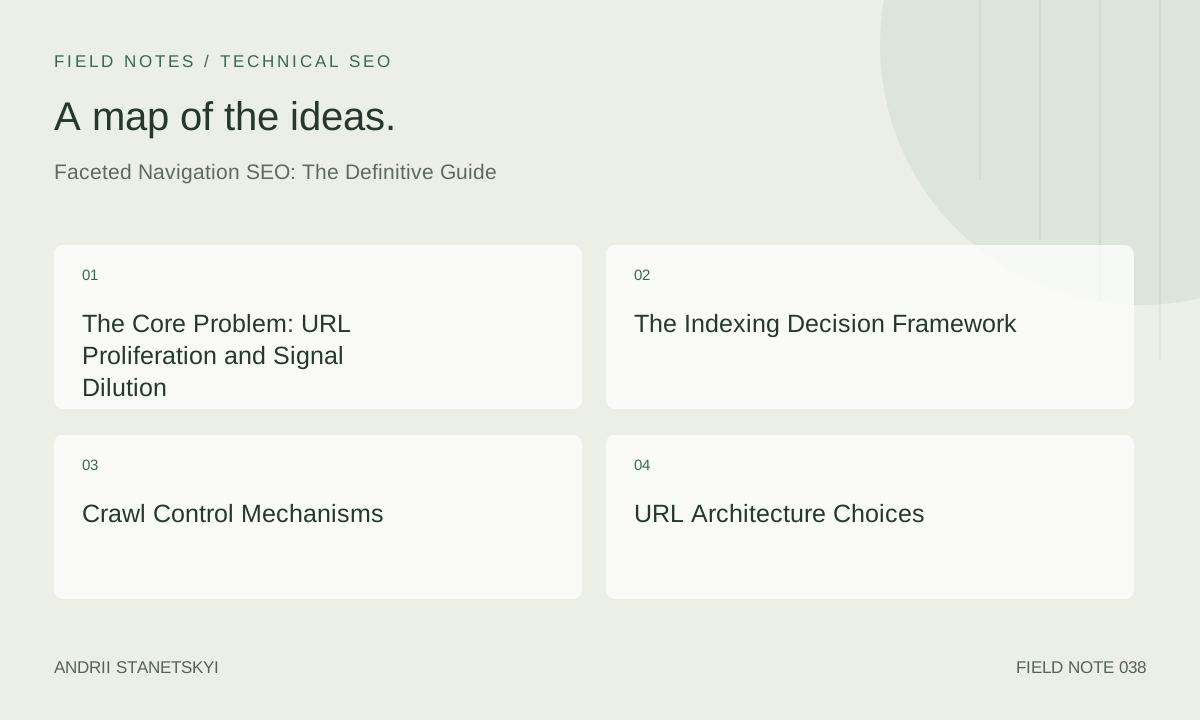
The Core Problem: URL Proliferation and Signal Dilution
Consider a clothing retailer with 5,000 products, organized into categories with these filter dimensions: color (12 values), size (8 values), brand (40 values), material (6 values), price range (5 buckets), occasion (7 values), and rating (4 values). The combinatorial space is 12 × 8 × 40 × 6 × 5 × 7 × 4 = approximately 32 million possible URLs. Even with filters applied one at a time, you're looking at 82 single-filter combinations, and crawlers will find them all if you let them.
The damage this does:
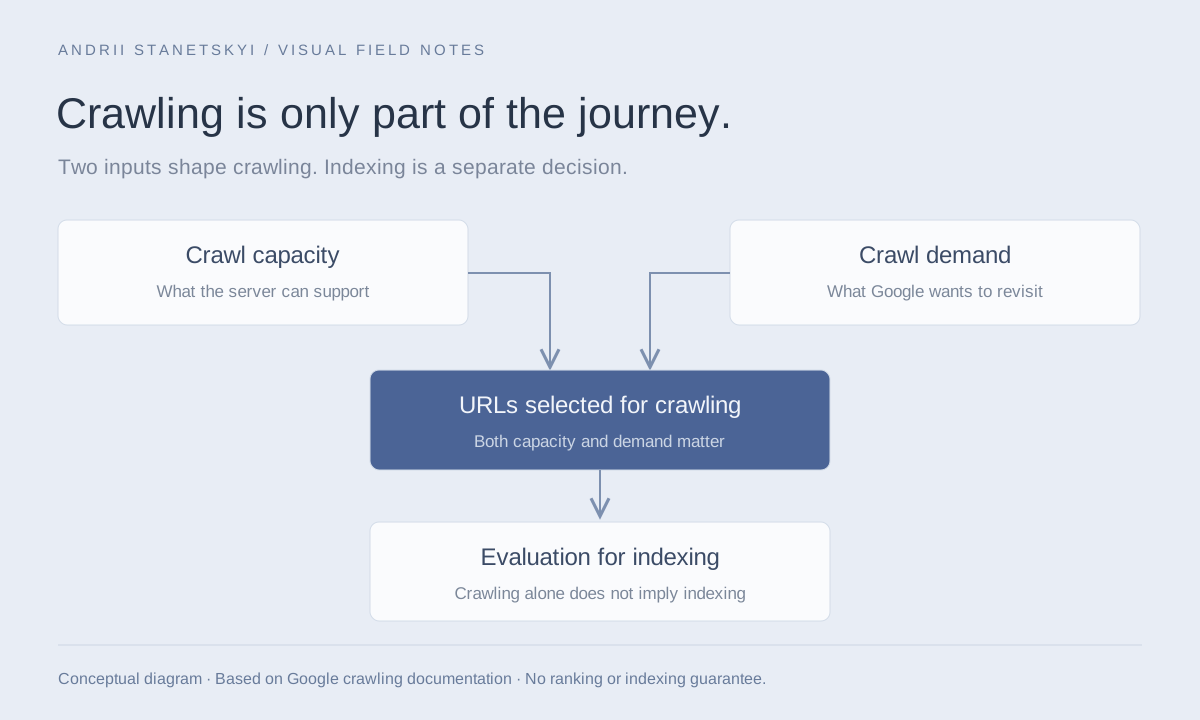
- Crawl budget exhaustion: Googlebot's crawl allocation for your domain is finite. Millions of near-duplicate faceted URLs crowd out your canonical category pages, product pages, and content.
- PageRank dilution: Internal links from category pages to filter combinations fragment link equity across thousands of thin pages.
- Duplicate content penalties: Faceted pages with minimal content differentiation compete with canonical categories in Google's deduplication process.
- Index bloat: Even if individual faceted pages don't rank, a swollen index can slow Googlebot's quality assessment of your site overall.
The Indexing Decision Framework
Every filter combination falls into one of three buckets:
Bucket 1: Index and Optimize
Filter combinations with measurable organic search demand, sufficient unique content (typically 15+ products), and a URL that represents a stable, reachable concept. Examples: "women's red running shoes," "waterproof hiking boots under $100," "iPhone 15 cases."
Identification method: pull filter dimension values into keyword research tools. Any combination with >100 monthly searches and products available warrants indexing consideration.
Bucket 2: Allow Crawl, Block Index
Filter combinations that are legitimate user journeys but have insufficient content uniqueness or too few products to merit a separate indexed page. Allow Googlebot to crawl them (so it can discover linked products), but block indexing with noindex.
Bucket 3: Block Crawl Entirely
Filter combinations that are purely navigational artifacts with no search demand, reverse-sorted permutations of existing combinations, multi-filter combinations beyond 2–3 dimensions, and price/rating filters with no topical uniqueness.
| Filter Type | Search Demand Typical | Recommendation | Implementation |
|---|---|---|---|
| Color alone (e.g., "red dresses") | High | Index | Clean URL + canonical + sitemap |
| Brand alone (e.g., "Nike trainers") | High | Index | Clean URL + canonical + sitemap |
| Size alone (e.g., "size 12 shoes") | Low-Medium | Noindex or block | robots.txt Disallow or noindex meta |
| Price range alone | Low | Block crawl | robots.txt Disallow |
| Sort order (price asc/desc) | None | Block crawl | robots.txt Disallow |
| Color + Brand (e.g., "red Nike trainers") | Medium | Case by case | Research-driven decision |
| 3+ filters combined | Very low | Block crawl | robots.txt Disallow |
| Rating filter | None | Block crawl | robots.txt Disallow |
Crawl Control Mechanisms
robots.txt for Parameter-Based Facets
User-agent: *

# Block sort, rating, and multi-value parameters
Disallow: /*?sort=
Disallow: /*?rating=
Disallow: /*&sort=
Disallow: /*&rating=
Disallow: /*?price=

# Block URL parameters used for session/tracking
Disallow: /*?ref=
Disallow: /*?utm_
Disallow: /*?sessionid=

# Allow specific high-value filter patterns
Allow: /womens-shoes?color=
Allow: /mens-jackets?brand=

User-agent: Googlebot
# More specific Googlebot rules if needed
Disallow: /search?
Critical caveat: robots.txt wildcards use a limited pattern syntax. Google's Googlebot supports * and $ wildcards in Disallow/Allow. Bing's Bingbot also supports these. Test your rules with Google's robots.txt Tester in GSC.
robots.txt for Path-Based Facets
Some architectures generate faceted URLs as paths rather than parameters:
User-agent: *
# Block faceted paths beyond one filter dimension
Disallow: /c/*/brand/*/color/
Disallow: /c/*/size/*/brand/
Disallow: /c/*/price/

# Allow single-dimension facets selectively
Allow: /c/shoes/brand/
Allow: /c/shoes/color/
noindex for Crawlable-but-Non-Indexable Facets
<!-- On faceted pages in Bucket 2 -->
<meta name="robots" content="noindex, follow" />
The follow is deliberate. You want Googlebot to follow links on these pages to discover and crawl product pages — you just don't want the faceted page itself indexed. noindex, nofollow would also block product page discovery from that URL.
Note: noindex requires Googlebot to crawl the page to read the directive. It does not save crawl budget on first encounter. For true crawl budget conservation, robots.txt Disallow is the only mechanism. Use noindex for pages that have some crawl value (product link discovery) but no index value.
Combining Both Controls
Never put noindex on a page also blocked by robots.txt. Googlebot won't fetch the robots.txt-blocked page, so it can't read the noindex — but more importantly, this creates a logical conflict. If you don't want it crawled, robots.txt is sufficient. If you want it crawled but not indexed, use noindex only.
URL Architecture Choices
Query String Parameters
https://example.com/shoes?color=red&brand=nike
Easiest to implement; naturally separate from clean URLs. Easy to block with robots.txt parameter rules. The downside: parameter order creates duplicate URLs (?color=red&brand=nike vs ?brand=nike&color=red). Your application must normalize parameter order and 301 the non-canonical order to the canonical order.
Path-Based Facets
https://example.com/shoes/color/red/brand/nike/
Cleaner aesthetically; robots.txt path blocking is more precise. The combinatorial duplicate problem is worse: path order creates even more permutations. You need URL normalization that canonicalizes all orderings to a single canonical path and robots.txt rules for every undesirable pattern.
Hybrid: Static Pages for High-Value, Dynamic for the Rest
The best architectural pattern for large e-commerce sites: pre-generate static pages for known high-value filter combinations (those in Bucket 1), and serve everything else dynamically with noindex or robots.txt blocking. The static pages can have custom titles, descriptions, and content blocks that the dynamic pages lack — making them genuinely more indexable.
<!-- Statically generated high-value page -->
<!-- /womens-red-running-shoes -->
<h1>Women's Red Running Shoes</h1>
<p>Shop our collection of 47 women's red running shoes...</p>
<link rel="canonical" href="https://example.com/womens-red-running-shoes" />

<!-- Dynamic faceted page blocked from index -->
<!-- /shoes?color=red&gender=womens&type=running -->
<meta name="robots" content="noindex, follow" />
<link rel="canonical" href="https://example.com/womens-red-running-shoes" />
Canonical Strategy for Faceted Pages
Canonicalization for faceted pages is nuanced. Three scenarios:
Scenario A: Faceted URL has no canonical equivalent
The faceted combination doesn't have a clean static URL. Canonical should point to the base category:
<!-- On /shoes?color=red&size=9&sort=price-asc -->
<link rel="canonical" href="https://example.com/shoes" />
Scenario B: Faceted URL is a high-value page you want indexed
Self-canonical. Add the canonical to the sitemap. Write unique content for the page.
<!-- On /womens-red-running-shoes (static high-value page) -->
<link rel="canonical" href="https://example.com/womens-red-running-shoes" />
Scenario C: Multiple parameter orderings of the same combination
All permutations canonicalize to one canonical order, AND that canonical is 301-redirected to from all others:
<!-- /shoes?brand=nike&color=red and /shoes?color=red&brand=nike both: -->
<link rel="canonical" href="https://example.com/shoes?brand=nike&color=red" />
<!-- Plus server-side 301 for non-canonical ordering -->
Targeting High-Value Filter Combinations
The methodology for identifying which faceted pages deserve indexing:
Step 1: Extract Filter Dimensions and Values
Pull your complete filter taxonomy from the database or via Screaming Frog crawl. Map to a spreadsheet: dimension, value, URL parameter, number of matching products.
Step 2: Keyword Research per Dimension
For each filter value, generate search queries: "[category] [filter value]" and "[filter value] [category]". Pull volume data from GSC, Ahrefs, or Semrush. Focus on queries with 100+ monthly searches and commercial intent.
Step 3: Competition Analysis
For top candidates, SERP analysis: are competitors ranking category pages or faceted pages for these queries? If Google is already ranking faceted pages from competitor sites, that's a strong signal that page type works for the query.
Step 4: Content Differentiation Plan
High-value faceted pages need more than a filter applied — they need a unique H1, unique meta title/description, a short introductory paragraph, and enough products (15+) to constitute a genuine collection. Without this, Google sees thin content even on a page with real search demand.
<!-- High-value faceted page template -->
<h1>Women's Nike Running Shoes</h1>
<p class="category-intro">
  Shop [X] women's Nike running shoes, including the Pegasus, React Infinity,
  and Air Zoom series. Free delivery on orders over £50.
</p>
<!-- Product grid follows -->
Step 5: Internal Linking Structure
High-value faceted pages must receive internal links from category pages, hub pages, and where relevant, blog content. A page with no internal links, even with a self-canonical, will be deprioritized for crawl and may be excluded from the index as low-value. Internal linking architecture for e-commerce is a prerequisite for faceted page indexing to work.
Diagnostic Workflow
Crawl Waste Assessment
# Identify how many URLs Googlebot is crawling that are faceted
grep "Googlebot" access.log | \
  grep -E "\?.*=" | \
  awk '{print $7}' | \
  grep -oP '\?[^"]+' | \
  sort | uniq -c | sort -rn | head -50
If Googlebot is spending >30% of its crawl budget on parameterized URLs, you have a crawl budget problem that faceted navigation controls need to address.
Index Bloat Check
# Use site: operator as rough indicator
# site:example.com/category — check result count
# Compare to known product count; large discrepancy = index bloat
In GSC: Coverage → Indexed — count total indexed URLs. Compare against your intended indexable URL set (products + categories + content). Any significant surplus is likely faceted pages Google has indexed despite your intent.
Screaming Frog + OnCrawl for Faceted URL Mapping
Configure Screaming Frog to crawl JavaScript-rendered pages (if your faceted navigation is JS-driven). In Configuration → URL Rewriting → Custom, flag URLs matching faceted patterns. Export to a spreadsheet and bucket into the three indexing categories based on your keyword research data.
OnCrawl's segmentation feature lets you define URL segments matching faceted patterns and track their crawl frequency, index status, and traffic contribution over time — essential for measuring whether your controls are working. See our OnCrawl workflow guide for setup details.
Botify Faceted Navigation Audit
Botify's URL structure analysis can identify parameter patterns automatically across large crawls. Use the "Top Parameters" report to see which parameters generate the most URL variants, then cross-reference against GSC click data to identify any faceted URLs actually driving traffic (ones you might be incorrectly blocking).
FAQ
Should I use JavaScript to generate faceted URLs so Googlebot can't crawl them?
No. Google crawls JavaScript-rendered content with Chromium-based rendering, typically on a second pass. JS-rendered faceted URLs will eventually be discovered and crawled. The latency between crawl and render also means you're burning rendering budget rather than saving crawl budget. Use server-side robots.txt controls or noindex meta tags — they're reliable, immediate, and don't depend on Google's rendering queue.
Can I use the URL Parameters tool in GSC to block faceted crawling?
The GSC URL Parameters tool was deprecated. Google's current guidance is to use robots.txt, noindex, or canonical tags. Do not rely on the legacy Parameters tool for crawl control — it was unreliable and is no longer actively supported.
What if my faceted pages are generating a significant amount of long-tail traffic?
Don't block them. Pull a GSC Performance report filtered by URL pattern for faceted pages. Any faceted URL generating >10 clicks/month should be audited individually before adding any blocking. The decision framework should always start with data — blanket blocking is how you lose traffic you didn't know you had.
How do I handle infinite scroll vs. paginated faceted results?
Infinite scroll that doesn't generate unique URLs (content loads via AJAX without URL change) has no SEO crawling implications for faceted navigation — Googlebot sees only the first "page" of results. If your infinite scroll does generate URL state (via History API pushState), those URLs need to be evaluated and controlled like paginated faceted pages. The crawl risk is real; the product discovery risk from blocking too aggressively is equally real.
How many products does a faceted page need to be worth indexing?
There's no hard rule, but pages with fewer than 8–10 products are high-risk for thin content assessment, even with good copy. Pages with 15+ products and a distinct topical focus (specific brand + category, specific color + category) are generally safe to index with proper content optimization. Test your actual pages against competitor pages for the same query — if they rank with 8 products, you don't need 20.
Does combining noindex with a canonical pointing to the category page help?
The combination sends contradictory signals. The canonical says "this URL's content belongs to the category page"; the noindex says "don't index this URL." These can coexist without technical errors, but Google typically honors noindex and ignores the canonical, meaning equity consolidation via canonical doesn't happen. If you want equity consolidation, use a canonical without noindex. If you want to suppress indexing, use noindex and allow Google to determine canonicalization from other signals.
Key Takeaways
- Categorize every filter combination into three buckets: Index, Noindex-but-crawl, Block-entirely. Apply controls precisely per bucket rather than using one blanket rule.
- robots.txt Disallow is the only mechanism that saves crawl budget. noindex still requires a crawl to take effect.
- Never put noindex on pages also blocked by robots.txt — pick one control method per URL.
- High-value faceted pages require unique H1s, meta data, introductory copy, and internal links — a canonical and noindex removal alone is insufficient.
- Normalize parameter order at the application level and 301 all non-canonical orderings.
- GSC URL Parameters tool is deprecated. Use robots.txt, canonical, and noindex.
- Botify and OnCrawl's segmentation features are the best tools for faceted navigation auditing at scale.
- Always check GSC Performance data before blocking faceted URLs — some may be driving traffic you'll lose.
Conclusion
Faceted navigation is not an SEO problem to be solved — it's a system to be managed. The combinatorial explosion is inherent; the question is whether you're making deliberate, data-driven decisions about which combinations to surface to crawlers and which to suppress. The practitioners who handle this best are the ones who treat it as a classification and data problem, build tooling to maintain the classification at scale, and monitor crawl budget and index composition closely enough to catch regressions before they compound. No configuration is set-and-forget at significant catalog scale.