Google deprecated rel=next/prev in 2019 and confirmed it had never used it as a ranking signal — only as a canonicalization hint. The SEO community collectively went through the stages of grief, and then largely moved on to cargo-culting the same incomplete advice: "use self-canonicals on paginated pages, submit only page 1 to sitemaps, and create a view-all page." This advice is incomplete at best and actively harmful at worst. This guide covers what actually works for pagination SEO in 2026, grounded in how Googlebot actually crawls and indexes paginated content.
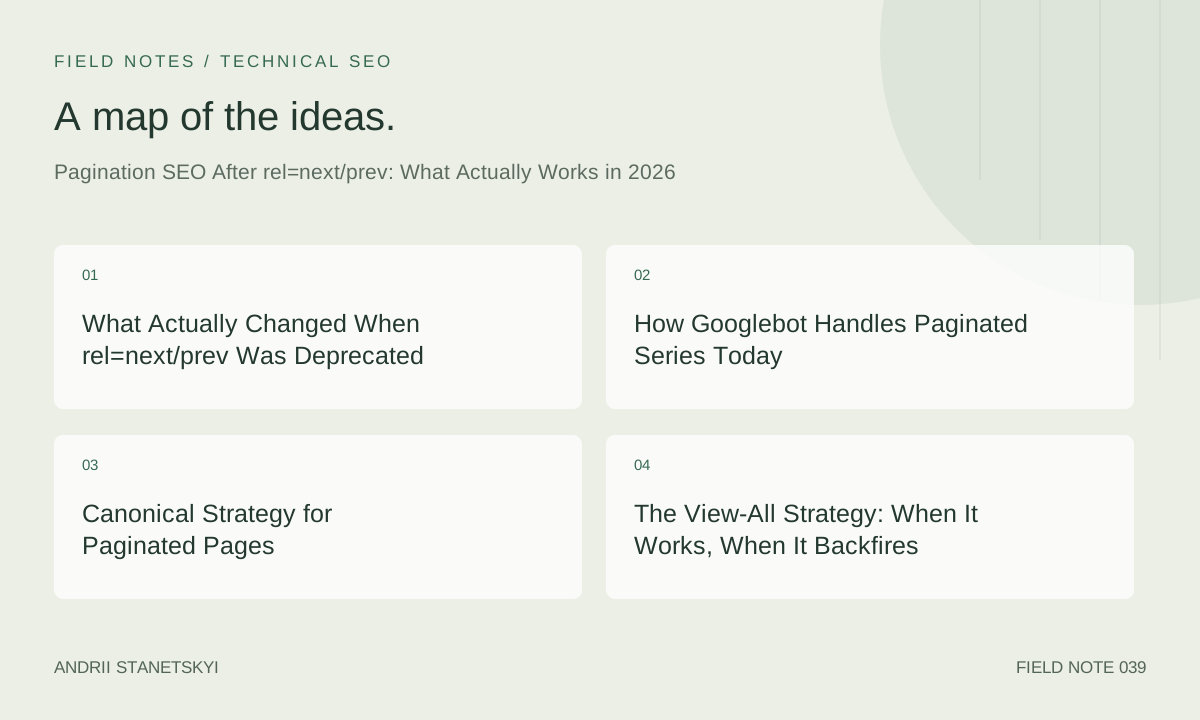
What Actually Changed When rel=next/prev Was Deprecated
The announcement from Gary Illyes in 2019 was precise: Google had never used rel=next/prev as a ranking signal. It had been used as a canonicalization hint — a signal that this page was part of a series, helping Google understand the relationship between pages in a paginated set. That canonicalization use was stopped.
What didn't change: Google still crawls paginated pages. It still indexes them. It still uses them to discover linked content (products, articles). The loss of rel=next/prev didn't change the fundamental crawling mechanics — it removed a structured signal that helped Google understand paginated structure, leaving Googlebot to infer that structure from other signals: URL patterns, internal links, page content, and next/previous navigation links.
Bing never heavily weighted rel=next/prev either. Bing's pagination handling relies more heavily on XML sitemap declarations and content similarity analysis.
How Googlebot Handles Paginated Series Today
Without rel=next/prev, Google's canonicalization algorithm for paginated series treats each page in the series as a potentially independent URL. Google's signals for understanding pagination now rely on:
- URL pattern regularity (
?page=2,/page/2/— Google recognizes common pagination patterns) - The presence of numerical "next/previous" navigation links in HTML (non-rel, just regular links)
- Content overlap and uniqueness analysis between pages
- Canonical tags on each page (self-referencing)
- Sitemap declaration strategy
The practical implication: Google is more likely to treat page 2, 3, 4 of a paginated series as independent documents today than it was before 2019, when rel=next/prev explicitly grouped them. This is actually fine for deep pages with unique content (individual products, articles) — but problematic if you have thin paginated pages where the only useful content is items also present on page 1.
Log File Evidence of Pagination Crawl Behavior
# Check Googlebot crawl frequency by page number
grep "Googlebot" /var/log/nginx/access.log | \
  grep -oP 'GET /category/\S+' | \
  grep -oP 'page=[0-9]+|/page/[0-9]+' | \
  sort | uniq -c | sort -rn

# Expected pattern: page 1 crawled most frequently,
# with diminishing crawl rate for higher page numbers
# Flat distribution across all pages = crawl budget waste
A healthy pagination crawl shows a decay curve — page 1 crawled most frequently, page 2 less, and so on. A flat distribution means Googlebot treats all pages equally, which indicates either very strong internal linking to deep pages (unusual) or that Googlebot can't identify the series structure and is treating each page independently.
Canonical Strategy for Paginated Pages
The prevailing (incorrect) advice is to canonical all paginated pages to page 1. This advice conflates "eliminating duplicate content" with "consolidating paginated content," and the consequences are real:
- Products on page 2+ are treated as duplicates of page 1's products, reducing their indexability
- Googlebot may deprioritize crawling pages 2+ if their canonicals point to page 1 (which is already crawled)
- Deep products that only appear on paginated pages and nowhere else lose their discovery path
The correct approach: self-referencing canonicals on all paginated pages. Each page declares itself as canonical.
<!-- On /category (page 1) -->
<link rel="canonical" href="https://example.com/category" />

<!-- On /category?page=2 -->
<link rel="canonical" href="https://example.com/category?page=2" />

<!-- On /category?page=10 -->
<link rel="canonical" href="https://example.com/category?page=10" />
The trade-off: self-canonicalizing deep paginated pages does mean they compete with page 1 for ranking relevance. But this is the correct outcome — a page that actually has unique content (different products) should compete, because it might rank for long-tail queries that page 1 doesn't match.
When to Canonical Deep Pages to Page 1
The only legitimate case: paginated pages with no independent search value and no unique content that a searcher could land on usefully. Sort-by-date archives page 50 of a blog with ephemeral posts from 2011. Canonical those to the blog root if the pages genuinely provide no value as landing pages. For product category pages, this case almost never applies — individual products have search value regardless of which page they appear on.
The View-All Strategy: When It Works, When It Backfires
A "view all" page that loads all items in a paginated series on a single URL was the dominant pre-2019 recommendation, and it still has legitimate use cases. But the conditions under which it actually helps have narrowed.
View-All Works When:
- The total item count is manageable (<200 items) — the view-all page loads quickly and doesn't result in a slow, JavaScript-heavy render
- All items on the view-all page are in the initial HTML response (not lazy-loaded by scroll)
- The view-all page has strong enough content weight to be a better landing page than any single paginated page
- Googlebot can render the full view-all page within its rendering budget
View-All Backfires When:
- 500+ items result in a page that takes 8+ seconds to fully load and render
- Items are lazy-loaded via JavaScript — Googlebot may not scroll and trigger loads
- The view-all page is created specifically for SEO but has a poor user experience (no one uses it)
- Server-side rendering of 1,000+ products creates significant server load
<!-- If you implement view-all -->
<!-- Paginated pages canonicalize to view-all ONLY if view-all renders all content -->

<!-- On /category?page=2 -->
<link rel="canonical" href="https://example.com/category?view=all" />

<!-- On view-all page -->
<link rel="canonical" href="https://example.com/category?view=all" />
<!-- View-all must be in sitemap -->
<!-- Paginated pages should have noindex if canonicaling to view-all -->
Sitemap Strategy for Paginated Content
What to include in sitemaps for paginated series depends on your canonical strategy:
| Strategy | Sitemap Entries | Rationale |
|---|---|---|
| Self-canonical on all pages | Include all pages | All pages are canonical; all need crawl priority signal |
| Canonical deep pages to page 1 | Page 1 only | Only page 1 is the declared canonical; others are variants |
| View-all canonical | View-all URL only | View-all is the canonical; paginated pages are noindexed variants |
| Hybrid: static high-value + dynamic | Static pages only | Dynamic paginated pages are noindexed; only static canonicals appear |
Including deep paginated pages in a sitemap when they're canonicalized to page 1 is a consistency error that sends contradictory signals. Keep your sitemap declarations consistent with your canonical declarations.
<?xml version="1.0" encoding="UTF-8"?>
<urlset xmlns="http://www.sitemaps.org/schemas/sitemap/0.9">
  <!-- Self-canonical strategy: include all paginated pages -->
  <url>
    <loc>https://example.com/category</loc>
    <lastmod>2026-04-29</lastmod>
    <changefreq>daily</changefreq>
    <priority>0.8</priority>
  </url>
  <url>
    <loc>https://example.com/category?page=2</loc>
    <lastmod>2026-04-29</lastmod>
    <changefreq>weekly</changefreq>
    <priority>0.5</priority>
  </url>
</urlset>
Pagination and Crawl Budget
The crawl budget concern with pagination is real but often overstated. For a site with 1,000 category pages each paginating to 20 pages deep, that's 20,000 paginated URLs. If Googlebot allocates 10,000 pages/day to your site, and each paginated page is crawled twice weekly, that's 40,000 crawls/week — 5,700/day from pagination alone, leaving 4,300/day for product pages, content, and everything else.
At what point does pagination become a crawl budget problem? When deep pages (10+) have extremely low unique product counts and no real search value. When the same products appear across multiple paginated series (search results + category pagination). When session IDs or tracking parameters multiply paginated URLs further.
# Robots.txt: block deep pagination beyond a threshold if crawl budget is constrained
# Only use this if log analysis confirms Googlebot is wasting budget on near-empty pages

User-agent: *
# Block pagination beyond page 10 for subcategories
Disallow: /subcategory/*?page=1[0-9]
Disallow: /subcategory/*?page=[2-9][0-9]

# Keep main categories fully crawlable
Allow: /main-category/
Use this only after log analysis confirms the problem. Premature blocking of deep pagination can eliminate product discovery paths.
Infinite Scroll: SEO Implications
Infinite scroll that doesn't produce unique URLs is invisible to Googlebot. The crawler sees the initial page load; items loaded via AJAX scroll are not crawled unless they produce URL state changes. This means:
- Products only visible after scrolling may not be indexed
- The "page" Google sees may show 20 products while 200 exist in the category
- Crawl budget impact is minimal (only one URL per infinite-scroll series), but product coverage suffers
Making Infinite Scroll SEO-Safe
<!-- Pattern 1: History API pagination (generates addressable URLs) -->
<!-- As user scrolls, update URL with pushState -->
<script>
window.addEventListener('scroll', function() {
  if (nearBottom()) {
    loadMoreItems();
    // Update URL to reflect current scroll position's page
    history.pushState(null, '', '/category?page=' + currentPage);
  }
});
</script>

<!-- Pattern 2: Paginated endpoints accessible to crawlers -->
<!-- Keep /category?page=N URLs functional even with infinite scroll UI -->
<!-- Googlebot can crawl the paginated URLs directly -->
The History API pattern creates URL state that Googlebot can crawl directly (if you keep the paginated URLs functional server-side). This is the best of both worlds: smooth UX for users, addressable pages for crawlers. See our JavaScript SEO guide for Googlebot rendering of scroll-triggered content.
Diagnostic Workflow
Step 1: Identify Your Paginated URL Pattern
# Screaming Frog: export all URLs, filter by pagination pattern
# Common patterns:
grep -E "\?page=[0-9]+|/page/[0-9]+|&p=[0-9]+" urls.txt | wc -l

# Identify maximum page depth
grep -oP 'page=([0-9]+)' urls.txt | \
  grep -oP '[0-9]+' | sort -n | tail -1
Step 2: Check Canonical Implementation
# Verify self-canonicals on paginated pages
for page in 2 3 4 5 10 20; do
  echo "=== Page $page ==="
  curl -s "https://example.com/category?page=$page" | \
    grep -i 'rel="canonical"'
done
Step 3: Validate Sitemap Consistency
# Extract URLs from sitemap and check against canonical strategy
curl -s https://example.com/sitemap.xml | \
  grep -oP 'https://[^<]+' | \
  grep -E "page=[0-9]+" | wc -l
# If your strategy is "page 1 only in sitemap," this should return 0
Step 4: GSC Coverage Analysis
GSC → Coverage → filter "Excluded" → "Excluded by 'noindex' tag." If paginated pages appear here unexpectedly, your canonical-to-page-1 strategy may have been implemented as noindex by mistake. Filter "Indexed, not submitted in sitemap" — paginated pages appearing here are indexed but not in your sitemap, which may be intentional or a gap depending on your strategy.
Step 5: Crawl Rate vs. Indexing Rate for Paginated Pages
# Log analysis: ratio of paginated URL crawls to paginated URL indexing
# High crawl, low index = Google is discovering but deprioritizing these pages
grep "Googlebot" access.log | \
  grep -E "page=[0-9]+" | \
  awk '{print $7}' | sort -u | wc -l
# Compare against GSC indexed count for paginated URLs
FAQ
Should I still implement rel=next/prev even though Google deprecated it?
There's no SEO benefit from Google for implementing it. Bing never heavily used it. Implementing it causes no harm, and some minor crawlers and aggregators may still use it. But it's a dead signal for the major search engines — spend that development time on self-canonicals, sitemap accuracy, and internal linking instead.
Is it still valid to noindex paginated pages beyond page 1?
Only in specific cases: when you have a genuine view-all page that renders all items and you're canonicalizing to it, or when deep paginated pages (20+) contain genuinely redundant content with no search value. For typical e-commerce category pagination up to pages 5–15, noindexing is usually a mistake that suppresses product discoverability.
How does Google handle URL parameters vs. path segments for pagination?
Google handles both. ?page=2 and /page/2/ are both recognized pagination patterns. The path segment approach (/page/2/) is technically cleaner and avoids parameter normalization issues, but either works. The implementation consistency matters more than the syntax choice.
What's the best way to handle pagination for a news site vs. an e-commerce site?
For news: the content on each paginated page (article headlines, publication dates) is genuinely time-sensitive and unique. Self-canonicalize all pages; prioritize recent ones in sitemaps with lastmod updates. For e-commerce: the decision is more complex because product pages have their own canonical URLs — paginated category pages are primarily product discovery vehicles, not landing pages in their own right.
Can pagination cause duplicate content issues in 2026?
Less so than before 2019, because Google's content deduplication is more sophisticated. The real risk today is less "duplicate content penalty" and more "crawl budget waste" and "poor product discoverability." Google is unlikely to penalize you for paginated content; it's more likely to simply ignore deep pages that have insufficient unique content signal.
How do I handle pagination for faceted navigation — e.g., /shoes?color=red&page=2?
This combination is particularly complex. If /shoes?color=red is an indexable high-value page (self-canonical, in sitemap), then its paginated pages should also self-canonicalize: /shoes?color=red&page=2 canonicalizes to itself. If /shoes?color=red is noindexed or canonicalized to /shoes, then /shoes?color=red&page=2 should be blocked via robots.txt. See our faceted navigation guide for the complete decision matrix.
Does crawling deep paginated pages affect my crawl budget significantly?
It depends on your site size. For a site with 100k products across 5,000 categories paginating to average depth 10, you have 50,000 paginated category URLs. At a crawl rate of 50,000 pages/day (common for medium-large e-commerce), that's one day's budget just on paginated category pages — potentially crowding out product page recrawling. Run the log analysis to measure; don't assume.
Key Takeaways
- rel=next/prev is dead as a Google signal. Replace it with self-referencing canonicals and consistent sitemap entries.
- Canonicalizing all paginated pages to page 1 is wrong for e-commerce. Self-canonical each page and include all in the sitemap.
- View-all pages work only when all content renders in the initial HTML response and the page loads fast. Don't create them for SEO theater.
- Infinite scroll requires History API URL updates or parallel paginated endpoints to be crawlable.
- Match your sitemap strategy to your canonical strategy — contradictions send mixed signals.
- Measure pagination crawl budget impact with log analysis before applying restrictive robots.txt rules.
- GSC Coverage "Indexed, not submitted in sitemap" is the key signal for diagnosing pagination indexing gaps.
Conclusion
Pagination SEO in 2026 is less about a specific technical tag and more about consistent, logical signals across canonical tags, sitemaps, robots.txt, and internal link architecture. The practitioners who handle this well understand that paginated pages serve two distinct SEO purposes — ranking as landing pages and discovering linked content — and that these purposes sometimes require different handling. Get clear on which purpose each page serves, implement the appropriate controls consistently, and validate with real log data rather than theoretical models.