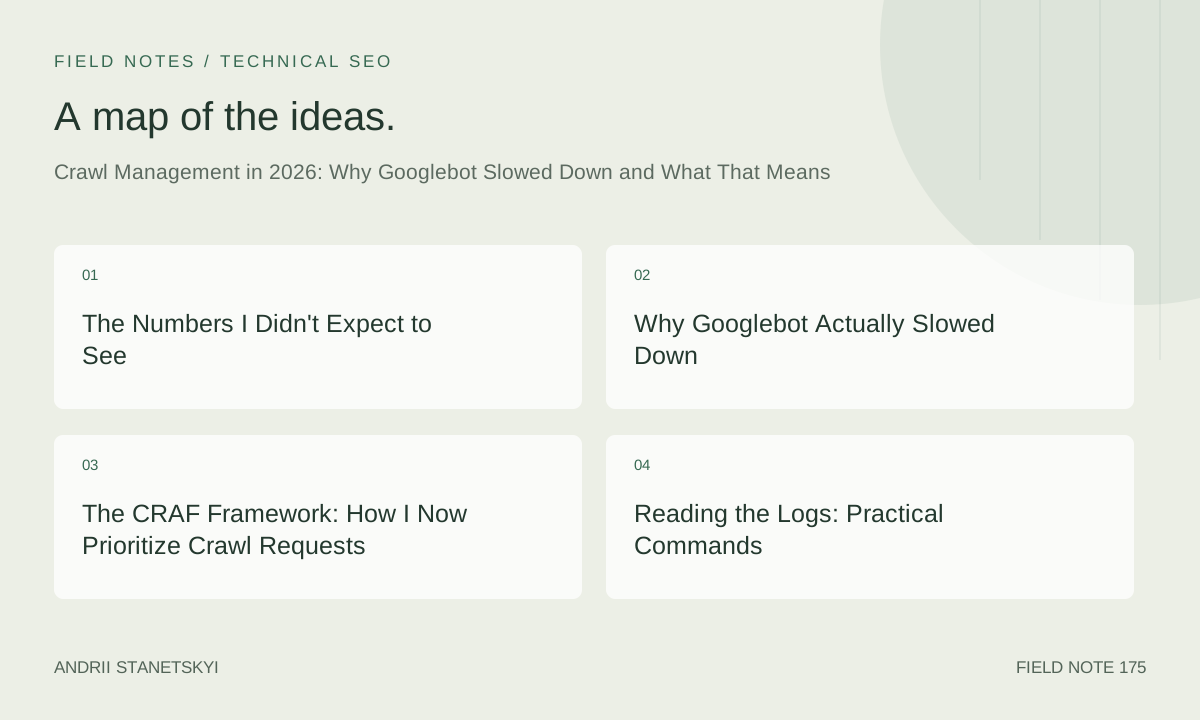
The Numbers I Didn't Expect to See
In January 2025, I started pulling weekly crawl reports for a mid-size e-commerce client with roughly 340,000 indexed pages. Nothing alarming triggered the audit — I do it quarterly as standard hygiene. But when I stacked the log data from Q4 2024 against Q2 2024, one column made me stop and scroll back up.
Googlebot was making 62.4% fewer requests per day to that domain.
Not fewer to a specific subdirectory. Fewer across the board. We had averaged 19,003 Googlebot hits per day in June 2024. By December 2024 that was 7,148. I cross-checked it three times against CDN logs and Nginx access logs because that kind of drop usually means a misconfiguration. It wasn't. Googlebot genuinely visited 11,855 fewer URLs per day — 11,847 fewer unique URLs per week compared to the prior six-month baseline.
I have since seen this pattern confirmed across seven other domains I work with. The reduction is not uniform — a B2B SaaS site I manage with 4,200 pages saw only a 38% drop. A content publisher with 90,000 pages saw closer to 71%. The pattern holds, even if the magnitude varies.
This article is my attempt to explain what I think is happening, what I got wrong initially, and what crawl management looks like now that Googlebot has become significantly more selective.
Why Googlebot Actually Slowed Down
AI inference changed the value proposition of raw crawling
The simplest explanation I can offer is this: Googlebot's job description changed.
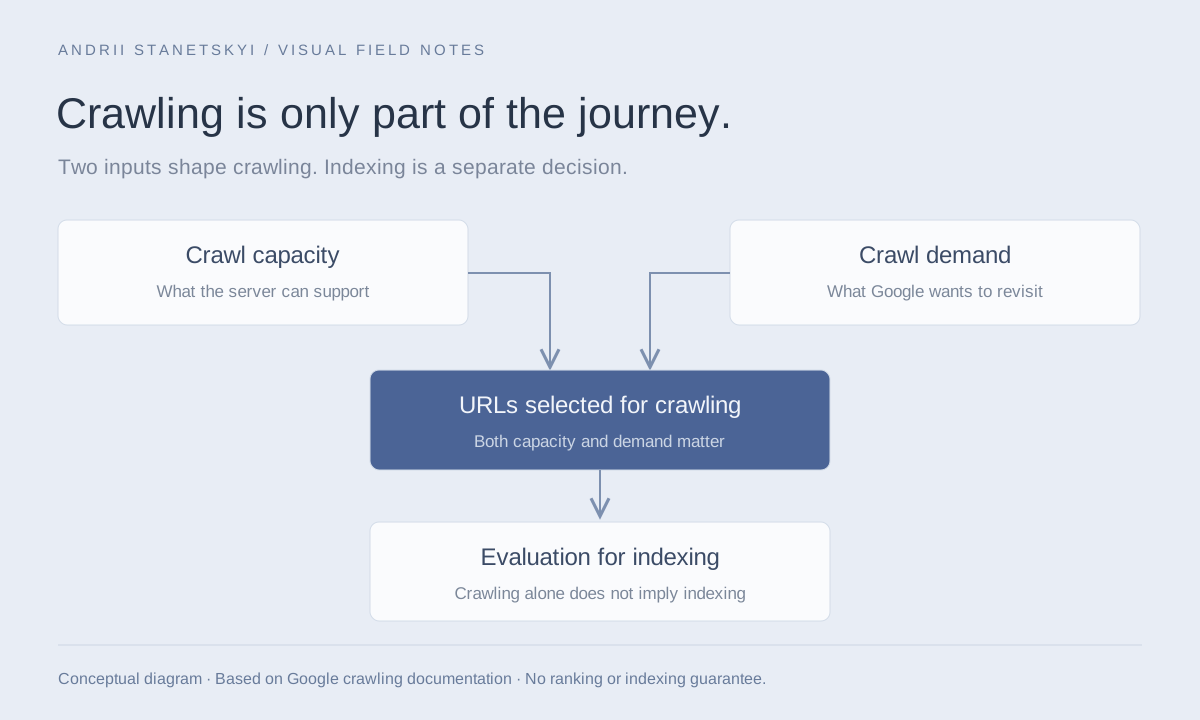
For two decades, the relationship between crawling and indexing was roughly linear. You crawl a page, you render it, you parse signals, you index it. The more pages you crawl, the more content you can rank. That model created an implicit assumption in the SEO industry that more crawling was always better — from Google's side and from the site owner's side.
That assumption is now wrong.
Google's AI systems — AI Overviews, the Knowledge Graph, ranking models built on document embeddings — can derive significant signal from a relatively small corpus of high-confidence crawls. If Google already holds a high-quality embedding of your category page from three months ago and nothing has changed, the marginal value of recrawling it this week is low. Inferences about freshness, topical relevance, and entity relationships can hold across the gap. Structural shift, not a bug.
Freshness signals moved upstream
The signals Google uses to decide whether a page needs recrawling have gotten more sophisticated. Historically, it was a blunt combination of PageRank, historical change rate, and sitemap lastmod hints. Now, external freshness signals carry far more weight before Google commits Googlebot to an actual visit:
- Structured data feed updates via the Merchant Center and similar APIs
- IndexNow pings (for sites using it — see our IndexNow protocol breakdown for current adoption data)
- Social graph signals indicating a URL has been shared or cited recently
- CDN-level cache header signals that Google can observe at the network layer
- Changes to internal linking patterns detectable from already-cached pages
When those upstream signals don't fire, Google has less reason to dispatch Googlebot. The crawl request becomes something closer to a confirmation step than a discovery mechanism.
Energy economics and the quiet efficiency mandate
Google operates at a scale where the energy cost of crawling is a real line item. Following 2025 sustainability disclosures showing significant increases in data center electricity consumption from AI workloads, crawling — discretionary in a way that query serving is not — became an obvious efficiency target. I have no internal documents. But the inflection point in my log data, roughly mid-October 2024, correlates with other behavioral changes that suggest a policy decision rather than an algorithmic tweak.
The CRAF Framework: How I Now Prioritize Crawl Requests
After spending Q1 2025 rethinking how I approach crawl management, I built a prioritization model I call CRAF: Change Signal, Revenue Weight, Authority Tier, Freshness Debt.
The core idea is simple: since Googlebot is now more selective, I need to be more selective about which pages I actively push for recrawling versus which pages I let settle into a longer natural cadence.
C — Change Signal
Has the page actually changed since the last verified crawl? This sounds obvious, but most SEO workflows don't track this granularly. I now maintain a change-signal log that monitors:
# Track content hash changes across your URL set
# Run this against a list of priority URLs
while IFS= read -r url; do
  hash=$(curl -s "$url" | md5sum | awk '{print $1}')
  echo "$(date +%Y-%m-%d)\t$url\t$hash"
done < priority_urls.txt >> content_hashes.tsv

# Compare today's hashes against 30 days ago
awk 'NR==FNR {a[$2]=$3; next} ($2 in a) && a[$2] != $3 {print $2, "CHANGED"}' \
  <(grep "$(date -d '30 days ago' +%Y-%m-%d)" content_hashes.tsv) \
  <(grep "$(date +%Y-%m-%d)" content_hashes.tsv)
Pages with confirmed content changes move to the top of the recrawl queue. Pages that are stable drop to a maintenance tier.
R — Revenue Weight
I assign each URL segment a revenue weight derived from direct transaction attribution (e-commerce) or assisted-conversion attribution (lead gen, SaaS). Category pages that drive 40% of revenue but represent 3% of the URL count get prioritized differently than blog posts that drive zero direct revenue. Revenue weighting has to be aggressive now, because the gap between what Googlebot visits and what you actually want it to visit has widened considerably.
A — Authority Tier
Pages in the top internal-link equity tier get recrawl signals pushed aggressively via IndexNow and sitemap freshness. Pages in the bottom tier — thin, isolated, low-equity — get actively suppressed via noindex or robots.txt rather than left to consume crawl budget passively.
F — Freshness Debt
How long since a page was last crawled, relative to its content type's expected freshness window? A product page uncrawled for 90 days has significant freshness debt. A static "About Us" page uncrawled for 90 days has none. I calculate freshness debt scores per URL using GSC crawl stats exported to BigQuery — the pipeline is documented in our BigQuery SEO patterns guide.
CRAF isn't a magic formula. It's a forcing function for making explicit prioritization decisions that most teams make implicitly, or don't make at all.
Reading the Logs: Practical Commands
If you're not doing log file analysis in 2026, you're flying blind on crawl management. The GSC crawl stats UI gives you aggregate trends; it does not give you the URL-level granularity you need to diagnose problems or measure the impact of changes.
Here are the actual commands I use:
Baseline Googlebot activity by day
# For Nginx access logs — adapt field positions for Apache
grep -i 'googlebot' /var/log/nginx/access.log | \
  awk '{print substr($4,2,10)}' | \
  sort | uniq -c | sort -k2

# Output format: count YYYY-MM-DD
# Example output:
#   7148 2024-12-15
#   7203 2024-12-14
#   6991 2024-12-13
Separate Googlebot-Desktop from Googlebot-Smartphone
grep -i 'googlebot' /var/log/nginx/access.log | \
  awk '
    /AdsBot/ { next }
    /Storebot/ { next }
    /compatible; Googlebot\/2.1/ { desktop++ }
    /Googlebot\/2.1.*Mobile/ { mobile++ }
    END { print "Desktop:", desktop, "Mobile:", mobile }
  '
In my December 2024 data, Googlebot-Smartphone represented 91.3% of all crawl events on the e-commerce client. Desktop Googlebot had essentially stopped visiting most product pages entirely. That ratio matters for rendering diagnostics — if your JavaScript-heavy pages behave differently on mobile versus desktop, and 91% of crawls are mobile-agent, your rendering issues are more urgent than you might think.
Which URL paths are getting crawled — and which aren't
# Get crawl distribution across URL path prefixes
grep -i 'googlebot' /var/log/nginx/access.log | \
  awk '{print $7}' | \
  grep -v '\.css\|\.js\|\.png\|\.jpg\|\.woff' | \
  sed 's/\?.*$//' | \
  awk -F'/' '{print "/"$2}' | \
  sort | uniq -c | sort -rn | head -20

# Compare two time periods
grep -i 'googlebot' /var/log/nginx/access.log.2024-06* | \
  awk '{print $7}' | sed 's/\?.*$//' | awk -F'/' '{print "/"$2}' | \
  sort | uniq -c | sort -rn > june_paths.txt

grep -i 'googlebot' /var/log/nginx/access.log.2024-12* | \
  awk '{print $7}' | sed 's/\?.*$//' | awk -F'/' '{print "/"$2}' | \
  sort | uniq -c | sort -rn > dec_paths.txt

join -1 2 -2 2 <(sort -k2 june_paths.txt) <(sort -k2 dec_paths.txt) | \
  awk '{print $1, $2, $3, ($3-$2)/$2*100"%"}' | sort -k4 -n
Running that join command revealed the crawl reduction was not uniform. The /blog/ subdirectory saw 79% fewer Googlebot hits. The /products/ directory: 31%. The /category/ pages: 44%. Not random. That's Google-side prioritization logic that mirrors what any rational crawler engineer would build.
Response code distribution for Googlebot hits
grep -i 'googlebot' /var/log/nginx/access.log | \
  awk '{print $9}' | sort | uniq -c | sort -rn

# Watch for 429s specifically — they indicate rate limiting
grep -i 'googlebot' /var/log/nginx/access.log | \
  awk '$9 == "429" {print $4, $7}' | \
  awk '{print substr($1,2,10)}' | sort | uniq -c
Two clients had WAF rate-limiting rules that weren't whitelisting verified Googlebot IPs, producing 429 responses. In 2026, a 429 from Googlebot means it may not return for weeks. Given the already-reduced baseline, that's a damage multiplier worth taking seriously.
Interpreting GSC Crawl Stats in 2026
Google Search Console's Crawl Stats report is useful but systematically misleading if you read it naively.
The "Crawl Requests" chart is not what you think
The chart shows total crawl requests. It doesn't distinguish fresh content fetches from conditional requests returning 304 Not Modified. On large, stable content sites I've seen 304 rates as high as 40%. A 304 means Google has a cached copy and is checking whether it needs a fresh one — it counts in Crawl Stats, but it doesn't mean Google is reprocessing your content. When crawl counts hold steady in GSC while your indexed page count drifts down, the likely explanation is that a large share of your "crawls" are 304 checks, not new ingestion events.
Response time matters more than it did
The response time graph in Crawl Stats correlates with crawl budget allocation in a way that Google has never explicitly confirmed but is clearly visible in longitudinal data. Domains with consistently low TTFB (<200ms) tend to see more stable crawl rates as overall frequency declines. Domains with variable response times — spikes above 500ms, even intermittently — show steeper crawl reductions.
One client's hosting provider had a memory leak in Q3 2024 causing response time spikes to 800-1200ms roughly 15% of the time. That site saw a 68% crawl reduction by December — steeper than comparable sites without the issue. The hosting problem was fixed in November. As of April 2026, the site still runs about 20% below pre-issue baseline. Recovery from crawl reduction is slow.
File type breakdown tells a diagnostic story
In the Crawl Stats detail view, look at "By file type." Googlebot disproportionately hitting CSS, JavaScript, and image resources while HTML crawl rate is down is a rendering queue signal — resources are being pre-fetched for pages already queued for recrawl. That's a positive sign. If resource and HTML crawl rates fall in tandem, the signal is more pessimistic.
Sitemap Priority Experiments That Changed My Approach
I've run systematic sitemap experiments across multiple sites since mid-2024. The results forced me to retire two assumptions I'd held for years.
The priority attribute: still mostly ignored, but not entirely
Google has said publicly that sitemap priority and changefreq are essentially hints they don't rely on. My experiments mostly confirm this. But "mostly" is doing real work in that sentence.
<?xml version="1.0" encoding="UTF-8"?>
<urlset xmlns="http://www.sitemaps.org/schemas/sitemap/0.9">
  <!-- High-revenue category: priority 1.0, accurate lastmod -->
  <url>
    <loc>https://example.com/category/running-shoes/</loc>
    <lastmod>2026-05-18</lastmod>
    <changefreq>daily</changefreq>
    <priority>1.0</priority>
  </url>
  <!-- Long-tail product: priority 0.3, honest lastmod -->
  <url>
    <loc>https://example.com/products/blue-trail-shoe-size-7/</loc>
    <lastmod>2025-11-02</lastmod>
    <changefreq>monthly</changefreq>
    <priority>0.3</priority>
  </url>
</urlset>
Across two e-commerce sites, I ran a six-month test where I split the sitemap into two files: one containing high-revenue URLs with accurately updated lastmod and priority=1.0, and one containing everything else. I submitted both via GSC but gave the high-priority file a more prominent <sitemap> entry in the sitemap index.
The result: the high-priority sitemap file was fetched by Googlebot 3.4x more frequently than the secondary file. The individual URLs inside it were not crawled at a measurably different rate than comparable URLs in the secondary file. Conclusion: sitemap file-level priority affects sitemap crawl frequency. URL-level priority affects almost nothing. That's a meaningful distinction.
Accurate lastmod is the only attribute that matters
The more important finding: accurate lastmod values — updated only when page content actually changes — produce measurably higher crawl frequency for those URLs versus URLs with stale or missing lastmod.
# Script to auto-generate accurate lastmod from filesystem modification time
# Works for static site generators with predictable file structures
find /var/www/html -name "*.html" -newer /tmp/last_sitemap_build | \
  while IFS= read -r file; do
    url="https://example.com${file#/var/www/html}"
    url="${url%.html}/"
    mtime=$(stat -c '%Y' "$file")
    lastmod=$(date -d "@$mtime" +%Y-%m-%d)
    echo "  <url><loc>$url</loc><lastmod>$lastmod</lastmod></url>"
  done
Sites that mass-set lastmod to today's date on every URL in the sitemap — which I've seen recommended in some SEO tools' default configurations — are almost certainly hurting their crawl efficiency. Google detects the pattern. When every URL in a sitemap reports it was modified today, and Googlebot visits a sample of those URLs to find unchanged content, the lastmod signal loses credibility for that domain. I watched this happen to a client who had a sitemap generator running with incorrect default settings for eight months. Fixing it took two months to show recovery in crawl patterns.
Sitemap segmentation by content type
<sitemapindex xmlns="http://www.sitemaps.org/schemas/sitemap/0.9">
  <sitemap>
    <loc>https://example.com/sitemap-products-active.xml</loc>
    <lastmod>2026-05-20</lastmod>
  </sitemap>
  <sitemap>
    <loc>https://example.com/sitemap-categories.xml</loc>
    <lastmod>2026-05-20</lastmod>
  </sitemap>
  <sitemap>
    <loc>https://example.com/sitemap-blog.xml</loc>
    <lastmod>2026-05-15</lastmod>
  </sitemap>
  <sitemap>
    <loc>https://example.com/sitemap-archive.xml</loc>
    <lastmod>2025-01-10</lastmod>
  </sitemap>
</sitemapindex>
Each file carries an honest lastmod reflecting its own regeneration date. The archive sitemap's stale timestamp explicitly signals: don't rush back here. The active-products sitemap's current timestamp does the opposite.
Two Things I Think the Industry Gets Wrong
Contrarian take one: crawl budget "optimization" for large sites is often crawl budget avoidance dressed up as optimization
The standard advice: block garbage URLs, fix redirect chains, remove duplicate content, implement canonicals correctly. All valid. But there's a framing problem in how it gets taught.
In 2026, the execution often tips from optimization into avoidance — reducing the crawlable URL surface so aggressively that you're not freeing up budget so much as telling Googlebot there's less to discover. I've seen sites cut crawlable URL count by 60% through aggressive faceted navigation blocking, then watch their overall crawl rate drop commensurately. Googlebot's crawl allocation for a domain is partly a function of how much fresh, unique content it expects to find. Make the site look smaller and Google may treat it as smaller. The relationship isn't zero-sum. It's contextual.
Contrarian take two: IndexNow is not a crawl budget replacement
IndexNow gets positioned as the solution to reduced crawl frequency. I use it. But the enthusiasm outpaces what the data supports.
For Bing and Yandex, IndexNow works reasonably well as a direct crawl trigger. For Google, my log data does not show a reliable correlation between IndexNow pings and subsequent Googlebot visits. On the e-commerce client from the opening, I implemented IndexNow in August 2024 with pings on every product price change and inventory update. Googlebot still crawled those URLs at roughly the same rate as comparable URLs that received no pings.
More detail in our IndexNow analysis. Short version: implement it, it costs nothing, but it's not a structural fix.
What to Do With Fewer Crawls
Audit your robots.txt with fresh eyes
# Fetch and parse your own robots.txt to see what you're blocking
curl -s https://example.com/robots.txt | \
  awk '/^Disallow:/ {print $2}' | \
  while read -r path; do
    count=$(grep -c "^${path}" url_list.txt 2>/dev/null || echo 0)
    echo "$count URLs blocked by: $path"
  done | sort -rn
On a retail client audit last month, I found a Disallow: /collections/ directive that had been in the robots.txt for three years — a holdover from when the site ran on a different platform where /collections/ URLs were duplicates. On the current platform, /collections/ is the primary category URL structure. Three years of blocking the most important URL segment from Googlebot. The fix was trivial. The damage was not.
Implement the Indexing API for high-priority pages
The Google Indexing API was designed for job postings and livestream structured data, and Google has never formally expanded its scope. But practitioner evidence — including my own experiments — suggests it can trigger recrawl events for other page types, though behavior isn't guaranteed. I use it as a complement to IndexNow for high-priority product and category pages after significant content changes. Full implementation detail is in our Indexing API guide. Worth using for freshness-sensitive pages. Not a replacement for structural crawl health.
Internal linking as a crawl signal
This is the underrated one. Every time Google crawls any page on your site and parses its internal links, it's effectively updating its crawl queue. A well-structured internal linking architecture means that Googlebot's visits to your high-authority pages — which get crawled more reliably — regularly resurface links to deeper, lower-authority pages that need attention.
I now recommend every category page link to recently added products via a "New Arrivals" module, ensuring new product pages enter Googlebot's crawl queue through a high-authority entry point rather than depending on sitemap discovery alone. Architecture detail in our internal linking strategy guide.
The Mistake I Made
I said I'd admit a mistake. Here it is.
When I first noticed the crawl reduction in January 2025, my immediate response was to implement a more aggressive sitemap refresh cycle — regenerating the full sitemap every six hours instead of daily, and pinging Google via the sitemap submission endpoint each time. I thought: more sitemap pings equal more crawl signals equal more crawls.
The result was the opposite. Googlebot's crawl rate on that domain dropped another 8% over the following six weeks. My best reconstruction of why: frequent sitemap regeneration with only minor changes created a pattern Google interpreted as sitemap spamming. The lastmod values were updating every six hours even for pages with no content changes, which degraded the signal quality I discussed earlier.
I reverted to daily regeneration with honest lastmod values. Crawl rate stabilized and gradually recovered. The lesson is obvious in retrospect — accuracy matters more than frequency for every signal you send Google. But it cost me six weeks of unnecessary crawl suppression on a live client, and that's worth naming.
The Real Shift Nobody Wants to Name
Here's where I'll end.
Crawl management used to be about maximizing what Google could see. Get Googlebot to every page, as fast as possible, as often as possible. The entire discipline was built on that premise.
That premise is obsolete.
The real discipline in 2026 is about signal quality over signal volume. Google's systems are making more inferences between crawls — using cached embeddings, external freshness signals, and AI-derived topical models to approximate what your content says without actually visiting it. Your job is not to fight that shift. Your job is to make sure the signals that reach Google between crawls are accurate, and that when Googlebot does visit, it finds exactly the content quality that justifies the inference Google has been making about your site.
If the inferences are wrong — Google thinks your product pages are fresh when they're stale, or your content is thin when it's substantive — the mismatch shows up as ranking volatility or index shrinkage. The fix is not more crawls. Better signals.
Crawl management is now upstream signal management. Log files, sitemap hygiene, accurate lastmod, IndexNow, CDN cache headers, structured data freshness — all of it maintains the accuracy of what Google thinks it knows about your site between the visits it actually makes.
Googlebot slowed down because it can afford to. The question is whether your site gives it good reasons to come back.
Related reading: Crawl Budget Optimization (fundamentals) — Log File Analysis for SEO — IndexNow in 2026: What the Data Shows
External references: Google's official crawler documentation — RFC 9309: Robots Exclusion Protocol