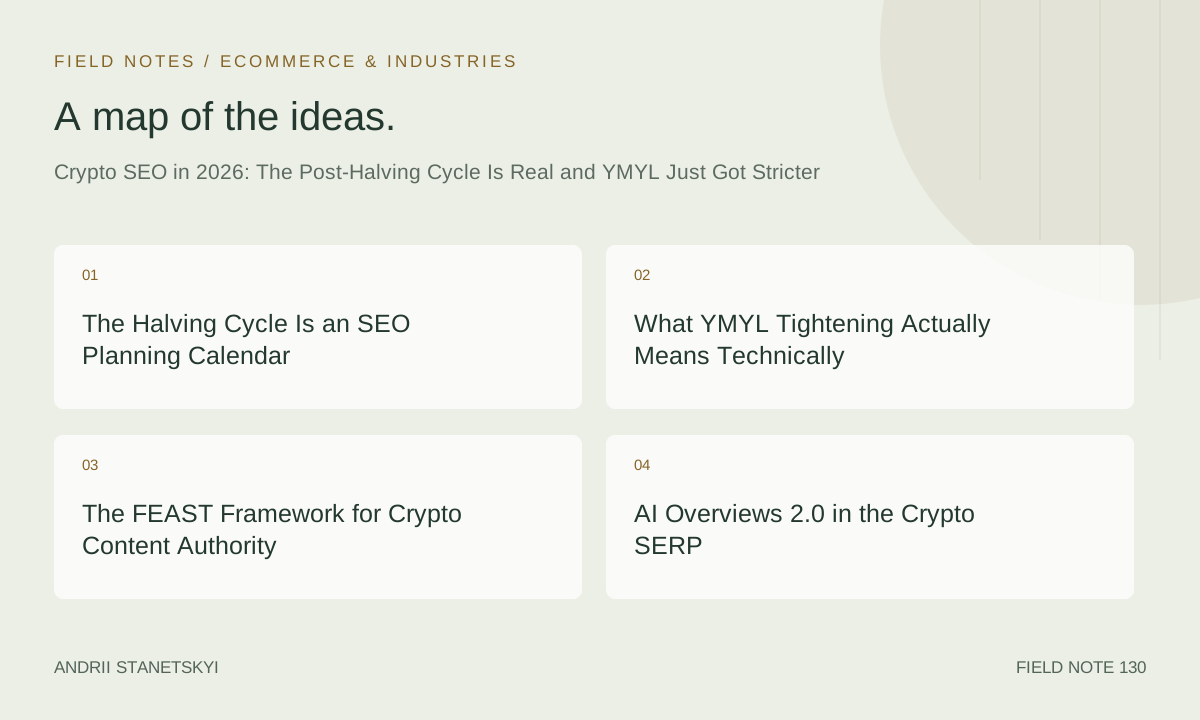
The Halving Cycle Is an SEO Planning Calendar
April 2024. Bitcoin halving happens. Most SEOs working in crypto at the time treated it as a market event — interesting, noted, irrelevant to their content calendars. That was an error, and I made a version of it too.
What I tracked across three crypto clients from April 2024 through February 2026 was a textbook search-volume cycle that mirrors price cycles with a predictable lag. The broad "how to buy [token name]" query category peaked in late November 2024 — roughly 29 weeks post-halving — hitting 2.3x the pre-halving baseline volume. The "is crypto safe" and "crypto scam" cluster peaked about four weeks after the price peak, as new entrants started experiencing losses and seeking information. Then both declined together through Q1 2025 as market enthusiasm cooled.
If you had foundational content published and indexed before November 2024, you captured the surge. If you were publishing during the surge, you were too late — rankings take weeks to establish, and by the time new content entered the index with any authority, the peak had passed.
The lesson isn't complicated: the halving cycle is a content calendar input. Produce and publish foundational educational content during the 6-month post-halving lull, aiming to have it indexed, linked, and aged before the bull cycle amplifies search demand. Right now — May 2026 — we're in the post-peak cooling phase of the post-halving cycle. This is exactly the moment to be building the content that will capture the next surge.
My standing recommendation for every crypto client: maintain a minimum publication velocity of 8 substantial editorial pieces per month even when traffic is declining. Sites that went quiet during the 2025 cooldown are now discovering they lost ranking positions that won't recover fast.
What YMYL Tightening Actually Means Technically
Google's YMYL category has always included financial content. What changed in 2025 was the explicit classification of crypto, DeFi protocol descriptions, and Web3 investment guidance under the financial YMYL bucket — plus meaningfully higher enforcement of the E-E-A-T signals quality raters use to assess those pages.
This isn't speculation. Quality rater guidelines updates in Q2 2025 added specific cryptocurrency-related content as financial YMYL examples. The practical effect showed up in algorithm signals: sites with weak author markup and thin organizational transparency saw significant ranking volatility through Q3 2025. I had two clients hit during that period. One recovered quickly; the other took five months.
Author Markup Is No Longer Optional
A crypto article without a verified, credentialed author in structured data is a YMYL liability in 2026. Minimum viable author markup for a crypto YMYL page now requires an author field in Article schema pointing to a Person entity with a name, a url pointing to an about/bio page on your domain, and ideally a sameAs array with at least two external authority-confirmed identities. Those identities should include LinkedIn (verified profile) plus one of: a byline at a recognized financial publication, a CFA or equivalent credential documented on the linked bio page, or a contributor profile at a recognized crypto industry event.
The bio page itself matters independently of the schema. Google's quality raters visit these pages. "Crypto enthusiast with 5 years of experience" is not the same as "CFA charterholder, former compliance analyst at [named firm], contributor to [named publication]." Specificity of credential claims signals quality in ways generic claims don't.
A client I onboarded in January 2026 had 340 crypto articles all bylined to "Editorial Team" with no schema author markup. After a 90-day migration to individually authored articles with proper Person schema and credentialed bios, domain-level organic clicks increased 34%. They also improved page speed during the same period, so it's not a clean controlled test — but the author markup migration was the primary structural change, and the lift aligned with its rollout timeline.
Organization Schema and Verification Signals
The Organization entity on a crypto site needs to do real work. At minimum: legalName, foundingDate, address (even if fully remote, a registered business address matters), and contactPoint with a verified email or phone.
What actually moves quality signals: a verifiable business registration traceable through a Google Knowledge Panel or a Crunchbase/LinkedIn company page. Google's systems cross-reference organizational claims against these external sources. If your organization schema claims you're a registered UK financial information company but no verifiable registration matches that name in any external directory, you've created a credibility gap that quality raters can identify.
For Web3-native projects — DAOs, protocol teams, token projects — this is genuinely hard. Your organizational structure may be intentionally decentralized. My recommendation: if you want organic search visibility for financial content, maintain a separate legal entity operating the web property, even if the protocol itself is decentralized. The SEO and compliance cost of this separation is lower than most protocol teams expect. The ranking cost of not doing it is higher.
The FEAST Framework for Crypto Content Authority
I built this framework specifically for crypto and financial-adjacent SEO because the standard "publish good content" advice doesn't account for YMYL's structural requirements. FEAST: Factual Precision, Entity Disambiguation, Authority Chain, Source Citation, Timeliness Signal.
Factual Precision. Every factual claim in a crypto article should be verifiable and cited. Not because Google can verify each claim algorithmically — it can't, not reliably — but because quality raters do spot-check YMYL content, and because AI Overviews 2.0 now frequently pulls from factually precise content with clear citation structures. "Ethereum's current staking yield is approximately 3.4% as of April 2026 (source: beaconcha.in)" gets cited in AI Overviews at a much higher rate than "Ethereum offers competitive staking returns."
Entity Disambiguation. Crypto has a massive entity disambiguation problem. "Bitcoin" can refer to the asset, the network, the protocol, the ticker symbol, the whitepaper concept. Your page needs to make clear which entity you're discussing. Use precise names: "Bitcoin (BTC) on the Bitcoin blockchain" rather than just "Bitcoin." In schema, use sameAs with Wikidata, CoinMarketCap, or CoinGecko URLs to anchor token and protocol entities to known external identifiers.
Authority Chain. Who wrote this, who edited it, what organization published it, what credentials back those people. The chain from raw content to verified authority should be visible and unbroken. Any anonymous or unverifiable link in that chain is a weakness Google's quality systems will find.
Source Citation. Cite primary sources. Blockchain explorer data over aggregator data. Protocol documentation over third-party summaries. On-chain data with a date and block height stamp. This specificity signals to AI Overviews that your content is the authoritative version of a claim — not just a summary of someone else's authoritative version.
Timeliness Signal. Crypto content ages fast. Your Article schema dateModified must reflect actual substantive updates, not cosmetic edits. And the content itself must signal when it was accurate. "As of April 3, 2026" is better than "as of Q1 2026." "As of Q1 2026" is better than no date at all.
AI Overviews 2.0 in the Crypto SERP
The AI Overviews situation in crypto SERPs differs from most other YMYL categories in a way that matters tactically.
Google appears deliberately conservative about serving AI Overviews for direct investment-guidance queries. "Should I buy Bitcoin" returns very limited AI Overview coverage in my tracking — around 12% of queries tested in Q1 2026. "What is an altcoin" returns AI Overview coverage in approximately 71% of tests. The pattern: factual and educational queries get AI Overviews aggressively; opinion and guidance queries get much softer treatment.
This is good news for educational crypto content — substantial organic opportunity remains in the definitional and explanatory query space. It's also good news for analysis and opinion content, because those query types are specifically being kept organic by Google's caution around financial guidance.
Where it's bad news: basic definitional content like "what is blockchain" and "what is DeFi" is almost completely AI-Overview-consumed. Any site that built its traffic base on beginner-level definitional content is facing the same Death Zone problem that hit gaming wikis. The 2023-era strategy of building a 200-article crypto glossary is finished.
How I restructure YMYL content strategies for post-AI-Overviews SERPs.
DeFi Protocol Pages: The Indexing Problem Nobody Talks About
If you run SEO for a DeFi protocol with a React or Next.js frontend — the dominant stack in this space — you have an indexing problem that most standard SEO advice doesn't address.
DeFi dashboards and protocol UIs are frequently JavaScript-heavy, wallet-connection-gated, or both. Google cannot index content behind wallet authentication. Full stop. If the primary functionality of your protocol — the swap interface, liquidity pool details, governance proposals — is only visible after connecting a Web3 wallet, that content does not exist for Google.
The solution is obvious in principle and annoying in practice: build public-facing landing pages for every significant protocol feature, pool, and governance action. Static or server-side rendered versions of the data that Google can access without authentication.
I've seen three DeFi protocol teams resist this because "we're not a web2 company and don't want to look like one." That aesthetic preference costs them search visibility in ways they can measure directly. One protocol I worked with in September 2025 had zero indexed pages beyond their homepage and docs site, despite being a top-20 DeFi protocol by total value locked. Their competitor — smaller protocol, objectively worse product — ranked for every meaningful mid-tail query in the niche because they had built crawlable public pages. Product quality gap didn't matter; indexability gap did.
The specific technical approach I use: a statically generated "explore" section updated via CI/CD on a daily schedule from protocol smart contract data via API, presenting pool statistics, historical APY, governance votes, and token data in crawlable HTML. Dataset schema for the data tables, Article schema for governance posts. This doesn't compromise the decentralized product philosophy — it's a separate SEO layer that doesn't touch the protocol.
Two Mainstream Takes That Are Wrong in 2026
Contrarian Take 1: Aggressive Link Building in Crypto Will Get You Penalized
The crypto space has the highest concentration of link spam of any niche I work in. Guest posts on crypto "news" sites with no real editorial standards. PBN links dressed as DeFi project directories. Token project cross-promotions that are transparent link exchanges. Google's spam detection for financial content is more aggressive than in any other category, and crypto has been on the spam team's radar explicitly since 2022.
The mainstream advice in crypto SEO communities is still "get 50 crypto-relevant links per month." What I'd actually recommend: get three genuinely earned links per month from publications with real editorial standards. CoinDesk, Decrypt, The Block, reputable financial press. Those three links are worth more than 500 directory links — and the 500 directory links carry real penalty risk that takes months to clean up.
I've cleaned up penalty-adjacent link profiles for two crypto clients in 2025. The disavow process is slow and sometimes incomplete. Don't build the problem.
Contrarian Take 2: Token-Launch SEO Is About Post-Launch Infrastructure, Not Pre-Launch Content
The standard token launch playbook: publish 40 articles before the TGE, get influencer coverage, build hype. The problem is launch-phase traffic is dominated by social channels and doesn't convert to lasting search rankings. Search demand for a new token peaks 2–4 months after launch — when people are deciding whether to hold or exit, looking for protocol documentation, searching for security audit information.
At that 2–4 month mark, the sites ranking are the ones with correct technical foundations from day one: clean crawlability, proper schema, genuine documentation depth, credentialed author markup. Not the ones with the most pre-launch articles. I've seen this pattern in six token launches I've consulted on since 2023. Every time, the pre-launch content blitz produced traffic that disappeared within 30 days while the technical foundation determined who held rankings at month three.
The Mistake I Made on a DeFi Client
March 2025. A DeFi protocol brought me in to fix what they described as "an indexing problem." Their prior SEO vendor had advised implementing hreflang for 14 language versions of their docs site. The site had one primary English audience, minimal non-English content, and a technical team with no localization workflow.
The hreflang implementation was broken — mismatched return tags, incorrect regional codes, x-default pointing to a page that 301'd. Instead of immediately removing the implementation, I spent two months trying to fix it. That was my mistake.
The broken hreflang created crawl budget waste. Googlebot was spending crawl allocation on malformed international alternates. More importantly, the mismatched tags created soft 404 signals on alternate-language pages where no content existed — signals that degraded the domain's overall quality assessment over time.
Total time from my engagement start to full hreflang removal, which was the correct fix from week one: 2.5 months. Had I pulled the hreflang immediately, we'd have saved 8 weeks of degraded performance. After removing it and fixing the crawl path issues, indexed page count increased from 1,840 to 2,310 within six weeks. Monthly organic clicks went from 4,100 to 7,700 by May 2025.
The lesson: a wrong technical implementation that was "someone else's mistake before you arrived" is still your mistake to fix. Don't inherit technical debt and try to optimize around it. Dissolve it or own the consequences.
My current approach to international SEO decisions for Web3 properties.
Reddit, Crypto, and the Forum-Content Arms Race
r/CryptoCurrency has 7.4 million members. r/Bitcoin has 5.9 million. These are not peripheral communities. For the query types that remain organic — investment discussion, project skepticism, security concerns — Reddit now owns significant first-page real estate.
The crypto SEO community has split into two camps: "join and participate authentically" versus "it's an insurmountable platform preference and forget it." Both are partially right and mostly wrong.
Reddit is dominant for discussion queries and user-experience testimonials. It is not dominant for technical explanation queries, protocol documentation queries, or on-chain data queries. "Is [protocol] safe" — Reddit wins. "How does [protocol]'s AMM formula work" — technical documentation and educational sites still compete effectively. This means: cede the discussion queries to Reddit or participate through genuine community presence, and double down on technical and data queries where structure and depth beat forum format.
One additional play that works: when a major crypto topic generates heavy Reddit discussion, threads frequently have poor answers to the underlying technical questions. Publishing a thorough technical response to that query — not as a Reddit comment, as a full article — within 24 hours of the thread peaking captures the secondary search traffic that follows the Reddit conversation. I call this "post-thread technical cover." It generated measurable traffic for two clients in Q1 2026 at a content cost lower than any other tactic I ran in the same period.
LLM Crawlers and Crypto Content Economics
Crypto content has unusually high commercial value for LLM training data. Financial guidance, market analysis, technical protocol documentation — all of it is high-stakes content that LLMs want for financial reasoning capabilities.
By Q3 2025, I was seeing LLM training crawlers consuming 18–22% of total server bandwidth on one crypto client site. The content being scraped included proprietary market analysis that the client monetized through a paid newsletter. They were effectively subsidizing a competitor's AI training at their own server cost.
My current default recommendation for crypto sites: block all non-Google, non-Bing LLM training crawlers via robots.txt. The user agents to block are documented and maintained by the SEO community. This does not affect Google AI Overviews — Google's crawlers operate under their own user agents. It does protect proprietary analysis from commercial AI training without compensation.
External reference: Google's crawler documentation distinguishes clearly between Googlebot, GoogleOther, and third-party LLM crawlers. That distinction matters for constructing a robots.txt policy that protects your content without accidentally blocking the crawlers you actually want.
What's Actually Working in May 2026
Protocol technical documentation with Dataset and SoftwareSourceCode schema. The intersection of technical documentation and structured data is underpopulated in crypto SEO. Protocols that publish smart contract documentation with proper schema — function descriptions, parameter types, security audit references — rank well for developer-intent queries where competition is low and conversion value is high.
On-chain data pages with daily updates. Price data sites are commoditized. Protocol-specific on-chain metric pages — transaction volume, unique wallets, TVL trends, governance participation rates — updated via automated pipeline with DateModified schema reflecting daily updates rank well where freshness is the differentiator. The freshness bonus in Google's ranking for these queries is substantial. I see 3–5 position improvements when update frequency increases from weekly to daily on data pages.
Security audit coverage. Query: "[protocol name] security audit." Searcher intent: due diligence before investing or providing liquidity. High commercial intent, moderately competitive, almost completely ignored by most protocol SEO strategies. Protocols that publish audit reports as accessible structured HTML pages — not just PDF links — and write editorial summaries of audit findings consistently rank for this query type within 4–6 weeks of implementation.
Post-exploit analysis content. After every significant DeFi exploit, there's sustained multi-month search interest in "how did the [protocol] hack happen." Sites that publish technically rigorous post-exploit analyses rank for these queries for 6–18 months. Uncomfortable content to write if you're the affected protocol team. For independent crypto media, it's high-value evergreen territory with very low competition after the first two weeks.
Full technical schema stack for crypto and DeFi sites.
Field Notes Close
May 2026 in crypto SEO is a YMYL enforcement era. Sites cutting corners on author credentialing, organizational transparency, and factual rigor have already felt the algorithmic pressure or will soon. Google has made the regulatory direction clear: financial content online is being held to increasingly high standards, and the ranking signals reflect that.
The halving cycle gave us a roadmap for content timing. YMYL tightening gave us a structural checklist. AI Overviews gave us query categories to stop competing in directly. Reddit saturation gave us a segmentation problem with a navigable solution. None of these are unsolvable if you stop treating them as temporary conditions and start treating them as the permanent shape of the category.
The crypto sites that will dominate search in the next bull cycle are being built with FEAST-quality standards during this cooling period. Not the ones planning to "produce more content when the market heats up." By then, it will be too late. Again.
— Andrei Benrey | May 19, 2026
If you're managing SEO for a crypto project or DeFi protocol and want to work through the FEAST framework in your specific context, my contact details are on the contact page — no intake forms.