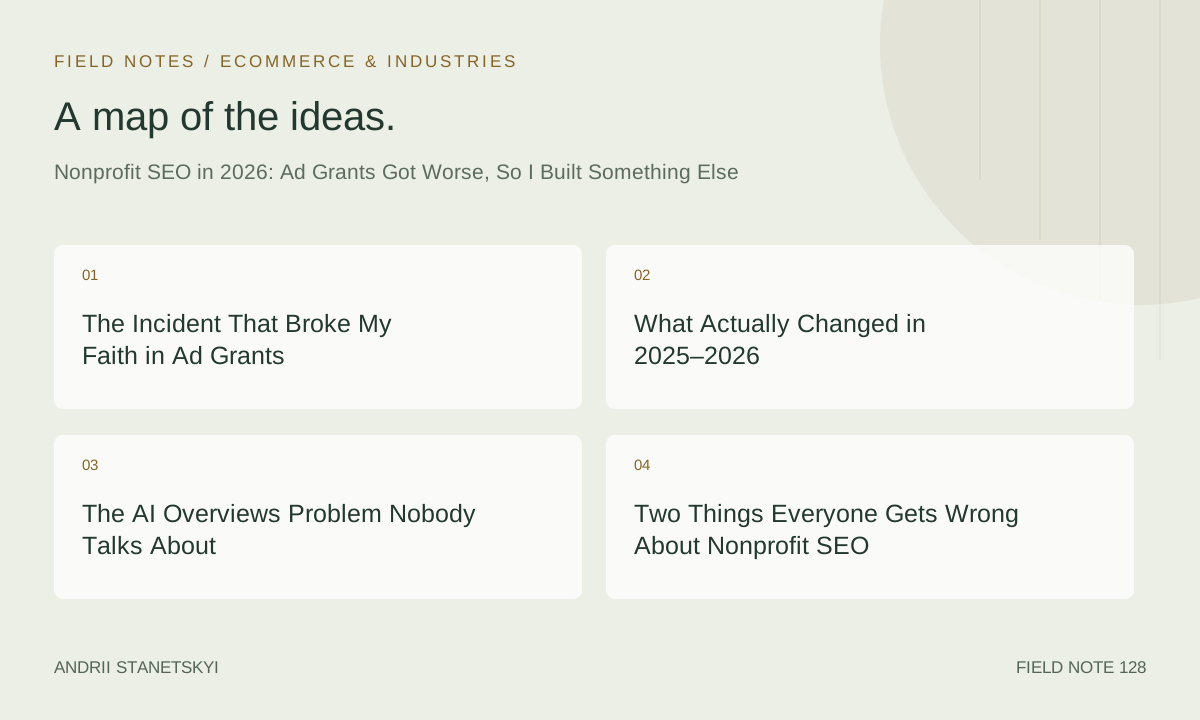
The Incident That Broke My Faith in Ad Grants
Last October I got a call from the digital director of a mid-size domestic 501(c)(3)—refugee resettlement, operating across four metro areas, annual budget roughly $4.2 million. They'd been on Google Ad Grants for three years. CTR was holding at 6.8%. Then, over a six-week period between late August and early October 2025, their impressions dropped 73% and their effective reach collapsed to almost nothing. Not a policy violation. Not a disapproved ad. The account was technically in good standing. The impressions just... stopped.
They'd been running the same grant-dependent traffic model that half the sector uses: Ad Grants covers top-of-funnel, organic handles brand searches, email handles retention. When the grant effectively went dark, they had no organic safety net. Nothing ranked. Their homepage was a 14-second LCP nightmare on mobile. Their "how to help refugees" content was being swallowed whole by AI Overviews. Monthly unique visitors dropped from 41,000 to 9,200 in eight weeks.
I've been doing SEO for nonprofits for about seven years—before that, I was in-house at an international charity operating in eleven countries. I thought I'd seen most of the failure modes. I hadn't seen this one. And I've spent the months since building a playbook that doesn't assume Ad Grants will ever be reliable again.
What Actually Changed in 2025–2026
Google tightened Ad Grants policy in early 2025, but the changes weren't announced the way normal policy changes are. There was no single blog post that said "here's what's different." What happened instead was a quiet recalibration of how grant campaigns compete in the unified auction. Grants still cap bids at $2 effective CPCs, but Google's Quality Score thresholds for grant-funded ads increased without a corresponding announcement. The practical result: grant ads that used to appear on competitive informational queries now rarely do. If a paid advertiser—a hospital, a university, a government agency—is also bidding on "how to help domestic violence survivors in [city]," your grant impression is suppressed. Not penalized. Just outcompeted by better-funded signals.
The second change hit harder. After the March 2025 Core Update, Google's AI Overviews started absorbing a significantly larger share of informational charity queries. Not donation queries—those still show traditional SERPs with some regularity. But the research-phase queries, the ones where potential donors are asking "what do food banks actually do with money" or "how does refugee resettlement work in the US," those are now answered directly in the Overview box about 60–70% of the time based on what I'm seeing in GSC data across six client accounts.
What the data actually shows
Across the nonprofit accounts I actively manage or advise, here's a rough picture of the last 14 months: informational query impressions are up (AI Overviews shows your content), clicks are down 35–55%. Brand query clicks are roughly stable. Donation-intent queries—"donate to [cause] [city]," "best charities for [cause]"—are actually showing moderate click growth, probably because those queries still carry commercial-adjacent intent signals that AI Overviews avoids absorbing.
That split matters for strategy. If you're producing content to educate potential donors about your cause, that content still generates impressions and possibly AI Overview citations, but it may not generate the direct clicks you were counting on. The conversion pathway has an extra step now—or a different step entirely.
The AI Overviews Problem Nobody Talks About
Here's what I keep having to explain to nonprofit boards: appearing in an AI Overview is not the same as not ranking. Your content may actually be cited as a source inside the Overview box. Google may be using your page to answer the query. But the user reads the answer in the SERP and never clicks through.
For a nonprofit trying to drive donations, that's a weird half-win. You've influenced the narrative. You've shaped how Google describes your cause. But your traffic didn't increase, your email list didn't grow, and your donation page saw zero additional sessions.
The sector hasn't reckoned with this yet. Most nonprofit digital teams I talk to are still measuring success the same way they did in 2022: organic sessions, direct conversions from organic, bounce rate. Those metrics are becoming less meaningful as the top of the SERP evolves. What they should be tracking instead: AI Overview citation frequency (you can approximate this with manual SERP monitoring on key queries), branded search volume over time (a lagging indicator of awareness built through Overview citations), and direct-session share as a proxy for brand memory.
I built a lightweight monitoring script for one client—an international children's health charity operating in West Africa—that pulls weekly SERP snapshots for 180 of their target queries and flags which ones now show AI Overviews with citations to their domain versus citations to Wikipedia or competitors. It's not a product, just a Python script and a Google Sheet. But it's the only way they know whether their content is actually feeding the machine or being ignored by it.
See my breakdown of how AI Overviews are changing CTR across verticals.
Two Things Everyone Gets Wrong About Nonprofit SEO
Contrarian take #1: High Domain Authority does not protect nonprofit content
I hear this constantly. "We're a well-known organization, we have strong DA, our content should rank." Domain authority—whatever proxy metric you use—has almost no bearing on whether a nonprofit's informational content survives AI Overview displacement. I've watched pages from organizations with DR 70+ get completely swallowed by AI Overviews on queries they'd owned for years. Meanwhile, a scrappy regional food bank with DR 34 is getting cited in Overviews because their content is structured in a way that makes it easy to extract and quote.
The signal that matters now is content structure, not domain authority. Specifically: does your content answer the exact question in a format that a language model can cleanly extract? Short declarative sentences, factual precision, proximity of the question and its answer on the page. These matter more than how many backlinks you've accumulated since 2018.
Contrarian take #2: Charity Navigator and GuideStar profiles are hurting your SEO
Not directly. But indirectly, and significantly. Most nonprofits treat their Charity Navigator and GuideStar profiles as credibility assets—which they are, for donors doing due diligence. The problem is that these platforms often rank above the nonprofit's own website for branded queries. Someone searches "[Organization Name] reviews" or "[Organization Name] rating" and they click the Charity Navigator result, get their question answered, and leave. Your site never saw the session.
More importantly, many nonprofits have thin or duplicate content on their own site because they assume third-party profiles are handling the trust-building. They're not—they're intercepting it. Your organization's website needs to have the most complete, most structured, and most regularly updated information about your own financial transparency, program outcomes, and credentialed leadership. Don't outsource E-E-A-T signals to a third-party directory and then wonder why you can't rank for your own name.
More on how E-E-A-T applies to mission-driven content.
Where Donor Intent Actually Lives Now
This is the part that makes traditional nonprofit digital teams uncomfortable. Donor research—the phase where someone goes from "I want to give to a cause" to "I'm giving to this specific organization"—has migrated significantly to Reddit and TikTok. Not entirely. Not exclusively. But enough that ignoring it is a real strategic mistake.
On Reddit: r/personalfinance, r/financialindependence, r/churning (for points-maximizing donors), and cause-specific subreddits like r/vegan, r/environment, r/refugees are where people actively discuss which organizations are worth supporting and why. These threads rank in Google. They get AI Overview citations. Someone asking "which food bank actually uses donations efficiently" is very likely to find a Reddit thread before they find your website.
On TikTok: the phenomenon is different. It's not research in the traditional sense—it's social proof and emotional activation. A former program participant posting about their experience. A staff member showing a day in the field. A donor sharing why they give annually. This content drives direct donations and, crucially, branded search volume. People see a TikTok about an organization they didn't know, then go search that organization's name. If your branded SERP is weak, you lose that conversion.
I'm not saying nonprofits need TikTok accounts. I'm saying that if you're doing nonprofit SEO and you're not thinking about the off-Google pathways that eventually lead to Google searches, you're optimizing a partial system.
The international charity client I mentioned earlier—the children's health one in West Africa—started tracking the correlation between their TikTok views and their branded search volume in GSC. The Pearson correlation over a rolling 90-day window is 0.71. That's not causal proof, but it's enough to take seriously.
The CARE Framework: What I Built Instead
After watching the refugee resettlement client's traffic collapse, I needed a framework I could explain to an executive director who has never looked at a GSC report. Something that survives Ad Grant volatility, accounts for AI Overview behavior, and doesn't require a development budget.
I call it CARE: Credibility Infrastructure, Addressable Queries, Retention Architecture, External Signal Cultivation.
C — Credibility Infrastructure
This is E-E-A-T work, applied specifically to the nonprofit context. It means: every named staff member on your site has a proper author bio with credentials and program experience. Your IRS Form 990 is linked from your site, not buried. Your program outcomes are published annually with methodology notes, not just feel-good statistics. Your leadership team has LinkedIn profiles that are consistent with your site's claims about their backgrounds.
Credibility Infrastructure isn't content—it's scaffolding. Google's quality raters and AI extraction systems are looking for evidence that the humans behind your content have real authority on the subject. For a refugee resettlement organization, that means citing your licensed caseworkers, your State Department reception and placement agreements, your years of program operation. This is verifiable experience. It's the "E" in E-E-A-T that most nonprofits completely skip.
A — Addressable Queries
Not all queries are worth targeting in 2026. Addressable Queries is about deliberately choosing the subset of your potential keyword universe that still drives clicks despite AI Overview prevalence. In practice, this means prioritizing: local queries (AI Overviews are weaker on geo-specific results), transactional/donation-adjacent queries (lower AI Overview coverage), long-tail operational questions ("how do I volunteer at a food bank in [city] on weekends"), and queries where your organization is uniquely named or positioned.
Broad educational queries—"how does hunger in America work," "what causes homelessness"—are largely AI Overview territory now. You can still produce this content for citation value and brand awareness. But you shouldn't count on it for traffic, and you shouldn't build your organic strategy around it.
R — Retention Architecture
Traffic from search that doesn't convert to an email subscriber or a donor is one-time value at best. Retention Architecture means: your site has a clear mechanism to capture and retain visitors who aren't ready to donate yet. An email newsletter with genuine program updates. A recurring donor program with transparent reporting. A volunteer pipeline that keeps people engaged in your mission.
Most nonprofit sites I audit have a "Subscribe" link in the footer and nothing else. That's not retention architecture—that's an afterthought. The organizations that have weathered the Ad Grants changes best are the ones with robust email lists that generate recurring traffic regardless of what Google does. They're not dependent on the search channel for every re-engagement touch.
E — External Signal Cultivation
This is the off-page work, but for nonprofits it looks different than for commercial clients. It means: pursuing local press coverage that generates .gov and .edu backlinks from city agency partnerships, building citation consistency across the nonprofit-specific directories (GuideStar, Charity Navigator, GreatNonprofits), and deliberately creating assets that journalists and researchers actually cite—annual impact reports, original survey data about your beneficiary population, program outcome studies.
One thing I've found that works surprisingly well: partnerships with university social work programs. Faculty at accredited programs need practicum sites for students. If your organization runs field placements, you're likely already linked from a .edu domain you've never looked at. Make sure that partnership is documented on your site, make sure it's current, and think about co-publishing a program outcome brief with the faculty supervisor. That's an external signal that has genuine E-E-A-T weight.
How to build links that actually move authority in 2026.
Content Architecture for Mission-Driven Sites
Most nonprofit websites are organized around their internal structure, not around how donors and volunteers find information. Programs are listed by department. Donation pages are buried three clicks deep. Location-specific information is in a footer dropdown.
This is a structural problem that SEO can't patch around. Content architecture for nonprofits in 2026 needs to be organized around three audiences with distinct journeys: people in crisis who need your services, people who want to help (donors and volunteers), and researchers/media who need credibility information. These three paths should be distinct in your navigation and your URL structure.
The program page problem
Nonprofit program pages are usually written for grant applications, not for web visitors. They're filled with impact language ("we served 12,400 individuals") without the context that makes that number meaningful or the structural signals that help Google understand what the page is about. Fixing this is not a content volume problem—it's a content structure problem.
Each major program should have its own page that explicitly answers: what is this program, who is it for (with specific eligibility criteria), where does it operate (with location schema markup), how does someone access it, and what does a real participant experience look like. That last one is the hardest to get clients to do, because it requires actual participant testimonials with first-person narrative—but it's also the content that AI Overviews are most likely to cite because it contains specific, verifiable, human-experience signals.
Location pages for multi-site nonprofits
If you operate in multiple cities, you need distinct location pages—not carbon copies with the city name swapped. Different staff profiles. Different local partner organizations. Different program hours. Different community context. This is more work than it sounds, and most nonprofit web teams don't have bandwidth for it. But the SEO value of genuinely differentiated location pages is substantial, especially because local queries remain one of the areas where AI Overviews are weakest.
My full guide to multi-location SEO for organizations with distributed operations.
Technical Realities on a $0 Dev Budget
I've worked with nonprofits that have a developer on staff and nonprofits where the executive director manages the WordPress site themselves. The technical realities are very different, and most nonprofit SEO advice ignores the resource constraint entirely.
If you're managing a nonprofit site on a limited technical budget, here's what actually matters: Core Web Vitals, specifically LCP and INP on mobile. The refugee resettlement client I opened with had a 14-second LCP. That's not a dev sprint problem—it's a hosting and image problem. Moving from shared hosting to a properly configured managed WordPress host and running images through a compression pass typically gets you from "terrible" to "acceptable" without touching code. That's a few hundred dollars, not a development project.
Schema markup is the other high-ROI technical item. At minimum, nonprofits should have Organization schema with their EIN, address, and 990 link; Event schema for fundraising events; FAQPage schema on key pages; and LocalBusiness or NGO type markup. None of this requires a developer—it can be added via a WordPress plugin or hardcoded into page templates by anyone who can follow JSON-LD documentation.
What you can deprioritize: JavaScript rendering issues (unless your site is built on a JS framework, which most nonprofit sites aren't), HTTP/2 push, and edge caching configuration. These matter for large commercial sites. They're not where a nonprofit's limited technical time should go.
The Mistake I Made (And Kept Making)
I need to be honest about something. For about two years—2022 through mid-2024—I told nonprofit clients to publish more educational content. More cause-awareness content. More "what is X disease" and "how does Y crisis affect communities" type content. I believed, and the evidence at the time supported, that this was how you built topic authority and earned donor trust through organic search.
It wasn't wrong exactly. It's that I didn't build a realistic exit path for when the content stopped driving clicks. I helped organizations produce hundreds of pages of educational content that now gets cited in AI Overviews and drives zero sessions. That content cost real money—staff time, contractor fees, review cycles. And it's now generating brand impressions that are impossible to convert directly.
I still think cause-education content has value. But I should have been pairing it with conversion architecture: email capture specific to the topic, remarketing lists, SMS opt-ins for advocacy alerts. If you're going to produce content that's likely to be AI Overview fodder, you need a different conversion mechanism than "they'll click through and find the donate button." I wasn't building that mechanism. I was building the content and hoping the click would follow. It often did, until it didn't.
If you're a nonprofit client reading this, and we worked together in 2022 or 2023, and I never talked to you about what to do when content starts generating impressions without clicks: that's on me. The fix now is to add contextual email capture to your highest-impression pages and to build the email sequence that converts subscribers over 90 days rather than expecting a one-session donation.
Playing the Long Game When Grants Fail
The nonprofit sector tends to run on short planning cycles. Annual budgets. Quarterly program reviews. Grant reporting periods. SEO doesn't fit that calendar. The organizations that are winning search visibility right now are the ones that started building organic infrastructure two or three years ago without expecting immediate returns.
That's cold comfort if you're the digital director whose grant impressions just dropped 73% in six weeks. So let me be practical about timelines.
Month one through three: fix the technical floor. LCP under 2.5 seconds, mobile-usable, schema markup in place, GSC fully configured. This isn't traffic-generating work—it's permission to compete work. Nothing else matters if your site fails Core Web Vitals on mobile.
Month four through eight: build the Addressable Query content. Location pages if you're multi-site. Program pages rebuilt around visitor intent rather than grant-report language. Donor FAQ content targeting the specific questions your potential donors are asking. This content starts generating signals immediately, but ranking takes time.
Month nine through eighteen: E-E-A-T depth. Staff author profiles. Annual impact report published with its own optimized landing page. University and government partnership pages. Original data, even simple survey data from your program participants, published with methodology and linked from external sources.
That's an 18-month runway to meaningful organic independence. I know that's a hard sell to a board that wants to replace lost Grant impressions by next quarter. The honest answer is: nothing replaces $10,000/month in free paid traffic overnight. But organic traffic that you own, that doesn't disappear because of a policy change, is worth more over a five-year horizon than any grant.
Why SEO timelines are longer than clients expect, and how to communicate that to stakeholders.
The international charity I worked with before going independent—the one in eleven countries—built its organic channel over four years without any Ad Grants at all (the program wasn't available in several of their operating countries). When I left, they were generating 180,000 organic sessions per month across their site properties. Not because they had a big SEO budget. Because they were consistent for four years and they built content that their program staff actually believed in and contributed to.
That's the model. It's slower than grants. It's harder to attribute in a board deck. But when Google changes its auction dynamics next year—and it will—your traffic stays.
Questions I Keep Getting Asked
Should we keep our Ad Grants account active even if impressions are down? Yes. The account is free to maintain and the policy environment could shift. Keep it active with compliant campaigns, but don't build strategy around it. Treat it as supplemental, not foundational.
Does having a .org domain help rankings? No meaningful ranking benefit. Google has stated this explicitly. TLD authority is a myth perpetuated by people who confuse correlation (established organizations often have .org domains and also have high authority) with causation.
How do we compete with Wikipedia on educational queries? You mostly don't, and you should probably stop trying. Wikipedia's depth of citation and update frequency on broad educational topics is nearly impossible to match. Target instead the specific, local, programmatic queries that Wikipedia doesn't cover—"food bank eligibility requirements [city]," "how to apply for rental assistance [county]"—and produce genuinely better content than what's there.
Is it worth hiring an SEO agency that specializes in nonprofits? Depends entirely on the agency. The honest answer is that most "nonprofit SEO" specialists are generalist agencies with a nonprofit client or two and a discount pricing structure. The skills that matter for nonprofit SEO are the same skills that matter for any SEO—technical competence, content strategy, E-E-A-T understanding—with added knowledge of the sector's specific constraints (limited dev budget, volunteer content contributors, grant-dependent funding cycles). Interview for those specific competencies, not just sector experience.
The refugee resettlement organization from October is slowly recovering. Eight months in, they've rebuilt their program pages from scratch, their mobile LCP is at 2.1 seconds, and their GSC shows 23 pages earning regular impressions on location-specific queries they never ranked for before. Monthly unique visitors are back to 18,000—not 41,000, but growing without a single dollar of Ad Grants. Their executive director sent me a note last month saying they'd onboarded their first monthly recurring donor cohort entirely through organic search. Sixty-three people, average gift $34/month.
That's not a victory lap. That's what the baseline looks like now. Smaller numbers, owned traffic, real durability. I'll take it over 41,000 sessions built on borrowed Google money.