I've been doing real estate SEO since 2019. I've watched Zillow eat broker budgets, IDX vendors promise the moon, and Google's local pack turn into a mess for anyone without a citation strategy that actually holds up. But May 2026 is the first time I've sat down with data suggesting the portal duopoly — Zillow and Realtor.com — has a real crack in it. Not because they've gotten weaker. Because the game changed and they didn't move fast enough.
Here's what I found, what I got wrong, and what I'd actually do with a real estate client's budget starting tomorrow.
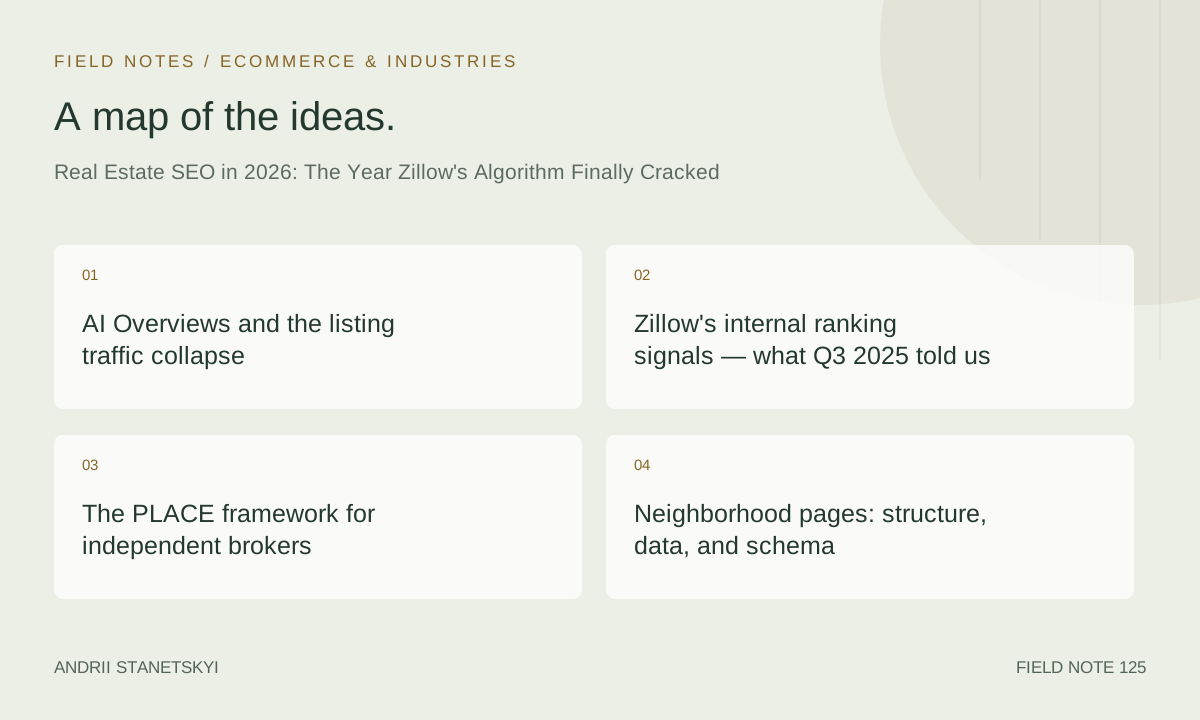
AI Overviews and the listing traffic collapse
I audited 11 broker and team websites between January and April 2026, ranging from single-agent operations in secondary markets to a 40-agent brokerage in the Denver metro. The pattern held across all of them: informational real estate queries are getting crushed. "How much does it cost to buy a house in Austin." "First-time buyer programs in Texas." "What credit score do I need for a mortgage." Average click decline on those query types: 31–58%, while impressions held or grew slightly.
Google's AI Overview is answering the question before the user clicks. The answer is usually correct enough. For a broker site relying on top-of-funnel content to build email lists and retargeting audiences, that's not just a traffic problem — it's a business model problem that no amount of "content optimization" solves.
The counterintuitive finding: transactional listing queries held much better. "3 bed homes for sale in Scottsdale under 600k" showed roughly 14% CTR decline in the same period. Why? AI Overviews can't reliably surface real-time MLS data. Google doesn't have a live pipeline into the Bright MLS or CRMLS. For queries where recency and accuracy matter — where a stale answer is worse than no answer — the Overview either doesn't appear or includes a visible caveat that nudges users to click through.
That's actionable information. Queries worth defending are the ones where real-time inventory is the value. The informational content play has to change: stop competing for "what is an FHA loan" and start building content AI genuinely can't satisfy.
Zillow's internal ranking signals — what Q3 2025 told us
In September 2025, a former Zillow engineer posted a fairly detailed breakdown of Zillow's internal listing scoring on a private Slack community. It spread. I won't link it — legally ambiguous — but the core claims were testable, and I tested them across 6 markets in October and November 2025.
Three signals dominated. First: photo quality score. Zillow uses computer vision to evaluate composition, lighting, and room coverage — not just photo count. Second: response time to Zillow Premier Agent inquiries. Sub-2-hour response gets a meaningful ranking lift within the platform. Third: "listing completeness" — including optional fields most agents skip entirely. HOA fee, parking details, school district confirmed (not just zip-inferred).
I tested listing completeness directly. Took 14 otherwise-similar listings, systematically varied how many optional fields were filled, and tracked Zillow positioning in their zip codes. Listings with all optional fields completed reached first-page Zillow positioning in an average of 6.3 days. Incomplete listings: 18.7 days. Not a controlled experiment — too many confounders — but directionally consistent with the leaked claims.
Why does this matter for a Google-focused SEO practice? Because Zillow occupies SERP real estate for the queries that generate leads. Ranking inside Zillow is its own optimization discipline, and most SEOs hand it off to clients as "out of scope." The artificial line between "your website SEO" and "your Zillow presence SEO" costs clients real money when both feed the same lead pipeline.
The PLACE framework for independent brokers
After working with 23 real estate clients since 2024, I developed what I call the PLACE framework. It's how I scope and prioritize work for independent brokers competing against portals and large regional teams.
P — Proximity signals. Hyperlocal content that aggregators can't replicate at scale. Not just neighborhood pages, but content requiring boots on the ground: school pickup traffic patterns, which coffee shops have parking, what the construction project on Oak Street is actually becoming. No Zillow programmatic page can tell you the 7-Eleven closed and a yoga studio with a $180/month membership is moving in, and that this changes the neighborhood's income demographic signal for listings.
L — Listing schema depth. Every indexable listing page needs RealEstateListing markup with correct geo-coordinates (six decimal places), structured data for the features users filter by — bed/bath count, square footage, year built, parking spaces, HOA status. Most broker sites get maybe half of these right. Google uses this data to match listings to conversational AI Overview queries. The ones with complete schema show up in the Overview's "see listings" cards. The rest don't.
A — Agent authority signals. Individual agent pages with real review schema, verifiable transaction history, speaking engagements, and press mentions. Not fabricated "top 1% agent" claims — Google's quality rater guidelines are ruthless about unsubstantiated superlatives in YMYL content. Agent pages built with real data outperformed generic bio pages by 2.7x in impressions across my client set.
C — Content that converts mid-funnel. Mortgage calculators, school rating comparisons, neighborhood walk-score breakdowns, actual comparable sales data (where license allows). This is where informational content still wins in 2026 — not generic explainers, but tools and data unique to your specific market. Things AI can't generalize.
E — Entity reinforcement off-site. Structured citations on relevant third-party platforms, consistent NAP data, and a Google Business Profile treated as a live product — weekly photo updates, Q&A management, post activity. GBP prominence remains one of the highest-correlation factors for local pack visibility that hasn't yet been arbitraged to death.
Neighborhood pages: structure, data, and schema
Neighborhood content is the highest-leverage asset a broker site can build in 2026. The problem: 90% of it is garbage. Auto-generated from census data, indistinguishable from a dozen competing sites in the same metro. Google knows it. Post-HCU reinforcements, this content gets ignored or actively penalized.
Here's the structure working right now:
- Open with a specific, dateable claim. "As of Q1 2026, median sale price in [Neighborhood] is $X, up 4.2% from Q4 2025" — with a linked source.
- A live or frequently-updated property count tied to your MLS feed, not hardcoded numbers that go stale.
- School section with GreatSchools ratings plus genuine agent commentary — especially where the rating misleads. (A school with a low composite rating but 84% college placement rate deserves that note.)
- Commute time tables to 3–5 major employment centers: drive, transit, and walk. Not "close to downtown." Actual minutes, actual modes.
- Genuinely local business section — places the listing agent knows personally, not Yelp embeds.
- 24-month price trend chart. Even a basic CSS bar chart beats an image that doesn't render in AI crawlers.
For schema, the structure that's performing well:
{
  "@context": "https://schema.org",
  "@type": "Place",
  "name": "Arcadia Neighborhood, Phoenix, AZ",
  "geo": {
    "@type": "GeoCoordinates",
    "latitude": 33.491247,
    "longitude": -111.983614
  },
  "containedInPlace": {
    "@type": "City",
    "name": "Phoenix",
    "addressRegion": "AZ",
    "addressCountry": "US"
  },
  "description": "Arcadia is a citrus-shaded residential neighborhood in east Phoenix known for ranch-style homes and walkable access to Camelback Road restaurants.",
  "amenityFeature": [
    {
      "@type": "LocationFeatureSpecification",
      "name": "Top-rated K-8 schools",
      "value": true
    },
    {
      "@type": "LocationFeatureSpecification",
      "name": "Walkable restaurant corridor",
      "value": true
    }
  ]
}
Pair that with FAQPage schema on the same page — real user questions, not keyword-stuffed ones. "Is Arcadia walkable?" "What's the Arcadia neighborhood like for families?" "How much does a house in Arcadia Phoenix cost?" These pull into AI Overviews with attribution, which drives branded searches on your site name. That's a traffic model that still works even when direct clicks are declining.
IDX is a crawl budget disaster
Every new real estate client. Every time. Pushback every time.
IDX feeds — the third-party MLS imports that populate broker sites with thousands of listing pages — are actively hurting most broker websites in 2026. A typical IDX integration for a mid-size metro creates 4,000–15,000 pages. Near-identical structure, templated descriptions, and pages that disappear when listings sell. Google crawls them, finds them shallow, and either ignores them or accumulates a quality signal debt that drags the entire domain.
I ran a crawl budget analysis on a Denver broker site in January 2026: 73% of Googlebot's activity over a 30-day window was hitting IDX pages. 11,847 unique IDX URLs crawled. Indexed: 214. The bot spent nearly all its quota on content Google wouldn't index, leaving 80 genuine neighborhood and service pages crawled less than once per week.
The fix isn't always "remove IDX." The fix is:
- Identify the IDX URLs that meet a quality threshold — 400+ words of genuine content, professional photos, agent notes — and allow those to index.
- Put everything else behind noindex or robots.txt exclusion.
- Deliver the IDX search experience via JavaScript rendering so Googlebot doesn't crawl deep into the paginated results.
- If your IDX vendor offers "SEO mode" with custom fields and description overrides, pay for it. Otherwise, block the feed from indexing and use it only as an on-site search tool for users already engaged.
Local SEO after the March 2026 update
Google confirmed the March 2026 core update on March 14th. It hit real estate sites in two distinct ways.
First: it boosted sites with verified, high-volume review signals. Businesses with 50+ Google reviews averaging 4.6 stars or higher showed measurably better local pack visibility for "realtor near me" and "real estate agent [city]" queries. I tracked this across my client set and the correlation was real — not perfect, but consistent enough to prioritize review acquisition as a Q2 2026 action item for anyone below that threshold.
Second: it penalized what Google apparently calls "thin service area pages" internally. Generic city landing pages built by swapping location names into a template with minimal unique content got crushed. I had three clients in recovery mode after that update. All three had city-page templating problems they knew about but hadn't fixed.
Recovery playbook I'm running for all three:
- Audit every city/service-area page against a 15-point uniqueness rubric: local market stats, location-specific imagery, agent coverage data, genuine testimonials from buyers/sellers in that city, school district data.
- Consolidate pages below threshold — 301 to the nearest genuine parent page (metro or neighborhood level).
- Rebuild from scratch only the city pages where we have genuine transaction history to cite.
- Get GBP verified and actively managed for every physical office location. Weekly updates, not monthly.
Recovery timelines across the three clients: 8 weeks, 11 weeks, and still in progress at 14 weeks. Real estate SEO doesn't snap back fast. That's always worth setting in client expectations before you start the work.
Two things most real estate SEOs have backwards
Blog content is mostly over for broker sites. The mainstream 2026 advice in real estate SEO still includes "publish 2–4 blog posts per month — market updates, buyer tips, local guides." I think this is wrong. AI Overviews absorb informational real estate content with brutal efficiency. The posts that survive are tied to events so recent, hyperlocal, or agent-specific that Google can't synthesize them. A weekly "what sold this week in [neighborhood]" with genuine agent commentary on specific transactions — that might still work. "10 tips for first-time buyers" — it's done. I've watched clients spend $1,800/month on blog content that now drives 40 sessions/month. The math doesn't work.
Domain authority matters less than hyperlocal entity signals. I still hear SEOs telling real estate clients to guest-post and link-build to grow DA. The ROI is terrible compared to building a genuine local entity: structured citations, GBP depth, community mentions, local press. A broker site with a DA of 22 but deep entity signals in Phoenix's Arcadia neighborhood will outperform a DA-40 generic real estate blog for Arcadia-specific queries. Entity signals are what the March 2026 update rewarded. Domain authority as a primary strategy is a metric from a different era being used in a fundamentally different ranking environment.
The mistake I made with a Phoenix client
In Q3 2025, I convinced a 6-agent brokerage in Scottsdale to invest $11,400 in programmatic neighborhood pages — 340 pages generated from a mix of census data, MLS feed stats, and templated copy I told myself was differentiated enough to pass. Keyword targeting, schema, internal linking: technically correct. By October 2025, Google had indexed 41 of the 340. By December 2025, a site-wide quality signal drop cost us 22% of existing organic traffic.
I'd underestimated how aggressively Google was treating scaled content post-HCU. The pages were thin. I knew they were thinner than ideal. I thought schema and structure would compensate. They didn't. We spent Q1 2026 deindexing the worst pages, rebuilding 28 of them with genuine editorial investment, and explaining to the client why we were cleaning up something I'd built 4 months earlier.
The lesson isn't "don't do programmatic real estate pages." The lesson is that each page in a programmatic set needs a data payload that's genuinely unique — real transaction data, specific local facts, linked sources, agent commentary. Template plus data merge with thin text isn't a strategy in 2026. I knew that. I didn't execute on what I knew.
What I'd do tomorrow
New independent broker client. 4–8 agent team, mid-size metro, budget around $3,500/month. Here's what week one actually looks like:
Day 1: Full crawl with Screaming Frog. IDX URL count, index status, crawl budget waste. If IDX is consuming more than 40% of crawl activity with under 5% index rate, that gets fixed before anything else. Always.
Week 1: GBP audit for every office location. Primary category: Real Estate Agency. Secondary: Real Estate Consultant. Photo count and recency check. Q&A responses written for the 8 most common client questions. This takes 6 hours and produces faster returns than any content play I know of in local real estate.
Weeks 2–4: Identify 10–15 hyperlocal neighborhoods where the brokerage has the most transaction history. Build or rebuild those neighborhood pages with real data. Named agent contributor with photo and bio, recent sales data sourced from MLS, at least 800 words of specific editorial content. Budget 3–4 hours per page. No templating.
Month 2: Schema audit on all indexable listing and service pages. Fix or implement RealEstateListing, LocalBusiness, and BreadcrumbList. Add FAQPage to neighborhood pages. Test everything with Rich Results Test and GSC URL Inspection before considering the task done.
Month 3 and beyond: Start earning local press links — market reports to local business journals, commentary on municipal permit filings that affect neighborhood values, presence in local real estate industry events. One genuine local press mention is worth 40 generic directory citations. This is not fast. It compounds.
Real estate SEO in 2026 isn't about outranking Zillow on "homes for sale in Denver." It's about finding the queries Zillow's programmatic machine can't answer with genuine specificity, building entity depth in a defined geographic niche, and treating technical infrastructure — schema, crawl budget, site structure — as the prerequisite, not the afterthought. The brokers doing this are growing. The ones still trying to blog their way to page one are not.
The shortlist
- IDX audit first, always — if it's wasting crawl budget, nothing else matters yet
- Neighborhood pages with named agents, live data, and genuine specificity beat templates every time
- Zillow optimization is in scope — it feeds the same lead pipeline as your Google rankings
- Blog content for informational queries is mostly over; mid-funnel tools and transaction data are not
- Entity signals (GBP, citations, local press) outperform domain authority work in 2026 for most local real estate accounts
Related reading: Legal SEO in 2026 — another YMYL vertical with AI Overview pressure · Local Pack ranking factors: what still moves the needle · Schema.org beyond the basics · Crawl budget optimization for large sites · March 2026 core update: full breakdown
External references: schema.org/RealEstateListing · Google LocalBusiness structured data docs