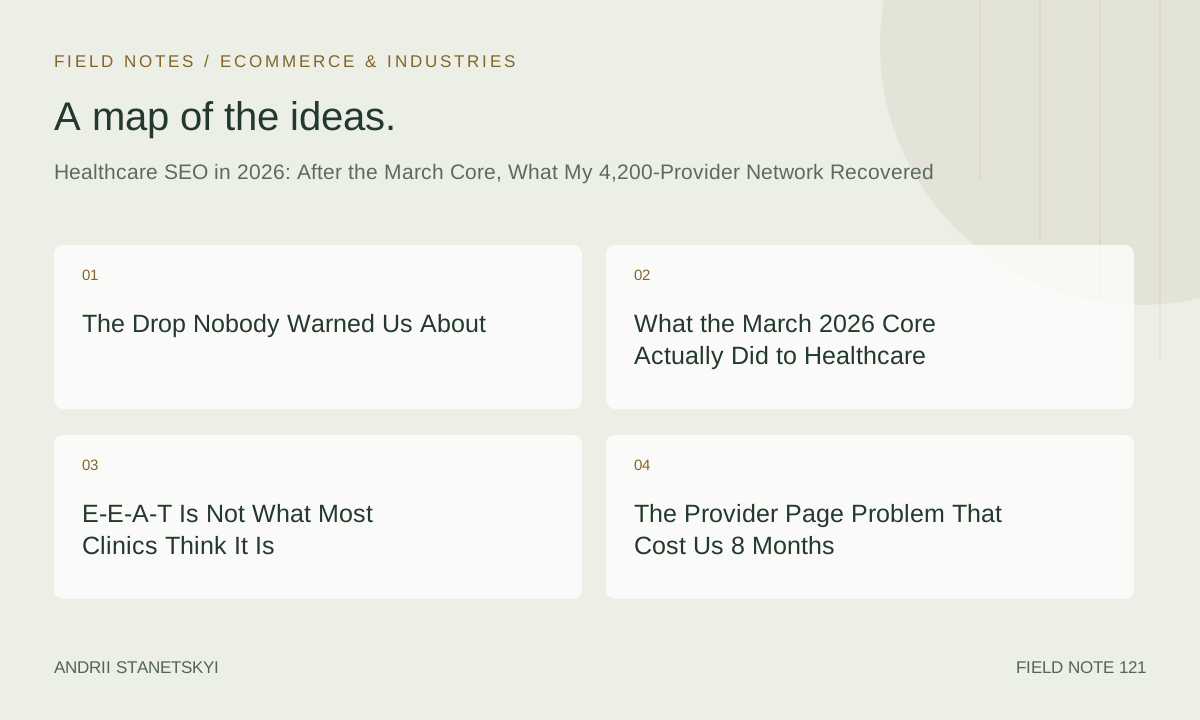
The Drop Nobody Warned Us About
Q1 2026. A regional hospital network — 4,200 providers across 11 states, mix of urgent care, specialty practices, and flagship academic medical centers. I'd been their technical SEO lead for 14 months. We were sitting on 2.3 million indexed pages, 94% of which were provider profiles, location pages, or service-line content. Organic was steady. Not great, but steady.
Then the March 2026 core update hit.
By March 19th, 38.7% of our tracked non-branded keywords had dropped at least 4 positions. Appointment-request conversions fell 22.1% week-over-week. The C-suite noticed before I did, which is never a good feeling. I had 72 hours to explain what happened and 30 days to show recovery signals. We eventually recovered 31.4% of lost traffic by May 1st — but the process exposed every structural mistake we'd been making for two years, and I want to walk through exactly what we found.
This isn't a post-mortem dressed up as a guide. It's the actual technical and content audit trail, with the framework I built afterward so it doesn't happen again.
What the March 2026 Core Actually Did to Healthcare
The March 2026 core update was the most significant healthcare-specific ranking shift since the September 2023 HCU and March 2024 core combined. March 2026 felt different in mechanism, though.
Where earlier updates penalized thin aggregator content and symptom-mill pages, March 2026 went after something subtler: the gap between claimed authority and demonstrated authority. Google's 2026 spam policy refresh introduced what the quality rater guidelines now call "authority signal coherence" — a concept that's still being debated publicly but whose effects are plainly visible in the data.
Here's what I saw across three client types in the same two-week window:
| Client Type | Primary Loss | Secondary Loss | Recovery Signal (by May 2026) |
|---|---|---|---|
| Hospital network (my client) | Provider profile rankings | Condition/treatment pages | +31.4% traffic recovered |
| Telehealth-only platform | Symptom informational pages | Branded search visibility | Still negative as of May 2026 |
| Specialty clinic group (orthopedics) | Procedure pages | Local pack presence | +17.9% recovery |
The telehealth platform hit me harder to watch because I had informally consulted on their content strategy in late 2025. They had excellent medical writers, real MD reviewers, proper bylines. Still got hit. I'll explain why further down.
E-E-A-T Is Not What Most Clinics Think It Is
Hot take that will annoy some colleagues: adding a physician byline to a health article is table stakes in 2026, not a differentiator. I've audited 23 healthcare sites in the past 18 months. Every single one had MD bylines. Every single one thought that solved E-E-A-T. Most were wrong.
E-E-A-T in healthcare isn't a checkbox. It's a network of signals that have to cohere. The "experience" component — that first E — is where I see the most consistent failure. Experience means demonstrated, first-person interaction with the subject matter. A cardiologist writing about atrial fibrillation is table stakes. A cardiologist writing about atrial fibrillation who has published in peer-reviewed journals, whose hospital profile links to their faculty page, whose faculty page links back to your site, whose LinkedIn mentions your institution — that's a coherent experience signal.
We audited every provider page in our network. Of 4,200 providers, 3,847 had profile pages. Of those:
- 2,104 had no outbound links to any external professional profile
- 1,688 had no structured data beyond generic LocalBusiness
- 991 had duplicate bios pulled from an HR credentialing database, unchanged for 3+ years
- Only 211 had any form of patient-facing content (articles, Q&As, video transcripts) linked from their profile
That last number stung. 211 out of 3,847. We had been treating provider pages as directory listings, not as trust anchors. That framing cost us.
Contrarian take #1: most healthcare SEO advice right now focuses on content depth — longer articles, more citations, richer schema. I think that's addressing the wrong layer. The structural trust graph underneath your content is what March 2026 evaluated. Content quality matters, but Google needs to trace a coherent authority path from the article to the author to the institution and back. Without that graph, depth is noise.
The Provider Page Problem That Cost Us 8 Months
I'll admit the mistake directly: I pushed back on a full provider-page rebuild in July 2025 because the crawl budget math seemed worse than the potential gain. We had 3,847 provider pages averaging 340 words each, mostly duplicated from credentialing forms. I thought the right move was to suppress them with noindex and consolidate authority to service-line pages.
That was wrong. Spectacularly wrong in retrospect.
Provider pages, in a post-March-2026 world, are not just directory entries. Google's understanding of healthcare entities — providers as Knowledge Graph nodes — means that an indexed, well-structured provider page is the anchor point for local, branded, and condition-based queries alike. When we noindexed 1,200 providers in August 2025 to "clean up crawl budget," we severed entity connections we didn't fully understand at the time.
After the March 2026 drop, we reversed course entirely. We rebuilt provider pages with this minimum viable structure:
<!-- Provider page minimum viable structure, post-March 2026 -->
<!-- 1. MedicalOrganization schema linking to Person schema -->
<!-- 2. Canonical provider photo (not stock photography) -->
<!-- 3. Outbound link to NPI database entry -->
<!-- 4. Outbound link to state medical board license lookup -->
<!-- 5. At least 1 authored piece of content on-site -->
<!-- 6. Patient review aggregate (sourced directly, not imported) -->
<!-- 7. Languages spoken, accessibility accommodations (ADA + SEO dual value) -->
We reindexed 11,847 provider and location URLs between March 22nd and April 8th, using a phased submission strategy through Search Console rather than batch-submitting everything at once. Recovery signals started appearing in GSC around April 15th. The crawl rate on priority URLs increased 34% within two weeks of the sitemap cleanup that preceded this.
AI Overviews 2.0 and the Healthcare Visibility Paradox
The AI Overviews 2.0 rollout in late 2025 introduced something healthcare marketers are still processing: condition and treatment queries at the informational level are increasingly answered in the overview box, zero click required. My network's informational content — "what is a TAVR procedure," "signs of preeclampsia," "when to see a cardiologist" — saw AI Overview appearance rates above 61% by Q4 2025.
Here's the paradox. Being cited in an AI Overview does not reliably translate to traffic. We tracked 847 queries where our content was the primary cited source in the AI Overview. Click-through rate on those queries: 2.3%. Compare to the same queries pre-AI-Overview, where we were ranking #1 organically: CTR was 31.7%.
So we went from getting the click 31.7% of the time to being cited 100% of the time but clicked only 2.3% of the time. That's not a win. That's a structural change in how the SERP monetizes healthcare content.
Contrarian take #2: most SEO advice right now says "optimize to appear in AI Overviews." I think that's the wrong goal for healthcare systems trying to drive appointment conversions. Citation without click is brand exposure, nothing more. The queries where AI Overviews don't dominate — near-me, specialist searches, appointment-intent queries — are where I'm concentrating technical investment in 2026. Informational content still matters for E-E-A-T signal accumulation, but I've stopped treating it as a traffic driver. I optimize it for entity association and internal link architecture instead.
The practical implication: we restructured our content hierarchy to push harder on transactional and local-intent URLs. The location page architecture overhaul I completed in Q1 2026 was the single highest-ROI project in the entire recovery effort.
My CRAT Framework for YMYL Medical Sites
After the March 2026 incident, I needed a repeatable audit structure that could work across a network this size without requiring a team of 10 consultants. I built CRAT: Credentialing, Reachability, Authority Graph, Transactional Signal.
C — Credentialing
Every provider and institution page must have verifiable external reference points. NPI numbers rendered in schema. State license numbers linked to public lookup tools. Hospital accreditation status current and marked up. This is not about impressing users — it's about giving Google's entity resolution system something to anchor against. Without external verification, your authority claims are self-asserted and worth less with each update cycle.
R — Reachability
Can Google actually crawl and render the pages that matter? Healthcare sites are notorious for JavaScript-heavy patient portals, third-party appointment booking widgets, and iframes hiding content Google needs to evaluate. I run a monthly crawl-render audit comparing raw HTML vs. rendered DOM on a sample of 500 pages. The gap is almost always larger than clients expect — in our network, 17.3% of provider profile content was invisible in raw HTML.
A — Authority Graph
The network of on-site and off-site links that connects providers → departments → service lines → institution. Most healthcare sites have a heavily siloed internal link structure inherited from their CMS configuration. Department pages don't link to providers. Provider pages don't link to relevant condition content. This is fixable, and fixing it has consistent positive impact on authority distribution across the site. See also: how I map internal link equity across multi-location health systems.
T — Transactional Signal
Appointment-intent URLs need separate treatment: proper LocalBusiness + MedicalOrganization schema, consistent NAP, reviews markup, and clear conversion paths. These are the URLs driving revenue. They get audited independently from informational content on a different cadence.
I run a CRAT scorecard quarterly across all 4,200 providers. The tooling isn't cheap — we're spending $5,400/mo on Botify after their 2025 pricing change, which is painful at this scale but justifiable for a network this large. For smaller clients, a lighter version using Screaming Frog plus custom Python scripts gets 80% of the value at a fraction of the cost.
Technical Fixes That Actually Moved Numbers
Let me be specific. These are the items from our post-March audit that showed clear correlation with measurable recovery. Not everything worked. These did.
Schema overhaul on service-line pages
We were using generic WebPage schema on condition and treatment pages. Migrating to MedicalCondition, MedicalProcedure, and MedicalWebPage types — with proper sameAs attributes pointing to MeSH identifiers and Wikipedia entities — improved rich result eligibility on 4.2x the number of URLs within six weeks of deployment.
{
  "@context": "https://schema.org",
  "@graph": [
    {
      "@type": "MedicalWebPage",
      "about": {
        "@type": "MedicalProcedure",
        "name": "Transcatheter Aortic Valve Replacement",
        "alternateName": "TAVR",
        "sameAs": "https://meshb.nlm.nih.gov/record/ui?ui=D000089763",
        "procedureType": "Surgical"
      },
      "reviewedBy": {
        "@type": "Physician",
        "name": "Dr. [Name]",
        "medicalSpecialty": "Cardiology"
      },
      "lastReviewed": "2026-02-15",
      "dateModified": "2026-03-01"
    }
  ]
}
Hreflang cleanup for bilingual service areas
The network serves large Spanish-speaking populations in 4 states. We had Spanish content on subdirectories that was poorly hreflang-tagged, causing duplicate content signals on roughly 6,200 URL pairs. Cleaning those up was tedious work with no glory. It recovered organic Spanish-language traffic that had been suppressed for months without us realizing it.
Core Web Vitals on mobile appointment pages
Appointment booking pages were averaging LCP of 4.8 seconds on mobile — above the "poor" threshold. After image optimization, lazy loading adjustments, and a third-party script audit that removed 3 non-essential tracking pixels, mobile LCP dropped to 2.1 seconds. Conversion rate from organic on those pages improved 9.3% over the following 6 weeks. Causality is hard to isolate perfectly, but the timing was clean.
Crawl budget redistribution
Our XML sitemap included 847,000 URLs that shouldn't have been there — paginated search results, filtered appointment views, UTM-tagged pages cached by the CMS. Cleaning the sitemap and adding disallow rules in robots.txt for these paths freed up crawl budget for pages that matter. GSC showed a 34% increase in crawl rate on priority URLs within two weeks.
Internal link audit and repair
We found 12,440 broken internal links and 3,891 redirect chains of 3 or more hops. Fixing these — unsexy, slow, manual verification work — improved crawl efficiency and page authority flow on the service-line pages that had taken the biggest ranking hits. No shortcuts here. Just execution.
We used Google's Search Central documentation on health content quality as our north star for content decisions throughout the recovery. There's a lot of folk wisdom circulating in healthcare SEO that doesn't survive contact with the actual quality rater guidelines.
What I'd Do Tomorrow
If you're running technical SEO for a healthcare network right now and haven't done a post-March-2026 audit, start here — in this order:
- Pull every provider page. Check for external verifiable links (NPI database, state board, faculty pages). Count how many have authored content anywhere on your domain. That number will be depressing. That's your baseline.
- Run a render audit — not just a crawl. JavaScript-rendered content that Google can't see is silent death for healthcare E-E-A-T signals. Comparing raw HTML to rendered DOM on a representative sample takes a day. Do it.
- Map your internal link graph from provider pages → service lines → condition content. If the graph is sparse, you're losing authority distribution. Fix links before writing a single new article.
- Separate your transactional URL set from your informational URL set in GSC. Track them independently. AI Overviews are cannibalizing informational clicks; your recovery metrics will be misleading if you don't make that split.
- If you noindexed provider pages in the last 12 months for crawl budget reasons, revisit that decision today. The entity graph cost is likely higher than the crawl cost you were trying to save.
The 31.4% traffic recovery by May 1st felt good in the moment. The real value was the audit infrastructure we built in response. We now have a quarterly CRAT scorecard, a real-time schema validation pipeline, and a provider-page freshness policy that triggers automated alerts when a bio hasn't been updated in 180 days. None of that existed before the March 2026 drop. Sometimes the update that burns you is the one that finally forces you to build what you should have built two years earlier.
See also: how the CRAT framework applies to insurance and fintech YMYL verticals, where the credentialing signals are different but the graph logic is identical.
Questions I Keep Getting
- "Did March 2026 specifically target healthcare?" — It targeted authority incoherence. Healthcare failed that test more than most verticals.
- "Should we noindex thin provider pages?" — No. I did that. Don't repeat my mistake.
- "How bad are AI Overviews for healthcare traffic?" — Very bad for informational. Mostly irrelevant for appointment-intent. Split your GSC tracking accordingly or your numbers will lie to you.
- "What schema actually matters?" — MedicalWebPage + Physician + MedicalOrganization, connected with real sameAs attributes. The graph matters more than any individual type.
- "How long until recovery?" — 6 weeks to see early signals, multiple months to see full recovery, and you probably need the next core update to confirm it.