The debate between long-form and short-form content has produced more hot takes than actionable guidance. "Google rewards long-form content" — a claim that was conditionally true in 2018 and has been steadily eroding since. "Short content is the future because attention spans are shrinking" — a claim that conflates social media behavior with search behavior and collapses under scrutiny the moment you look at which pages actually rank for competitive keywords.
The honest answer in 2026 is more precise than either camp admits: the optimal content length is determined by search intent, competitive landscape, and the information density required to fully satisfy a specific query. Neither long-form nor short-form is universally superior. But the conditions under which each wins are knowable, and the framework for making that determination is what this article delivers.
We will examine real CTR data by position, GSC Performance patterns, the impact of Google's Helpful Content updates on length as a ranking signal, and the specific content types where long-form wins, where short-form wins, and where the question itself is the wrong frame.
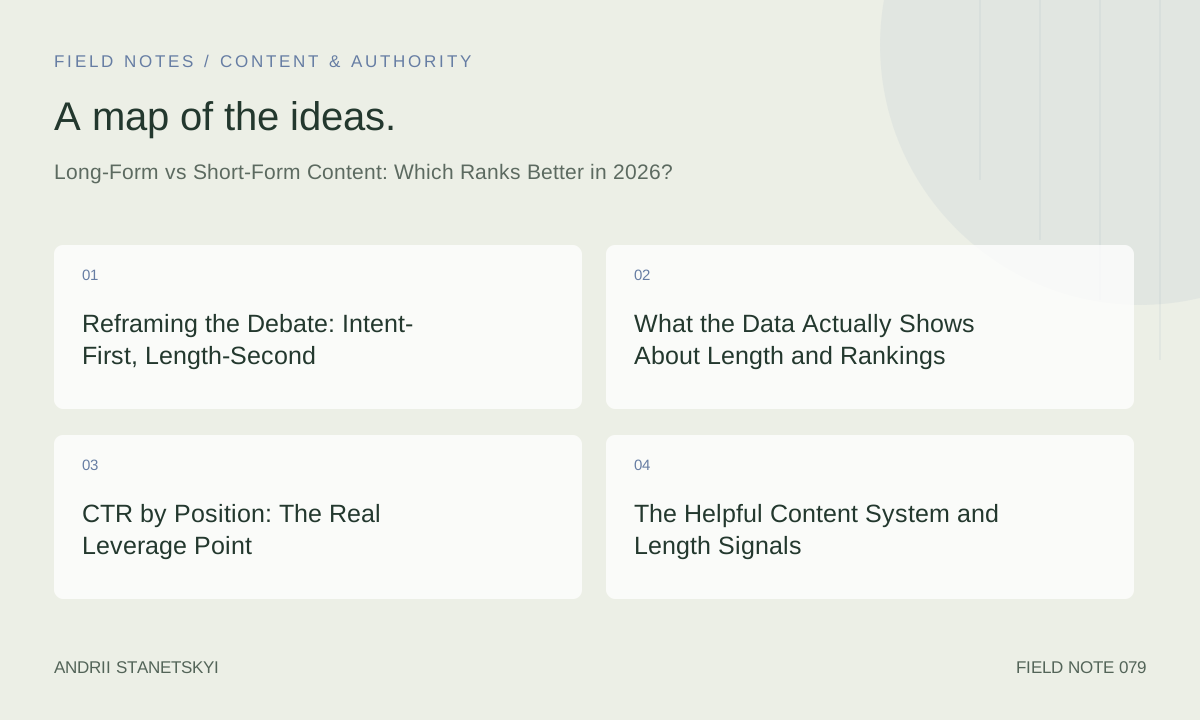
Reframing the Debate: Intent-First, Length-Second
Search intent is not a soft concept. It is the primary filter Google applies before evaluating content quality, authority, or length. If your content mismatches intent — even if it's extraordinarily well-written and comprehensive — it will not rank where it should.
Google classifies search intent into four categories: informational, navigational, commercial investigation, and transactional. The intent category determines the content format Google promotes in SERPs, and format determines the appropriate length range. A transactional query like "buy noise-cancelling headphones under $200" is best served by a comparison page or product listing — not a 4,000-word essay on headphone technology. An informational query like "how does zero trust architecture work" may require 2,500 words to fully satisfy the multi-part implicit question behind it.
Length is a downstream consequence of intent and scope, not a ranking variable you optimize in isolation. Practitioners who set word count targets before understanding intent — "all our blog posts must be 2,000+ words" — are guaranteeing mismatches between content and query for a meaningful percentage of their keyword portfolio.
What the Data Actually Shows About Length and Rankings
Multiple industry studies (Backlinko, Semrush, HubSpot) have reported a correlation between longer content and higher rankings. These studies are frequently cited and frequently misinterpreted. The correlation exists — but the mechanism is misunderstood.
Longer content tends to rank better not because Google rewards word count, but because:
- Comprehensive content naturally includes more semantically related terms, improving topical relevance signals
- Longer content earns more backlinks — informational queries with high research intent attract link-worthy assets
- Longer content increases dwell time, producing a positive engagement signal
- The queries where comprehensive content is needed tend to be the queries with higher search volume and commercial value — creating a selection bias in the correlation data
The 2023 and 2024 Helpful Content Updates explicitly stated that length is not a ranking factor — padding content to hit a word count target is actively penalized. Posts that artificially extend content with repetition, excessive caveats, or filler paragraphs perform worse than shorter, denser content addressing the same query.
Semrush 2025 Ranking Factors Study
Semrush's 2025 study of 700,000 keywords found that content in the top 3 positions averaged 1,890 words for informational queries, 1,320 words for commercial queries, and 640 words for transactional queries. The standard deviation within each category was substantial — meaning intent alignment explained far more variance than length alone.
CTR by Position: The Real Leverage Point
Content length decisions should be understood in the context of where they put you — and what that position earns in click-through rate. The CTR differential between positions is dramatic and non-linear.
| Position | Average CTR (Desktop) | Average CTR (Mobile) | CTR Range |
|---|---|---|---|
| 1 | 28.5% | 24.8% | 22–39% |
| 2 | 15.7% | 13.2% | 11–20% |
| 3 | 11.0% | 9.4% | 8–14% |
| 4 | 8.1% | 6.7% | 5–11% |
| 5 | 6.1% | 5.0% | 4–9% |
| 6–10 | 2.5–4.3% | 2.0–3.6% | 1–6% |
| 11–20 | 0.5–1.8% | 0.3–1.4% | <2% |
The practical implication: the content quality decision that moves you from position 4 to position 2 for a 5,000-search/month keyword is worth roughly 380 additional monthly clicks. Length only matters insofar as it contributes to that quality decision. A 1,200-word article at position 2 beats a 3,500-word article at position 7 every time.
GSC Performance data is your calibration tool. For any keyword cluster, filter GSC by URL path, sort by average position, and identify pages hovering at positions 8–15 — these are your content improvement candidates. The question is not "should I make this longer?" but "what is missing from this content that the pages ranked above me provide?"
-- GSC BigQuery: identify content improvement candidates by position band
SELECT
  query,
  page,
  AVG(position) AS avg_position,
  SUM(impressions) AS impressions,
  SUM(clicks) AS clicks,
  ROUND(SUM(clicks)/SUM(impressions)*100, 2) AS ctr_pct
FROM project.dataset.gsc_data
WHERE
  date BETWEEN DATE_SUB(CURRENT_DATE(), INTERVAL 90 DAY) AND CURRENT_DATE()
  AND position BETWEEN 8 AND 20
  AND impressions > 200
GROUP BY query, page
ORDER BY impressions DESC
LIMIT 100;
The Helpful Content System and Length Signals
Google's Helpful Content System, now integrated into the core ranking algorithm (not a periodic update), applies a site-wide quality classifier. A key signal this classifier uses: does the content demonstrate first-hand experience and expertise, or is it produced primarily for search engines?
The length-relevance implication: thin content produced at scale — 500-word articles written to capture long-tail keywords without genuine informational depth — is a Helpful Content risk flag. Not because the content is short, but because the pattern of producing high volumes of short, low-depth content is associated with SEO-first rather than user-first publishing behavior.
Conversely, a site with 30 carefully crafted 800-word articles, each precisely answering a specific question with genuine expertise, is not a Helpful Content target. The question is not length — it's authenticity of value.
When Long-Form Wins
Long-form content (2,000+ words) has demonstrable advantages in specific conditions:
Complex Informational Queries
Queries where the implicit question has multiple sub-components — "how to implement zero trust security" implies questions about what zero trust is, when to use it, what tools are needed, how to phase implementation, and what pitfalls exist. A 2,500–4,000 word article can address all of these; a 600-word article cannot.
High Keyword Difficulty Verticals
When competing against high-DA sites for competitive keywords, content comprehensiveness is often the differentiator. A thorough 3,500-word treatment with original data, frameworks, and examples can outperform a high-authority competitor's thin 800-word coverage of the same topic.
Link-Magnet Content
Research articles, original surveys, comprehensive guides, and "ultimate" reference pieces earn disproportionate backlinks relative to short-form content. If link acquisition is part of the content's job, longer content formats with original data are the right bet.
Featured Snippet and PAA Capture
Long-form articles with well-structured H2/H3 sections and explicit question-answer formatting capture more featured snippets and People Also Ask boxes. These SERP features effectively give a long-form page multiple points of SERP presence beyond its organic position.
When Short-Form Wins
Short-form content (under 1,000 words) wins in conditions that are equally specific:
Navigational and Transactional Queries
When users already know what they want and are searching to complete a task — "Ahrefs pricing", "Surfer SEO login", "content audit checklist template" — brevity and directness are optimal. A long-form treatment of a transactional query signals content-intent mismatch and performs accordingly.
Definition and Glossary Terms
Single-concept definitional queries ("what is topical authority", "define content velocity") are typically best served by concise, precise answers. Google's featured snippet algorithm rewards clean definition formats, not exhaustive treatments.
News and Timely Content
Breaking news, product updates, and event coverage compete in a freshness-weighted environment where speed and precision matter more than length. These pieces are often 400–800 words and aim for Google News visibility rather than organic ranking longevity.
Content for High-Bounce-Tolerance Audiences
When your audience segment (social media traffic, newsletter subscribers visiting for a quick update) has a documented preference for brevity, forcing long-form on them inflates bounce rate and suppresses the engagement signals you need. Know your traffic source and calibrate accordingly.
Using Surfer, Clearscope, and Frase to Determine Optimal Length
Content optimization tools provide data-driven length guidance by analyzing the SERP competitors currently ranking for a target keyword. Each tool approaches this differently:
Surfer SEO
Surfer's Content Editor shows the word count range of pages ranking in positions 1–10 for your target keyword. The "guidelines" panel recommends a word count range based on the top-performers' average. Critically, Surfer also shows NLP term frequency — the semantic terms appearing most in top-ranking content — which is often more actionable than the word count guidance alone.
Limitation: Surfer recommendations can be gamed by outliers. A top-10 SERP with one 8,000-word outlier inflates the average. Always review the individual distribution, not just the mean.
Clearscope
Clearscope's grading system evaluates content against term usage benchmarks derived from top-ranking pages. It is less prescriptive about length and more prescriptive about topic coverage — which aligns better with how Google actually evaluates content. An A-grade Clearscope score with 1,200 words is preferable to a B-grade score with 3,000 words.
Frase
Frase's AI-powered brief generation includes a word count recommendation with a rationale. Its strength is the question research layer — surfacing the actual questions users ask around a keyword, which directly informs whether short or long-form is appropriate. If a keyword surfaces 12 distinct user questions in Frase's research, you probably need 2,500+ words to address them adequately. If it surfaces 2–3, 800 words may be sufficient.
See our complete tool comparison: Surfer vs Clearscope vs FraseMini Case Studies: Length Decisions That Changed Rankings
Case Study A: Expanding Short-Form to Earn Position 1
An HR software blog had a 750-word article on "employee onboarding checklist" ranking at position 11. Competitor analysis revealed positions 1–5 all featured 2,000–3,200 word articles including interactive checklists, role-specific examples, and legal compliance sections. The article was expanded to 2,800 words with a downloadable Google Sheets checklist. Within 10 weeks, it moved from position 11 to position 3, increasing monthly organic traffic to the page from 240 to 1,680 visits.
Case Study B: Trimming Long-Form to Recapture Featured Snippet
A fintech publication had a 4,200-word article on "how to open a business bank account" that had lost its featured snippet position to a competitor's 900-word article. An audit revealed the first 800 words contained excessive background context before reaching the actual step-by-step process Google was featuring. The article was restructured: the step-by-step section moved to the top, background context relocated to an H2 later in the page. Featured snippet recaptured within 3 weeks; the overall article remained 3,800 words but the intent-match at the top of the page improved dramatically.
The Length Decision Framework
| Query Type | Intent | Competitor Avg. Length | Recommended Range | Primary Format |
|---|---|---|---|---|
| How-to / Process | Informational | Any | Match or +15% | Numbered steps, H3 headers |
| Definition | Informational | Any | 600–1,000 | Definition block, FAQ |
| Comparison | Commercial | Any | 1,500–2,500 | Comparison table, scored criteria |
| Best [X] for [Y] | Commercial | Any | 2,000–3,500 | Listicle with evaluation criteria |
| Buy / Pricing / Sign up | Transactional | Any | 400–800 | Landing page with CTA |
| News / Trend | Informational (fresh) | Any | 400–900 | Inverted pyramid |
| Ultimate Guide / Hub | Informational (broad) | 3,000+ | 3,000–6,000 | ToC, multiple H2/H3 sections |
The core rule: set content length to match or slightly exceed the average length of pages ranking in positions 1–5 for your specific target keyword, calibrated by intent type. Do not add length that doesn't add information. Do not truncate content that leaves questions unanswered.
Related: How to conduct a competitive content audit using Ahrefs and GSC Google's documentation on creating helpful, reliable, people-first contentFAQ
Is 2,000 words still the "sweet spot" for blog posts?
No. The 2,000-word recommendation was a useful heuristic in 2019–2021 when comprehensive content was systematically underrepresented in most niches. Today, the SERP landscape is more competitive and the optimal length is query-specific. Use competitor analysis through Surfer or Clearscope to set target length, not industry averages.
Can short articles rank for competitive keywords?
Yes, when the intent is transactional or definitional and the page is highly optimized for conversion or direct answer formatting. However, for competitive informational keywords — where the top-10 is occupied by 2,000–4,000 word comprehensive guides — a 600-word article will rarely break into the top 5 regardless of other optimization factors.
Does word count directly affect Google rankings?
No. Google has explicitly stated that word count is not a ranking factor. What correlates with rankings is the presence of comprehensive, semantically relevant content — which often produces higher word counts as a byproduct. Target informational completeness, not word count.
How do I find the right content length for a specific keyword?
Run the keyword in Surfer Content Editor or Frase. Review the word count distribution of pages ranking in positions 1–10. Identify the median (not mean) length. Set your target at the median +10–15% if your domain authority is lower than most competitors, or at the median if authority is comparable. Always cross-check against search intent — if the SERP is dominated by 3,000-word articles but the query is clearly transactional, trust intent over data.
Does short-form content harm a site's Helpful Content signal?
A small number of short, precisely useful articles does not harm a site. A large volume of thin, short articles with low information density — particularly if they appear to target keywords rather than answer genuine user questions — is a Helpful Content risk. The classifier is looking at patterns across the site, not individual page length.
How should I handle content that's ranking at position 8–12?
Audit the top-ranking competitors for that keyword: (1) What is their word count? (2) What questions do they answer that your content doesn't? (3) What structural elements (tables, steps, FAQ, original data) do they use that yours lacks? The gap between position 12 and position 3 is usually a content coverage gap, not a length gap. Fill the coverage gap; length will follow naturally.
Is there a difference between long-form for SEO and long-form for readers?
Yes, and reconciling them is the craft challenge. Long-form for SEO needs to cover the topic's full semantic territory, include supporting subtopics, and address common questions. Long-form for readers needs a strong hierarchy, progressive disclosure, and clear payoff for the time investment. A well-structured long-form article achieves both: the H2/H3 structure provides SEO signals while also giving readers scannable navigation. Poor long-form content sacrifices reader experience for coverage and achieves neither goal well.
Key Takeaways
- Content length is not a ranking factor. Informational completeness relative to search intent is the underlying variable that length correlates with — target the latter, not the former.
- CTR drops non-linearly from position 1 (~28%) to position 5 (~6%) to position 10 (~2%). The content decisions that move you up positions are more valuable than almost any other optimization lever.
- Google's Helpful Content System penalizes patterns of thin, keyword-stuffed short-form production. A site with 50 thin articles is at more risk than a site with 20 comprehensive ones.
- Long-form wins for: complex informational queries, high-competition verticals, link-magnet assets, and SERP feature capture.
- Short-form wins for: transactional queries, definitions, news content, and audiences with documented brevity preferences.
- Use Surfer, Clearscope, or Frase to determine competitor word count distributions for specific keywords — then calibrate to the median, adjusted for your domain authority relative to top-rankers.
- For content ranking at positions 8–15 with high impression volume, the intervention is almost always content coverage expansion, not arbitrary word count inflation.
Conclusion
The long-form vs short-form debate is the wrong frame. The right frame is: what does this query require to be fully satisfied, and what do the current top-ranking pages provide that my content doesn't? The answer to those questions determines length as a consequence of quality decisions, not as a primary variable to be targeted.
Build the habit of running GSC Performance analysis before making length decisions. Let position data and CTR benchmarks guide your prioritization. Let competitor analysis guide your content scope. Let intent classification guide your format. Length will take care of itself.