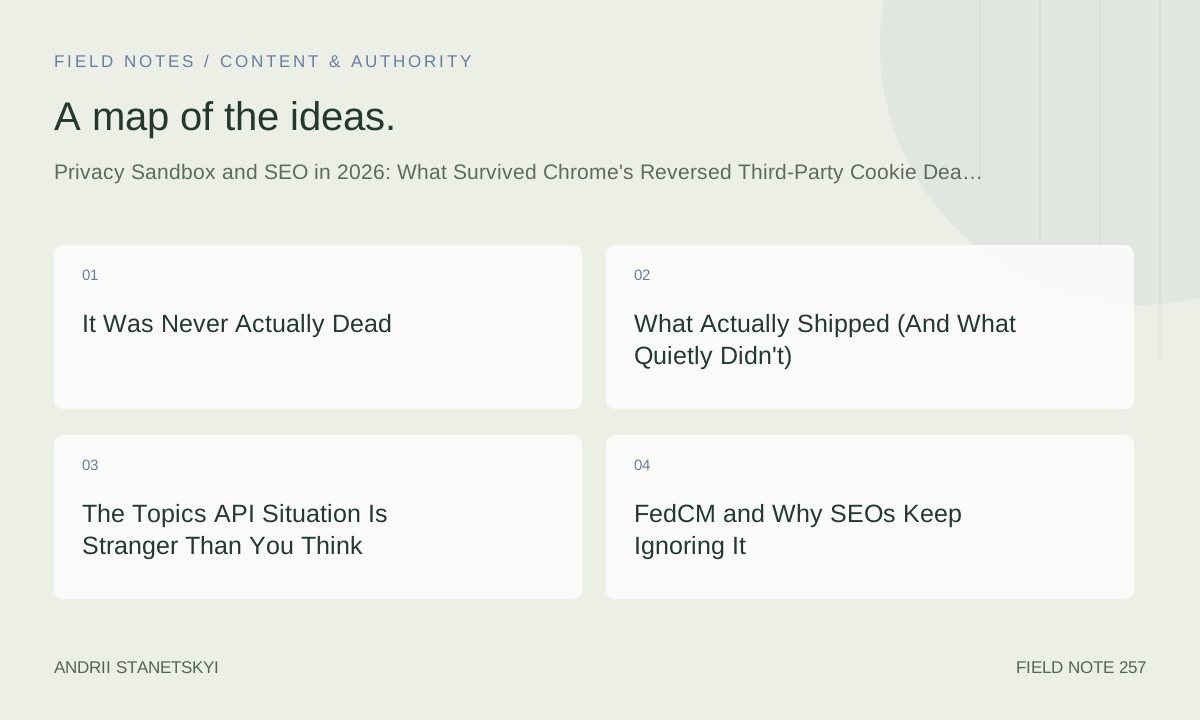
It Was Never Actually Dead
The third-party cookie obituary I wrote in my head sometime around late 2023 turned out to be premature. I had it fully drafted. I had the narrative arc, the solemn retrospective, the triumphant pivot to first-party data as the obvious successor. Then Google reversed course, third-party cookies survived in Chrome, and I had to delete about four months of positioning work from client decks.
That reversal happened in mid-2024. If you followed it in real time, you remember the cognitive whiplash. Google's announcement acknowledged that eliminating third-party cookies entirely would create "significant challenges" for web monetization and that they wanted to give the industry "more time." More time. After years of Privacy Sandbox development, trial phases, developer testing, the CMA oversight in the UK, and the entire ecosystem bracing for impact.
What it actually meant: Privacy Sandbox APIs are shipping. Third-party cookies are staying, at least with a user-choice prompt. And SEO professionals are left interpreting what that means for measurement, personalization, and signal fidelity in a world that is now neither the old one nor the new one. It is something in between. Something genuinely weird.
I have spent the last year and a half working inside that weirdness with clients across e-commerce, SaaS, and content publishing. The numbers I was seeing in late 2025 did not match any prediction I had made, and several of the frameworks I had built for clients required substantial revision. This piece is an attempt to be honest about what I got right, what I got badly wrong, and where I think SEOs actually need to focus their attention on May 20, 2026.
What Actually Shipped (And What Quietly Didn't)
Let me be precise, because the vagueness in coverage of Privacy Sandbox has been genuinely harmful to SEO practitioners trying to make decisions.
The APIs that are live in Chrome today in some form: Topics API (with significant limitations), Protected Audience API (formerly FLEDGE), Attribution Reporting API, Shared Storage, Private Aggregation API, FedCM, and Private State Tokens. These are real. They have documentation. Developers can use them.
The gap between "available" and "in widespread production use" is enormous. Topics API has the highest adoption discussion but the lowest actual publisher implementation I have seen across client audits. Attribution Reporting is being used by some ad tech partners, but the conversion data it produces differs from what historical cookie-based attribution produced in ways that most analytics teams have not fully accounted for.
Shared Storage and Private Aggregation are primarily of interest to ad tech companies, not SEOs directly, though they influence the measurement environment SEOs operate in. Protected Audience runs remarketing without third-party cookies, which matters to anyone whose organic-to-paid cross-channel analysis depends on clean audience segmentation.
The Opt-In Prompt Problem
Here is a piece of data I was not prepared for. When Chrome began rolling out the user-choice prompt for third-party cookies in late 2025, opt-out rates in the populations I was tracking varied between 23% and 61% depending on the user cohort, the site context, and how the prompt was surfaced. That range is almost useless for planning purposes. A 23% opt-out on a tech-savvy developer tool audience means something very different than a 61% opt-out on a privacy-focused news publication audience.
What this means for SEO is that even with third-party cookies "surviving," a meaningful and growing share of Chrome users are already operating in a cookieless environment as a matter of their own choice. The Privacy Sandbox APIs fill that gap for those users. So the question of whether to implement them is no longer a future-proofing exercise. It is partially a present-tense operational question.
The Topics API Situation Is Stranger Than You Think
Topics API is the Privacy Sandbox component SEOs have the most surface-area relationship with, because it is the mechanism through which interest-based advertising can theoretically operate without third-party cookies or cross-site tracking. The browser observes browsing behavior, assigns the user to a small set of topic categories from a predefined taxonomy, and shares those topics with ad tech on participating sites.
The taxonomy itself is publicly available. As of now it runs to roughly 470 topics organized in a hierarchy. Here is how a site can query which topics the browser has for a user:
// Topics API: Basic Implementation
// Only works in secure contexts (HTTPS)
// Requires Permissions-Policy header: browsing-topics=()

async function getTopicsForAd() {
  if ('browsingTopics' in document) {
    try {
      const topics = await document.browsingTopics();
      // topics is an array of objects, each with:
      // { configVersion, modelVersion, taxonomyVersion, topic, version }
      console.log('Current user topics:', topics);
      return topics;
    } catch (error) {
      // User may have opted out, or browser support missing
      console.log('Topics unavailable:', error.message);
      return [];
    }
  }
  return [];
}

// Observe topics (for earning topic eligibility on your domain)
async function observeAndGetTopics() {
  const options = { skipObservation: false };
  const topics = await document.browsingTopics(options);
  return topics;
}
The SEO implication that gets underreported: which topics your pages are classified into affects the advertising revenue potential of your content, which in a competitive content landscape can affect whether publishers invest in certain content categories. This is an indirect effect, but it is real.
What the Classification Actually Does
Google's classifier that assigns your pages to topics in the taxonomy is not the same as the systems used for organic search ranking. They share underlying ML infrastructure conceptually, but they are separate models trained on different objectives. I have seen pages with strong topical authority in search rank well for queries where their Topics API classification is inconsistent or absent. They are not the same signal.
You cannot directly optimize your pages for the Topics taxonomy the way you optimize for search intent. But you can audit how your content-heavy pages are classified, and if your site operates in a category where display revenue matters, that audit is worth doing. Tools that surface this are still thin in 2026, though a few enterprise SEO platforms have begun adding Topics classification data into their content audit modules.
A contrarian take
Most SEO commentary treats Topics API as purely an ad tech concern. I disagree. If you run a content operation where display advertising is part of the revenue model, Topics API classification affects your monetization floor in a cookieless user segment. That is a business model concern that flows directly into content investment decisions. Ignoring it because it sounds like "paid media stuff" is leaving real money unexamined.
FedCM and Why SEOs Keep Ignoring It
Federated Credential Management. FedCM. Almost no SEO writeup I have read treats this as their problem.
It is very much their problem.
FedCM is the Privacy Sandbox mechanism that allows federated login flows (Sign in with Google, Sign in with Apple, OAuth-based SSO) to work without third-party cookies. That sounds like a developer concern. It is also a conversion rate concern, a crawlability concern, and in some architectures, a content access concern. Here is a simplified implementation pattern:
// FedCM: Federated Identity without third-party cookies
// Replaces legacy identity federation that relied on cross-site cookies

async function signInWithFedCM() {
  if (!window.IdentityCredential) {
    // FedCM not supported — fall back to legacy OAuth popup
    return legacySignIn();
  }

  try {
    const credential = await navigator.credentials.get({
      identity: {
        providers: [{
          configURL: 'https://accounts.example-idp.com/fedcm.json',
          clientId: 'your-client-id',
          nonce: generateSecureNonce()
        }]
      }
    });

    if (credential) {
      // credential.token is the ID assertion from the IdP
      return authenticateWithServer(credential.token);
    }
  } catch (error) {
    if (error.name === 'IdentityCredentialError') {
      // User dismissed or IdP unavailable
      console.log('FedCM flow failed:', error.message);
    }
  }
}
The SEO angle: sites that put high-value content behind a login gate are increasingly seeing crawl and indexing issues when the login gate depends on federated identity that breaks in environments without third-party cookies. Googlebot does not log in, so this is not a Googlebot issue directly. But it becomes one when your server-side rendering or CDN edge logic makes content decisions based on authentication state that relies on cookie availability.
I worked with a media client in late 2025 where their metered paywall was bleeding indexable content because the metering logic called an OAuth endpoint that behaved differently in Safari and in Chrome with third-party cookies blocked. Pages that should have been soft-gated were returning full blocks to some crawlers and full content to others, creating significant coverage inconsistency in their Search Console data. FedCM migration fixed it. Their SEO team had not recognized this as a Privacy Sandbox issue at all until we traced the crawl behavior to authentication middleware.
If your site has a login, paywall, or personalization layer built on federated identity, FedCM should be on your 2026 technical audit checklist.
Attribution Reporting: My Mistake and the Recovery
I have to be straightforward here because I see others making the same error I made.
In late 2024 and into early 2025, I was advising clients to treat Attribution Reporting API data as a reasonable substitute for the conversion signal they were losing from users who opted out of third-party cookies. I was wrong. Not completely wrong, but wrong in a way that caused real measurement problems for at least two clients whose paid-organic blended attribution models I helped build.
Attribution Reporting API produces aggregated, differentially private reports. The privacy noise built into the system means that for small conversion volumes, the reports are actively misleading. One client was running a B2B campaign where conversions numbered in the dozens per month across targeted keywords. The Attribution Reporting output had noise levels that could flip whether a keyword appeared to be converting at all. We were making bidding and content decisions based on data that was statistically meaningless for that conversion volume.
The fix was not to abandon Attribution Reporting. It was to set appropriate volume thresholds below which we treated the API output as directional only, and to build in longer aggregation windows (90-day rather than 30-day) to accumulate enough signal to dilute the noise. Here is the pattern we implemented for event-level versus summary reports:
// Attribution Reporting API: Source and Trigger Registration
// Two modes: event-level reports and summary (aggregatable) reports

// 1. Register Attribution Source (on ad click/impression)
// Server sets this response header when serving the ad:
// Attribution-Reporting-Register-Source: {
//   "destination": "https://advertiser.example",
//   "source_event_id": "12340873456",
//   "expiry": 2592000,
//   "priority": 100,
//   "aggregation_keys": {
//     "campaignCounts": "0x159",
//     "geoValue": "0x5"
//   }
// }

// 2. Register Trigger (on conversion page)
// Fetch with attributionsrc to fire trigger:
async function registerConversionTrigger(conversionValue) {
  const triggerConfig = {
    event_trigger_data: [{
      trigger_data: "1",
      priority: "100",
      deduplication_key: crypto.randomUUID()
    }],
    aggregatable_trigger_data: [{
      key_piece: "0x400",
      source_keys: ["campaignCounts"]
    }],
    aggregatable_values: {
      campaignCounts: conversionValue
    },
    // Noise mechanism threshold — critical for small-volume advertisers
    aggregatable_filtering_id_max_bytes: 1
  };

  // Trigger registration via fetch
  await fetch('https://adtech.example/report', {
    keepalive: true,
    attributionsrc: ''
  });
}

// Summary report output arrives at your registered aggregation service
// Report noise epsilon is ~17.6 by default — substantial for low volumes
// Threshold for statistical reliability: >1000 attributable conversions/window
The comment in that code about >1000 conversions per window is something I wish someone had told me explicitly in 2024. Google's documentation mentions noise levels but does not make the practical implication obvious: if your monthly conversions are below a few hundred, the summary reports require careful statistical treatment before you act on them.
The recovery lesson for SEOs: do not hand Attribution Reporting outputs to paid media teams without a briefing on what the noise means. The teams that are doing this well in 2026 have a hybrid model where Attribution Reporting feeds directional trends, GA4 with consent mode fills conversion modeling, and first-party CRM data anchors the ground truth.
Private State Tokens Are Not a Cookie Replacement
A frustratingly common mischaracterization in SEO writing. Private State Tokens (formerly Trust Tokens) are a mechanism for conveying trust signals about a user across contexts without revealing identity. They are primarily used to fight fraud, not to maintain personalization state.
// Private State Tokens (PST): Issuing and Redeeming
// Use case: Anti-fraud, bot detection, trust propagation
// NOT suitable for: session management, user preferences, personalization

// Token Issuance (happens on a site where user is known/trusted)
// Requires Private-Token HTTP header in fetch requests
async function issuePrivateStateToken() {
  // This runs on the issuer's origin
  // Issuance is triggered by a fetch with privateToken option
  const response = await fetch('https://issuer.example/issue-token', {
    privateToken: {
      operation: 'token-request',
      // version: 1 per current PST spec
    }
  });
  // Browser stores the token — not accessible to JS
  return response.ok;
}

// Token Redemption (happens on a different site needing trust signal)
async function redeemPrivateStateToken() {
  const response = await fetch('https://issuer.example/redeem', {
    privateToken: {
      operation: 'token-redemption',
      refreshPolicy: 'none'
    }
  });
  // Redemption Record (RR) is now attached to the user's browser state
  // for this browsing session

  // Downstream: send RR with subsequent requests
  const protectedRequest = await fetch('https://your-api.example/data', {
    privateToken: {
      operation: 'send-redemption-record',
      issuers: ['https://issuer.example']
    }
  });
}
Where this touches SEO: bot traffic quality. If your analytics or crawl budget is distorted by sophisticated bot traffic, Private State Tokens offer a browser-native mechanism for trusted issuers to vouch for human users. Sites that integrate with PST-compatible anti-fraud providers can potentially segment bot traffic out of behavioral signals more cleanly than purely server-side bot detection allows.
This is not a front-page SEO concern for most sites. For large-scale content operations where bot inflation of traffic metrics is a recurring problem, understanding PST as part of your signal hygiene toolkit is worth the time.
Two Things Everyone Gets Wrong
Wrong Thing One: First-Party Data Is Not the Answer to Privacy Sandbox
The "first-party data is the future" narrative has become so dominant in marketing conversations that it functions more as a comfort blanket than a strategy. Yes, first-party data is valuable. Yes, it is not subject to third-party cookie deprecation. But the volume and diversity of signal that third-party cookies enabled at scale cannot be replicated by first-party data for most publishers, and pretending otherwise leads to underinvestment in the Privacy Sandbox APIs that actually address the gap.
For a mid-sized content publisher with 2 million monthly uniques, maybe 3-8% of those users are logged in. Maybe. The first-party data strategy covers that slice. The other 90-plus percent are reached through privacy-preserving mechanisms like Topics and Protected Audience, or they are not reached with personalization at all. Calling first-party data "the answer" for that publisher is analytically irresponsible.
Related reading on audience signal strategy is covered in our audience signal strategy guide.
Wrong Thing Two: Privacy Sandbox Is an Ad Tech Problem
I have made this case throughout this piece but let me be direct about why the "that's a paid media thing" dismissal is a strategic error for SEOs.
The measurement environment in which organic search value is attributed exists downstream of the same privacy mechanisms that affect paid media. When your client asks "what is the SEO ROI for this content cluster," and you are relying on GA4 behavioral data, consent mode modeling, and cross-channel attribution, you are already inside the Privacy Sandbox ecosystem. You are already interpreting data that is shaped by these APIs. Understanding how that data is generated and where its limitations are is not a paid media skill. It is a measurement literacy skill that every serious SEO practitioner needs.
More on measurement frameworks in our SEO measurement frameworks series.
The CAFE Framework for Privacy-Era SEO
After spending most of 2025 rebuilding measurement and content strategy frameworks for clients operating in this environment, I settled on a way of organizing the decision space that I find useful enough to share. I call it CAFE.
C — Consent Architecture. What percentage of your users are operating under which consent states? Do you know your actual opt-in/opt-out rates for third-party cookies in Chrome? Your Safari ITP exposure? Your Firefox Enhanced Tracking Protection exposure? This is the foundation. Without it, everything else is guesswork. Segment your analytics to understand your cookieless user population before you touch anything else.
A — API Readiness. Which Privacy Sandbox APIs are relevant to your measurement and personalization stack? Have you or your ad tech partners implemented Attribution Reporting? Are you receiving Topics observations on your content pages? This is an audit question, not a deployment question. Know what is running before you decide what to change.
F — First-Party Fidelity. How clean and complete is your first-party data collection? CRM integration with analytics, login state tracking, newsletter subscriber behavior, on-site search data. This is not about replacing cookies. It is about making sure your high-quality first-party signal is being captured and used. Many sites I audit are collecting this data but not connecting it to SEO decision-making in any systematic way.
E — Exposure to Noise. This comes directly from my Attribution Reporting mistake. For every measurement source you rely on, what are the noise characteristics? GA4 modeling thresholds, Attribution Reporting noise levels, Topics taxonomy classification lag. Knowing where your data has noise baked in tells you which signals to weight heavily and which to treat as directional.
CAFE is not a technical framework. It is a diagnostic structure. Run through it for any client before making recommendations that depend on behavioral or conversion data. The number of times I find "A" and "E" are unknown even to fairly sophisticated teams is consistently higher than I expect.
See also our 2026 technical SEO audit checklist for how CAFE integrates into a full site audit.
Where We Are Standing on May 20, 2026
The honest state of things today.
Chrome has third-party cookies with a user-choice prompt. A meaningful share of users are opting out. That share is growing. Privacy Sandbox APIs are available and being adopted at uneven rates across the ad tech ecosystem. The measurement environment for SEO has more uncertainty baked into it than it did in 2022, and that uncertainty is structural rather than temporary.
SEOs who spent the last two years waiting to see how the cookie situation "resolved" before adapting their measurement practices are behind. Not catastrophically, but meaningfully. The waiting was rational given the genuine unpredictability of Google's announcements, but the uncertainty has not resolved and will not fully resolve. The prompt-based opt-out system means the cookieless population is a permanent feature of Chrome, not a future state.
The sites that are in the best position right now share a few characteristics. They have consent architecture that tells them what their actual cookieless user percentage is. They are not making major content investment decisions based on behavioral data without checking whether that data is from consenting or modeled users. They have tested Attribution Reporting against their actual conversion volumes. They have technical SEO audits that explicitly include FedCM and authentication middleware in their coverage checks.
And they are not panicking. The SEO fundamentals have not changed. Content quality, topical authority, crawlability, Core Web Vitals. None of that is affected by Privacy Sandbox. What changed is the precision of the measurement environment around that work. Learning to operate with more noise, more uncertainty, and more explicit acknowledgment of data limitations is the actual skill the moment is asking for.
For more on the technical foundations that remain stable through privacy changes, the work at Google's web.dev Privacy Sandbox documentation is the most reliable primary source I return to, even when I disagree with how Google has handled the broader rollout.
For anyone still trying to build a single coherent picture of "what Privacy Sandbox means for SEO," I would say: that picture does not exist yet. What exists is a set of overlapping systems, each with different adoption timelines, different noise characteristics, and different implications for different types of sites. The CAFE framework is my attempt at navigating that without pretending to a certainty that the situation does not support.
We are building planes while flying them. That has been true of SEO for its entire existence. This is a harder version of the same challenge, not a fundamentally different one.
Detailed coverage of how these changes affect specific verticals is in our vertical-by-vertical Privacy Sandbox impact analysis.
Frequently Asked Questions
- Does Privacy Sandbox affect organic search rankings?
- Not directly. Google has stated that Privacy Sandbox APIs are not ranking signals. However, the measurement and behavioral data that SEOs use to make content and optimization decisions is generated within an environment shaped by Privacy Sandbox, so indirectly the quality and reliability of your decision inputs is affected.
- Should I implement Topics API on my site?
- If your site runs display advertising and you have a meaningful share of users operating without third-party cookies, yes. Topics API observations allow your site to contribute to the interest-based advertising system for those users, which has revenue implications for content-heavy sites. If you run a pure SaaS or B2B site with minimal display advertising, it is lower priority.
- How does FedCM affect SEO crawling?
- FedCM itself does not affect Googlebot crawling directly, since Googlebot does not authenticate. The indirect effect is through paywalls, login gates, and personalization layers that behave differently depending on whether third-party cookies are available. If your site's content access logic runs through federated identity middleware, audit whether that middleware behaves consistently across cookie-blocked environments.
- What is the minimum conversion volume for Attribution Reporting to be reliable?
- The Privacy Sandbox documentation does not give a clean number, but practitioners working with the API have generally found that summary reports become statistically meaningful around 1000 or more conversions per aggregation window. Below that threshold, treat the data as directional rather than actionable. Event-level reports have different noise characteristics and may be more useful for lower-volume scenarios.
- Are Private State Tokens useful for fighting SEO spam and bot traffic?
- As a direct tool for SEOs, no. As part of a broader bot detection and signal hygiene infrastructure operated by your analytics or security platform, potentially yes. Private State Tokens allow trusted issuers to vouch for human users, which can improve the quality of behavioral signals feeding into analytics. The value depends on whether your analytics vendor or bot detection provider has implemented PST issuance.
- Has the Chrome cookie reversal made Privacy Sandbox less important for SEOs?
- No, for two reasons. First, the opt-out prompt means a growing share of Chrome users are already in a de facto cookieless state. Second, Safari and Firefox have never relied on third-party cookies, so any site with meaningful non-Chrome traffic is already operating in a mixed environment. Privacy Sandbox addresses the Chrome cookieless population specifically, and that population is real and growing regardless of whether cookies were "officially" deprecated.