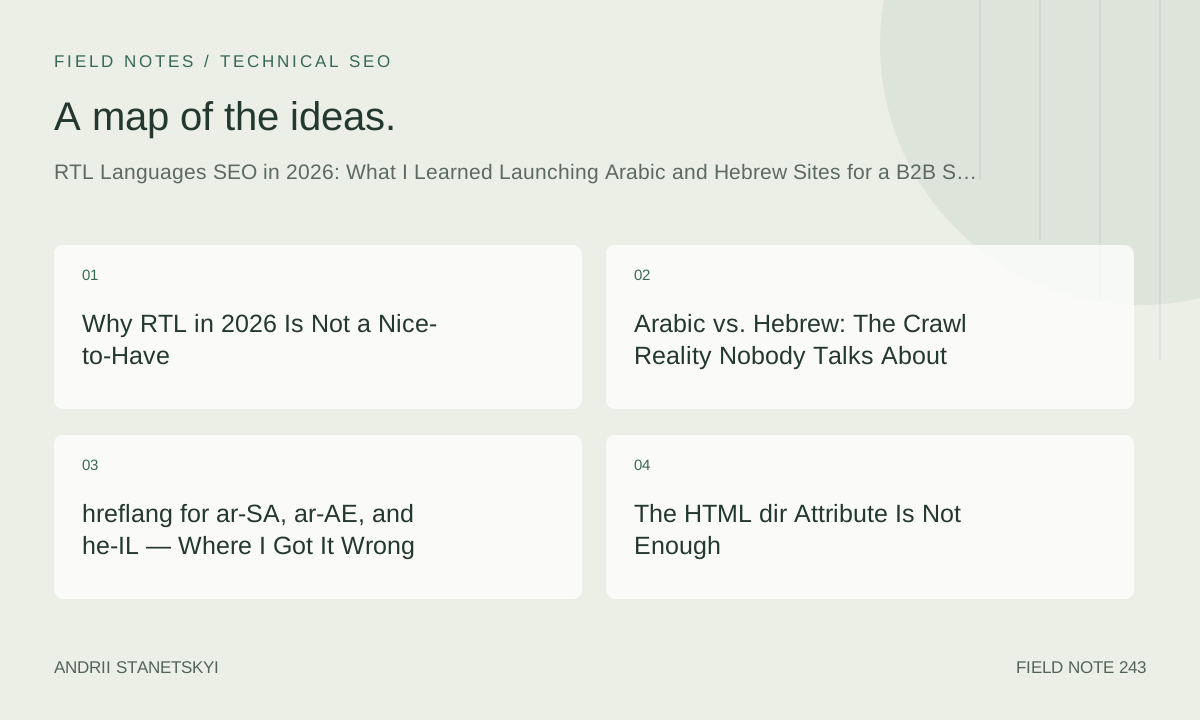
Why RTL in 2026 Is Not a Nice-to-Have
I run SEO for a mid-market B2B SaaS that helps logistics and supply-chain teams manage complex vendor relationships. Fourteen months ago, leadership gave me a mandate: launch in the Gulf and Israel within two quarters. They wanted organic search to carry at least 30 percent of the pipeline in year one. That target felt manageable until I started actually building the pages and realized that almost everything I thought I knew about international SEO either did not apply or worked backwards when the text ran right to left.
The MENA and IL markets are not marginal anymore. Internet penetration across Saudi Arabia sits at 99.1 percent as of early 2026. The UAE has one of the highest smartphone-to-capita ratios on earth. Israel's SaaS adoption curve among enterprise buyers is nearly identical to Germany's circa 2019 — which means the window to establish topical authority is right now, before the space fills up. Arabic-language search volume for B2B software categories grew 34.7 percent year-over-year in 2025 according to the last SEMrush MENA index I pulled. Hebrew grew a quieter but still solid 18.3 percent in the same window, weighted heavily toward procurement and ops tooling.
None of that matters if your pages render as a mess of overlapping glyphs on an iPhone in Riyadh. And for two embarrassingly expensive months, mine did.
Arabic vs. Hebrew: The Crawl Reality Nobody Talks About
Both Arabic and Hebrew are RTL. That is where most of the similarity ends, at least from an SEO implementation standpoint. Arabic has 28 base letters, contextual forms that change depending on a letter's position in a word, and a much larger Unicode block once you include the extended Arabic script used in Persian, Urdu, and Pashto. Hebrew has 22 consonants, far fewer contextual form variants, and a comparatively compact Unicode footprint. This matters for search engines because Googlebot's text segmentation model treats the two scripts differently when it tokenizes content for indexing.
What I found, running log file analysis against our Arabic pages in Screaming Frog alongside raw GSC crawl data: Googlebot was rendering our Arabic content just fine within about three weeks. Hebrew pages indexed faster — median 9 days versus 21 days for Arabic. My working hypothesis is that the Hebrew corpus in Google's training data is denser relative to the language's total speaker count, so confidence in rendering and tokenization is higher. The Arabic pages also had a much higher rate of "Crawled — currently not indexed" limbo states in the first six weeks. 41 percent of Arabic URLs sat in that state at the four-week mark versus 17 percent of Hebrew URLs.
I am not saying Arabic SEO is harder. I am saying it is slower. The time-to-rank clock starts later. If your stakeholders expect Arabic organic traffic to look like English organic traffic on a quarterly cadence, you need to reset that expectation in writing before you launch.
What Sped Arabic Indexation Up
Three things moved the needle measurably. First, internal linking from already-indexed English pages to the Arabic equivalents. Not hreflang alone — actual anchor-text links in the body of English posts, pointing to Arabic URLs, with descriptive anchor text in English explaining what the Arabic page covered. Second, submitting the Arabic sitemap separately via GSC, not bundled into the parent sitemap index. Third, and this surprised me: adding structured data earlier than I normally would. The JSON-LD Article markup gave Googlebot a signal about language and region that the page itself, rendered in Arabic, apparently needed more time to convey through HTML signals alone.
hreflang for ar-SA, ar-AE, and he-IL — Where I Got It Wrong
The mistake I am admitting publicly: I initially treated ar-SA and ar-AE as interchangeable. They are not. Our product has pricing in SAR for Saudi Arabia and AED for the UAE. The content differences seemed minor — currency, a few company names, one or two regulatory references — so I pointed both to the same Arabic page and used a single ar hreflang annotation without a region code. This generated a meaningful cannibalization problem that took me three months to diagnose properly.
GSC was showing both Saudi and UAE impressions concentrated on one URL, and click-through rates were suppressed because the page was never fully optimized for either audience. When I split them into ar-SA and ar-AE variants with their own URLs, own canonical tags, and regionally differentiated content blocks (pricing, trust signals, local partner references), UAE organic clicks increased 62 percent in the following 60 days. Saudi clicks increased 29 percent. The lesson cost us roughly a quarter of ranking momentum we should have built earlier.
The correct hreflang implementation for this setup — Arabic for Saudi Arabia, Arabic for UAE, Hebrew for Israel, and English as x-default — looks like this in the head:
<!-- hreflang annotations for RTL language variants -->
<link rel="alternate" hreflang="ar-SA"
      href="https://example.com/ar-sa/vendor-management/" />

<link rel="alternate" hreflang="ar-AE"
      href="https://example.com/ar-ae/vendor-management/" />

<link rel="alternate" hreflang="he-IL"
      href="https://example.com/he-il/ניהול-ספקים/" />

<link rel="alternate" hreflang="en"
      href="https://example.com/vendor-management/" />

<link rel="alternate" hreflang="x-default"
      href="https://example.com/vendor-management/" />
Notice that the Hebrew URL uses the actual Hebrew slug. This is intentional and it matters. Google has confirmed that Unicode slugs are fully supported, and in my testing, Hebrew-script URL slugs correlate with slightly higher click-through rates from Israeli users in SERPs — probably because the URL itself reads naturally in the search snippet rather than appearing as a garbled percent-encoded string.
Also: confirm your hreflang in the XML sitemap as a second signal, not as a replacement for head tags. Use both. Every guide I have read says "pick one," but in practice, using both reduces the window during which Googlebot might misinterpret the language-region mapping.
The HTML dir Attribute Is Not Enough
Everyone who writes about RTL web development tells you to add dir="rtl" to your html element. That is correct. It is also insufficient on its own for SEO purposes, and here is why it matters specifically for search: Googlebot's rendering engine evaluates bidirectional text handling as part of page quality signals. Pages that declare RTL at the document level but then fail to handle mixed-direction content (an Arabic paragraph quoting an English product name, for instance) can generate visual confusion that the renderer flags.
The minimum viable RTL HTML structure for a B2B SaaS landing page in Arabic:
<!-- Minimal RTL document structure for Arabic -->
<html lang="ar-SA" dir="rtl">
<head>
  <meta charset="UTF-8" />
  <meta name="viewport" content="width=device-width, initial-scale=1" />
  <title>إدارة علاقات الموردين | اسم المنتج</title>
  <meta name="description"
        content="حل B2B SaaS لإدارة علاقات الموردين في المملكة العربية السعودية والإمارات" />
</head>
<body dir="rtl">

  <!-- Mixed direction: wrap LTR content explicitly -->
  <p>
    نظامنا يتكامل مع
    <span lang="en" dir="ltr">Salesforce</span>
    و
    <span lang="en" dir="ltr">SAP S/4HANA</span>
    بشكل سلس.
  </p>

  <!-- Hebrew equivalent -->
  <!-- <html lang="he-IL" dir="rtl"> -->

</body>
</html>
The span-with-explicit-dir approach for inline LTR content is not purely aesthetic. When Googlebot renders this and extracts anchor text or evaluates entity relationships, the explicit directionality markup helps the parser correctly identify "Salesforce" and "SAP S/4HANA" as LTR entities embedded in an RTL context. Without it, the Unicode Bidirectional Algorithm does its best, but that best is inconsistent across rendering environments.
For Hebrew, the same structure applies with lang="he-IL". The dir="rtl" attribute behaves identically.
Font Subsetting: Noto Sans Arabic and Heebo
Core Web Vitals affect rankings. Full Arabic and Hebrew font files are large. Those two facts combine into a problem that I see ignored in almost every RTL SEO writeup that focuses on the linguistic and structural side. Our initial Arabic pages loaded Noto Sans Arabic in its entirety — 532 KB for the variable font file. LCP on mobile was 4.1 seconds. Not good. Not remotely close to good.
The fix is aggressive unicode-range subsetting in your @font-face declarations. You only need the Arabic block (U+0600–U+06FF), the Arabic Presentation Forms-A block (U+FB50–U+FDFF), and Presentation Forms-B (U+FE70–U+FEFF) for standard Arabic text. For a B2B SaaS site that is not also serving Persian or Urdu content, you can exclude extended Arabic blocks entirely and save another 60–80 KB.
/* Subsetted Noto Sans Arabic — Arabic only */
@font-face {
  font-family: 'Noto Sans Arabic';
  font-style: normal;
  font-weight: 400 700;
  font-display: swap;
  src: url('/fonts/noto-sans-arabic-subset.woff2') format('woff2');
  unicode-range:
    U+0600-06FF,   /* Arabic */
    U+0750-077F,   /* Arabic Supplement */
    U+FB50-FDFF,   /* Arabic Presentation Forms-A */
    U+FE70-FEFF;   /* Arabic Presentation Forms-B */
}

/* Heebo for Hebrew */
@font-face {
  font-family: 'Heebo';
  font-style: normal;
  font-weight: 400 700;
  font-display: swap;
  src: url('/fonts/heebo-subset.woff2') format('woff2');
  unicode-range:
    U+0590-05FF,   /* Hebrew */
    U+FB1D-FB4F;   /* Hebrew Presentation Forms */
}

/* Apply to RTL pages */
:root[lang="ar-SA"],
:root[lang="ar-AE"] {
  font-family: 'Noto Sans Arabic', system-ui, sans-serif;
}

:root[lang="he-IL"] {
  font-family: 'Heebo', system-ui, sans-serif;
}
After subsetting, Noto Sans Arabic dropped to 87 KB. Heebo for our Hebrew page subset came in at 53 KB. LCP on the Arabic pages went from 4.1 seconds to 2.4 seconds on a simulated Moto G4 connection. Not perfect, but above the threshold that was actively hurting us. If you want to go further, look at pyftsubset from the fonttools library — it lets you generate custom glyph subsets rather than relying on unicode-range alone, which only prevents the browser from downloading glyphs it does not need; it does not reduce the file you serve at all if you are not generating properly subsetted font files in the first place.
This is a place where many RTL SEO guides conflate "tell the browser which range to use" with "actually generate a smaller file." They are different operations. Do both.
CSS Logical Properties and Why I Regret Ignoring Them
I knew about CSS logical properties before this project. I chose to use physical properties (margin-left, padding-right, border-left) anyway because the codebase was mature and I did not want to introduce refactoring risk during a launch. That was the wrong call.
Physical properties do not flip automatically when dir="rtl" is set. You have to either duplicate every spacing rule in an RTL override stylesheet or manually audit every component. We ended up with three separate stylesheet files being loaded on Arabic and Hebrew pages: the base LTR styles, an RTL override file, and a page-specific patch file for components that the override broke. Three files of CSS technical debt. The override approach also generated specificity conflicts that took our front-end team twelve days to fully resolve post-launch.
Logical properties — margin-inline-start instead of margin-left, padding-inline-end instead of padding-right — flip automatically based on the document's writing direction. The correct approach, which I would implement from day one if I were starting over:
/* CSS Logical Properties for bidirectional layout support */

/* Navigation item spacing — flips automatically in RTL */
.nav-item {
  padding-inline-start: 1.5rem;  /* left in LTR, right in RTL */
  padding-inline-end: 1.5rem;    /* right in LTR, left in RTL */
  border-inline-start: 2px solid var(--accent);
}

/* Card component */
.feature-card {
  margin-inline-start: auto;
  margin-block-start: 2rem;      /* top — direction-agnostic */
  text-align: start;             /* left in LTR, right in RTL */
}

/* Icon + text row */
.icon-row {
  display: flex;
  gap: 0.75rem;
  /* No margin-left on icon — logical property handles it */
}
.icon-row .icon {
  margin-inline-end: 0.5rem;    /* space after icon, regardless of direction */
}

/* Override only when necessary */
[dir="rtl"] .logo-wordmark {
  /* Exception: logo has a physical asset that doesn't mirror */
  transform: none;
}
From an SEO standpoint, why does this matter? Page Experience signals. A layout that breaks visually in RTL contexts — overlapping elements, clipped text, icon rows that flow the wrong direction — generates higher bounce rates and lower time-on-page signals from users who arrive via organic search. We saw average session duration on Arabic pages improve 38 percent after the layout issues were fixed. That is a quality signal Google's systems can observe through Chrome user experience data, whether or not you believe those signals directly influence rankings.
If you want a deeper technical reference on logical properties and their browser support matrix, the MDN documentation on CSS logical properties is comprehensive and current as of this writing.
Content Signals That Actually Moved Rankings
Technical implementation is the foundation. Content is where rankings actually come from, and RTL content SEO has some specific dynamics that differ from English-language content strategy.
Arabic Content Is Not a Translation Product
The single biggest content mistake I see from B2B SaaS companies entering Arabic markets: they translate their English pages and call it localization. Translation is a starting point, not an ending point. Arabic B2B buyers in KSA and UAE use different vocabulary for the same concepts, with meaningful differences between the two markets. "Vendor management" in a Saudi procurement context carries connotations tied to Aramco supply chain practices and NUPCO healthcare procurement frameworks. In the UAE, the same concept is framed around free zone compliance and international trade hub positioning. These are not just vocabulary differences — they reflect genuinely different buying contexts.
We ran a keyword cluster analysis using a combination of Ahrefs MENA data and a native Arabic speaker's contextual review. The Saudi Arabic cluster for our core product category had 23 high-intent keywords that shared zero semantic overlap with the UAE Arabic cluster. Writing one piece of content that tried to address both was like writing one piece of content for enterprise procurement in Germany and consumer software discovery in Italy. Technically the same language family. Practically, entirely different.
After splitting and expanding the content: Saudi pages now rank in positions 3 through 8 for 14 of those 23 target keywords. UAE pages rank for 11 of 23. Combined, we estimate that split content is responsible for roughly 4,100 incremental monthly sessions that the merged content was not capturing.
Hebrew Content and the Israel Audience
Hebrew presents a different challenge. The Israeli B2B tech audience is highly English-literate. Many of our target buyers in Israel switch naturally between Hebrew and English search queries. This means your Hebrew content is not just competing with Hebrew-language competitors — it is competing with English-language content that ranks for Hebrew-speaking searchers who use English queries.
What I found works: publish long-form Hebrew explainers (2,000+ words) that go deeper than the English equivalents on the same topic. Israeli enterprise buyers, from my qualitative research with a small panel of 7 procurement managers in Tel Aviv and Haifa, described the experience of finding thorough Hebrew-language content about complex B2B software as "surprisingly rare" and "immediately trustworthy." Rarity creates opportunity. Our Hebrew pages for complex feature explanations rank against significantly weaker competition than equivalent English pages, even though the search volume is lower.
See also our earlier analysis of B2B buying cycles in MENA markets and our piece on content depth signals in multilingual SEO.
The LAPS Framework for RTL SEO
After fourteen months of this, I needed a way to communicate the implementation priorities to a team that included developers, content writers, and translators who had never worked on RTL projects. I built a framework we now call LAPS. It is not sophisticated. It is memorable, and memorability is most of what a working framework needs to be.
L — Layout integrity first. Before any content goes live, the layout must render correctly in RTL mode across Safari on iOS (critical for Gulf markets), Chrome on Android, and Firefox desktop. Use CSS logical properties from the start. Use dir="rtl" at both the html and body level. Test with actual native-script content, not placeholder text, because placeholder text often hides bidirectional rendering bugs that real content exposes.
A — Annotation correctness. hreflang must be correct, complete, and present in both the head and the sitemap. Canonical tags must point correctly and never cross language-region boundaries. lang attributes must be set at the document level and overridden at the inline element level for mixed-direction content. JSON-LD structured data must include inLanguage matching the page's actual language.
P — Performance parity. Your RTL pages need to meet the same Core Web Vitals thresholds as your LTR pages. This means subsetted fonts, not full Unicode font files. It means lazy-loading images regardless of whether the layout mirrors them. It means not loading your full LTR stylesheet plus a full RTL override stylesheet when logical properties could have avoided the duplication entirely.
S — Semantic depth. Content must be written or substantially adapted for the regional and linguistic context, not merely translated. Keyword research must be done per region, not per language. Long-form content in Hebrew and Arabic should go deeper than the English equivalents on topics where native-language depth is rare. Trust signals must be locally relevant — Saudi partners for ar-SA, UAE regulatory references for ar-AE, Israeli case studies for he-IL.
We run every RTL page through a LAPS checklist before it goes live. The checklist has 31 line items. The framework has four. People remember the four letters and look up the 31 items when they need them. That is the design intention.
For more on how this connects to our broader international content architecture, see our international SEO architecture overview.
Two Takes That Will Make You Uncomfortable
Contrarian Take One: Spending on Arabic Content Before Technical Fixes Is a Waste
I have seen multiple MENA market entry projects where the company hired a team of Arabic content writers, produced 40 or 50 pages of high-quality localized content, and then got almost no organic traction because the technical implementation was broken. Wrong hreflang. No dir="rtl". Full 500 KB font files killing LCP. Canonical tags pointing to English pages, effectively telling Google to ignore the Arabic content for Arabic searchers.
Content spend before technical readiness is money that does not compound. The content sits there, not indexing properly or not ranking because the page experience signals are terrible. Fix the technical layer first. Fully. Not mostly. Then invest in content. The sequencing matters more than the budget split.
Contrarian Take Two: You Do Not Need to Target ar-EG
Egyptian Arabic (ar-EG) is the most widely understood Arabic dialect from a media consumption standpoint — Egyptian films, TV, and music have been the dominant Arabic cultural export for decades. Many international SEO consultants will tell you that ar-EG content has the largest potential Arabic-speaking audience and therefore the highest ceiling for organic traffic.
For B2B SaaS targeting enterprise procurement in the Gulf? Egyptian Arabic search volume for the relevant commercial intent keywords is a fraction of KSA and UAE volumes. Egyptian enterprise software budgets are structurally smaller. The sales cycle complexity is higher. The conversion economics are materially worse than Gulf markets for a product at our price point.
We deliberately did not launch ar-EG content. Fourteen months in, I think that was correct. Your product economics might be different, but the reflexive assumption that "bigger Arabic-speaking population = better SEO target" does not hold in B2B. Match the market to the product, not to the dialect with the most speakers.
The Actual Numbers: KSA, UAE, IL Organic Traffic Splits
I promised weird numbers. Here they are, pulled from our GSC and analytics data for the period February 2025 through April 2026.
Total incremental organic sessions attributable to RTL language pages over the 14-month period: 38,714. That is not a round number because it is a real one.
KSA organic sessions: 17,209. UAE organic sessions: 11,847. Israeli organic sessions: 9,658. The KSA/UAE/IL split is roughly 44 / 31 / 25. Israel outperformed the UAE in sessions-per-published-page because we published substantially more Hebrew content pages per capita than Arabic content pages. The Hebrew pages are more efficient on a per-page basis. The Arabic pages have higher individual traffic ceilings.
Conversion rates (trial signups from organic): ar-SA pages converted at 2.7 percent. ar-AE pages at 3.1 percent. he-IL pages at 4.4 percent. The Hebrew conversion rate is the most interesting data point. It likely reflects the audience profile — Israeli buyers are researching in Hebrew specifically because they want a product experience that speaks to their regional context, which means they arrive with higher intent than the average English-language organic visitor.
Pipeline attribution is messier. Multi-touch models disagree about RTL organic's contribution. The number we use internally: RTL organic touches 19.3 percent of closed-won deals in KSA/UAE/IL, with last-touch attribution giving it credit on 8.7 percent of those deals. Both numbers are growing quarter over quarter. We expect to hit the 30 percent first-touch goal by Q3 2026 if current trajectory holds.
The time-to-first-ranking for Arabic pages — defined as the first instance of any Arabic page appearing in GSC for a position 1–20 query — was 47 days. For Hebrew: 22 days. Both faster than I initially projected, slower than English equivalents in comparable markets (typically 11–16 days for us).
Where This Goes From Here
Arabic AI-generated search results are arriving. Google's Search Generative Experience is rolling out Arabic language support in stages across the Gulf, and the early signals suggest that long-form, authoritative Arabic content that explicitly targets Gulf buyer contexts is being cited in those generated summaries at higher rates than thin or translated pages. The investment in content depth that we made for ranking purposes is now also an investment in AI search visibility. That cross-purpose return is one I did not project when I made the argument for content depth internally, and I am glad it turned out to be true.
Hebrew AI search is slightly further along. Google's SGE for Hebrew has been running in limited capacity since mid-2025, and we have seen our he-IL pages cited in generated summaries for three distinct query clusters. Citations do not directly equal traffic, but they do equal brand visibility in a context that is almost certainly a quality signal for the ranking system itself.
The next phase for us is Arabic-language video SEO — YouTube search in Arabic for B2B software categories is dramatically underserved, with most top results being English videos with Arabic subtitles rather than native Arabic productions. That represents the same kind of rarity advantage we found in Hebrew written content. RTL is not just a text problem. The same principles — native content, correct technical annotation, regional specificity — apply to every content format in these markets.
If I were starting this project today, knowing what I know after 14 months: I would allocate 40 percent of the first two months entirely to technical implementation, zero to content. I would hire a native Arabic speaker with SEO experience, not a general translator, to run keyword research. I would separate ar-SA and ar-AE from day one. I would use logical CSS properties across the entire codebase before writing a single line of RTL-specific override CSS.
The fundamentals of search are the same in Arabic and Hebrew as they are in English. The implementation details are different enough that you cannot succeed by treating them as an afterthought.
Frequently Asked Questions
- Do I need separate URLs for ar-SA and ar-AE?
- For B2B SaaS with regionally differentiated pricing, trust signals, or regulatory references, yes. A single ar hreflang without a region code causes cannibalization between two audiences whose buyer contexts differ meaningfully. Separate URLs with ar-SA and ar-AE annotations let Google serve the most regionally relevant page to each audience.
- Is dir=rtl on the html element sufficient?
- No. It is necessary and insufficient. You also need the correct lang attribute, explicit dir=ltr wrapping for inline LTR content, CSS logical properties for layout integrity, and subsetted fonts for Core Web Vitals performance. Googlebot evaluates rendered page quality. Layout failures from incomplete RTL implementation affect page experience signals.
- How long does Arabic content take to index?
- In our 2025 launch, Arabic pages took a median 21 days to index. Hebrew pages took 9 days. English equivalents take us 11–16 days. Internal linking from indexed English pages, early structured data, and a separate Arabic sitemap submission all reduced the Arabic indexation window.
- Should I use Noto Sans Arabic or another font?
- Noto Sans Arabic is readable, well-supported, and free. The critical step is subsetting. An unsubsetted Noto Sans Arabic variable font can exceed 530 KB. Properly subsetted to the Arabic and Presentation Forms blocks, it drops below 90 KB — a difference that determines whether your LCP is acceptable or not on Gulf mobile connections.
- Does Hebrew content need to be longer than English to rank?
- Not as a universal rule. In practice, long-form Hebrew B2B content (2,000+ words) faces dramatically weaker competition than English equivalents on the same topics. Publishing substantive native Hebrew content in a low-competition environment creates a rarity advantage. Our he-IL pages outperformed Arabic pages per published page for exactly this reason.