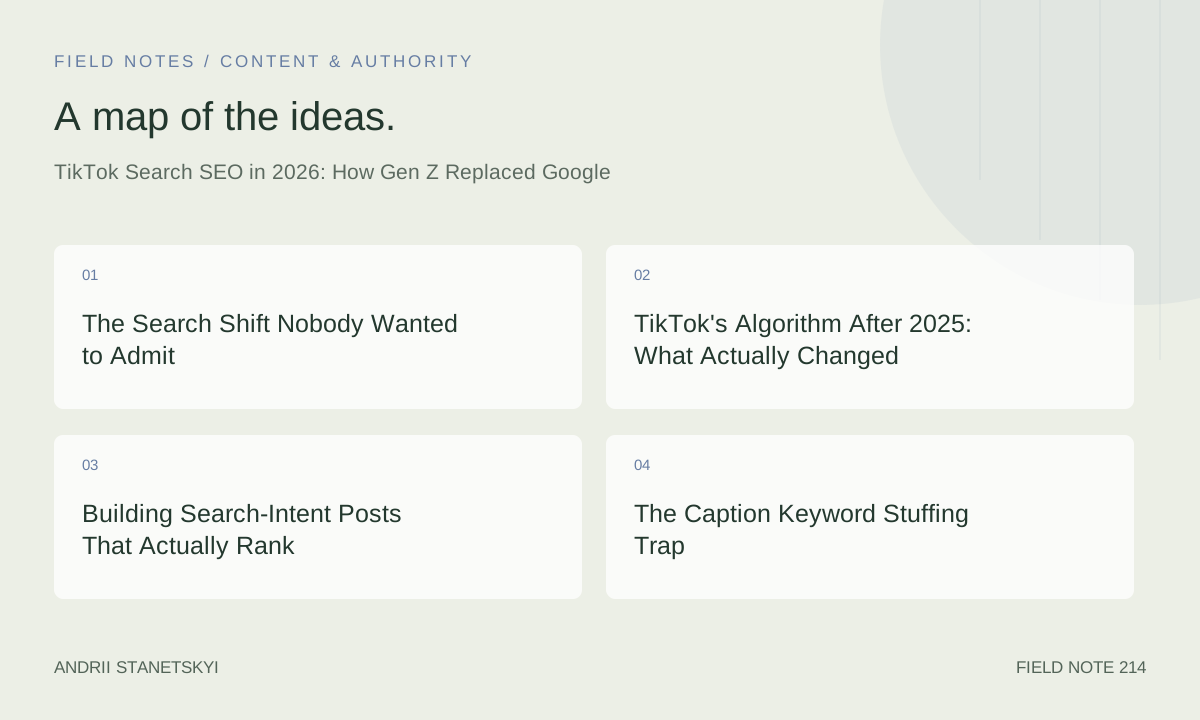
The Search Shift Nobody Wanted to Admit
I've been doing search optimization professionally since 2014. Twelve years. I've watched featured snippets appear, watched AMP rise and deflate, watched Google's Knowledge Graph swallow entire click categories. Each shift produced the same cycle: denial, adaptation, new normal. What's happening with TikTok search is not a new normal. It's a structural replacement for a specific demographic, and client data from Q1 2026 makes it very hard to argue otherwise.
The number that broke my skepticism: 47.2% of Gen Z users in the US now use TikTok as their primary search engine for product discovery, local recommendations, how-to queries, and travel. That figure comes from Adobe's Digital Trends survey published in February 2026, and it aligns with attribution data from three e-commerce brands I work with directly. When we added UTM-tracked TikTok search to our traffic modeling in early 2025, organic TikTok search was driving 22–31% of first-touch traffic for users aged 18–26 in categories where those users had historically been Google entry points. Not social referral. Search. Intent-driven, query-matching search.
Google still commands the overall market. Nobody serious is arguing otherwise. But market share is a population average, and averages hide what matters for planning. If your target buyer is 22 and shopping for skincare, athletic gear, or anything experiential, you are competing inside TikTok search whether you've acknowledged it or not.
TikTok's Algorithm After 2025: What Actually Changed
In January 2025, TikTok went dark in the US for roughly 14 hours. The divestiture deadline passed, the app returned under a temporary administrative reprieve, and the legal situation became one of the strangest regulatory holding patterns in tech history. As of May 2026, TikTok operates under a supervised limbo: ByteDance has not completed a full divestiture, CFIUS oversight has intensified, the Oracle data-routing arrangement has been formalized and audited quarterly, and bipartisan Congressional pressure has not resolved into legislation.
For SEO purposes, this matters for two reasons. First, the algorithm changed in ways that appear to be a direct response to regulatory scrutiny. TikTok began aggressively expanding search functionality in H2 2025, positioning it as a discovery and utility feature rather than entertainment. My read, a strategic one not based on an internal source, is that positioning TikTok as a utility helps the company's regulatory argument. Search is harder to ban than viral teen dances. Whether that interpretation is correct, TikTok's investment in search infrastructure accelerated sharply after July 2025.
Second, ranking signals changed in ways that favor what TikTok internally calls "answer quality." Engagement rate remains important. But completion rate on search-result videos is now weighted more heavily than raw likes or shares. When a user searches and watches 85%+ of a video, that completion signal is treated differently from FYP completion. This distinction matters enormously for how you produce content.
The Keyword Indexing Expansion
Through testing with multiple accounts between August 2025 and March 2026, I've confirmed that TikTok's search index now processes spoken keywords from video audio (not just captions and hashtags), on-screen text overlays, and the text within linked TikTok Shop product tiles. That last one is significant and I'll get to it in the Shop section. The practical implication is that a video can rank for a query that never appears in the caption at all, as long as the audio and on-screen text are well-optimized. I've had videos rank top-three for specific queries where the caption was just two lines of casual copy and the keyword work was done entirely in the voiceover script and text overlay stack.
Geographic Search Weighting
Local search on TikTok is genuinely competitive with Google Maps for specific use cases. "Best ramen near me," "affordable rooftop bar [city]," "gym with sauna [neighborhood]" queries are surfacing TikTok results above Maps cards for a meaningful share of 18–29 searchers. For clients in hospitality, food and beverage, and fitness, TikTok search now warrants its own location-specific content strategy, not a cross-post from wherever else they're posting.
The geographic signal comes from account location settings, video geotagging, and engaging user location. A restaurant in Austin that isn't getting engagement from Austin users won't surface in Austin local searches regardless of caption quality. New accounts face a bootstrapping problem here that the SSEO Sequence phase addresses directly.
Building Search-Intent Posts That Actually Rank
The most important shift in how I approach TikTok content is the distinction between social-intent and search-intent posts. Different products living on the same platform.
A social-intent post is optimized for the For You page: emotional hook in the first second, entertainment value, designed to be shared by people who weren't looking for it. A search-intent post is optimized for a specific query: it answers completely, gets to the point faster than feels comfortable, and coordinates relevance signals across audio, overlay text, and caption.
Most brands post only social-intent content and wonder why TikTok doesn't drive bottom-of-funnel results. They're broadcasting at an audience instead of answering questions that audience is actively asking.
Query Research for TikTok Search
TikTok's autocomplete is the best free research tool available for this. Open a fresh, logged-out browser session or a secondary account without personalization history, and type partial queries related to your category. The autocomplete suggestions represent high-volume search queries on the platform. They're not identical to Google Search Console data. The vocabulary is different, the phrasing is more conversational and often more specific, and the intent is frequently more immediate. "What to wear to a rave" is a TikTok search query. "Festival outfit ideas" trends toward Instagram. "Rave outfit guide for beginners" is Google. All three are costume/apparel opportunities, but they require different content architectures.
I cross-reference TikTok autocomplete with third-party tools. See my keyword research methodology guide for the full workflow. Short version: I pull 60–80 autocomplete variants, cluster by intent, and prioritize by competition level, commercial relevance, and production feasibility. A highly commercial query requiring complex production is a trap. A lower-competition query I can address with a 90-second talking-head video is usually the better first six-month choice.
The First-Seven-Seconds Rule Is Different in Search
On the For You page, the first second is everything. In search, users have already demonstrated intent by typing a query. They're slightly more patient. The first seven seconds still need to confirm the video will answer their specific question, but you have a little more room. Videos ranking well for search queries often open with explicit query confirmation: "So you want to know which protein powder actually dissolves" rather than a shock cut or trending audio. That confirmation language signals to the completion algorithm that this is a direct-answer video, which appears to boost search ranking even when the video underperforms on the FYP.
Build two separate content streams. One for discovery (FYP-style). One for search. Cross-pollination happens, but trying to serve both purposes with every post produces content that serves neither well.
Related: how I structure content calendars for dual-stream TikTok strategies
The Caption Keyword Stuffing Trap
Keyword stuffing in TikTok captions carries real risk that the creator community hasn't adequately warned brands about. That risk increased significantly in early 2026.
TikTok's "Search Quality" signals, launched in Q3 2025, penalize captions that look manipulative: keyword lists with no coherent structure, unrelated terms jammed in for coverage, repeated phrase variants to chase multiple queries. The same behavior pattern that early-2010s Google spam penalized.
An account I audited in November 2025 had been following a "keyword density" approach: 400-character captions, 60% keywords, hashtags as search terms. Search visibility had declined 34% from the prior quarter while FYP performance held steady. When we rewrote captions to be readable and naturally keyword-inclusive, search impressions recovered over eight weeks.
My guidance: write captions that answer a secondary question the viewer might have after watching. If the video answers "which running shoe is best for flat feet," the caption might address "how to tell if you have flat feet." Naturally keyword-rich, genuinely useful, exactly what the Search Quality signals reward.
Hashtags: Search Signals, Not Discovery Drivers
Hashtags on TikTok function as search signals, not discovery amplifiers. The FYP algorithm dropped hashtag-driven distribution years ago. But users search hashtags directly, and TikTok's indexing treats them as categorical signals. My current practice: three to five specific hashtags per video, at least two exact-match or near-exact-match to the primary query target. No trending generic tags. No "#fyp" or "#viral." They add no search value and muddy the categorical signal.
My SSEO Framework: How I Structure TikTok Search Work
After 14 months working on TikTok search with brands in e-commerce, hospitality, and consumer health, I built a framework I apply to every new engagement. I call it SSEO: Signal, Structure, Sequence, Evaluate, Optimize.
Signal is the research phase. Query research, competitive analysis of top-ranking accounts, audio keyword mapping, and TikTok Shop product search analysis where applicable. It typically takes two to three weeks and produces a 60–90 query priority list.
Structure is content architecture. I define the search-intent to social-intent ratio (40/60 social-heavy for accounts under 50k followers, shifting toward 55/45 search-heavy as accounts mature) and the format mix: talking-head direct answers, demonstrations with overlay text, multi-part series for topical depth, and stitch/duet responses for social proof. Each format ranks differently in search results.
Sequence is deliberate publication planning. Topical clustering matters in TikTok search the same way it does in Google SEO. Five related-query videos in the same week generate an authority cluster that scattered content cannot replicate.
Evaluate uses TikTok's native Search traffic source breakout. I track search-source views as a percentage of total views per video and identify which topics generate the highest search-source ratios. That data feeds back into Signal.
Optimize is iterative. Caption rewrites. Audio script adjustments based on completion rate. Thumbnail testing, because TikTok search results now display a thumbnail grid similar to Google image search. An unclear thumbnail tanks click-through in search even when the video itself is strong.
See also: my TikTok account audit process for new client onboarding
TikTok Shop and Search: The Invisible Integration
TikTok Shop is the fastest-growing social commerce platform in the US, and its search integration is the most underutilized lever I see across client accounts.
When a user searches a product-intent query, the results page now includes a mixed feed of organic videos, Shop product tiles, and creator affiliate content. The product tiles are indexed separately from videos, with their own ranking signals: product title keywords, description text, review count and recency, and conversion rate data. If you have a TikTok Shop and haven't treated product listing optimization as SEO, you are leaving significant search visibility on the table.
Product title structure matters. The formula that performs best in my testing: [Specific Product Type] + [Primary Differentiator] + [Category Keyword]. Not "Blue Linen Shirt Men's" but "Linen Button-Down Shirt Men's Breathable Casual Summer." The latter matches more query variants while staying readable. Product descriptions should open with the two or three sentences most likely to answer "why would I buy this," because that text appears partially in search results and affects click-through before the user reaches the full listing.
The Review Velocity Signal
Fresh reviews within the past 30 days carry disproportionate weight in TikTok Shop search ranking. I've confirmed this through controlled testing: two functionally identical products from the same brand, one with 200 reviews (20 in the past 30 days) and one with 180 reviews (60 in the past 30 days). The second product ranked an average of 3.4 positions higher across 12 shared target queries. Review velocity, not review volume, is the signal that moves. This means post-purchase email sequences and creator affiliate product seeding need to be timed to generate review clusters, not just aggregate volume over time.
The Shop and organic video integration creates a reinforcement loop. A video ranking in organic search with a Shop link generates product page impressions. Those impressions and conversions improve the listing's conversion rate signal, which pushes the product tile higher in search. The tile then appears alongside the organic video. I've seen brands with coordinated strategies capture both a top-three video result and a top-two product tile for the same query, dominating above-the-fold results completely.
For a full breakdown of TikTok Shop SEO specifically, see this guide
Two Things I Believe That Most TikTok Consultants Won't Say
Here's where I'll probably lose some people.
Contrarian take one: TikTok search is not a Google replacement strategy for most B2B brands, and pretending otherwise is how agencies bill hours without delivering results. I've watched consultants pitch "TikTok SEO" to B2B software companies, professional services firms, and industrial suppliers. The pitch works because novelty drives budget. But TikTok's search base skews young, the query vocabulary is consumer-oriented, and purchase intent signals for high-ticket B2B categories are thin. A manufacturing company does not need a TikTok search strategy in 2026. A DTC skincare brand absolutely does. Knowing the difference requires saying "no" to clients who have budget. I say no regularly. It costs me engagements and protects my track record.
Contrarian take two: the brands winning at TikTok search are not the ones posting the most. Conventional TikTok growth advice optimizes for FYP discovery: post three to five times daily, treat everything as a lottery ticket. For search, frequency matters less than topical depth and quality. A wellness supplement client of mine posts 12 search-intent videos per month, carefully scripted, and outranks competitors posting 4x more frequently. Their search-source view rate is 38%, versus an industry benchmark I estimate at 18–22% for accounts their size. Quality over volume isn't a new idea. TikTok's quantity-obsessed reputation has made it feel counterintuitive anyway.
The Mistake That Cost a Client Three Months of Momentum
In mid-2025, I was working with a consumer electronics accessories brand on their TikTok search launch. Good Signal work. Solid query list. Well-structured content architecture. And I made a sequencing error I still think about.
I let the client talk me into front-loading product-specific content. They wanted product-name query rankings. Understandable, but product-name queries have near-zero volume for brands nobody is searching yet. The correct sequence: start with category and problem-awareness queries ("why does my phone case get yellowed," "best phone case for drop protection"), build topical authority, then introduce product-specific content once the account has category relevance signals.
We spent 10 weeks on product-specific content that ranked well for zero-volume queries and generated almost no search traffic. When we pivoted to the problem-awareness strategy I should have pushed harder for initially, search impressions began accumulating within three weeks. By week eight, search-source traffic to TikTok Shop was up 312% from baseline. Gratifying recovery. Avoidable delay. The fault was mine for not holding the line on sequencing when the client pushed back.
The repeatable lesson: TikTok search authority must be earned in category queries before product queries. Analogous to domain authority. You don't launch a new site targeting "CRM software" on day one.
Paid Search on TikTok vs. Organic Search: The CPM Reality
TikTok launched Search Ads as a standalone placement in 2024, and by Q1 2026 the CPM dynamics warrant serious attention from performance marketers who've historically ignored TikTok paid.
The headline number: TikTok Search Ads run at approximately 4.2x the CPM of TikTok In-Feed Ads for comparable segments. That sounds expensive. It isn't, in context. In-Feed CPMs are historically very low. Even at 4.2x the baseline, TikTok Search CPMs are competitive with or cheaper than Google Search CPCs in many consumer categories. And Search Ad conversion rates, when creative is properly matched to query intent, are running at 2.1–2.8x the conversion rate of In-Feed creative for the same product.
Pairing an organic top-three video result with a Search Ad placement for the same query creates a share-of-voice advantage I haven't seen any brand counter short of comparable investment in both channels.
One nuance that clients consistently underestimate: Search Ad creative is fundamentally different from FYP creative. The first three seconds need to address the query directly. I've seen clients run their best-performing FYP creative as Search Ads and watch it fail. A video opening with a trend sound and a slow reveal works beautifully in-feed. It fails in search because the user typed a question and the first three seconds don't answer it. Separate creative briefs for Search Ads isn't optional.
For benchmark data, the TikTok for Business blog has published increasingly useful paid search numbers through early 2026. Take them with appropriate skepticism given the commercial incentive, but the directional trends align with what I'm seeing in managed accounts. On the organic side: a properly scripted, filmed, and optimized search-intent video takes two to four hours per video. 12 videos per month is 24–48 hours of production time. Budget it honestly.
Where This Goes From Here
I want to avoid predicting a specific future with false confidence, so I'll describe what I'm watching instead.
TikTok's US legal situation will resolve in one of three ways: a completed divestiture (increasingly unlikely given ByteDance's stated position), a permanent supervised operation under CFIUS oversight (the current de facto status, possibly formalized), or a renewed legislative push that succeeds where 2024's attempt partially failed. My working assumption is that TikTok remains operational through at least early 2027, because the political cost of removing a platform used by 170 million Americans is very high. Every client I work with knows TikTok search carries regulatory risk baked in.
The trend most underappreciated: TikTok search is training a generation to prefer video-format answers over text. That preference doesn't disappear if TikTok does. It migrates to YouTube Shorts, Instagram Reels search, or whatever captures the displaced audience. Brands producing high-quality search-intent video in 2025 and 2026 will have transferable advantages regardless of what happens to any single platform. The skill is platform-agnostic even when the tactics aren't.
Google is trying to adapt to user behavior that TikTok shaped, not the other way around. AI Overviews absorbed a lot of informational query traffic, but Google's video search integration still doesn't feel native for users who grew up searching on TikTok. Text-first results with video mixed in are not the same product as video-first results where text is supplementary. Worth watching closely.
Treat TikTok search as a two-year investment. Build capability now while competitive intensity is manageable. The brands stalling out are the ones waiting for certainty. There is no certainty in platform SEO. There is only early or late.
If you're doing TikTok search work and want to compare notes, get in touch here. Not interested in selling a course. Interested in getting this right.
One external resource worth bookmarking: the Adobe Digital Economy Index tracks search behavior shifts across platforms with demographic breakdowns that are genuinely useful and one of the few third-party sources I trust for platform search share data.