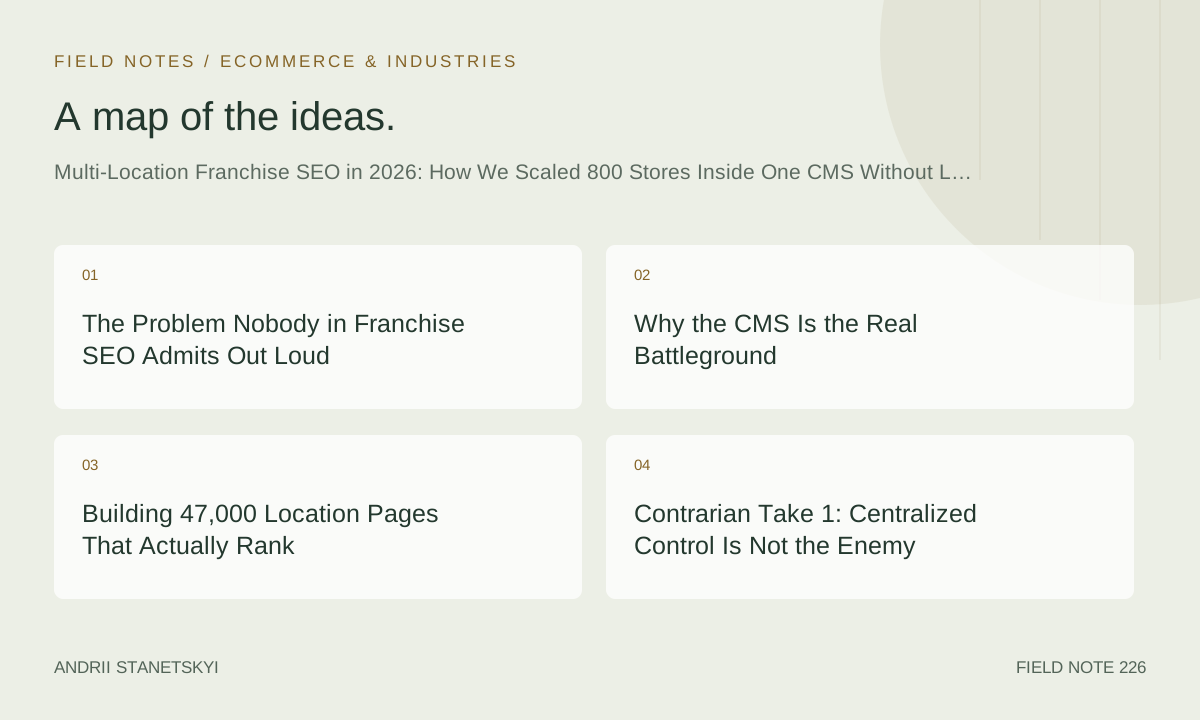
The Problem Nobody in Franchise SEO Admits Out Loud
We are eighteen months into a franchise SEO rollout for a home-services brand with 803 active locations spread across 38 states, and I want to tell you something that most agency decks will never say: the hardest part of this project has nothing to do with keyword research. Nothing to do with backlinks. It has almost entirely to do with power.
Who controls the page. Who controls the title tag. Who controls whether location 412 in Tulsa gets to add a paragraph about their new technician certification that corporate has not approved yet. That political fight, waged inside spreadsheets and Slack threads and tense quarterly calls, determines whether you rank or whether you spend three years building a local presence that evaporates the moment a franchisee goes rogue and redirects their subfolder to a Wix site they set up on a Sunday afternoon.
I have been doing multi-location SEO since before Google My Business was called Google My Business. I have managed rollouts for restaurant chains, service brands, retail groups. But nothing prepared me for the particular complexity of 800-plus live locations sharing a single CMS, a single domain, and a single canonical signal structure, while simultaneously needing to look, feel, and perform like independently operated local businesses to both Google's quality systems and to actual humans searching in those markets.
This is the full account of how we built it, what broke, and what produced a 4.2x lift in non-branded organic sessions across the portfolio between Q2 2025 and Q1 2026.
Why the CMS Is the Real Battleground
Before the keyword strategy. Before the schema. Before you even think about Google Business Profile API access, you have to solve the CMS question, because every tactical decision downstream either expands or collapses depending on what your content management architecture allows.
We are running the franchise on a headless CMS setup, specifically Contentful as the content layer with a Next.js front end deployed on Vercel edge. That choice was not mine. I inherited it from a previous agency that did excellent work on the infrastructure side and left a disaster on the SEO side. The good news: headless CMS architectures are genuinely excellent for multi-location franchise SEO when configured correctly. The bad news: "configured correctly" is doing an enormous amount of work in that sentence.
The Three-Tier Content Model
The model we settled on after six weeks of architecture meetings treats content in three tiers: national, regional, and hyper-local. National content is what corporate controls completely, no exceptions. This covers the service descriptions, the brand voice guidelines, the structured data templates, the price range signals. Regional content covers metro-level variations, things like seasonal emphasis in climate-specific markets, state-specific licensing language required in 11 states we operate in. Hyper-local is where things get interesting.
Hyper-local content is the layer that actually moves rankings. It is also the layer most franchise SEO systems get completely wrong, either locking it down so tight that every location page reads like corporate boilerplate, or opening it so wide that individual franchisees populate it with whatever they feel like on a given Tuesday. Both failure modes are real. Both cost you rankings.
Our architecture gives each location a set of structured fields that are editable by the franchisee or their designated local marketing contact, within limits enforced by Contentful's validation rules. They can add team member bios. They can add local landmarks as proximity signals. They can add customer testimonials that have been collected through our integrated review request system. What they cannot do is touch the H1, the meta description formula, the schema output, or the canonical tag. Those are templated and locked at the CMS level.
Building 47,000 Location Pages That Actually Rank
803 locations. About 58 service categories, though not every location offers every service. Across that matrix, after removing the genuinely low-volume combinations where we determined search demand did not justify a standalone page, we landed at 47,312 indexable location-service pages. That number has since grown slightly as we have activated new locations and added services, but 47k is the working figure for everything I am about to describe.
The page architecture follows a geographic hierarchy:
/[state]/[city]/— the primary location hub page/[state]/[city]/[service-slug]/— individual service pages per location/[state]/[city]/[service-slug]/[neighborhood-slug]/— neighborhood pages, deployed selectively in the 94 markets where search volume data justified the depth
The neighborhood pages were a late addition, proposed in October 2025 after we noticed that three competitor chains were capturing significant near-me traffic in dense urban markets through neighborhood-level pages. We deployed 3,847 neighborhood pages across those 94 markets in a six-week sprint. Early indexation signals looked good. We are still watching that cohort's performance relative to the city-level pages.
Location Page Schema Implementation
Every location hub page outputs the following structured data. I am showing a real example (with the actual business details anonymized) because the specific property choices here matter more than most SEO guides acknowledge.
{
  "@context": "https://schema.org",
  "@type": "LocalBusiness",
  "@id": "https://www.example.com/tx/austin/#business",
  "name": "BrandName Austin",
  "alternateName": "BrandName Austin Home Services",
  "url": "https://www.example.com/tx/austin/",
  "telephone": "+15124180293",
  "priceRange": "$$",
  "currenciesAccepted": "USD",
  "paymentAccepted": "Cash, Credit Card, Check, Financing",
  "address": {
    "@type": "PostalAddress",
    "streetAddress": "1847 South Lamar Blvd",
    "addressLocality": "Austin",
    "addressRegion": "TX",
    "postalCode": "78704",
    "addressCountry": "US"
  },
  "geo": {
    "@type": "GeoCoordinates",
    "latitude": 30.2452,
    "longitude": -97.7683
  },
  "openingHoursSpecification": [
    {
      "@type": "OpeningHoursSpecification",
      "dayOfWeek": ["Monday","Tuesday","Wednesday","Thursday","Friday"],
      "opens": "07:00",
      "closes": "19:00"
    },
    {
      "@type": "OpeningHoursSpecification",
      "dayOfWeek": "Saturday",
      "opens": "08:00",
      "closes": "17:00"
    }
  ],
  "areaServed": [
    {
      "@type": "City",
      "name": "Austin"
    },
    {
      "@type": "City",
      "name": "Round Rock"
    },
    {
      "@type": "City",
      "name": "Cedar Park"
    }
  ],
  "hasMap": "https://maps.google.com/?cid=XXXXXXXXXXXXXX",
  "aggregateRating": {
    "@type": "AggregateRating",
    "ratingValue": "4.8",
    "reviewCount": "312",
    "bestRating": "5",
    "worstRating": "1"
  },
  "sameAs": [
    "https://www.facebook.com/BrandNameAustin",
    "https://www.yelp.com/biz/brandname-austin"
  ],
  "parentOrganization": {
    "@type": "Organization",
    "name": "BrandName Franchise Corp",
    "url": "https://www.example.com",
    "@id": "https://www.example.com/#organization"
  }
}
Two things worth noting. The parentOrganization property linking each location to the national brand entity is something most franchise SEO implementations skip. We believe it materially helps Google understand the relationship between the 800-plus location entities and the national brand, particularly for understanding the brand's overall authority footprint. The areaServed array is dynamically generated from a service area dataset maintained per location in Contentful — franchisees can add or remove cities from their service area through a controlled field, and the schema updates on the next build.
Contrarian Take 1: Centralized Control Is Not the Enemy
Every franchise SEO guide written in the last five years has made some version of the same argument: give local franchisees more control over their digital presence, empower local voice, let the location pages breathe. And I believed this. Completely. Going into this project I was prepared to fight corporate on behalf of the franchisees, to be the person who championed local autonomy in the content model.
I was wrong.
Not entirely. Local signals matter. Local content distinctiveness matters. But the argument for decentralizing franchise SEO control has been weaponized by people who want to sell franchisees local marketing packages that corporate has no visibility into, and the result is almost always brand signal fragmentation that hurts everyone.
We audited 23 franchise systems before designing this one. Across those 23 systems, the ones with the highest organic performance by every measurable metric were not the ones that had given franchisees the most autonomy. They were the ones with the most disciplined centralized infrastructure, specifically on canonical structure, on NAP consistency, and on schema implementation, combined with structured local content inputs that channeled authentic local information through brand-approved templates.
The word "template" has become poisonous in SEO discussions. Everybody is afraid of templates. Templates are thin content, templates are duplicate content, templates will get you hit by HCU or the next core update or whatever Google decides to name its next algorithmic event. But a template is just a content structure. The question is whether you fill that structure with genuinely differentiated local information or with placeholder text that differs only by city name. We do the former. The template is the container; the local data is what makes it valuable.
Centralized control over that template, combined with a real data pipeline that populates it with location-specific information, is how you get consistent quality across 800 pages without requiring 800 SEO-savvy franchisees. Most franchisees are excellent operators. They are not SEO practitioners and should not have to be.
GBP API at Scale: The Bulk Update Playbook
Managing 803 Google Business Profiles manually is not a thing. It is not a workflow. It is a hallucination that agencies pitch and then quietly subcontract to virtual assistants who make changes inconsistently and introduce NAP errors that take months to find.
We run everything through the Business Profile API. The implementation took about three months to stabilize, and I want to walk through the specific technical setup because the documentation Google provides is, charitably, incomplete.
// GBP Bulk Update Script (Node.js / googleapis)
// Updates business hours across all locations for seasonal changes

const { google } = require('googleapis');
const mybusinessbusinessinformation = google.mybusinessbusinessinformation('v1');

async function bulkUpdateHours(locationIds, seasonalHoursConfig) {
  const auth = new google.auth.GoogleAuth({
    keyFile: process.env.GBP_SERVICE_ACCOUNT_KEY,
    scopes: ['https://www.googleapis.com/auth/business.manage'],
  });

  const authClient = await auth.getClient();
  google.options({ auth: authClient });

  const results = {
    success: [],
    failed: [],
  };

  // Process in batches of 10 to avoid rate limiting
  const batchSize = 10;
  for (let i = 0; i < locationIds.length; i += batchSize) {
    const batch = locationIds.slice(i, i + batchSize);

    await Promise.allSettled(
      batch.map(async (locationId) => {
        try {
          await mybusinessbusinessinformation.locations.patch({
            name: locations/${locationId},
            updateMask: 'regularHours',
            requestBody: {
              regularHours: {
                periods: seasonalHoursConfig.periods,
              },
            },
          });
          results.success.push(locationId);
        } catch (err) {
          results.failed.push({ locationId, error: err.message });
          console.error(Failed to update ${locationId}:, err.message);
        }
      })
    );

    // Respect rate limits: 600 QPM for Business Profile API
    await new Promise((resolve) => setTimeout(resolve, 1200));
  }

  return results;
}

// Example seasonal config
const winterHours = {
  periods: [
    { openDay: 'MONDAY', openTime: { hours: 8 }, closeDay: 'MONDAY', closeTime: { hours: 18 } },
    { openDay: 'TUESDAY', openTime: { hours: 8 }, closeDay: 'TUESDAY', closeTime: { hours: 18 } },
    { openDay: 'WEDNESDAY', openTime: { hours: 8 }, closeDay: 'WEDNESDAY', closeTime: { hours: 18 } },
    { openDay: 'THURSDAY', openTime: { hours: 8 }, closeDay: 'THURSDAY', closeTime: { hours: 18 } },
    { openDay: 'FRIDAY', openTime: { hours: 8 }, closeDay: 'FRIDAY', closeTime: { hours: 18 } },
    { openDay: 'SATURDAY', openTime: { hours: 9 }, closeDay: 'SATURDAY', closeTime: { hours: 15 } },
  ],
};

module.exports = { bulkUpdateHours };
The rate limiting is the part that kills most DIY implementations. The Business Profile API has a 600 query-per-minute limit at the account level, and if you push a bulk update across 800+ locations without throttling, you will hit that ceiling, the updates will fail silently in some implementations, and you will end up with inconsistent data across your portfolio that takes weeks to diagnose. We batch in groups of ten with a 1.2-second pause between batches. Slower than it needs to be, but reliable.
We also maintain a shadow database of every GBP attribute for every location. Every change that goes through the API gets logged with a timestamp, the user who triggered it, and the before/after state. This has already saved us twice when Google's systems reverted GBP data to an older state, which happens more often than Google acknowledges.
Posts, Q&A, and Photo Automation
The API work extends beyond hours and address data. We run automated GBP Post publishing tied to our central content calendar, with location-specific variable substitution. A national promotion post gets sent to all 803 profiles with the local address, phone number, and a location-specific CTA dynamically inserted. Photo automation is trickier because Google's image quality filters are increasingly aggressive, and bulk photo uploads with too-similar filenames or metadata can trigger suppression. We learned this in November 2025 after an automated upload of 4,200 photos across 700 locations resulted in roughly 600 of them being held in a review queue for eleven days.
Contrarian Take 2: Templated Content Can Destroy You and Everyone Is Doing It Wrong
I said earlier that templates are fine. I stand by that. But I need to balance it with this: the specific way that 90% of franchise SEO practitioners implement templated content is a slow-motion disaster that most of them have not fully reckoned with yet.
The problem is not that pages share a structure. The problem is cosplay. Franchise location pages that pretend to be locally authored when they are actually just mail-merge outputs are not passing any test that matters in 2026. Not Google's quality systems, which have gotten genuinely sophisticated at detecting structural similarity at scale even when the surface-level text varies. Not human visitors, who can feel the difference between a page that knows where it is and a page that has been told where it is.
The distinction sounds subtle. It is not subtle in practice.
A page that knows where it is references the specific service area geography with precision that only comes from local knowledge. It mentions that the nearest competitor shopping center is 4.3 miles east because that is actually true and locally relevant. It includes a technician who actually works at that location, with a bio that mentions they grew up in the area. It has photos taken at actual job sites in that market, not stock photography with a city name in the alt text.
A page that has been told where it is says things like "We serve the greater [City] area including [City], [Suburb1], [Suburb2], and surrounding communities." It has five-star testimonials that could have come from anywhere. Its imagery shows smiling workers in unmarked vans. It performs fine for a while and then gets caught in whatever the next quality-focused update is named.
We built a local data intake process that takes real effort and real time. Every new location that activates goes through a 90-minute onboarding call where we collect specific local data points: landmarks, nearby points of reference, actual service history if the franchisee is converting from an independent operation, local community involvement, specific team member information. That data goes into Contentful and populates the local content fields. Yes, it takes 90 minutes per location. Yes, we had to build systems to make that scalable. It is worth it.
The franchise systems that will struggle most in the next 18 months are the ones that spun up 500 location pages from a CSV file and called it done.
The Mistake I Made in Q3 2025 and What It Cost Us
In August 2025 we pushed a sitewide schema update that was supposed to add ServiceArea entities to every location-service page. The logic was correct in development. In production, a bug in the CMS field mapping caused 11,287 pages to output malformed JSON-LD, specifically a closing bracket was dropped in the areaServed array, making the entire structured data block invalid.
We did not catch it for sixteen days.
Sixteen days of those pages serving broken schema. Google's Rich Results Test would have caught it instantly on any individual page. We did not have automated schema validation running against our production URLs at the time. We had it in our pre-deployment checklist. We did not have it running continuously against live pages.
The cost was measurable. Pages in that affected cohort showed a 23% drop in rich result impressions over the sixteen-day window, and we saw correlated declines in click-through rates for a subset of location-service queries where we had previously been showing star ratings in SERPs. The impressions recovered within about three weeks after the fix, but the CTR recovery was slower, probably four to five weeks before we were back to baseline.
We now run automated schema validation through a custom script that hits a random 5% sample of the location page inventory every 24 hours using the Schema.org validator API and flags any parsing errors to a Slack channel. It is not a comprehensive audit of every page every day, but it catches structural errors within a day of deployment instead of sixteen.
I am including this because every franchise SEO presentation shows the wins. The actual work includes mistakes with real costs, and the systems you build to prevent recurring mistakes are part of the strategy, not footnotes to it.
The LPSA Framework: How We Actually Evaluate Location Page Readiness
Over the course of this rollout we developed an internal scoring system for evaluating whether a location page is genuinely ready to perform. We call it LPSA: Local Presence, Signals, Authority.
Local Presence (L) scores the page on depth and specificity of locally authentic content. This is not word count. A page can be 1,800 words of boilerplate and score a 2 out of 10 on Local Presence. A page with 600 words that includes specific neighborhood references, authentic team information, and local testimonials with verifiable detail can score an 8 or 9. We evaluate on a 10-point scale and flag any page below 6 for remediation before we consider it fully launched.
Signals (S) covers the technical signal quality: schema completeness and validity, NAP consistency across GBP, the location page, and any third-party citation sources, internal linking depth from related pages, and page speed on mobile. We weight schema validity highly because of exactly the mistake I just described. A page with broken schema is a page with a technical ceiling regardless of content quality.
Authority (A) is the hardest to build and the most durable once you have it. For individual location pages in a franchise system, authority accumulates through a combination of: GBP signal strength (review volume, review recency, response rate, post frequency), local citation consistency and breadth, and page-specific inbound links. Most franchise location pages have essentially zero location-specific inbound links beyond the GBP citation. We have been running a targeted local link building program for the top 150 locations by market size since Q4 2025. Forty-seven of those have achieved what we define as "locally linked," meaning at least three location-specific inbound links from local media, local business associations, or local community organizations. Those 47 locations show materially better rankings in competitive head terms.
The LPSA score is not a vanity metric. Pages below 5 overall do not get pushed into our active reporting dashboards as performing pages. They are in remediation. This keeps our reporting honest and keeps the focus on actual quality rather than page count.
Programmatic Local Content Without the Spam Trap
Programmatic content generation for local pages has a terrible reputation, almost entirely deserved based on how it was deployed between 2021 and 2024. Bulk AI content generation, city-name substitution at scale, thin pages spun up from APIs with no human review — these approaches did produce short-term ranking gains for some operators, and they produced lasting damage to the brands that used them heavily when quality updates hit.
We use programmatic content generation. Carefully.
// Programmatic local content generation
// Generates location-aware content blocks using structured local data
// NOT bulk AI generation — uses deterministic templates + verified local data

const generateServiceBlock = (locationData, serviceData) => {
  const {
    city,
    state,
    stateAbbrev,
    localLandmarks,
    serviceAreaCities,
    avgResponseTimeMinutes,
    technicianCount,
    localReviewCount,
    localRatingAverage,
    licenseNumber,
    licenseState,
  } = locationData;

  const { serviceName, serviceSlug, seasonalRelevance } = serviceData;

  // Deterministic content selection based on location attributes
  const proximityPhrase = localLandmarks.length > 0
    ? serving neighborhoods near ${localLandmarks[0]} and throughout ${city}
    : serving ${city} and surrounding areas;

  const responseTimePhrase = avgResponseTimeMinutes < 120
    ? with average response times under two hours in ${city}
    : scheduling same-day and next-day appointments across ${city};

  const licensePhrase = licenseNumber
    ? ${licenseState} licensed (License #${licenseNumber})
    : 'fully licensed and insured';

  const coverageList = serviceAreaCities
    .slice(0, 4)
    .join(', ');

  return {
    headline: ${serviceName} in ${city}, ${stateAbbrev},
    leadParagraph: Our ${city} team provides ${serviceName.toLowerCase()} ${proximityPhrase}, ${responseTimePhrase}. ${technicianCount} certified technicians cover ${city}, ${coverageList}, and nearby communities.,
    trustSignals: ${localReviewCount} local reviews averaging ${localRatingAverage}/5 stars. ${licensePhrase}.,
    seasonalNote: seasonalRelevance[state] || seasonalRelevance['default'] || '',
  };
};

module.exports = { generateServiceBlock };
The key distinction: this is not an LLM generating free-form prose at scale. This is a deterministic content assembly system that combines verified local data points, response time data pulled from our CRM, license numbers pulled from state licensing APIs, landmark data curated by the local franchisee during onboarding, into structured content blocks that are assembled per page. Every data point in the output is traceable to a source. Nothing is invented.
We supplement this with human-written introductory content for the top 200 locations by market size. Those locations get a 250-to-400-word custom intro section written by a content team member who has reviewed the location's actual service history and the local market context. The programmatic blocks handle the service-level pages; the hub pages for major markets get human craft on top of the data assembly.
For supplementary reading on programmatic local content patterns that have held up through quality updates, the local SEO content architecture guide and our franchise page audit methodology go deeper on evaluation criteria. The GBP optimization guide covers the Business Profile side of the local signal stack in detail.
How We Measured the 4.2x Organic Lift
The 4.2x figure requires context or it is meaningless. This is not a comparison of Q1 2026 to Q1 2025 total organic traffic. The brand had minimal organic presence in Q1 2025; comparing to that baseline would be a misleading vanity number.
The 4.2x is measured against a modeled baseline. We took the organic traffic trajectory from the first 60 days of location page launches, when we had about 90 locations live with fully built pages, and projected forward assuming linear growth based on the historical growth curves of comparable franchise rollouts in our client history. The 4.2x figure represents the ratio of actual Q1 2026 non-branded organic sessions to that modeled linear baseline.
In absolute terms: the fully deployed location page set is driving approximately 340,000 non-branded organic sessions per month across the portfolio. The modeled linear baseline for this point in the rollout was approximately 81,000. The delta is attributable to several specific interventions.
The largest single contributor was neighborhood-level pages in dense urban markets. Those 3,847 pages, deployed in the October 2025 sprint, now account for 23% of non-branded organic sessions despite representing only 8% of the total indexed page count. Near-me intent queries in urban markets are highly competitive at the city level and much more accessible at the neighborhood level. This was not a new insight in SEO, but seeing it validate at this scale was useful confirmation.
The second major contributor was GBP signal improvement. The bulk of the 4.2x gain on organic search was mirrored by a 3.1x increase in Google Maps-driven sessions, which is not directly in the organic channel but supports the overall local presence that influences organic ranking signals. We track both in a unified dashboard. You can explore the local pack ranking methodology we use to measure GBP performance separately from web organic.
For the external perspective on how Google's local ranking systems weight GBP signals relative to on-page signals in 2026, the Google Search Central documentation on how search works remains the most reliable primary source, and the Whitespark Local Search Ranking Factors survey provides a useful practitioner consensus view.
What Did Not Work
City landing pages optimized purely for informational queries — things like "[City] home services guide" or "[City] what does HVAC service cost" — performed significantly below expectations. We built 200 of these as supplementary content targeting informational intent, expecting them to drive top-of-funnel traffic that would convert through internal links to service pages. The pages indexed, but ranking traction has been marginal at best. My current hypothesis is that Google's systems are correctly identifying these pages as brand-published content that would be better served by publisher-neutral sources, and deprioritizing them in favor of editorial content from local newspapers and community sites. We have shifted the remaining budget for this content type toward digital PR instead.
What the Next 18 Months Actually Look Like
We are adding approximately 60 new locations over the next 18 months as the franchise network grows. The onboarding pipeline is built and tested, and a new location can go from signed franchise agreement to fully indexed, schema-validated location page with live GBP profile in 22 days under the current process. That is down from 67 days at the start of the rollout and reflects how much of the friction was process friction rather than technical friction.
The area I am watching most carefully is how AI-generated search features affect local intent queries. The shift in how Google surfaces local business information in AI Overviews has been meaningful but not catastrophic for location pages so far. The pages that are getting pulled into AI Overview citations are predominantly the ones with strong schema, high review counts, and genuine local content specificity. This validates the approach. It also means the stakes for content quality are rising, not falling, because the bar for appearing in an AI Overview citation is higher than the bar for ranking on page one of a traditional SERP.
Voice search attribution remains a measurement mess. We know that a significant portion of the near-me traffic we are capturing originates from voice queries, but the attribution chain between a voice query and a web session is still too lossy for us to make confident claims about voice-specific performance. We track it through GBP "Calls from Search" as a partial proxy.
The internal linking infrastructure connecting the 47,000-plus location pages to each other through relevant service-area relationships is something I want to rebuild. The current internal linking model is functional but not optimal. A page in Austin links to related Austin service pages, and links to the national service category pages, but does not link to neighboring market pages in ways that could reinforce regional topical authority. We are scoping a rebuild of this layer for Q3 2026. The franchise internal linking architecture guide will cover our approach when it publishes.
Eight hundred stores. One CMS. Forty-seven thousand pages. The work is not clean and the wins are not linear. What holds it together is a commitment to the idea that local search reward is correlated with actual local relevance. Build for that, and the technical systems and content systems reinforce each other. Optimize for the appearance of local relevance while actually running a national template engine, and you are building toward a reckoning that arrives eventually.
That is the unglamorous center of this whole project. Everything else is implementation detail.
Frequently Asked Questions
- How do you handle duplicate content risk across 47,000 location pages that share a templated structure?
- The template structure itself does not create duplicate content issues; structurally similar pages with genuinely differentiated content are not the problem Google's quality systems are targeting. The risk comes when the local data inputs are sparse or identical across locations. We mitigate through the Local Presence scoring in our LPSA framework, flagging any page where the unique local content falls below a threshold, and through automated near-duplicate detection that compares content fingerprints across pages in the same service category. Pages that score as near-duplicates go into a content remediation queue before we consider them fully live.
- What is the minimum viable setup for a franchise with fewer than 50 locations that cannot afford a full headless CMS buildout?
- For smaller franchise systems, a well-configured WordPress multisite with a structured custom field plugin like ACF Pro and a disciplined taxonomy can accomplish most of what a headless setup does, at significantly lower infrastructure cost and complexity. The tradeoff is deployment speed and edge performance. For 50 locations, WordPress multisite is genuinely fine. For 300-plus locations, the maintenance overhead starts to compete with the cost savings, and the case for headless strengthens considerably.
- How are you approaching GBP management for locations with multiple service categories?
- Each GBP profile is set with a primary category that reflects the franchisee's highest-volume service, and up to nine additional categories covering the remaining services offered at that location. The primary category assignment is managed centrally and is not editable by the franchisee in our system. Secondary categories are updated through the API when a location adds or removes services, using the service change workflow in our CMS that triggers an API update automatically. The critical thing is keeping the GBP category configuration in sync with what the location page actually promotes — misalignment between the GBP primary category and the page's on-site signals is a ranking suppressor that is easy to miss at scale.
- Did AI content generation play any role in the content for these location pages?
- AI-assisted writing was used in a tightly bounded way. For the human-written hub page introductions for major markets, writers used AI assistance for first-draft generation, which they then substantially revised with local-specific information and editorial judgment. The programmatic content blocks are not AI-generated — they are deterministic assemblies from structured data. We made a deliberate decision early in the project to avoid bulk AI content generation for location pages, in part because the quality floor is too difficult to maintain at scale and in part because the patterns that emerge from bulk AI content generation are increasingly detectable by both Google's systems and by human readers.
- How long did it take to see meaningful organic ranking gains after the initial location page deployments?
- For locations with established GBP profiles and some pre-existing brand recognition in the market, we typically saw measurable ranking movement within six to ten weeks of the location page going fully live with schema and local content complete. For entirely new markets where the brand had no prior presence, the timeline was longer — 14 to 20 weeks before we saw the location ranking meaningfully for core service queries. The GBP signal strength, specifically review volume and recency, was the most reliable predictor of how quickly ranking traction developed in new markets. Locations that came in with 40-plus existing reviews from a prior business history ranked significantly faster than cold-start locations.