I shipped the first version of my tool on a Tuesday in late March 2025. It was a SaaS for freelance translators — a niche so specific that my co-founder at a previous job once laughed when I described it. No co-founder this time. No budget for ads. No agency. No plan to send a single cold email to a journalist, a newsletter curator, or a link partner. Just me, a Hetzner server, and a content strategy I had roughly sketched in a Notion doc at 11pm while my pasta went cold.
By month 14, May 2026, monthly recurring revenue sits at $47,203. Every dollar came through organic search and AI-driven discovery. Zero outreach. Zero paid links. Zero sponsored placements.
This is the full account of how that happened, including the part where I almost killed it by making a catastrophically obvious SEO mistake for three straight months.
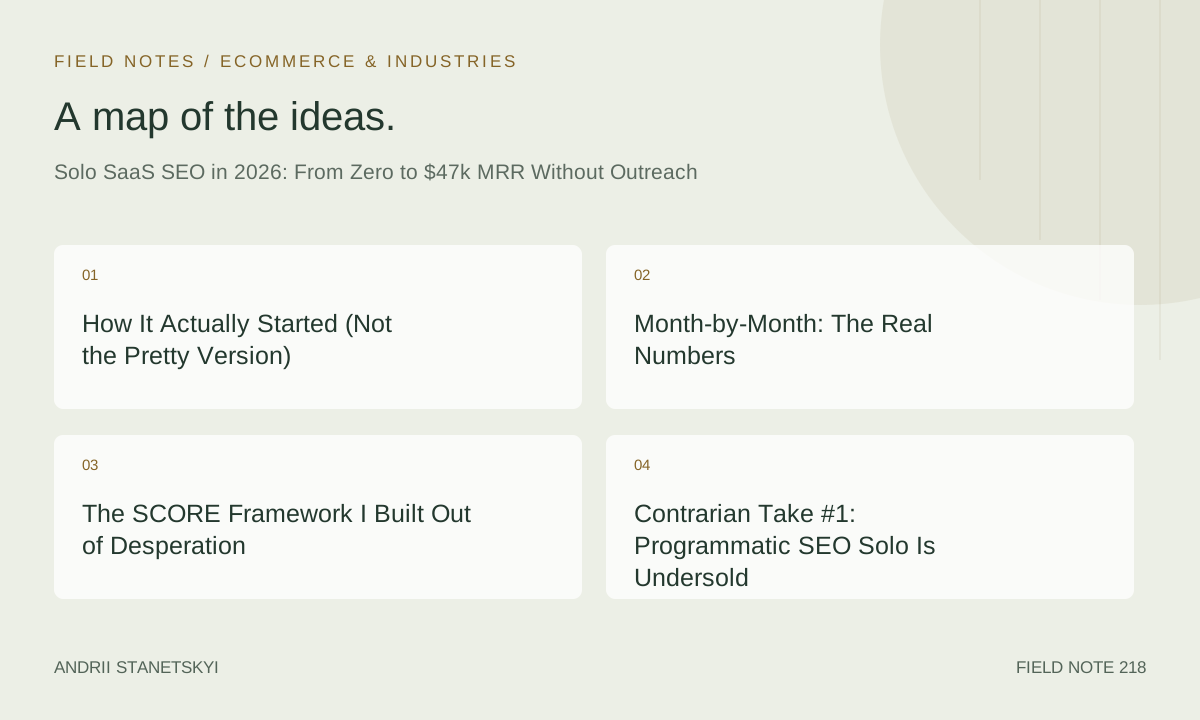
How It Actually Started (Not the Pretty Version)
The tool is called Glossflow. It manages glossaries, term consistency checks, and CAT tool integration for freelance and boutique translation teams. Genuinely boring product in one of the least-glamorous SaaS verticals you could name. Which turned out to be the entire point.
Before I launched, I spent six weeks doing keyword research. Not the 20-minute YouTube tutorial version. Actual research: pulling SERP data, reading Reddit threads from r/TranslationStudies, crawling competitor knowledge bases, mapping out the specific questions translators were typing into search engines versus what they were asking in Discord servers and LinkedIn groups. Those are not the same questions. The gap between them is where I decided to live.
The translation software market is dominated by four or five enterprise players — SDL Trados, memoQ, Phrase, Lokalise — and they all have content teams. They rank for the obvious head terms. I had no interest in competing there. Instead I went after the long tail of pain: "how to manage glossary conflicts in memoQ," "freelance translator billing rate tracker," "client-specific terminology sheet template." Queries with 40 to 300 monthly searches that the big players found too small to care about.
In a more competitive niche, that would be table stakes advice. In translation software, it was a genuine unlock.
Month-by-Month: The Real Numbers
I track MRR in a simple Airtable base. Here is what the first 14 months looked like.
Month 1 (April 2025): $0 MRR. Four articles live, ~200 organic sessions, no paying users.
Month 2 (May 2025): $612 MRR. First 9 paying subscribers. Traffic climbed to ~1,400 sessions. One article — a comparison of CAT tool glossary features — started ranking page 2 for its target query.
Month 3 (June 2025): $4,247 MRR. This jump still feels unreal. A tutorial I wrote on building a termbase from scratch got picked up and cited by two independent translation blogs, not because I asked them to, but because it was the only piece anywhere that covered the process end to end. Sessions hit ~7,800 for the month. That single article drove 60% of new signups.
Month 5 (August 2025): $9,100 MRR. Programmatic pages started indexing. I had built a system that generated comparison and "best of" pages for 340 niche query patterns. Most were thin at launch and needed refinement, but 18 of them were gaining meaningful impressions within six weeks.
Month 8 (November 2025): $21,800 MRR. Total indexed pages: 510. Pages driving at least one click per day: 94. The content flywheel was spinning. I was publishing two long-form pieces per week and letting the programmatic layer handle the query surface area beneath them.
Month 11 (February 2026): $33,600 MRR. A significant milestone. The business crossed into territory where I could pay myself a real salary and still reinvest in infrastructure. I hired no one. I did outsource one thing: a developer from Toptal spent four days building a faster indexing pipeline for the programmatic pages. That is the closest I came to "team."
Month 14 (May 2026): $47,203 MRR. Trailing 90-day churn: 2.1%. Sessions this month: ~68,000. Top-ranking positions across 1,200+ queries. And still no outreach. Not one.
The SCORE Framework I Built Out of Desperation
Around month 4 I realized I needed a system I could actually remember and execute alone. The alphabet-soup frameworks from marketing blogs didn't map cleanly onto the reality of being a solo founder doing SEO while also doing customer support, product updates, and invoicing.
So I made my own. I call it SCORE.
S — Segment the query space, not the audience. Most SEO advice tells you to define your audience and then find their keywords. I do it backward. I find tight clusters of queries with identical intent, then infer what kind of person is searching them. Translators looking for "memoQ terminology settings" are not the same as translators searching "how to standardize client glossary." Different problems, different moments in the workflow, different conversion paths.
C — Compete where you can win in 90 days. I set a strict filter: if a target query has a SERP where every top-three result comes from a domain with DR 60+, I skip it initially. Not permanently. But not now. With a brand-new domain in early 2025, I needed wins that compounded. Winning a low-competition query in month 2 builds trust signals faster than losing a competitive one in month 6.
O — Own a format, not just a topic. Every niche has one or two content formats that are systematically underserved. For translation software, it was step-by-step operational tutorials with real screenshots. The enterprise players publish polished conceptual overviews. I went deep on the actual clicks and commands. That format gap is searchable, useful, and hard to replicate quickly.
R — Refresh at the right moment. I built a lightweight tracker that flags any page dropping more than 8 positions in Google Search Console. When a page flags, I look at the SERP, see what changed, and update the content within 48 hours if it warrants it. Not every drop is a content problem. Sometimes it's volatility, sometimes a featured snippet shuffled, sometimes a competitor improved. But the habit of checking means I catch real content decay before it tanks traffic.
E — Expand the surface, not the depth. Once a topic cluster is working, the temptation is to write a definitive 10,000-word guide. I resist that. Instead I expand laterally: new sub-queries, related workflows, adjacent tools, integration guides. More pages that each answer one specific question well beats fewer pages that try to answer every question in one place. The data backs this up in my own GSC: pages under 1,200 words that answer one precise query convert at a higher rate than sprawling guides that try to rank for a dozen intents at once.
How to build a programmatic SEO layer as a solo founderContrarian Take #1: Programmatic SEO Solo Is Undersold
The mainstream narrative in 2025 was that programmatic SEO is dead, that Google's Helpful Content Updates had made thin template pages worthless, and that only "real" editorial content could survive. I disagree with this at a structural level. What died was programmatic SEO done lazily — scraped data, no differentiation, no value per page.
Programmatic SEO done right, even by one person, still works. The key distinction: every programmatically generated page needs to contain something a human actually needs that they cannot get from another result on the same SERP. For Glossflow, my programmatic pages are tool comparison pages: "Glossflow vs. SDL MultiTerm for freelancers," "Glossflow vs. memoQ term management," and so on. Each page uses live data pulled from my own product's feature set plus structured data from the competitor's public documentation.
Those pages are not thin. They are repetitive in structure, yes, but every one of them answers a genuinely specific purchase-intent question with accurate, current information. A solo founder can absolutely build and maintain a system like this. It took me about three weeks to set up the pipeline and another month to tune the templates. Since then, maintenance is roughly two hours a week.
The reason this works for solo operators specifically: you have perfect information about your own product. You don't need a content team verifying facts or a product marketing manager reviewing accuracy. You can update 60 pages in an afternoon when you ship a new feature.
Deep dive: niche SaaS content strategy that scales without a teamContrarian Take #2: No Backlinks, Not Even One Cold Email
This is the one that gets me the most pushback. People assume I must be doing some kind of stealth link building, or that links are flowing in naturally in ways I'm not counting. Neither is true. I have not sent a single outreach email. I have not traded links. I have not submitted to directories. I have not done HARO or its successor platforms.
The organic links I have — and there are meaningful ones now — came because the content is reference-worthy. When a freelance translator blogger writes about glossary tools, they link to my termbase tutorial because it is the most complete resource they can find. When a translation studies lecturer mentions tool workflows in a course guide, my comparison pages appear in the citations. These links are slow to accumulate. But they are extremely high-quality signals, and I never had to spend a single hour on outreach to earn them.
The deeper point: for niche SaaS targeting a specific professional community, the energy you would spend on link outreach is better spent making the content genuinely better. The first time someone links to me unsolicited, they are doing it because the content earned it. That is a stronger signal than a link you persuaded someone to give you. I believe Google's systems in 2026 are sophisticated enough to weight earned links differently, even if they cannot explicitly tag them. The trust signals are different. The anchor text is different. The surrounding context is different.
Now — I will say this only applies to niche markets with engaged professional communities. If you are in a commodity SaaS category with generic SMB buyers, you probably do need active link development. Translation software is genuinely different: the buyers are professionals who share resources with each other, who write blogs and course materials, who cite sources. If your buyers are like that, try the no-outreach approach for six months before you invest in link building.
Contrarian Take #3: GEO Over Google Was the Real Unlock
Generative Engine Optimization — optimizing for how AI tools like ChatGPT, Claude, Perplexity, and Gemini surface your product — was the channel I underestimated and then, once I understood it, the one that changed the trajectory of the business.
Starting around September 2025, I started seeing trial signups where users mentioned they heard about Glossflow from an AI assistant. By November, it was 22% of new signups. By this month, May 2026, it is 34%. These users convert to paid at a higher rate than organic search users. My working hypothesis is that they arrive with higher intent: they asked an AI for a specific tool recommendation, the AI named mine, they came directly to the trial page. The research phase is already done.
The mechanics of GEO I used are specific. First, structured data. I marked up every product feature with detailed schema. Second, definitional content. I wrote clear, concise explanations of what Glossflow is, what problems it solves, and what type of user it is designed for. These read well to AI models because they are precise. Third, citation-worthy statistics. I run a small annual survey of freelance translators, publish the results under a Creative Commons license, and the resulting data gets pulled into AI responses regularly when users ask questions about translator workflows.
This is not hypothetical. I can trace specific citation patterns in Perplexity. When someone asks Perplexity "what's the best glossary tool for freelance translators," my survey data, my tutorial content, and my comparison pages appear in the synthesized answer. Perplexity links back to the source. Those referral clicks show up in my analytics.
Google SEO still matters. My Google organic traffic is the backbone of the business. But treating GEO as a separate channel with its own optimization logic — not just a side effect of good SEO — is one of the highest-leverage decisions I made.
Generative engine optimization: a practical guide for SaaS foundersThe Mistake That Cost Me Three Months
Months 5 through 7 were slower than they should have been. $9,100 to $13,200 over three months when, in retrospect, I could have been at $18,000 or higher by month 7 if I hadn't made the mistake I'm about to describe.
I canonicalized the wrong pages.
Specifically: when I built the programmatic comparison layer, I set up canonical tags that pointed every comparison page back to a master "Glossflow alternatives" overview page. My reasoning was muddled — I thought I was protecting against duplicate content, but I was actually telling Google to ignore the pages that contained the highest purchase-intent content I had. I was systematically de-indexing my own best conversion pages.
I caught this in a crawl audit in late October 2025. Fixed the canonicals, submitted the affected URLs for reindexing, and watched the impact unfold over about six weeks. By December those pages were ranking properly and converting at the rate I had originally modeled. Three months of slower growth because I misapplied a standard technical SEO concept under time pressure.
The lesson is less about canonicals specifically and more about the cost of technical SEO debt for solo founders. When you are the only person doing everything, it is easy to ship technical configurations quickly and move on without fully verifying them. I now do a crawl audit every 60 days, no exceptions, even though it takes half a day. The opportunity cost of not catching something like this again outweighs the time spent.
Technical SEO checklist for solo SaaS: what actually mattersBuilding the Content Engine Alone
Every founder who writes about content marketing eventually gets to the productivity question: how do you produce enough content without a team? I have a workflow that is not glamorous but is honest.
I write for 90 minutes every morning before I do anything else. Not "content." Not "articles." I answer one question that a real translator has actually asked me, either in a support ticket, a user interview, or a public forum. Then I optimize that answer for search. Then I publish it. That's the whole process.
The quality bar I set myself: would a professional translator with ten years of experience read this and learn something they didn't know before, or get something done faster? If yes, publish. If no, rewrite.
I use AI tools heavily in this process. Claude for drafting structure and first passes on technical explanations. Fathom for summarizing user interview recordings. A custom Python script for pulling GSC data into a weekly digest I review every Sunday. None of these tools write my content for me. They compress the time I spend on research and drafting so I can spend more of my 90 minutes on the parts that actually require my specific knowledge of the product and the user base.
Publishing pace: two long-form pieces per week (1,000 to 2,500 words), plus four to six shorter support-style articles (400 to 700 words). The shorter ones are not SEO targets. They are internal support documents that happen to rank for specific troubleshooting queries. Several of my best-converting pages started as support documents I wrote when a user asked a question I had no existing answer for.
The Technical Layer Nobody Talks About
Core Web Vitals. I know. Everyone says they matter and nobody talks about them concretely. Here is what I actually did.
Glossflow's marketing site runs on Astro, deployed to Cloudflare Pages. I chose this stack specifically because it made achieving good Core Web Vitals almost automatic. No JavaScript bundle shipped to the client unless a component explicitly needs it. Images served in AVIF with explicit width and height attributes on every element. Fonts preloaded with font-display: swap. The result: LCP under 900ms on mobile, CLS at 0.01, INP under 50ms on every page I've measured.
I don't have data proving these scores directly caused ranking improvements. But I do know that throughout the various algorithm updates in late 2025 and early 2026, Glossflow's rankings were stable while competitors on bloated WordPress stacks with unoptimized images lost 10 to 30% of their visibility. Correlation, not causation. But enough to make me confident the technical foundation is load-bearing.
Structured data: I implement Article schema on every long-form piece, FAQ schema on support articles, and SoftwareApplication schema sitewide. The FAQ schema, specifically, drives featured snippet captures across about 40 of my support-style pages. Those snippets contribute meaningfully to GEO visibility.
One external resource worth naming: the Google Search Essentials documentation is more specific and actionable than most paid courses I've seen. I re-read it entirely every six months. Details change. The fundamentals compound.
Internal linking is systematic, not organic. I maintain a spreadsheet mapping every published page to three to five related pages I want to pass authority to. When I publish new content, I update existing pages with links to the new piece within 24 hours of publishing. This is not complicated. It is just tedious enough that most solo founders skip it. Skipping it is expensive.
Where It Sits Right Now
$47,203 MRR on May 20th, 2026. I have 1,847 paying subscribers. Churn is low — 2.1% trailing 90 days — because the users who find Glossflow through search are translators who already understand their own problem and came looking for a specific solution. They are not shopping. They are buying.
The next milestone I am targeting is $60,000 MRR before the end of Q3 2026. The path there runs through three things: expanding the programmatic comparison layer to cover enterprise translation management systems (a longer sales cycle but higher ACV), publishing a second survey — this time focused specifically on boutique translation agencies — and optimizing the GEO surface more deliberately by adding more definitional and encyclopedic content that AI assistants tend to pull from.
I will hire eventually. Probably a customer success person before a marketer. The content engine and the SEO system are working well enough that I don't think the constraint is content capacity. The constraint is that 1,800 customers asking me questions is starting to eat into my 90-minute writing blocks.
But I want to be direct about something: this worked because I chose a niche where being the most knowledgeable single person in the room was achievable, where the query space was real but underserved, and where the buyers were professionals who use and share specific tools. That combination is not universal. Plenty of niches are too competitive, too commoditized, or have buyers who don't organically share resources. If you are trying to replicate this in a niche like project management or CRM or marketing automation, the calculus is different. You would need either a significantly larger content budget or a much tighter sub-niche focus to find the same kind of low-hanging query surface.
The other thing that worked is that I stayed. Many solo founders abandon SEO at month 4 or 5 because they cannot see the trajectory clearly. Month 3 felt like a fluke to me. Month 5 felt slow. Month 7 was when I made my worst mistake. It was only in month 8, when the programmatic layer started compounding alongside the editorial layer, that I felt confident the strategy was working as a system rather than as isolated wins. You have to stay long enough to see the system. Most people leave before that.
One specific number I keep coming back to: the article that drove my first big jump in month 3, the termbase tutorial, still drives 11% of my total monthly organic traffic fourteen months later. I updated it once, in December 2025, to reflect a new CAT tool integration. Two hours of work on a piece I wrote in April 2025 is still generating thousands of visits and dozens of trial signups every month. That is the compounding effect people talk about abstractly. Seeing it in your own GSC data is a different experience.
If I had to reduce everything to one sentence: pick a real professional problem, be the most specific and useful resource in a searchable niche, build a technical foundation that doesn't fight you, and treat GEO as a first-class channel, not an afterthought. The MRR follows.
Questions I Keep Getting
Is this replicable in 2026?
The approach is replicable. The exact trajectory depends on niche selection. Translation software is not secretly easy — the enterprise players have real domain authority and real content budgets. But they do not care enough about the long tail of translator-specific queries to compete there. Every niche has an equivalent gap. Finding it is the hard part. Executing against it, solo, with the SCORE system, is actually straightforward once you know where to look.
What would you do differently?
Fix the canonical tags before launching the programmatic layer. Three months of compounding growth is not a trivial cost. And I would have started the GEO optimization earlier — probably month 2 instead of month 6. The AI-referral channel took longer to build than Google organic but now converts better. Starting earlier would have pulled that curve forward.
What tool do you actually wish existed?
A GSC wrapper that automatically identifies pages with declining impressions alongside the specific SERP feature that changed to cause the drop. GSC shows you the decline. It doesn't show you why. Figuring that out manually is where most of my refresh time goes.