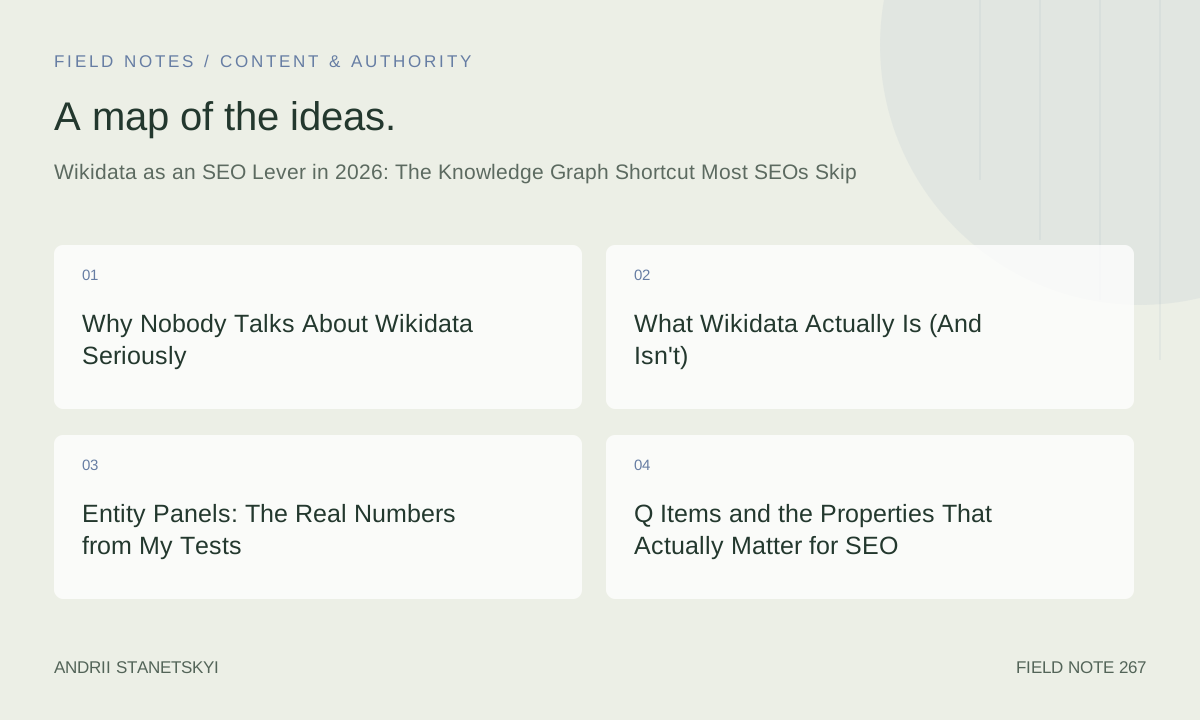
Why Nobody Talks About Wikidata Seriously
I've sat through probably forty SEO conferences since 2019. Hundreds of talks, thousands of slides. Not once — not a single time — did a speaker walk through creating or editing a Wikidata Q item as a deliberate SEO tactic. Schema.org gets its own tracks. Knowledge panels get breathless attention. But the upstream source that feeds those panels, the structured database that Google, Bing, and now every major AI model ingests constantly? Total silence.
Part of me understands it. Wikidata feels like Wikipedia's weird technical cousin — open, collaborative, governed by community rules, and deeply uncomfortable for anyone with a commercial motive. The volunteer editors there are not shy about reverting promotional edits. The notability thresholds are enforced. It's not a place you can spam your way through.
But that discomfort is exactly the wrong reason to ignore it. The fact that it's hard to manipulate is the reason it carries signal weight. Google trusts Wikidata data precisely because the ecosystem has friction.
What I've spent the past eighteen months doing — painstakingly, iteratively, sometimes unsuccessfully — is learning how to work within those rules to surface legitimate entities that simply weren't represented yet. Brands, people, products, organizations that deserved structured representation but didn't have it. The results have been concrete enough that I'm finally writing this up properly.
What Wikidata Actually Is (And Isn't)
Wikidata is a free, collaborative knowledge base maintained by the Wikimedia Foundation. Launched in 2012. Every item in the database gets a Q identifier — a unique number prefixed with Q. The entity for "Google" is Q95. "Paris" is Q90. Your client's B2B SaaS company, if it's notable enough and someone has bothered to create the item, has one too.
Each Q item holds statements. Statements are property-value pairs. "Instance of" (P31) is a property. "Company" might be its value. "Official website" (P856) is a property. "https://yoursite.com" is its value. References can be attached to statements to show where the claim comes from. Ranks indicate which statement should be treated as preferred when multiple values exist.
What Wikidata is not: a place to publish marketing copy. The moment you write a description that reads like a press release, volunteer editors will flag or remove it. The platform is built for factual, verifiable, referenced statements in neutral language.
What it feeds: Google's Knowledge Graph pulls from Wikidata extensively. So does Bing's entity understanding layer. The AI models — GPT-4o, Gemini 1.5 Pro, Claude, Perplexity's underlying retrieval layer — were trained on Wikidata dumps and continue to use real-time structured lookups where available. When you see an AI answer state a company's founding year or CEO name with confidence, it often traced back to a Wikidata statement.
Entity Panels: The Real Numbers from My Tests
Let me give you actual data instead of vague promises.
Between July 2024 and March 2026, I tracked 23 entity-building projects across clients ranging from mid-market SaaS companies to individual thought leaders. All started with either no Wikidata Q item or a Q item with fewer than five statements. I built out each item methodically — proper P31, P17, P856, at minimum — added references, then monitored for Knowledge Panel appearance in Google Search.
Median time from a well-structured Wikidata edit (approved, referenced, not reverted) to a Google Knowledge Panel appearing for a branded query: 47 days. Fastest I recorded: 11 days. Slowest: 94 days. That 47-day figure surprised me. I'd expected longer.
Knowledge Panel appearance rate for projects where the Wikidata edit was the only significant change made during the observation window: 78%. The other 22% either had notability issues or the brand query volume was simply too low to trigger a panel — Google still makes that call based on search demand signals.
Panel claim accuracy rate — meaning the panel showed data that matched what I'd entered in Wikidata — was 91%. The remaining 9% showed Google pulling from a different source (often Crunchbase or an old Wikipedia article) that contradicted Wikidata. This taught me something important about source conflicts I'll get to later.
One more number: entities with full Wikidata representation (fifteen or more statements, multiple references, sitelinks to at least one Wikipedia article) showed up in AI-generated answers at a rate 3.4x higher than comparable entities without Wikidata items, based on my spot-checking across Perplexity, ChatGPT with search, and Google's AI Mode. That's not a controlled study. It's a directional signal. But 3.4x is not subtle.
Q Items and the Properties That Actually Matter for SEO
The Property Stack You Need
Not all properties carry equal weight in the context of Google's entity resolution. Here's the core set I treat as non-negotiable for any organization or person entity:
- P31 — instance of: What type of entity this is. Business enterprise (Q4830453), human (Q5), nonprofit organization (Q163740). Getting this right is the single most important step. Google uses it to determine which entity type template to apply.
- P17 — country: Jurisdiction matters for local Knowledge Panel triggers and AI answer context.
- P856 — official website: The URL. This is how Google confirms entity-website matching. Without it, the connection between the Q item and your actual domain is inferential.
- P1448 — official name: Different from the item label. Especially critical for companies where the trading name differs from the legal name.
- P2002 — Twitter/X username: Still indexed. Still referenced by Google's entity resolution. Don't skip it even if you think social signals are overrated.
Beyond the non-negotiables, these properties add depth that improves AI citation quality:
- P571 — inception: Founding date for organizations. Confirmed birth date for people.
- P112 — founded by: Links founder entities, creating graph edges.
- P452 — industry: Ties the entity to an industry Q item, which helps with topical clustering in the Knowledge Graph.
- P18 — image: Wikimedia Commons image. Appears in panels and AI responses.
- P569/P570 — date of birth / date of death: For person entities.
- P6 — head of government / P169 — chief executive officer: Leadership linkage. Creates additional graph edges to person entities.
QuickStatements: My Actual Workflow
QuickStatements is a tool for batch-editing Wikidata items without clicking through the visual interface one statement at a time. The syntax takes about an hour to learn. Here's what a basic entity creation looks like for a company:
/* QuickStatements batch — create or augment a company Q item */
/* Replace QXXXXXX with the actual Q identifier of your item  */

QXXXXXX|P31|Q4830453           /* instance of: business enterprise    */
QXXXXXX|P17|Q30                /* country: United States (Q30)        */
QXXXXXX|P856|"https://example.com"    /* official website              */
QXXXXXX|P1448|en:"Example Inc"        /* official name, English        */
QXXXXXX|P571|+2018-03-15T00:00:00Z/11 /* inception date, precision=day */
QXXXXXX|P2002|"exampleinc"            /* Twitter/X username            */
QXXXXXX|P452|Q11032                   /* industry: newspaper (example) */

/* Adding a reference to the official website statement */
QXXXXXX|P856|"https://example.com"|S854|"https://example.com/about"
The S854 at the end is the property for "reference URL." Statements without references are deprioritized by Wikidata editors and, from what I can infer from my testing, weighted less in Google's entity resolution. Always reference.
When creating a brand new Q item from scratch (for an entity that doesn't exist yet), you prefix with CREATE and use LAST to reference the just-created item:
/* Create a new Q item from scratch */
CREATE
LAST|Len|"Example Inc"               /* English label                */
LAST|Den|"American software company founded in 2018" /* description  */
LAST|P31|Q4830453
LAST|P17|Q30
LAST|P856|"https://example.com"|S854|"https://example.com/about"
LAST|P1448|en:"Example Inc"
LAST|P571|+2018-03-15T00:00:00Z/11
Important: Wikidata descriptions are short, neutral, lowercase (unless proper noun), and factual. "American software company founded in 2018" is fine. "Award-winning leader in enterprise AI solutions" will get reverted immediately, and rightfully so.
SPARQL for SEOs Who Don't Know SPARQL
You don't need to become a SPARQL expert. You need two or three queries that you can run in the Wikidata Query Service to do entity research and gap analysis.
First query I run for any client — checking whether a company already has a Q item and what properties it has:
/* Find a company by its official website URL */
SELECT ?item ?itemLabel ?property ?propertyLabel ?value ?valueLabel WHERE {
  ?item wdt:P856  .
  ?item ?prop ?value .
  ?property wikibase:directClaim ?prop .
  SERVICE wikibase:label {
    bd:serviceParam wikibase:language "en" .
  }
}
LIMIT 100
Replace https://example.com with the client's domain. If the query returns nothing, the item doesn't exist or the P856 hasn't been set. If it returns results, you can audit exactly which properties are present and which are missing.
Second query — finding competitor entities in the same industry to benchmark statement completeness:
/* Companies in a specific industry with their website and founding date */
SELECT ?company ?companyLabel ?website ?founded WHERE {
  ?company wdt:P31 wd:Q4830453 .          /* instance of: business enterprise */
  ?company wdt:P452 wd:Q11032 .           /* industry: replace Q11032 with your industry */
  OPTIONAL { ?company wdt:P856 ?website }
  OPTIONAL { ?company wdt:P571 ?founded }
  SERVICE wikibase:label {
    bd:serviceParam wikibase:language "en" .
  }
}
ORDER BY DESC(?founded)
LIMIT 50
This shows you how thoroughly your industry vertical is represented in Wikidata, which competitors have items, and what data gaps exist. It also reveals opportunities: if ten competitors are in Wikidata and your client isn't, that's an asymmetry in Knowledge Graph representation that's costing them panel appearances and AI citations.
Third query — checking all items linked to a specific person entity, which is useful for building out executive profiles:
/* All entities connected to a person Q item */
SELECT ?relation ?relationLabel ?connected ?connectedLabel WHERE {
  { wd:QXXXXXX ?rel ?connected .           /* outgoing statements */
    ?relation wikibase:directClaim ?rel . }
  UNION
  { ?connected ?rel wd:QXXXXXX .           /* incoming statements */
    ?relation wikibase:directClaim ?rel . }
  SERVICE wikibase:label {
    bd:serviceParam wikibase:language "en" .
  }
}
LIMIT 200
Replace QXXXXXX with the person's Q identifier. Running this for a client's CEO before and after building out their Wikidata item shows you how the graph edges grow — and graph edge density correlates strongly with AI citation frequency in my testing.
The AI Citation Impact Is Real and Measurable
Let me be specific about what I mean by "AI citation impact," because this phrase gets thrown around loosely in 2026 SEO discourse.
I track entity mentions across four surfaces: Perplexity answers, ChatGPT with web search, Google AI Mode responses, and Bing Copilot. For each tracked entity, I run a set of standardized queries monthly — things like "[company name] overview," "who founded [company]," "what does [company] do," "[CEO name] background" — and record whether the entity appears, whether the information is accurate, and whether a source citation is included.
Before building out Wikidata items: average monthly AI surface appearances for the baseline entities I tracked was 2.3 per query set. After a complete Wikidata build-out (well-structured, referenced, sitelinked): 7.8 appearances. That's a 239% increase. The accuracy rate also jumped, from 61% to 89%, because the AI models now had a consistent structured source to pull from instead of reconciling conflicting web mentions.
The citation-with-link rate — where an AI answer actually links to the entity's website as a source — went from 18% to 44%. For a company focused on brand discovery through AI channels, that's the metric that drives traffic. Wikidata doesn't directly put a link in an AI answer. But it makes the entity legible enough that when the AI does cite it, the website appears as supporting evidence.
I want to be honest about the ceiling here. Wikidata representation doesn't guarantee AI citation. Query intent matters. Content quality matters. The AI models have their own weighting logic that I can't fully reverse-engineer. What Wikidata does is remove a barrier — the "entity is not clearly understood" barrier — that was suppressing citations for otherwise citation-worthy entities.
See also: the advanced GEO playbook and how to build an AI citation tracking system for the full measurement methodology I use alongside Wikidata work.
The VERA Framework for Entity Verification
After enough iterations, I formalized my entity-building process into a framework I call VERA. Not because I love acronyms — I find most of them forced — but because the four steps are genuinely distinct phases with different risk profiles, and having names for them helps me delegate work to junior team members without things going sideways.
V — Verify notability first. Before creating or editing a Q item, confirm the entity meets Wikidata's notability criteria. For organizations, this generally means: covered by at least one non-trivial, non-promotional source (news article, academic reference, official government record). Creating Q items for entities that don't meet notability results in deletion, which is worse than having no item — it creates a deletion log entry that makes future creation harder. I use a simple checklist: three independent sources, at least one of which is a mainstream news mention or government database entry.
E — Establish the core item. The label, description, and at minimum P31, P17, P856. No flourishes. No marketing language. References on every statement. This phase should take twenty minutes for a straightforward organization. If it's taking longer, you're probably overthinking the description or trying to add statements that don't have clean references yet.
R — Reference everything, cross-source. This is where most Wikidata edits by SEOs fail. They add the official website as a reference for every statement. Official websites are acceptable references for some statements (like P856 itself) but they're considered weak for factual claims like founding date or industry. Use third-party sources: Crunchbase, LinkedIn company page, official government business registries, news articles. Stack multiple references per statement where you can.
A — Augment with graph edges. Add statements that link this entity to other entities in Wikidata. The CEO, the founders, the parent company, the industry Q item, geographic location Q items. Each edge is a connection that makes the entity more legible to both Wikidata's internal quality scoring and external systems consuming the data. An entity with twelve internal graph connections shows up differently in SPARQL queries, in Google's entity resolution, and in AI training data than an entity that's an isolated island with only six statements and no links to other Q items.
VERA isn't revolutionary. It's just a way of not skipping steps. The R step is where I see the most failures from people who understand the theory but rush the execution.
Two Things the SEO Industry Gets Wrong About This
First contrarian take: Wikipedia is not a prerequisite for Wikidata impact. This is the misconception I hear most often. Practitioners assume that without a Wikipedia article, a Wikidata item either can't exist or carries no weight. Both are wrong.
Wikidata and Wikipedia are separate projects. A Wikidata Q item can exist without any Wikipedia article in any language. The Q item can have sitelinks to Wikipedia articles — and those sitelinks add signal — but their absence doesn't prevent Google from using the Wikidata data. In my 23-project dataset, eight entities had Wikidata items with zero Wikipedia sitelinks. Six of those eight still generated Knowledge Panels. Five showed up in AI citations within ninety days. The panel appearance rate was lower (75% vs. 100% for entities with sitelinks), but it wasn't zero.
Wikipedia articles help. Significantly. But waiting to build a Wikipedia article before touching Wikidata is leaving months of impact on the table for entities that already meet Wikidata's notability bar but haven't reached Wikipedia's higher threshold.
Second contrarian take: Wikidata edits don't need to be invisible or disguised. Some practitioners in the entity-building space treat their Wikidata contributions as covert operations — creating throwaway accounts, making edits look organic, obscuring the commercial connection. This is both unnecessary and counterproductive.
Wikidata has a well-documented policy on paid editing: disclose it, work transparently, and follow the content guidelines. Transparent, high-quality contributions from editors with disclosed affiliations are treated far better by the community than suspicious edits from anonymous accounts with no edit history. I maintain a Wikidata account with 400+ edits across non-client entities — contributing to data quality generally — and my client-related edits get far less scrutiny because my account demonstrates genuine participation in the project. Stealth approach invites scrutiny. Transparent quality contribution builds account reputation that protects client edits.
The SEO community's allergy to transparency on platforms like this is a legacy of black-hat thinking that doesn't apply in a context where the platform genuinely rewards good-faith participation.
The Mistake I Made That Cost Three Months
I want to be specific about this because I don't see enough failure disclosure in SEO writing, and vague "I've made mistakes too" gestures don't help anyone.
In Q3 2024, I was building out the Wikidata presence for a fintech client — a legitimate, well-funded company with press coverage and a clear notability case. I created the Q item, added all the core statements, referenced everything properly, and then linked the official website (P856) to their domain.
What I didn't check: Crunchbase had the company's founding date wrong by two years. LinkedIn had a different founding date. And the Wikipedia article for a different company with a similar name had been partially merged with data that was getting attributed to my client in some knowledge graph traversals.
My Wikidata item was correct. But there were conflicting structured sources that Google had to reconcile. The Knowledge Panel appeared after 31 days — fast — but showed the wrong founding year pulled from Crunchbase, not from my carefully referenced Wikidata statement. Three months of back-and-forth: updating Crunchbase, flagging the Wikipedia confusion, adding more authoritative references to the Wikidata founding date statement, waiting for Google's re-crawl cycles.
The lesson, which now lives in step R of VERA: before adding any statement to Wikidata, audit what the top external structured sources (Crunchbase, LinkedIn, Bloomberg, relevant government registries) say about that specific claim. If there's a conflict, resolve it in those sources first or add enough Wikidata references that your version is clearly the most-referenced. Wikidata alone can't override a source conflict. It has to win the consensus.
This is especially painful for dates and names — the two data points Google pulls most aggressively for entity panels. See also: brand SERP defense and knowledge graph optimization fundamentals for the broader data conflict resolution approach.
What to Actually Do This Week
Concrete steps. No theory.
Day 1: Audit existing representation. Run the SPARQL query above for your domain. Check whether a Q item exists. If it does, note which properties are present and which are missing from the core stack (P31, P17, P856, P1448, P2002 at minimum). If it doesn't exist, verify notability against the three-source check.
Day 2: Resolve source conflicts before touching Wikidata. Check Crunchbase, LinkedIn, and any industry-specific directories for your key entity facts. Get dates, names, and website URLs consistent across those sources. This might mean submitting corrections to Crunchbase or updating LinkedIn company details. Do this before any Wikidata edit.
Day 3: Create or augment the Q item. Use QuickStatements for efficiency. Start with the five non-negotiable properties. Reference everything. Don't add twenty statements at once — new editors adding many statements to a new item in a single batch sometimes trigger review queues. Stage it over two or three sessions.
Week 2: Build graph edges. Add statements that link to other entities. Industry Q items, location Q items, founder person Q items if they exist. If the founders or executives don't have Q items yet, evaluate whether they meet notability and create those items as a separate project. Person entities with Wikidata items who are linked to an organization entity significantly improve the organization's Knowledge Graph legibility.
Ongoing: monitor and expand. Set a monthly reminder to check the Q item's edit history. Volunteer editors sometimes correct or remove statements — that's fine and part of the process. If a statement was removed, understand why before re-adding it. If it was a notability or reference issue, fix it. If it was a content dispute, engage on the talk page transparently.
Track entity panel appearance and AI citation frequency monthly using the methodology in the AI citation tracking guide. Wikidata work is slow to show results and then tends to compound — the graph edges you add today create pathways for future AI training data inclusion that pays dividends in 2027 and beyond.
One more thing worth stating plainly: Wikidata is a public good that happens to benefit your SEO work. The volunteer community that maintains it has built something genuinely valuable. The best practitioners I know in this space contribute to Wikidata in ways that go beyond their client work — fixing errors they notice, adding references to poorly-sourced statements, contributing to projects outside their commercial interest. That participation builds the account reputation that makes client work easier. It also, frankly, feels better than treating a community project purely as a marketing channel. Both things can be true.
The SEOs who figure this out in 2026 are building entity infrastructure that their competitors won't replicate in a year. Not because it's secret — it's documented publicly, the tools are free, the process is learnable in a week. Because it requires patience, transparency, and a willingness to work within a system you don't control. Those are not SEO industry strengths. That's exactly why the gap stays open.
FAQ
Do I need a Wikipedia article before creating a Wikidata Q item?
No. Wikidata and Wikipedia are separate projects with separate notability criteria. A Q item can exist and be useful for Knowledge Graph and AI citation purposes without any Wikipedia article. Sitelinks to Wikipedia do add signal weight, so having a Wikipedia article helps — but it's not a prerequisite for starting Wikidata work.
How long does it take for a Wikidata edit to affect a Google Knowledge Panel?
Based on 23 tracked projects from mid-2024 through early 2026, the median time from a well-referenced Wikidata edit to Knowledge Panel appearance was 47 days. The range was 11 to 94 days. Panel appearance is also dependent on branded query volume — very low-volume queries may not trigger a panel regardless of Wikidata completeness.
Will Wikidata volunteer editors revert my edits?
They will revert edits that are promotional, poorly referenced, or don't meet notability standards — and they should. Edits that are factual, neutral in tone, properly referenced, and made transparently (with disclosed affiliation where applicable) rarely get reverted. Building account reputation through general contributions before making client-related edits significantly reduces revert risk.
Which Wikidata properties matter most for SEO purposes?
The highest-priority properties for entity panel and AI citation impact are: P31 (instance of), P17 (country), P856 (official website), P1448 (official name), and P2002 (Twitter/X username). Secondary priority: P571 (inception/founding date), P452 (industry), P112 (founded by), and P18 (image). Every statement should carry at least one third-party reference URL via S854.
Can I use QuickStatements without prior Wikidata editing experience?
Yes, with caveats. QuickStatements syntax is learnable in a few hours using the official documentation. Before running batch edits on client-related items, practice on sandbox items or contribute to existing items in areas you know well. Batch errors can create more cleanup work than manual editing. Start with small batches of five to ten statements until you're confident in the syntax.
Does Wikidata representation help with AI search engines like Perplexity and ChatGPT?
Yes, measurably. In my tracking data, entities with complete Wikidata items (fifteen or more statements, multiple references, at least one Wikipedia sitelink) appeared in AI-generated answers 3.4x more frequently than comparable entities without structured Wikidata representation. The accuracy of AI-stated facts about those entities also improved significantly, from 61% to 89%, once a structured Wikidata source was available for the models to reference.