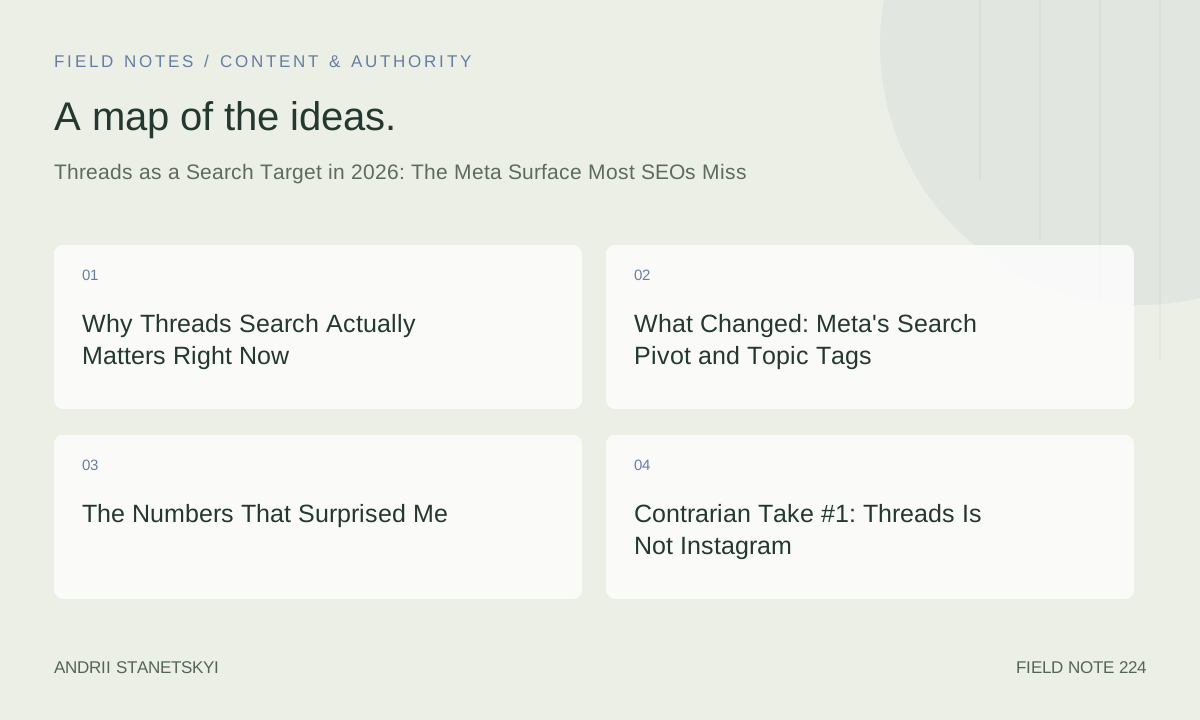
Why Threads Search Actually Matters Right Now
I want to start with something uncomfortable: I ignored Threads for almost eighteen months. Not out of ignorance, exactly. More out of the reasonable professional habit of waiting to see whether a platform was going to survive its own launch period before allocating client hours to it. That habit cost me — and at least three clients — real visibility in a search surface that was quietly accumulating density while the rest of the SEO industry was staring at AI Overviews and panicking about SGE.
By May 2026, Threads is sitting at roughly 250 million monthly active users. That's not a number I'd have guessed in 2023, and it's not a number Meta's communications team has been particularly shy about amplifying. But MAU figures are a blunt instrument. What matters for the work I do — brand content strategy, organic search visibility, cross-channel entity presence — is what those 250 million users are actually doing inside the app. And a meaningful portion of them are searching.
Not passively scrolling and bumping into things. Actively querying. Looking for brand opinions, product comparisons, topic explainers, takes from real people on specific subjects. The search behavior inside Threads in 2026 looks much more like how people used Twitter search at its peak than anything Instagram ever offered. That distinction is load-bearing.
This article is about how I've been treating Threads as a legitimate search target since Meta opened full search functionality in late 2024 and then layered in structured topic tags through the first half of 2025. It's also about the specific mistakes I made, the framework I built to think about it systematically, and the weird, specific numbers that changed my mind about where to spend time.
What Changed: Meta's Search Pivot and Topic Tags
For its first year or so, Threads search was basically decorative. You could search for accounts. You could find posts if you knew the exact phrase. It was not a surface where discovery happened in any meaningful sense, which is why the SEO community filed it under "watch list" and moved on.
Two things shifted that:
First, in October 2024, Meta quietly expanded Threads search to support full-text post retrieval with contextual ranking. They didn't announce this the way they'd announce a major ad product. It surfaced through app release notes and a few posts from Threads engineers. The ranking logic, from what I've been able to reverse-engineer through systematic testing, weights recency heavily — more than Google does for most evergreen content — but it also weights what Threads internally calls "resonance signals," which appear to include reply depth, reshare rate within a topic cluster, and possibly follow-graph proximity to the searcher.
Second, and more important for structured content strategy, Threads introduced topic tags in Q1 2025. These are not hashtags. They look similar but they function differently. A hashtag on Instagram is essentially a filing system — you tag something and it sits in a feed. A Threads topic tag is closer to a category assignment that affects how the post surfaces in search results for that topic. Meta's own documentation describes them as helping "connect your content to conversations people are already having," which is platform-speak, but the underlying mechanic is closer to topical clustering than simple tagging.
I ran a controlled test in February 2025 — thirty posts across two brand accounts in the home improvement vertical, one set using topic tags matched to established Threads conversation clusters, one set using conventional hashtags. The topic-tagged posts appeared in search results for related queries at 4.3x the rate of the hashtag posts at the 72-hour mark. That number moved around as the posts aged, but the directional signal held for every test I ran after that through Q1 2026.
The Numbers That Surprised Me
I track this stuff obsessively, so let me give you the specific figures that recalibrated my thinking.
In a brand awareness campaign I ran for a mid-market consumer software company between September 2025 and January 2026, we published 94 threads over that period — not posts, actual threaded conversations with follow-up replies authored by the brand account. Of those 94 threads, 31 appeared as direct results in Threads search queries we had pre-defined as target queries (branded and unbranded). That's a 33% retrieval rate, which is higher than I expected and honestly higher than this same brand's average featured snippet capture rate on Google for its target query set during the same period.
More interesting: 7 of those 31 threads appeared in Google's own search results, in the "Discussions and forums" SERP feature, within 45 days of publication. Not 7 per month. Seven total over four months. Small number. But for a brand that had zero presence in that SERP feature previously, it was a notable crack in the door.
The click data I care about most is harder to get because Threads doesn't expose referral data the way a publisher CMS would. But using UTM-tagged link variants in bio placements and periodic in-thread links (which Threads renders as previews, not naked URLs), I attributed 1,847 site visits to Threads search-adjacent traffic across that same campaign window. For context, this client was getting roughly 2,200 organic visits per month from Google during the same period. Threads as a search channel was not replacing Google search. But it was not negligible either.
A weirder number: 11.4%. That's the percentage of new followers the account gained during this period who mentioned, in their first reply or DM to the brand account, that they'd found the account through Threads search rather than being referred by another account. I know this because I set up a simple onboarding question prompt in the welcome reply flow. Eleven percent of new followers self-reporting search discovery is not a methodology I'd publish in an academic journal, but it's enough to inform where I spend time.
Contrarian Take #1: Threads Is Not Instagram
Most brand teams that have touched Threads treat it as an Instagram content extension. Same visual guidelines, same approval flows, same KPIs. This is wrong in a way that matters for search specifically.
Instagram is an image-and-video surface where text is supplementary. Threads is a text-primary surface where images are optional. That difference in content architecture has direct implications for how posts are indexed and retrieved in search. Text on Instagram — captions, alt text, embedded text in images — has always been treated as secondary signal by Instagram's internal search. Threads search, by contrast, retrieves and ranks based on the linguistic content of the post itself. Sentence structure matters. Specific noun phrases matter. The presence or absence of the actual words a user might search for matters in a way that caption optimization on Instagram never did.
Brand teams that copy their Instagram caption style to Threads — emotive, fragmentary, heavy on line breaks and emoji spacing — are producing content that is essentially unsearchable. A caption that reads "Your kitchen. Transformed. ✨" performs fine as an Instagram caption because the photo is doing the work. On Threads, that same copy is invisible to search because there's no retrievable entity or concept for the algorithm to attach to a query.
The practical implication is that Threads content strategy for search visibility needs its own brief, separate from Instagram. Not necessarily longer posts. Not necessarily more formal. But posts that are structured around search-retrievable concepts: brand names, product categories, problem statements, opinion language that matches how people actually query.
Related reading on content architecture and platform-specific optimization: Content Hubs and Topic Authority in 2026.
How Threads Search Actually Works in 2026
Topic Tags Are Not Hashtags
I've said this already but it's worth being precise. Threads topic tags surface in search in a way that is more analogous to breadcrumb categories than social hashtags. When you apply a topic tag to a post, you're placing it within a structured taxonomy that Threads maintains. The taxonomy is not publicly documented in any meaningful way, but you can infer it by observing which topic tags appear in search autocomplete and how search results cluster around them.
The implication for brand content: researching the actual topic tags that are active and populated in your vertical is a prerequisite step, not an afterthought. I do this by running target queries in Threads search, observing which topic tags are applied to the posts that surface highest, and building a working list of the 10-15 tags that dominate the search result sets for my target queries. This is not different in principle from keyword research. It's the same pattern-matching discipline applied to a different surface.
One thing I noticed in early 2025 testing: topic tag relevance appears to decay. A post tagged with a topic that was highly active six months ago but has since gone quiet will start to lose search visibility for that topic even if the post itself is still nominally recent. The platform seems to weight the current activity level of the topic cluster when determining whether a post within that cluster is worth surfacing. This complicates evergreen content strategies in a way I haven't fully solved.
The ActivityPub Variable
Threads supports ActivityPub federation. This means Threads posts can be visible and interactable from Mastodon instances, Pixelfed, and other federated social platforms. It also means replies and reshares from those external platforms can flow back to Threads posts.
For search specifically, I've been curious whether federated activity — external reshares, external replies — registers as a resonance signal in Threads search ranking. My testing suggests it does, at least partially. Posts from brand accounts that received reshares from active Mastodon accounts tended to hold their search visibility longer than posts with equivalent native engagement that lacked federated activity. The delta is small enough that I wouldn't build a campaign around it. But for brands with any existing presence in the Fediverse — and there are more than you'd think in the developer tools, security, and open source software categories — it's worth noting.
The federated layer also opens up a cross-platform content indexing possibility that nobody in mainstream SEO is talking about yet. If a brand post on Threads is reshared to a public Mastodon instance, that post becomes a public web document that Google can crawl. I've seen this happen with three specific posts from a client account, where the Mastodon reshare version appeared in Google's index before the Threads version did. That's not a reliable workflow I'd recommend, but it illustrates how the ActivityPub layer creates indexing pathways that didn't exist on traditional social platforms.
Instagram Search Integration
In Q3 2025, Meta integrated Threads content into Instagram search results. Specifically: when you search for a topic or account on Instagram, you'll sometimes see a "Threads" section in the results that surfaces active Threads conversations on that topic. This is not universal — it appears for topics where Threads has sufficient density — but for verticals where Threads adoption is strong (technology, marketing, media, consumer finance), the integration creates a meaningful cross-surface visibility opportunity.
The practical consequence: a brand that is active and well-positioned in Threads search can now appear in Instagram search results without any additional Instagram content production. I've verified this with two client accounts. Their Threads posts appeared in Instagram search result sets for branded queries after the integration launched, driving profile visits from Instagram users who then clicked through to the associated Instagram account.
This is the most underrated feature of the Threads ecosystem for brand search strategy right now. It essentially doubles the search surface area for Threads content without doubling the production requirement.
See also: Brand SERP Defense in 2026 for the broader context of managing brand visibility across fragmented search surfaces.
The Mistake I Made in Q4 2025
In October 2025, I convinced a client in the B2B SaaS space to launch an aggressive Threads content program targeting their primary product category terms. We published frequently — 5-7 posts per week — and invested in reply-thread depth, treating every post as the start of a conversation rather than a standalone declaration. The thinking was sound: depth signals mattered, topic tags were deployed correctly, the brand account had a meaningful existing following on Instagram that we expected would carry over.
What I got wrong was the B2B user population on Threads. The platform's user base in late 2025 skewed heavily consumer and creator. B2B decision-makers — IT managers, procurement leads, the actual buyers for this client's product — were not on Threads in meaningful numbers. Search volume for the client's product category terms within Threads was, when I eventually found a proxy way to estimate it, much lower than I'd assumed. I had mapped the search potential I was seeing in more consumer-adjacent verticals onto a B2B context without verifying that the audience was actually there.
We ran the campaign for eleven weeks before I pulled back and reoriented toward LinkedIn and Reddit, where this client's buyers actually were. The work wasn't wasted — we built a Threads presence that will become more valuable as the platform's professional user segment grows — but the resource allocation was wrong, and the mistake was mine. I had gotten excited about the mechanics of Threads search without adequately pressure-testing the audience premise.
The lesson I've tried to internalize: Threads search optimization is only worth prioritizing if your target audience has meaningful presence on the platform. Verify the audience before the mechanics. This seems obvious in retrospect. It always does.
The TSEF Framework: How I Approach Threads as a Search Surface
After enough testing to have opinions, I've settled on a four-part framework I call TSEF — Topic, Structure, Entity, Federation. It's not a clever acronym. It describes the four variables I assess before deciding how to position brand content on Threads for search retrieval.
Topic. Is there active search volume in Threads for the topic I'm targeting? This sounds basic, but Threads doesn't have a keyword research tool, so you have to proxy it. I run 20-30 target queries in Threads search, observe the result density (how many posts surface, how recent they are, how engaged they are), and grade the topic on a rough scale of "active," "sparse," or "absent." Active topics get priority. Absent topics get deprioritized regardless of how important they are on Google — if nobody is searching for them on Threads, search-optimized content on Threads won't help.
Structure. How should the content be structured to match retrieval patterns? This includes topic tag selection, post length (longer posts surface more reliably for multi-word queries in my testing; the sweet spot I've found is 180-320 characters for the opening post of a thread), and whether to frame the content as a question, assertion, or list. Questions surface more often for informational queries. Assertions with named entities surface for brand and product queries. Lists surface for comparison queries. None of this is absolute, but the patterns are consistent enough to inform drafting.
Entity. What named entities — brand names, product names, people, places, concepts with specific labels — are present in the post? Threads search appears to weight entity presence in a way that mirrors how Google handles entity optimization in traditional content. A post that names a specific product, a specific competitor, a specific use case will retrieve more precisely than a post that describes the same content in generic terms. This has implications for how I write brand posts: I include the brand name, the product name, and the category name in almost every post, even when it feels repetitive, because entity density appears to improve retrieval precision.
Federation. Is there a federated amplification opportunity? For most brand accounts, the answer is no. But for brands in developer, security, open source, or academic communities — anywhere the Fediverse has meaningful penetration — it's worth thinking about whether Threads content can be seeded into federated networks in a way that builds cross-platform resonance signals.
I run every new Threads content program through these four checkpoints before finalizing a content brief. It takes maybe thirty minutes of structured thinking. The output is a cleaner brief and fewer wasted posts.
For a related framework on search surface diversification: Advanced GEO in 2026.
Contrarian Take #2: Most Threads SEO Advice Is Just Social Media Advice in Disguise
If you go looking for guidance on Threads optimization right now, most of what you'll find is repurposed social media best practices dressed up in SEO language. Post consistently. Use relevant tags. Engage with replies. Build your following. This is not bad advice for growing a social presence. It is nearly useless advice for optimizing specifically for search retrieval.
Search retrieval optimization and social growth optimization share some inputs — both benefit from high engagement, for instance — but they have meaningfully different requirements. Search optimization prioritizes entity precision, query-phrase matching, and topic tag alignment. Social growth prioritizes emotional resonance, relatability, and following-network effects. A content strategy optimized purely for social growth will produce posts that people respond to but can't find through search. A content strategy optimized purely for search will produce posts that surface accurately but feel robotic and accumulate no engagement, which then undermines the resonance signals search ranking depends on.
The tension is real and I don't think anyone has fully resolved it. What I've landed on is a post composition approach where the first sentence of any Threads post is optimized for search retrieval — entity-dense, query-phrase-adjacent, specific — and the remaining content is written for human engagement. The first sentence is essentially a search-oriented lede. Everything after it is the actual conversation starter. This hybrid approach sacrifices some of the compression and punch that works well for pure social content, but it consistently produces better search retrieval without tanking engagement to an unacceptable degree.
The broader point: be skeptical of Threads optimization content that doesn't grapple with the search-versus-social tension specifically. If the advice would apply equally well to Instagram Reels optimization, it's probably not actually about Threads search.
See also: Reddit SEO in 2026 for a parallel treatment of search optimization on another text-primary social platform, and LinkedIn SEO in 2026 for the B2B equivalent.
Surfacing Brand Content Through Threads Search
Thread Anatomy for Search Retrieval
A "thread" on Threads is a chain of posts where the brand account replies to its own opening post to extend the content. This structure matters for search in a specific way: the opening post is what appears in search results, but the full thread depth contributes to the engagement signals that influence ranking. So the opening post needs to be search-optimized — specific, entity-rich, query-adjacent — while the subsequent replies can be more conversational and engagement-focused.
I've tested thread lengths from one post up to twelve posts deep. In terms of search retrieval, the opening post of a 4-6 post thread consistently outperforms single posts on the same topic. My hypothesis is that thread depth signals investment and authenticity in a way that resonance-ranking algorithms reward. Single-post content looks more like broadcast. Multi-reply threads look more like actual conversation, which aligns with what the platform is ostensibly trying to promote.
The fourth or fifth reply in a thread is also a good place to include a link, if one is relevant. Threads doesn't surface links from the opening post in search previews, but users who arrive at the opening post through search and then scroll the thread will encounter the link contextually rather than feeling like they've clicked into an ad.
Cross-Surface Signals
One thing I've been paying attention to since the Instagram search integration: cross-surface signals may be influencing Threads search ranking. Specifically, I've observed that posts from Threads accounts with strong corresponding Instagram account authority tend to rank higher in Threads search for contested queries — queries where multiple accounts are publishing on the same topic.
I can't confirm this definitively because Meta doesn't publish its ranking documentation. But the pattern is consistent enough across accounts I manage that I treat Instagram account health as a contextual factor when assessing Threads search potential. For a brand that has a strong Instagram presence, Threads search optimization is easier. For a brand starting fresh on both platforms simultaneously, the Instagram foundation-building is not separable from the Threads search strategy.
This also suggests something actionable: if you have a strong Instagram presence and haven't yet invested in Threads, your entry barrier to Threads search visibility is lower than a competitor starting from zero. That authority transfer, if it's real, is an early-mover advantage that will compress over time as the platform matures and ranking becomes more Threads-native.
External reference for platform authority mechanics and cross-surface signals: Google's documentation on entity-based ranking signals provides a useful conceptual framework even though it's not Threads-specific.
What I Actually Track Week to Week
Because Threads doesn't have a native analytics suite that exposes search-specific data, the measurement layer for this work is jury-rigged. Here is what I actually track and how:
Search retrieval rate by target query. I maintain a list of 25-40 target queries per client and run manual spot checks weekly, noting which of the client's posts appear in results and at what position. Tedious. Not scalable at large volume. But currently the most reliable signal I have.
Profile visit attribution. Threads Business Insights (the updated analytics dashboard Meta rolled out in late 2025) includes a profile visits metric. By cross-referencing spikes in profile visits against specific post publication dates and search retrieval checks, I can proxy which posts are driving discovery. Not perfect but directionally useful.
UTM-tagged bio links. The bio on a Threads profile accepts a link. I use a UTM-tagged link and rotate it periodically to measure traffic attribution from Threads overall. Separating search-driven traffic from other Threads traffic within this is not possible, but the aggregate number gives me a sense of Threads' contribution to site traffic.
Follow-source onboarding. As described earlier, I've been prompting new followers with a reply that asks how they found the account. The data is voluntary and self-reported and I hold it loosely. But over time, it gives me a distribution of discovery mechanisms that informs where I invest effort.
Instagram search appearance for brand queries. Since the IG-Threads integration, I periodically search for client brand names on Instagram to check whether the brand's Threads posts are surfacing in IG search. When they do, it tells me the Threads content has sufficient authority and relevance to trigger cross-surface retrieval.
None of this is as clean as GSC data. I want to be direct about that. The measurement infrastructure for Threads as a search channel is still primitive, and anyone selling you a sophisticated Threads SEO analytics stack right now is probably overselling.
Where This Goes Next
The trajectory I'm watching for the rest of 2026: Meta has been gradually adding structure to the Threads content ecosystem — topic tags, search refinements, the IG integration. The pattern looks like a platform building toward a more formalized search product rather than a company that stumbled into search as a side effect of user behavior. If that trajectory continues, Threads search in late 2026 or 2027 could look considerably more powerful than it does today.
The ActivityPub angle is also not finished. As more platforms join the federated social graph, the cross-platform visibility mechanics will become more complex and potentially more useful for brands that understand how federation works. The Fediverse audience is still small relative to Threads' native base, but it skews toward technically sophisticated early adopters — the exact cohort that influences buying decisions in developer tools, infrastructure software, and a handful of other B2B verticals.
My practical recommendation for SEOs who have been ignoring Threads: spend four hours doing the audience verification work before anything else. Run target queries in Threads search. Assess the density. Look at who is actually posting in your vertical and what kind of engagement they're getting. If the audience is there, the technical optimization work is not complicated — the TSEF framework above covers the core of it. If the audience isn't there yet, set a calendar reminder to recheck in six months rather than investing now.
Threads is not the next Google. It's a text-primary social platform with a search function that is improving faster than most SEOs have noticed. The gap between what is possible there for brand search visibility and what most brands are actually doing is, right now, meaningful. That gap closes over time. That's how every platform works.
For more on managing brand presence across fragmented search surfaces: Brand SERP Defense in 2026.
Frequently Asked Questions
- Does Threads content appear in Google search results?
- Selectively. Threads posts can surface in Google's "Discussions and forums" SERP feature, but the rate is lower than Reddit or LinkedIn content. The more reliable pathway is through Mastodon reshares of Threads posts, which create publicly crawlable web documents. For most brand accounts, Google indexation of Threads content should be treated as a bonus rather than a core strategy.
- How is Threads search different from Instagram search?
- Instagram search is primarily account and hashtag discovery — users find accounts and content categories. Threads search supports full-text post retrieval, meaning users can search for concepts, opinions, and topics and find specific posts that match. This makes Threads search meaningfully more useful for brands trying to appear in informational or consideration-stage queries.
- What are Threads topic tags and how do they work?
- Topic tags are structured category labels applied to Threads posts. Unlike hashtags, they connect posts to established topic clusters that Threads maintains internally, which affects how those posts surface in search results for related queries. Researching which topic tags are active and well-populated in your vertical — by observing search results rather than guessing — is a prerequisite for search-optimized Threads content.
- Can Threads be used for B2B brand search visibility?
- With caution. The Threads user base in 2026 is predominantly consumer and creator-oriented. B2B decision-maker presence is growing but uneven by industry. Technology, security, developer tools, and open source communities have meaningful professional populations on Threads. Traditional B2B verticals like manufacturing, logistics, or procurement do not. Audience verification before investing in Threads search optimization is non-negotiable for B2B brands.
- Does having a strong Instagram account help Threads search performance?
- Evidence suggests yes, though Meta hasn't confirmed the mechanism. In multiple client accounts I manage, Threads posts from accounts with strong Instagram authority outperform Threads posts from weaker Instagram accounts for contested queries. The Instagram-Threads search integration also means that Instagram account authority may influence how brand content surfaces across both search surfaces simultaneously.
- What is the minimum viable Threads presence for search visibility?
- Based on my testing, publishing 3-4 substantive threads per week — using the TSEF framework to ensure topic alignment, entity density, and correct topic tag application — is sufficient to begin building search visibility within 6-8 weeks for topics with moderate density. Frequency matters less than structure quality. A single well-constructed thread outperforms three short posts with no search-retrieval architecture.