Meta descriptions don't directly affect rankings. Google rewrites them approximately 70% of the time anyway. And yet, the meta description is one of the highest-leverage on-page elements you control — because it directly influences click-through rate, and CTR is one of the few levers that moves traffic without touching your ranking position.
A page ranking position 4 with a 6% CTR versus position 4 with a 3% CTR generates twice the traffic. The ranking is identical. The content hasn't changed. The only variable is how well the SERP snippet converts browsers into visitors. That's the game meta descriptions play, and it's worth playing well.
This guide covers the mechanics, the psychology, the testing infrastructure, and the operational workflow for meta descriptions at scale — with real CTR data where available and tool-specific workflows for GSC, Screaming Frog, and Semrush.
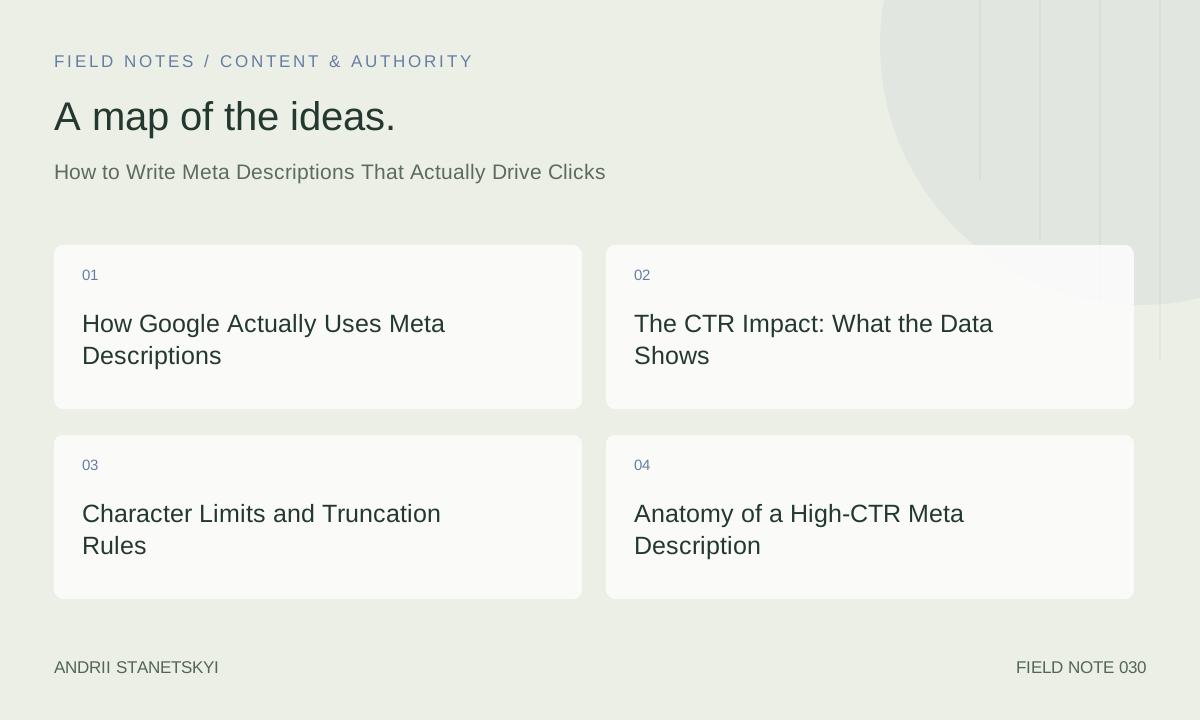
How Google Actually Uses Meta Descriptions
Google's behavior with meta descriptions has been studied extensively and the picture is clear: Google uses your meta description as the SERP snippet when it judges it relevant to the query, and overwrites it when it doesn't. The frequency of rewrites depends on query type:
- For branded queries, Google tends to use the meta description you provide more often (~60% usage rate)
- For informational head terms, Google frequently pulls snippet text from the body of the page
- For long-tail specific queries, Google often pulls the exact passage answering the query
The implication: meta descriptions matter most for the queries you're already converting — branded, commercial, and navigational. For informational content, the body copy is as important as the meta description for snippet control. Well-structured content with clear, query-answering sentences near the top of relevant sections gives you more snippet control than a perfect meta description on a poorly-structured page.
Google's John Mueller confirmed in a 2023 webmaster office hours that meta descriptions influence whether a page is clicked, and that indirectly this can affect how often the page is served — a feedback loop from CTR to ranking signal. This is the mechanism that makes meta description optimization worth the investment.
The CTR Impact: What the Data Shows
CTR benchmarks by position (from aggregated GSC data and industry studies in 2024–2025):
| SERP Position | Average CTR (Desktop) | Average CTR (Mobile) | CTR Range (Well vs. Poorly Optimized) |
|---|---|---|---|
| 1 | 28–34% | 22–28% | 18% – 45% |
| 2 | 13–17% | 10–14% | 8% – 24% |
| 3 | 8–11% | 7–10% | 4% – 17% |
| 4 | 5–7% | 4–7% | 2% – 12% |
| 5–10 | 2–5% | 2–5% | 1% – 9% |
The CTR range column is the critical data point. A position 4 page can earn 12% CTR or 2% CTR depending on snippet quality. The top of that range typically reflects pages with: a compelling, specific description that matches the query intent; unique value proposition visible in the snippet; urgency or curiosity triggers where appropriate; and no truncation that cuts off before the key message.
Using GSC, you can identify your pages where actual CTR falls significantly below the position benchmark. Pages at position 3–5 with CTR below 4% are your highest-priority meta description targets. Pull these via GSC's Performance report filtered by position 1–10 and sort by CTR ascending.
Character Limits and Truncation Rules
Google's SERP displays meta descriptions up to approximately 155–160 characters on desktop and 130 characters on mobile, measured in pixels rather than characters. This means that character counting tools that don't account for character width are imprecise.
Practical rules for truncation avoidance:
- Target 140–155 characters for the safe zone across both device types
- Front-load the value proposition — put the most compelling content in the first 120 characters
- Wide characters (W, M, uppercase letters) consume more pixel width than narrow ones (i, l, 1)
- Test truncation in Google's Rich Results Test or by searching the URL in an incognito window
- Avoid ending the displayed portion mid-word or mid-sentence — it signals poor editorial quality
Tools that measure pixel width rather than character count: Portent's SERP Preview Tool, Yoast SEO's preview (for WordPress), and Semrush's On Page SEO Checker all offer SERP preview functionality that catches truncation before publishing.
Anatomy of a High-CTR Meta Description
Effective meta descriptions share a consistent structural pattern:
1. Lead with the User's Problem or Goal
The user scanning search results is looking for a page that understands their need. The fastest way to demonstrate relevance is to name their problem or desired outcome immediately.
Weak: "Learn about meta descriptions in this comprehensive guide."
Strong: "Meta descriptions written wrong get rewritten by Google. Here's what actually gets clicks."
2. State the Specific Value Delivered
Vague promises ("everything you need to know," "the ultimate guide") have eroded in effectiveness as users have become more skeptical. Specific, concrete value propositions outperform:
Weak: "Comprehensive guide to URL structure for better SEO."
Strong: "URL structure decisions for 10,000+ page sites — when parameters kill crawl budget and when to migrate."
3. Differentiate from Competing Snippets
Before writing a meta description, search the target keyword and read the existing snippets. Then write something different. If every result says "step-by-step guide," don't say "step-by-step guide." If every result is passive voice academic tone, write in direct second-person. The marginal snippet that stands out gets the click.
4. Include a Soft CTA Where Appropriate
Action verbs create momentum: "Find out," "See how," "Get the framework," "Compare options." These work on commercial and transactional pages. On purely informational content, they can feel manipulative — use judgment.
5. Match the Query's Emotional Tone
A user searching "emergency plumber near me" is anxious. A snippet with "Fast response, licensed plumbers available now" matches that emotional state. A user searching "best noise canceling headphones 2026" is in research mode. A snippet with "Tested 12 models over 6 months — here's what actually performs" matches that mode. Emotional alignment is a CTR driver that few SEOs explicitly consider.
Matching Search Intent and Query Context
Meta descriptions must match the dominant intent of the query, not the content of the page in isolation. A page about content pruning serves informational intent for the query "what is content pruning" and navigational intent for "content pruning guide." The meta description should be written for the dominant intent of the target keyword, not for the page broadly.
The four intent categories and their meta description implications:
- Informational: Lead with the answer or the promise of the answer. "X is Y because Z" or "Here's how [topic] works and why it matters."
- Navigational: Confirm identity and category quickly. "Official [Brand] page for [Product]. [Key differentiator]."
- Commercial investigation: Lead with comparison angle or selection criteria. "Compared [X] vs [Y] vs [Z] — here's what matters for [use case]."
- Transactional: State product/offer, key proof point, urgency or incentive. "[Product] from [Brand]. [X reviews], [price/offer]. [CTA]."
Templates by Page Type
For large sites, individual meta descriptions for every page are not operationally feasible. Use templates for programmatic generation, with manually crafted descriptions reserved for your highest-traffic and most competitive pages.
Blog Post Template
[Pain point or goal statement]. [What the article delivers, specifically].
[Differentiator or hook]. ~140 chars

Example:
"Crawl budget wasted on parameterized URLs? This framework identifies
which parameters to block, canonical, or ignore — with Screaming Frog
workflows."
Product Page Template
[Product name + key spec or differentiator]. [Social proof element].
[CTA or urgency].

Example:
"[Product Name] — [Key Feature]. Rated 4.8/5 by 2,400+ customers.
Free shipping on orders over $50."
Category Page Template
Browse [X] [category] from [Brand]. [Filter/selection value prop].
[Trust signal].

Example:
"Browse 340 ergonomic office chairs from certified brands. Filter by
lumbar support, material, and price. Free 30-day returns."
Service Page Template
[Service] for [target customer]. [Specific outcome or deliverable].
[Trust signal + CTA].

Example:
"Technical SEO audits for enterprise e-commerce. Crawl, indexation,
and Core Web Vitals analysis — with a 90-day roadmap. Get a quote."
What Not to Do
- Do not keyword-stuff. Meta descriptions are not a ranking signal. Adding your target keyword three times does nothing for rankings and reads as spam to users.
- Do not leave them blank. An empty meta description guarantees Google pulls whatever passage it considers relevant — often the navigation text or a sentence fragment. Write it yourself and control the message.
- Do not duplicate meta descriptions across pages. Screaming Frog flags duplicate meta descriptions in its overview report. Each page should have a distinct description reflecting its specific value. Duplicates are a crawl quality signal and confuse users who see the same snippet for multiple results.
- Do not use the same meta description for desktop and mobile without considering mobile truncation. At 130 characters mobile, a 155-character description loses 25 characters. Ensure the mobile-visible portion (first ~130 chars) is complete and compelling on its own.
- Do not include quotes in meta descriptions. Google strips quotation marks from meta descriptions, which can break the intended meaning or formatting. Use apostrophes instead.
- Do not overpromise. Clickbait meta descriptions that don't deliver what they promise increase bounce rate — a behavioral signal that can depress rankings over time.
Testing Meta Descriptions: A GSC-Based Framework
Meta description A/B testing at scale requires a structured approach. Google does not offer a native meta description testing tool, but you can proxy it through GSC performance data.
The Before/After Protocol
- Identify your test group: pages ranked positions 3–10 with CTR below position benchmark by at least 30%
- Record baseline CTR and impressions from GSC for the prior 90 days
- Rewrite meta descriptions for all test group pages on the same day
- Wait 45–60 days (for statistical accumulation and Google's re-indexing)
- Compare CTR in GSC for the same period length post-change
- Control for seasonality by comparing year-over-year if applicable
Statistical Validity
For CTR testing to be meaningful, pages need at least 500 impressions over the test period. Pages with fewer impressions than this will show high CTR variance regardless of meta description quality. Prioritize high-impression, low-CTR pages for your test group.
For a more rigorous testing approach, use a split-URL or time-series analysis with a holdout group. Maintain the original meta descriptions on 30% of similar pages as a control. Compare CTR change in test versus control group. This controls for SERP changes, seasonality, and competitor snippet changes that would affect both groups.
Connect your GSC data to BigQuery or Looker Studio for time-series CTR analysis. A dashboard tracking CTR by page versus position-adjusted expected CTR makes performance patterns visible without manual spreadsheet work.
For integrating meta description testing into your broader on-page audit workflow, see our on-page SEO audit framework.
Writing and Auditing at Scale
For a 50,000-page site, writing individual meta descriptions is not feasible. The operational model:
Tier 1: Manually Written (Top 200 pages by traffic)
Your top 200 pages by organic clicks from GSC deserve individually crafted meta descriptions. These pages drive the majority of your organic revenue and deserve the investment. Review and update quarterly.
Tier 2: Templatized but Customized (Pages 201–2,000)
Use a template with page-specific variable injection. For a product page: {Product Name} — {Key Spec}. {Review Count} reviews, {Rating}/5. {CTA}. These can be generated at scale from structured data already in your database.
Tier 3: Fully Programmatic (All other pages)
Category-level templates with dynamic variables. The goal is to avoid blank meta descriptions and to avoid exact duplicates. Programmatic is acceptable here; manual is not operationally viable.
Auditing with Screaming Frog
Run a Screaming Frog crawl filtered to indexable URLs. The "Meta Description" tab surfaces:
- Missing meta descriptions (blank)
- Duplicate meta descriptions (exact matches across multiple URLs)
- Over-length meta descriptions (flagged by pixel width estimator)
- Under-length meta descriptions (suspiciously short, may signal template failure)
Export and sort by issue type. Prioritize: Missing > Duplicate > Over-length. Import into your content management queue by traffic tier.
Also use Semrush's On Page SEO Checker for page-by-page recommendations that incorporate SERP competitor analysis — it compares your meta description length and keyword presence against the top 10 ranking pages for each target query, which Screaming Frog alone cannot do.
For multilingual sites, audit meta descriptions separately per language subdirectory. A translated template that works in English may produce over-length output in German (compound words inflate character count significantly).
See our companion guide on title tag optimization for the other primary snippet element, and how title and description work together as a unit.
Case Studies
Case Study 1: E-commerce Category Pages CTR Improvement
An e-commerce retailer with 800 category pages had average CTR of 2.1% across positions 3–7. An audit showed 600 pages using a generic programmatic template: "Shop [Category] at [Brand]. Free shipping on orders over $X." The descriptions were accurate but undifferentiated — every competitor used nearly identical language.
Rewrite strategy: identify the top 3 decision factors for each category (determined by surveying recent purchasers), inject them into a new template: "[Top use case or persona]. [X products] with [Key filter options]. [Trust proof] — [Shipping/return incentive]." For the Outdoor Furniture category: "Create your ideal outdoor space. 240+ weather-resistant pieces — filter by material, style, and size. 4.7/5 rated, free 30-day returns."
Result: 45-day post-implementation CTR increased from 2.1% to 3.6% across the test group (n=600 pages, 1.2M impressions in period). Organic sessions from these pages increased 71% with no change in ranking positions.
Case Study 2: B2B SaaS Blog CTR Recovery
A SaaS company's blog was averaging 4.2% CTR for positions 1–3 — significantly below the 13–17% benchmark. Investigation revealed Google was rewriting the meta descriptions for 78% of posts (verified by comparing GSC snippet previews against source meta descriptions). The original descriptions were written as article summaries, not user-intent-matched hooks.
Rewrite approach: analyzed GSC query data for each article, identified the top 3 queries driving impressions, rewrote meta descriptions to address the primary query intent directly and match the language patterns of those queries. Post-implementation (60-day window): Google's rewrite rate dropped from 78% to 41%. CTR for positions 1–3 increased from 4.2% to 9.8%. Additional organic sessions: approximately 3,400/month with no ranking improvement.
FAQ
Do meta descriptions affect SEO rankings directly?
No. Google has confirmed that meta descriptions are not a ranking signal. They affect CTR, and CTR is a behavioral signal that may influence rankings indirectly over time. The primary value is click-through rate, not ranking position.
Should you include the target keyword in the meta description?
Yes — not for rankings, but for relevance signaling to the user. Google bolds query terms that appear in the snippet, making your description visually more relevant to the searcher. Match the keyword naturally. Don't force it if it produces awkward copy — the CTR benefit of bold formatting is marginal versus the loss of readability.
How often should meta descriptions be updated?
Top 200 pages by traffic: review quarterly and after any significant SERP layout change. Programmatic pages: review the template logic annually. Specific trigger events: after a ranking position change of 3+ positions (intent signals may have shifted), after a Core Algorithm Update, or when GSC shows a sustained CTR drop not explained by position change.
What if Google keeps rewriting your meta descriptions?
Google rewrites when it judges your description poorly matched to the query. The fix is not to keep the same description — it's to understand what queries are triggering the rewrite. Pull GSC query data for that URL, identify the top impression-driving queries, and rewrite the description to address them more directly. If Google still rewrites, ensure body copy is well-structured with clear, query-answering sentences near the top of the page — Google will pull snippet text from there.
Are there SERP features that make meta descriptions irrelevant?
Featured snippets, People Also Ask, and AI Overviews (in markets where deployed) can reduce click-through to the organic result below them. On informational queries dominated by these features, optimizing your meta description has lower leverage than earning the featured snippet or optimizing for the AI Overview citation. Prioritize meta description work for commercial, navigational, and transactional queries where traditional organic results remain the dominant SERP feature.
How do you write meta descriptions for pages with multiple keyword targets?
Write for the primary target keyword — the one driving the most impressions in GSC. If the page has genuinely distinct keyword targets (e.g., a page targeting both a product name and a category term), consider whether the page itself needs to be split. A single meta description optimized for one intent will always outperform a compromise description trying to serve two.
What character encoding issues affect meta descriptions?
Special characters (em dashes, ellipses, copyright symbols) can cause rendering issues in some CMSs and on some devices. Use HTML entities (—, …) or plain ASCII alternatives. Emoji in meta descriptions render in most modern browsers and can increase visual distinctiveness in SERPs — test carefully as rendering varies by OS and browser version.
Key Takeaways
- Meta descriptions don't affect rankings but directly affect CTR — and CTR has an indirect ranking feedback loop. The investment is justified.
- Google rewrites meta descriptions ~70% of the time. Understand when and why, then write descriptions Google is likely to use.
- Target 140–155 characters. Front-load the value proposition in the first 120 characters for mobile safety.
- Match search intent, not just page content. The description should speak to the query, not the article topic in the abstract.
- Use GSC CTR data to identify underperforming pages ranked 3–10. These are your highest-leverage targets.
- At scale, tier your approach: manual for top 200, templatized for next 2,000, programmatic for the rest.
- Screaming Frog for auditing (missing, duplicate, overlength); Semrush On Page SEO Checker for competitor-aware recommendations; GSC for before/after CTR measurement.
- Test with 45–60 day windows, minimum 500 impressions per page. Use a holdout group if possible for statistical validity.
Conclusion
Meta descriptions are the closest thing in on-page SEO to copywriting. They're not a technical configuration — they're a conversion element. Every word needs to earn its place in 155 characters. The goal is one thing: get the right person to click.
The frameworks above — intent matching, structural anatomy, testing protocol, and operational tiering — are what separates meta description work that moves numbers from meta description work that looks busy. Run the GSC CTR audit, find your underperforming high-impression pages, and start rewriting. The data will tell you whether it's working.