Most SaaS SEO guides are written by content marketers who have never looked at a product analytics dashboard. They talk about keyword research and backlinks while ignoring the single most important insight available to modern SaaS companies: your product data already contains the SEO strategy. The activation events, the feature adoption sequences, the churn signals — all of it maps directly onto a keyword architecture that can drive compounding organic revenue.
This playbook is written for 2026 realities. AI Overviews have absorbed the informational top of the funnel. Zero-click SERPs have made vanity traffic metrics meaningless. What survives — and what compounds — is intent-precise, product-led SEO built on the mechanics of how your users actually discover, evaluate, and commit to SaaS tools. This is what Linear, Notion, Webflow, and a handful of other PLG-native companies figured out before anyone called it a playbook.
We will cover the full architecture: from funnel-layer keyword mapping and programmatic page systems through to the technical stack, the content operations model, and the measurement framework that ties organic traffic to pipeline, not pageviews.
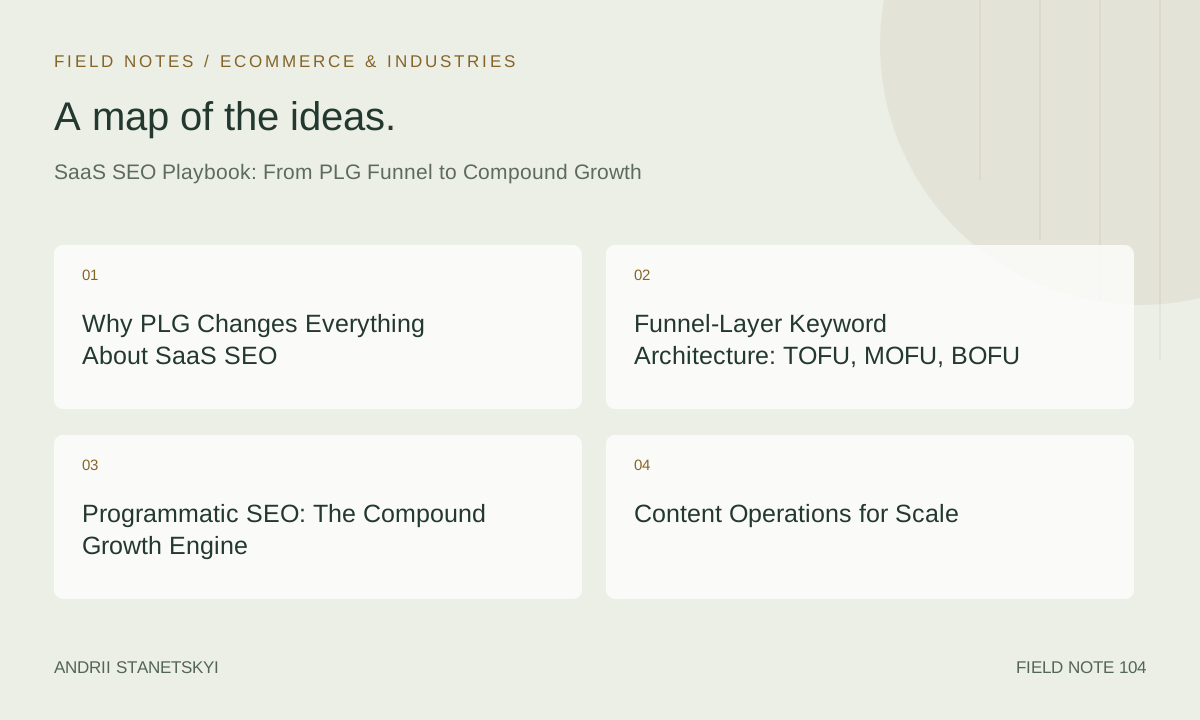
Why PLG Changes Everything About SaaS SEO
Product-led growth inverts the traditional sales funnel. In a sales-led motion, organic content generates a lead, a salesperson qualifies and nurtures it, and the product is revealed late. In a PLG motion, the product is the first meaningful touchpoint. SEO's job is not to hand a lead to sales — it is to deliver a user to a moment of self-directed product discovery at exactly the right level of intent.
This distinction has enormous structural consequences. In a PLG company, the highest-value SEO pages are not blog posts about industry trends. They are comparison pages, integration pages, use-case landing pages, and template libraries — pages that a prospect visits when they are already forming a vendor shortlist or solving a specific workflow problem. The organic channel at its best should deliver users who are three days away from activating on a paid plan, not three months away from understanding why they need your product category at all.
Notion understood this early. Their template gallery is not a blog. It is an SEO surface that ranks for thousands of workflow-specific queries — "meeting notes template," "product roadmap template," "OKR tracker" — and delivers users directly into a product trial at the moment of maximum intent. Each template page is simultaneously a landing page, a product demo, and a backlink attractor. That is PLG SEO working at its most elegant.
The implication for strategy is that you need to segment your organic investment by funnel stage and measure success differently at each layer. Traffic at the top of the funnel is measured in assisted conversions and brand recall. Traffic at the bottom is measured in free trial starts, product qualified leads, and — if your attribution is mature enough — closed ARR influenced by organic touch.
Funnel-Layer Keyword Architecture: TOFU, MOFU, BOFU
The most operationally useful thing you can do before writing a single word of content is build a funnel-layer keyword map. This is not a spreadsheet of keywords grouped by topic cluster. It is a deliberate assignment of every keyword opportunity to a funnel stage, matched to a content format, a conversion goal, and an expected ROI timeline.
| Funnel Layer | Content Type | Example Keywords | Primary KPI | Avg. Time to Revenue Impact | ROI Multiplier (vs. Paid) |
|---|---|---|---|---|---|
| TOFU | Educational guides, glossary, trend reports | "what is product-led growth," "saas churn definition" | Email capture, brand impressions | 9–18 months | 1.2–2x (long tail) |
| MOFU | Use-case pages, integration pages, workflow guides | "project management for engineering teams," "notion vs confluence" | Trial starts, demo requests | 4–9 months | 3–6x |
| BOFU | Comparison pages, pricing pages, alternative pages | "linear vs jira," "webflow alternative," "best saas project management" | Activated trials, PQL, closed ARR | 1–4 months | 8–15x |
| Programmatic | Template libraries, integration directories, city pages | "notion crm template," "zapier slack integration," "asana for startups" | Scale + trial starts at low CAC | 3–12 months (after index) | 10–25x at scale |
The ROI multiplier column is the one that gets budget approved. BOFU pages converting at 4–8% to trial starts, with a trial-to-paid rate of 15–25%, mean that a single well-optimized comparison page can generate dozens of new paid customers per month at near-zero marginal cost once it ranks. That math is what justifies prioritizing BOFU content even when your instinct is to build brand with educational content first.
Building Your BOFU Page Strategy
Start with Semrush's Keyword Gap tool comparing your domain against two or three direct competitors. Filter for keywords containing "vs," "alternative," "best," "review," or competitor brand names. Export, segment by monthly search volume, and sort by your current ranking position. Every keyword where a competitor ranks in positions 1–5 and you rank outside the top 20 is a BOFU page you are missing.
The page structure that converts in 2026 is not a biased takedown of your competitor. It is an honest comparison matrix — features, pricing, ideal customer profile, migration complexity — with a clear recommendation logic. Users landing on comparison pages are sophisticated. They can smell artificial advocacy. The pages that rank and convert acknowledge competitor strengths, define the decision criteria clearly, and make an opinionated recommendation based on use case. Linear's positioning pages do this exceptionally well: they do not claim to be better than Jira for every team, they claim to be better for a specific type of engineering team that values velocity over process.
MOFU: Integration and Use-Case Pages at Scale
Integration pages are the most systematically underbuilt MOFU asset in SaaS SEO. Every integration your product supports is a keyword cluster. "Tool A + Tool B integration," "how to connect Tool A to Tool B," "Tool A Tool B workflow" — these keywords have high commercial intent because users searching for integration solutions are already invested in both tools and are evaluating which platform becomes their hub.
Webflow built an entire ecosystem of integration and use-case pages that drove significant organic growth in their 2021–2024 period. Each page combined technical documentation with workflow narrative, targeting the user who had already decided to use Webflow for design but was evaluating whether it could handle their full stack. That is a user at the very edge of a purchasing decision, and organic content was the channel that closed them.
Programmatic SEO: The Compound Growth Engine
Programmatic SEO is the practice of generating large numbers of targeted pages from structured data rather than manually authoring each page. Done well, it produces the compounding traffic curves that make SaaS SEO look like a revenue-generating asset rather than a cost center. Done poorly, it produces thin-content penalties and domain authority erosion.
The distinction between good and bad programmatic SEO is almost entirely about data quality and template differentiation. A page that is 80% identical to 10,000 other pages on your domain will not rank. A page that draws on structured, unique data — product attributes, user-generated content, integration-specific workflows, geographic market data — can rank at scale because each instance genuinely answers a distinct query.
The Notion Template Gallery Model
Notion's template gallery is the canonical example of programmatic SEO done right in PLG SaaS. Each template page contains: a unique title and description, a rendered preview of the actual template, a categorized use case, tags for team type and workflow, and user-generated customization notes. No two pages are meaningfully identical. The data layer — the templates themselves, created by users — is the differentiation engine.
The SEO mechanics are elegant: Notion ranks for extremely specific, high-intent queries like "weekly team standup template" or "sales pipeline tracker notion" at near-zero content production cost because the templates are user-generated. The platform captured the creation energy of its most engaged users and converted it into organic search surface area. That is a flywheel, not a campaign.
Building a Programmatic SEO System
The technical architecture for programmatic SEO in a modern SaaS stack typically involves three components: a structured data source, a templating layer, and a rendering pipeline optimized for crawlability.
For the data source, you need records that are genuinely differentiated. This can be your product's feature set mapped to use cases, your integration catalog, user-generated templates or workflows, industry-specific benchmarks, or geographic market data. If the data does not vary meaningfully between records, the pages will not rank.
A minimal programmatic page data schema might look like this:
{
  "page_type": "integration",
  "tool_a": "Slack",
  "tool_b": "Linear",
  "use_cases": [
    "Sync Linear issues to Slack channels",
    "Get Slack notifications for Linear status changes",
    "Create Linear issues from Slack messages"
  ],
  "workflow_steps": [...],
  "difficulty": "beginner",
  "time_to_setup": "15 minutes",
  "user_testimonials": [...],
  "related_integrations": ["Notion + Slack", "Jira + Slack"]
}
Each field in this schema maps to a content element on the rendered page. The combination of fields produces a page that is technically unique and genuinely useful — the two criteria that separate programmatic pages that rank from ones that get deindexed.
Segment Events That Signal Programmatic Page Performance
Tracking programmatic page performance requires instrumentation beyond standard GA4 pageviews. You need to know which programmatic pages drive product activation, not just which drive traffic. A basic Segment event schema for this looks like:
analytics.track("Programmatic Page Conversion", {
  page_type: "integration_page",
  tool_a: "Slack",
  tool_b: "Linear",
  conversion_event: "trial_started",
  organic_entry: true,
  keyword_category: "MOFU_integration",
  session_id: "abc123",
  user_id: null,
  anonymous_id: "xyz789"
});
Running this event through your data warehouse and joining it against Clearbit enrichment on converted users gives you a programmatic page attribution model that connects organic content to company segment, ICP match score, and eventual ARR. That is the measurement infrastructure that justifies continued programmatic investment to a CFO.
Content Operations for Scale
The bottleneck in SaaS SEO is almost never keyword opportunity. It is content production velocity at acceptable quality. The companies that build compounding organic growth solve this operational problem before they run out of easy keyword wins.
The 2026 content operations model for a mature SaaS SEO program looks like this: a small editorial team of two to four senior strategists owns the content architecture and quality bar. They use AI tooling for first drafts on well-defined formats (comparison pages, integration pages, glossary entries) and reserve human writing for BOFU pages, thought leadership, and any content that requires genuine product expertise or narrative judgment.
A practical content calendar structure segments production by content type and assigns ownership and SLAs by type. Comparison pages require a two-week production cycle: one week for research and competitive intelligence gathering using Ahrefs and Semrush data, one week for writing, internal review, and CRO optimization. Integration pages on a programmatic system can be produced in bulk — 50 pages per sprint — using structured data inputs and template rendering. Thought leadership pieces require four to six weeks including subject matter expert interviews and editorial review.
The internal linking architecture is as important as the content itself. Every piece of content should have a defined internal linking role — does it receive links from high-authority pillar pages, does it pass authority to BOFU pages, or both? Build your internal link map before you start writing, not after. Retrofitting internal links into 200 published pages is one of the most expensive and error-prone operations in SEO, and most teams do it wrong because they did not plan the architecture upfront.
Technical Foundations That Actually Matter
Technical SEO for SaaS in 2026 has a much shorter list of genuinely important factors than most technical SEO guides suggest. Core Web Vitals matter if you are failing them — if you are not, marginal improvements produce marginal gains. Crawl budget matters if you have a large programmatic site. Structured data matters for specific content types. JavaScript rendering matters if your framework is not server-side rendering or static site generating your content.
The highest-impact technical investment for most SaaS sites is rendering architecture. If your marketing site is a single-page application with client-side rendering of content, you have a fundamental indexability problem regardless of how good your content is. Googlebot renders JavaScript, but imperfectly and with significant crawl delays. Move your marketing and blog surfaces to Next.js with static site generation or server-side rendering, or to a purpose-built CMS with SSR support. This single architectural change consistently produces the largest organic traffic gains of any technical intervention we have seen in SaaS audits.
For programmatic SEO specifically, the technical requirements are more demanding. You need clean URL structures, pagination handled correctly, canonical tags on near-duplicate pages, and a sitemap generation system that updates dynamically as new programmatic pages are created. RevenueCat's integration directory is a useful reference for how to handle this at scale — they maintain thousands of indexed pages with clear URL taxonomy and proper canonicalization, resulting in stable rankings across a large programmatic surface.
Schema Markup for Comparison Pages
Comparison pages benefit from a specific schema implementation that signals their comparative nature to search engines. A minimal implementation for a SaaS comparison page:
{
  "@context": "https://schema.org",
  "@type": "WebPage",
  "name": "Linear vs Jira: Feature Comparison 2026",
  "description": "An in-depth comparison of Linear and Jira for engineering teams evaluating project management software.",
  "mainEntity": {
    "@type": "ItemList",
    "name": "Comparison: Linear vs Jira",
    "itemListElement": [
      {
        "@type": "Product",
        "name": "Linear",
        "url": "https://linear.app",
        "description": "Issue tracking built for modern engineering teams"
      },
      {
        "@type": "Product",
        "name": "Jira",
        "url": "https://atlassian.com/software/jira",
        "description": "Enterprise project and issue tracking by Atlassian"
      }
    ]
  }
}
This schema does not guarantee rich results, but it signals content type clearly and aligns with Google's entity understanding of comparison content — which is increasingly important as AI Overviews draw on structured data when constructing comparative responses.
Measurement: From Organic Traffic to Closed Revenue
The single biggest failure mode in SaaS SEO programs is measuring the wrong things. Traffic, rankings, and domain authority are leading indicators at best and vanity metrics at worst. The measurement framework that survives CFO scrutiny connects organic activity to pipeline and revenue.
Build your measurement stack in three layers. The first layer is acquisition: organic sessions by landing page, by funnel stage, by keyword category. Use Ahrefs to track ranking positions and Search Console to track impressions and clicks. This layer tells you whether your SEO strategy is generating the right traffic.
The second layer is activation: of users who entered through organic, what percentage started a free trial, activated a key feature, or requested a demo? This requires joining your web analytics (GA4 or Amplitude) with your product analytics (Mixpanel, Amplitude, or PostHog) using a shared anonymous ID. The Segment event schema above is designed for exactly this join. This layer tells you whether your organic traffic is the right traffic — whether the intent signal in the keyword matches the behavior in the product.
The third layer is revenue attribution: of organic-sourced trials, what is the trial-to-paid conversion rate, average ACV, and 12-month retention rate compared to other acquisition channels? This requires your CRM (HubSpot, Salesforce) to carry first-touch and multi-touch attribution from your web analytics, and it requires your subscription billing system (Stripe, RevenueCat for mobile) to expose cohort revenue data queryable by acquisition source.
A SQL query that surfaces organic-to-revenue attribution from a data warehouse might look like this:
SELECT
  s.organic_landing_page,
  s.keyword_category,
  COUNT(DISTINCT u.user_id) AS organic_trial_starts,
  COUNT(DISTINCT CASE WHEN sub.status = 'active' THEN u.user_id END) AS converted_to_paid,
  ROUND(
    COUNT(DISTINCT CASE WHEN sub.status = 'active' THEN u.user_id END)::NUMERIC /
    NULLIF(COUNT(DISTINCT u.user_id), 0) * 100, 2
  ) AS trial_to_paid_pct,
  SUM(sub.mrr) AS mrr_attributed
FROM sessions s
JOIN users u ON s.anonymous_id = u.anonymous_id
LEFT JOIN subscriptions sub ON u.user_id = sub.user_id
WHERE s.channel = 'organic'
  AND s.created_at >= CURRENT_DATE - INTERVAL '90 days'
GROUP BY s.organic_landing_page, s.keyword_category
ORDER BY mrr_attributed DESC NULLS LAST;
This query, run weekly and piped into a dashboard visible to both the SEO team and the CFO, transforms organic from a marketing KPI into a revenue line item. That is the organizational shift that unlocks serious SEO investment.
Real SaaS Cases: What the Patterns Actually Look Like
Linear's SEO strategy is worth studying in detail because it is disciplined in a way that most SaaS companies are not. Linear does not try to rank for "project management software" — a keyword dominated by Asana, Jira, Monday, and Trello with domain authorities and backlink profiles that would require years and significant budget to compete against. Instead, Linear built authority in a specific corner of the market: engineering team workflow, software development velocity, and the concept of opinionated tooling. Their content positions around "issue tracking for software teams," "engineering velocity," and "linear method" — terms they effectively own because they defined them.
This is a lesson in targeting keyword spaces where you can build genuine topical authority rather than spreading investment across a broad keyword set where you will always be outgunned. Ahrefs' topical authority metrics make this strategy quantifiable: identify the keyword clusters where your competitors have invested heavily and look for adjacent clusters at the same intent level where authority is lower and your product has a genuine right to win.
Webflow's approach to MOFU content provides a different pattern. Webflow built a university and a showcase gallery — two organic surfaces that serve completely different intent profiles. The university ranks for "how to build a website," "CSS flexbox tutorial," and hundreds of other educational queries. The showcase ranks for "website design inspiration," "webflow examples," and portfolio-related queries. Neither surface is primarily about converting visitors to trials — both are about building brand equity with the population of designers and developers who will eventually choose Webflow when they need a tool. The conversion happens through brand recall at the moment of decision, not through a direct CTA on the content page. That is a long-game TOFU strategy that requires patience and organizational alignment on multi-touch attribution.
A lesser-known but instructive case is how B2B SaaS companies in the data and analytics space, including tools that compete in the Clearbit enrichment and intent data category, have used programmatic pages targeting specific company segments and job titles. Pages structured around "best tools for [specific role] at [company stage]" capture decision-maker queries at exactly the moment of active evaluation. Combined with Clearbit reverse-IP identification on organic visitors, these pages can trigger sales outreach sequences at the moment of maximum intent signal — collapsing the distance between organic content and sales conversation.
See also: our deep dive on programmatic SEO for B2B SaaS and the PLG content strategy guide for more case studies in this pattern.
For additional reference on SEO measurement frameworks in SaaS, Ahrefs' SaaS SEO resource library provides complementary tactical depth on the keyword research and competitive analysis methodologies referenced throughout this playbook.
Frequently Asked Questions
How long does it take for SaaS SEO to show measurable revenue impact?
For BOFU content — comparison pages, alternative pages, high-intent use-case pages — a well-executed strategy targeting achievable keywords typically shows measurable trial starts within 60–90 days of publishing, assuming the pages are indexed promptly and the site has baseline domain authority. Revenue impact attribution is visible within a 90–120 day window for short sales cycle PLG products. MOFU and TOFU content operates on a 6–18 month timeline to revenue impact, which is why mature SaaS SEO programs invest in all three layers simultaneously rather than waiting for one layer to produce results before investing in the next.
Should SaaS companies invest in TOFU content in 2026 given AI Overviews?
Selectively, yes. Purely informational TOFU queries — "what is churn rate," "how does SaaS pricing work" — are increasingly absorbed by AI Overviews and produce minimal click-through. The TOFU investment that still generates meaningful organic value in 2026 is original research, proprietary data, and strong editorial opinion — content types that AI Overviews cite rather than replace. If you publish a benchmark study based on your own product data, that is TOFU content with genuine organic durability. Generic educational content about category definitions is largely not worth the investment at current AI Overview coverage rates.
How do you build backlinks for a SaaS product without a content budget for large-scale link building?
The highest ROI link building strategy for SaaS with limited budget is asset-based: build genuinely useful free tools, calculators, benchmark reports, or open datasets that attract natural editorial links. A churn rate calculator that embeds on a blog post attracts links every time someone references the concept of churn and wants to point readers to a calculation tool. This approach requires upfront development investment but produces links at essentially zero marginal cost per link over time. The second-best strategy for early-stage SaaS is integration partnerships — getting listed on partner tool directories, integration marketplaces, and comparison sites that pass genuine PageRank. Both strategies require patience but scale without the cost structure of manual outreach campaigns.
What is the right internal linking architecture for a SaaS marketing site?
Think in terms of authority flow and conversion pathing simultaneously. Your highest-authority pages — typically the homepage, the most-linked blog posts, and any pillar pages — should link to your BOFU pages to pass authority to the pages where conversion actually happens. Your BOFU pages should link to trial signup, not back to more content. Your MOFU pages should link both up to pillar pages (for authority flow) and across to related BOFU pages (for conversion path). Avoid internal linking patterns that create authority sinks — pages that receive many internal links but link out to no pages that matter for conversion or authority consolidation. Audit your internal link architecture quarterly using Screaming Frog or Ahrefs' site audit internal link report.
How should PLG SaaS companies handle SEO for their in-app help and documentation?
Documentation SEO is a significant opportunity that most PLG companies underinvest in. Help center and documentation pages rank for extremely high-intent queries: "how to [specific feature] in [product name]" queries are searched by users in active evaluation and active use phases. Keep documentation on a subdirectory of your main domain rather than a subdomain to consolidate authority. Structure documentation with clear H1/H2/H3 hierarchy, add FAQ schema to pages that answer specific questions, and include contextual CTAs to upgrade or explore adjacent features for users who arrived organically and are not yet customers. RevenueCat's documentation is a strong reference for how to do this at scale — their docs rank for dozens of mobile subscription-related queries and serve as a meaningful organic acquisition surface.
What keyword research tools are most effective for SaaS SEO in 2026?
Ahrefs and Semrush remain the two indispensable platforms — not because any single tool is perfect but because their databases and feature sets are complementary enough that using both catches opportunities either would miss alone. Ahrefs' keyword explorer and traffic value metrics are superior for understanding competitive keyword economics. Semrush's keyword gap tool and topic research features are better for competitor analysis and content ideation. Beyond these two, Google Search Console remains irreplaceable for understanding your own site's actual search performance. For intent classification at scale, tools that layer AI intent analysis on top of keyword data are increasingly useful for sorting large keyword exports by funnel stage without manual review.
How do you prioritize which programmatic SEO pages to build first?
Prioritize based on the intersection of three factors: search volume of the target query class, data quality of your structured data source for that query class, and product-market fit signal — whether users who find these pages are actually likely to be your ICP. Integration pages targeting your most popular existing integrations typically win on all three criteria: search volume is meaningful, your data on the integration is authoritative, and the user searching for it already uses both connected tools. Template pages win if you have genuine user-generated template content. City or vertical pages only win if you have real product differentiation or customer presence in those markets — geographic programmatic pages based on no underlying data are the classic thin-content mistake.
Key Takeaways
- PLG SaaS SEO is not about traffic volume. It is about delivering users at the right intent level to the right product moment. Build your strategy backwards from product activation events, not forwards from keyword volume.
- BOFU pages — comparison, alternative, and high-intent use-case pages — generate 8–15x the revenue ROI of TOFU content with a 1–4 month payback window. Prioritize them even when the instinct is to build brand first.
- Programmatic SEO is the compound growth engine that separates SaaS companies with 10,000 organic keywords from those with 100. The Notion template gallery model — user-generated structured data rendered into thousands of unique, rankable pages — is the architecture worth studying and adapting.
- Technical rendering architecture is the highest-impact single technical investment. If your marketing site is client-side rendered, fix that before doing anything else in technical SEO.
- Measurement must connect organic sessions to trial starts to revenue attribution. The SQL and Segment event schemas in this playbook are starting points for building the data infrastructure that makes SEO a CFO-visible revenue channel.
- Topical authority concentration — the Linear model of owning a specific keyword cluster rather than competing broadly — outperforms broad keyword coverage strategies for companies without legacy domain authority.
- AI Overviews have materially reduced the value of generic informational TOFU content. Original research, proprietary data, and editorial opinion are the TOFU formats with durable organic value in 2026.
Conclusion
The SaaS companies that will have compounding organic revenue five years from now are the ones that treat SEO as a product discipline rather than a marketing expense. They are instrumenting their organic pages with the same rigor as their product onboarding flows. They are building programmatic content systems with the same engineering attention as their API infrastructure. They are measuring organic contribution to pipeline with the same specificity as their paid acquisition channels.
This is not aspirational. Notion, Linear, Webflow, and a cohort of PLG-native companies built exactly this infrastructure over the last five years, and the compounding returns are visible in their organic traffic curves and in their customer acquisition cost structures. The playbook exists. The tools — Ahrefs, Semrush, Segment, Clearbit, RevenueCat for measurement — are mature and accessible. The architectural patterns are documented.
What separates the companies that execute from the ones that produce quarterly blog posts and quarterly disappointment is organizational alignment: the belief that SEO is a long-horizon, compounding investment that deserves engineering resources, data infrastructure, and patient measurement rather than a content marketing function chasing monthly traffic targets.
Start with your BOFU keyword gap. Build two comparison pages and one alternative page. Instrument them properly. Measure trial starts from organic, not just sessions. When the data shows the ROI, use it to fund the programmatic system. That is the PLG SEO flywheel, and it starts with a single spin.