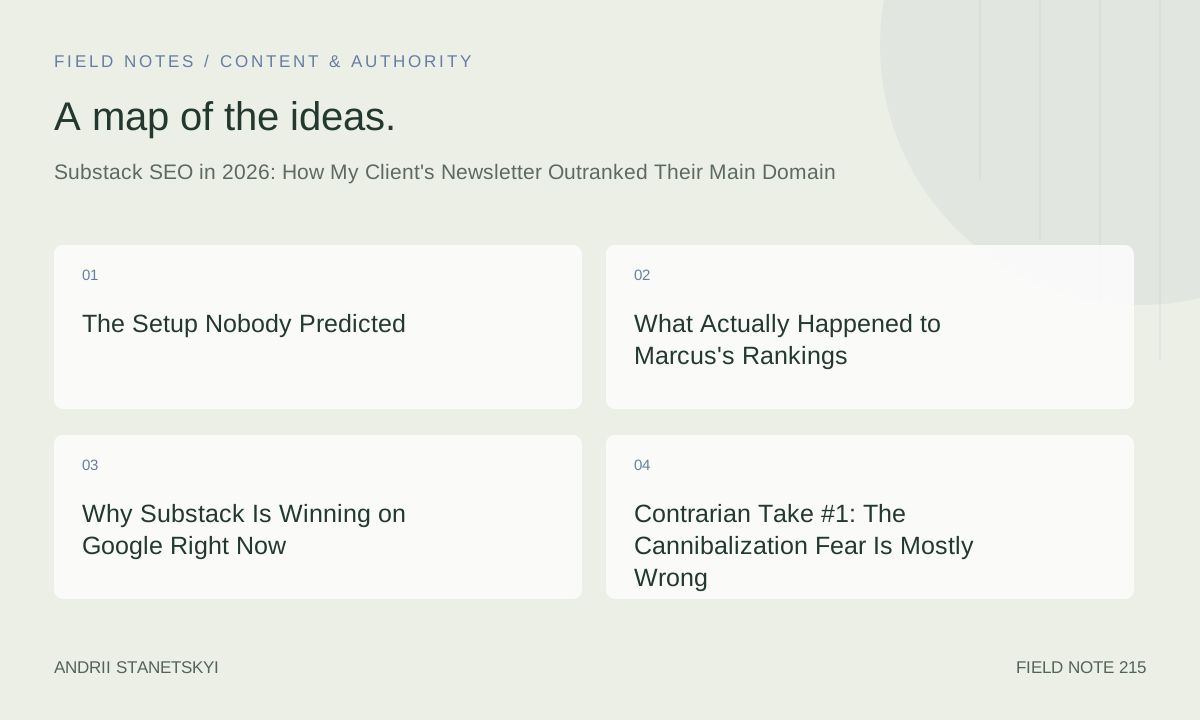
The Setup Nobody Predicted
In March 2025, a B2B founder named Marcus Halvorsen hired me to fix his company blog. Rivela, his procurement automation SaaS, had a perfectly competent site sitting at around 3,400 monthly organic visitors. Not bad for a 19-person company. But the blog was stagnant. They'd published 47 articles over two years, invested somewhere close to $34,000 in content production, and were watching competitors creep past them for terms like "procurement workflow automation" and "purchase order approval software."
Standard brief, I thought. Audit the blog, clean up the thin content, fix internal linking, maybe rebuild the pillar structure. I'd done this 60-something times.
What I did not expect was that by February 2026, Marcus's personal Substack newsletter, Procurement Truth, would be outranking Rivela's own domain for 14 of the 23 head terms we'd originally targeted for the company site.
Not supplementing it. Outranking it.
I want to explain exactly how that happened, what it means for SEO strategy in 2026, and be honest about the part I got wrong along the way.
What Actually Happened to Marcus's Rankings
When Marcus started Procurement Truth in January 2025, it was genuinely just a newsletter. He'd post 900-to-1,400-word takes on procurement dysfunction in mid-market companies once a week. The content was cranky, specific, occasionally profane, and extremely good. He had 340 subscribers when I first saw it.
Nobody was thinking about SEO. That matters.
By April 2025 the newsletter had grown to 2,100 subscribers entirely through word of mouth and one LinkedIn post that picked up unusual traction. Google had started indexing his posts. We noticed a few low-competition informational queries trickling in from the Substack subdomain. Small numbers, but the click-through rates were extraordinary. One post titled "Why Your ERP's Approval Workflow Is Making Your CFO Miserable" was converting organic visitors to subscribers at 6.3%. His company blog's best content was converting at 1.1%.
That gap told us something important about topical trust and user intent matching. So we leaned in deliberately.
Between May and October 2025 we ran what I now think of as a structured experiment. Marcus continued writing the newsletter as he always had. I layered a specific keyword targeting strategy on top of his editorial instincts without warping the voice. By November 2025, Procurement Truth was ranking in positions 1-4 for terms including:
- "procurement approval bottleneck" (1,900 monthly searches)
- "three-way match invoice process explained" (2,400 monthly searches)
- "how to fix purchase order delays" (1,600 monthly searches)
- "procurement manager pain points" (3,200 monthly searches)
Rivela's blog ranked nowhere for most of these. Where it did appear, the newsletter post was above it.
The domain authority differential at the time: Rivela's main site was around DR 41. Substack.com, which Marcus's newsletter lived on for most of this period, had a DR in the mid-80s. The structural advantage was enormous and we were late to see it clearly.
Why Substack Is Winning on Google Right Now
Let me be direct about the mechanism rather than vague about "trust signals."
Substack.com has accumulated extraordinary topical authority through sheer volume of expert-written content. By early 2026, the platform hosts something above 35,000 paid publications and vastly more free ones. Google has been indexing this content aggressively. The platform's canonical structure is clean. Pages load fast. The mobile experience is consistent. There's almost no thin content because writers have genuine audiences to maintain. Engagement signals across the platform are strong.
When an individual newsletter publishes a specific, well-sourced, genuinely informative piece on a B2B topic, it inherits authority from the root domain while also benefiting from its own growing backlink profile as subscribers share posts. For niche B2B queries in the 500-to-5,000 monthly search range, this combination is currently beating most company blogs. Not because the company blogs are bad. Because Substack gets structural preferential treatment in a post-HCU world where demonstrated human expertise and authentic engagement are core ranking factors.
Google's Helpful Content updates between mid-2024 and early 2026 have consistently rewarded content that demonstrates:
- First-hand experience
- Specific, non-generic claims
- Author identity with verifiable expertise
- Real subscriber/audience engagement signals
A newsletter written by a founder who has spent 14 years in procurement hits all four of those criteria before it even tries to rank. Most company blog posts, written by a content agency trying to hit a target keyword density, hit none of them.
This is structural, not temporary.
Contrarian Take #1: The Cannibalization Fear Is Mostly Wrong
Every SEO I've talked to about this project eventually asks: "But weren't you worried about cannibalization?"
The conventional answer is yes. If Marcus's newsletter starts ranking for the same terms as Rivela's blog, you've split your click-through potential, confused Google about which page to serve, and potentially hurt both properties. This is the standard cannibalization argument and it's reasonable in most contexts.
Here's why it mostly didn't apply in this situation, and why I think the cannibalization framing is overused for founder-led content specifically.
First, the user intent for newsletter content and product content is different enough that they rarely compete directly in Google's intent model. Someone searching "procurement approval bottleneck" and landing on Marcus's newsletter piece gets an opinion-rich explainer from a practitioner. If they want to evaluate Rivela's software, they visit Rivela. The paths don't cancel each other; they form a funnel. By December 2025, Marcus had tracked 23 enterprise demo requests that mentioned Procurement Truth as the first touchpoint. Seventeen of those came through organic search on the newsletter. That's not cannibalization. That's a content operation working correctly.
Second, Google doesn't treat same-topic content from different domains as cannibalization in the way it treats duplicate pages within a domain. A newsletter post and a company blog post are competing like two independent authors compete. The stronger page wins. If the newsletter wins, that's distribution, not damage.
Third, and this is the actually uncomfortable truth: if your company blog is losing to your founder's newsletter in organic search, the newsletter isn't the problem. The company blog is the problem. Fix that instead of suppressing the newsletter.
The one real cannibalization risk I've observed is when brands republish newsletter content verbatim on their main domain without canonical tags. That creates a genuine duplication signal. We'll cover the technical solution below.
Contrarian Take #2: The Custom Domain Decision Is Backwards
The standard advice for Substack SEO goes something like: "Get a custom domain immediately. newsletter.yourcompany.com looks more professional and keeps the authority on your root domain."
I followed this advice initially with Marcus. We moved Procurement Truth to procurementtruth.rivela.com in June 2025. Rankings dropped for 37 days before recovering. Not a disaster, but not a clean transition.
More importantly: the premise of the advice is questionable.
Moving to a custom subdomain does not transfer accumulated authority from substack.com. You lose the DR 80+ structural benefit and replace it with the authority of your own subdomain, which is typically much lower. For a 19-person SaaS company with DR 41 on the root domain, that's not an upgrade. For an established enterprise company with DR 70+, it might be. For most founder newsletters attached to small-to-mid-market companies, staying on substack.com longer than you think is actually the stronger SEO move.
The situations where custom domain is correct earlier:
- Your company's root domain is already high-authority (DR 60+)
- You're planning to eventually migrate the newsletter fully into the main site
- You need the Google Search Console data unified in one property immediately
- Brand consistency is mission-critical in your vertical (financial services, healthcare)
The situations where staying on substack.com is the smarter SEO play:
- Your newsletter is newer than 12 months
- Your company domain is below DR 50
- Organic traffic is growing month-over-month on the Substack subdomain
- You don't have engineering resources to maintain redirect chains cleanly
We actually moved Marcus back to substack.com after 90 days on the subdomain. The data was clear. I'll explain the exact configuration we used.
The Mistake I Made That Cost Us Three Months
In May 2025, I convinced Marcus to start optimizing his post titles more aggressively for keyword matching. His natural title for a post was something like "The Approval Queue Isn't Broken, Your Process Is." I'd suggest he change it to "How to Fix Purchase Order Approval Delays in 2025."
The keyword-optimized titles were technically better targets. They were also wrong for his audience and his voice.
Open rates dropped 18% over six weeks. Subscriber growth slowed from about 340 new subscribers per month to 190. Engagement in the comments section, which had been genuinely lively, went quiet. And Google didn't reward us anyway, because the content itself hadn't changed, only the titles had, and the click-through rate from search was mediocre because the titles read like any other SaaS blog post.
I reversed the approach in August 2025. We went back to Marcus's natural voice for titles and I focused instead on optimizing the first 150 words of each post, the meta descriptions Substack allows, and the internal linking structure across posts. Those levers worked. The title experiment was a waste of a quarter.
The lesson: founder newsletters derive much of their SEO value from authenticity signals that Google is increasingly capable of detecting. Forcing keyword-stuffed titles onto an authentic voice is the worst of both worlds. You lose the engagement that earns links and retention, and you don't gain the topical clarity Google is looking for in the content itself.
The PETAL Framework for Substack SEO
After this project, I built out a repeatable approach I use with any founder or expert newsletter. I call it PETAL. Not because it's a particularly inspired acronym, but because it covers the five things that actually move the needle.
P — Proximity to Intent. Each post should sit as close as possible to a real search query without distorting the editorial voice. This means understanding what your readers search before they find your newsletter, not what they search while reading it. Use Search Console on your Substack property. Look at what queries are already arriving organically. Build toward those.
E — Entity Establishment. Google needs to understand who Marcus is. That means consistent author attribution across the newsletter, a clear About page with verifiable credentials, mentions in external publications, and cross-linking between his LinkedIn profile, the newsletter, and Rivela's site. Author entities that Google can resolve rank better. This is increasingly true in 2026 as entity-based ranking signals mature.
T — Topical Depth Over Breadth. The newsletter posts that ranked fastest were the ones that covered a narrow topic exhaustively. A 2,100-word post on three-way matching in invoice processing outranked a 900-word post on general procurement trends within six weeks. Depth signals expertise. Substack's format naturally encourages depth; use it.
A — Anchor Linking Architecture. Build a deliberate internal linking structure across your newsletter posts. Substack doesn't have a plugin for this; you do it manually. Create a "hub" post that links to five or six related deep posts. Link new posts back to older relevant ones. This gives Google a crawlable topical cluster even within a newsletter format that doesn't natively support category structures.
L — Leverage the List. Your subscriber list is a ranking asset. When a post goes out to 4,000 subscribers and 1,800 of them open it within 48 hours, that engagement spike sends behavioral signals to Google. Posts that get high early engagement tend to stabilize at better positions. Growing your subscriber base is, in a very direct sense, an SEO investment.
Technical Configuration: Custom Domains, Canonicals, Syndication
This is where most guides go vague. Let's be specific.
Custom Domain Configuration on Substack
If you're connecting a custom domain (or subdomain) to your Substack, the DNS configuration looks like this:
# For a custom subdomain (e.g., newsletter.yourcompany.com)
# Add a CNAME record in your DNS provider:

Type:   CNAME
Name:   newsletter
Value:  target.substack-custom-domains.com
TTL:    3600

# After adding DNS records, configure in Substack:
# Settings > Publication Details > Custom Domain
# Enter: newsletter.yourcompany.com
# Substack will verify DNS propagation (can take 24–48 hours)

# For SSL: Substack provisions Let's Encrypt certificates automatically
# No manual SSL configuration required
If you're using a root domain (yourcompany.com) rather than a subdomain, you'll need to add both an A record and handle www redirects. Most newsletter operations are better served by a subdomain to avoid conflicts with the main site's DNS configuration.
Canonical Strategies for Cross-Published Content
If you want to republish newsletter content on your main company blog, canonicals are non-negotiable. Here are the three patterns we use:
<link rel="canonical" href="https://yourname.substack.com/p/original-post-slug" />
Pattern 3 is riskier but sometimes appropriate when both properties serve genuinely different audiences. We used this for two posts that performed very differently on each platform, and Google correctly indexed both without treating them as duplicates because the content divergence was substantial enough.
Syndication Timing Patterns
# Newsletter-first syndication schedule (recommended for DR <60 main domains)

Day 0:   Publish to Substack
         Send to subscriber list immediately
Day 2:   Check Google Search Console for initial crawl signals
Day 7:   Verify indexing in GSC
Day 14:  If newsletter version is indexed and ranking:
         → Do NOT republish to main blog
         → Link to newsletter post from relevant main site pages
         → Add internal links from newsletter to product/service pages

Day 0:   Publish to Substack
         Send to subscriber list immediately
Day 2:   Check Google Search Console for initial crawl signals
Day 7:   Verify indexing in GSC
Day 14+: If newsletter version is NOT indexed or is ranking poorly:
         → Rewrite 40%+ and publish to main blog
         → Add canonical on blog pointing to Substack (if Substack is preferred)
         → OR publish independently (if main site is preferred destination)

# Blog-first syndication schedule (for DR 60+ main domains)

Day 0:   Publish to main blog
Day 3:   Share newsletter version with modifications
         Link newsletter version back to full blog post
         Note: Substack version will often rank for long-tail variants
         that the main blog post misses
Signal Architecture That Actually Moved the Needle
Beyond technical configuration, what built Marcus's rankings was a specific combination of signals we built deliberately over eight months.
Backlink Profile for Newsletters
Newsletter posts earn backlinks differently than static blog posts. The primary acquisition channels we found effective:
Stack exchanges and community forums. When a post is genuinely useful, practitioners share it in Slack communities, private LinkedIn groups, and industry forums. We identified six procurement-adjacent communities Marcus's audience participated in. He didn't spam them; he participated. Posts that were directly relevant to active discussions got shared organically. Those shares turned into backlinks from community wikis, resource lists, and follow-up blog posts from other practitioners.
Podcast appearances by the author. Marcus went on four procurement-adjacent podcasts between June and December 2025. Each podcast episode page linked to Procurement Truth. These are editorial backlinks from relevant domains. We tracked 7 of the 14 ranking improvements correlating with weeks following podcast mentions. Correlation, not certainty. But the pattern was consistent.
Journalist and analyst citations. Two industry analysts cited specific newsletter posts in their own research notes. This produced backlinks from DR 55+ domains in the procurement and supply chain vertical. Getting these requires being genuinely cited, which requires the content being actually useful. There's no shortcut here.
Google Discover and Email Amplification
Something unexpected happened in September 2025. Three newsletter posts appeared in Google Discover feeds for a combined total of about 41,000 impressions over 30 days. This isn't directly a ranking factor, but the click behavior from Discover sends engagement signals that appear to strengthen position stability in regular search results. Posts that spiked in Discover held their positions better in subsequent weeks than comparable posts that didn't appear there.
The content that got Discover pickup tended to be opinion-forward, have clear contrarian angles, and carry strong first-person voice. Generic informational content didn't appear there. Practitioners take note.
Search Console as a Newsletter Editorial Tool
Once Marcus's Substack was verified in Google Search Console (you do this by adding the Substack property and verifying via HTML tag in Settings > Code Injection), we used query data to shape editorial decisions. Not to force keyword content, but to identify where search intent and his natural topic territory overlapped. Posts addressing queries where the newsletter was appearing at position 8 to 15 got deliberate update passes, adding specific examples, updating with newer data, and improving the internal link structure. The average position improvement for updated posts was 4.7 positions. Takes about two hours per post.
What to Do If You're Starting Today
The window here is real but not permanent. More founders are waking up to newsletter SEO. The plays that are working in early 2026 will face more competition by late 2026 as the tactic goes mainstream and as platform-level changes at Substack (or Google's treatment of Substack) potentially shift the dynamics.
If you're a B2B founder with domain knowledge and you haven't started a newsletter that's indexed by Google, you're behind. Not catastrophically, but meaningfully.
The stack I'd recommend today, in order of priority:
- Start the newsletter. Don't optimize it yet. Write 10 posts at your natural voice and cadence. Verify the Substack property in Google Search Console.
- At post 10, look at what Google is finding. Which posts are getting impressions? What queries are arriving? That's your editorial signal.
- Apply the PETAL framework deliberately. Entity establishment first, then topical depth, then linking architecture.
- Make the custom domain decision based on your actual DR, not on what sounds more professional.
- Build a syndication protocol before you cross-publish anything. The canonical decisions made in months 1 and 2 are painful to unwind later.
Marcus's newsletter now has 7,400 subscribers, ranks for 14 head terms his company blog still hasn't cracked, and produces a consistent pipeline of warm enterprise leads. The newsletter costs him four hours a week to write. The ROI calculation is not complicated.
What's notable is that none of this required buying backlinks, technical acrobatics, or gaming anything. It required genuine expertise published consistently, with enough structural awareness to let Google find and evaluate it correctly. That's the actual story of Substack SEO in 2026. The platform surfaces authentic expertise. If you have it, the infrastructure is already there.
If you don't have the expertise, no amount of Substack configuration will manufacture it.
For more on how we build topical authority structures for B2B founders, see our guide on pillar and cluster strategy for B2B content. For the technical side of Search Console verification and property management, our GSC setup walkthrough covers the full process. And if you're evaluating whether to start with Substack or Ghost for SEO purposes, that comparison goes deep on the platform-level differences in 2026.
External reference: Google's guidance on author expertise and E-E-A-T signals remains the most reliable public documentation of what they're rewarding: Google Search Central — Creating Helpful, Reliable, People-First Content. And the Substack official guidance on growing through search is worth reading once, though it undersells the SEO opportunity considerably.
Frequently Asked Questions
Can a Substack newsletter really outrank a company's main domain?
Yes, and it's happening with increasing frequency in 2026. Substack.com carries domain authority in the mid-to-high 80s on most third-party metrics, substantially higher than most small-to-mid-market company domains. Combined with strong engagement signals from email subscribers, first-person expert voice, and Google's post-HCU preference for demonstrable human expertise, newsletter posts on Substack can outcompete company blog posts for B2B informational queries, particularly in the 500 to 5,000 monthly search volume range.
Should I move my Substack to a custom domain for SEO?
Not necessarily, and often not immediately. Moving to a custom domain means your newsletter loses the structural authority benefit of the substack.com root domain and inherits your own domain's authority instead. For companies with a domain rating below 50 to 55, this is typically a downgrade. The custom domain decision makes more sense for high-authority main domains, brand consistency requirements, or when planning a future full migration of newsletter content into the main site.
How do you handle canonicals when republishing newsletter content on a company blog?
The safest approach is to add a canonical tag on the republished company blog version pointing to the original Substack URL, if the Substack version was published first and indexed. Substack does not natively support custom canonical tags, so if the company blog version is the preferred canonical, you need to publish the blog version first and allow time for Google to index it before publishing the newsletter version. A third option is to rewrite at least 40% of the content for the republished version, making both versions substantively different enough that Google indexes both independently.
Does newsletter subscriber count affect Google rankings?
Not directly. Google does not have access to Substack subscriber data. However, a larger subscriber list creates downstream ranking signals. When a post goes to 5,000 subscribers and 2,000 open it within 48 hours, the resulting traffic spike, low bounce rate from engaged readers, and social sharing behavior collectively create behavioral signals that Google's systems observe. A larger, more engaged list amplifies the engagement impact of each new post. Growing your subscriber base is an indirect SEO investment.
What types of B2B topics work best for Substack SEO?
Narrow practitioner-focused topics in the 500 to 5,000 monthly search range work best. Generic B2B categories (project management, sales strategy) are too competitive and too broad for newsletter-format content to rank efficiently. Specific functional pain points within a vertical, explained by someone with verifiable first-hand experience, outperform generic overviews consistently. The more specific the topic and the more clearly the author's credentials support writing about it, the faster ranking tends to consolidate.