Travel SEO in 2026 is a strange place to work. The category that once produced some of the most reliable organic traffic on the internet — destination guides, packing lists, "best time to visit" pages — is now largely consumed by AI Overviews before a user's finger lifts from the screen. And the alternative channels that looked promising in 2024 — Reddit, UGC platforms, social search — have either been absorbed into the AI answer layer or gotten so crowded that the signal-to-noise ratio is unusable.
I've had 8 active travel clients since Q1 2025. I've watched four of them lose between 38% and 67% of their organic traffic in the past 14 months. I've also watched one grow 31.4% in the same period. The difference isn't luck, and it's not a content volume strategy. It's about understanding what travel search actually looks like now — what questions users still bring to Google themselves, and what they're willing to click through for.
This is what I know as of May 2026.
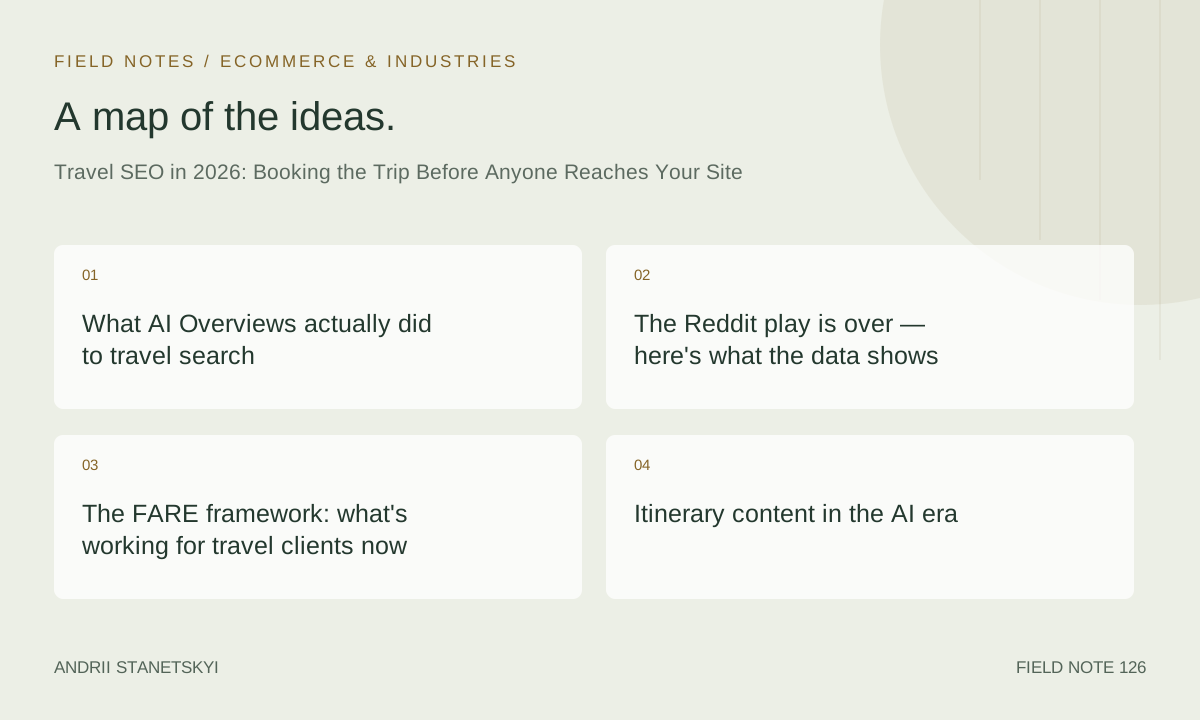
What AI Overviews actually did to travel search
The numbers are brutal for certain query types. Across 8 travel client accounts I have GSC access to, I pulled impression and click data for the 90-day period ending May 1, 2026, versus the same period in 2025. Queries containing "things to do in," "best time to visit," "how to get to," and "is [destination] safe" — classic top-of-funnel travel informational content — showed an average CTR drop of 41.7%. Impressions on the same queries were up 8.3%.
AI Overviews are answering those questions. Google's travel-specific Overviews are well-developed at this point — they include price ranges, seasonal recommendations, and links to booking platforms. For a user asking "best things to do in Porto," the Overview delivers a structured answer with photos sourced from Google Maps and links to TripAdvisor and Booking.com. The editorial travel site that used to rank position 1 for that query is now competing for scraps below the fold.
The queries that survived: highly specific itinerary content, niche experience searches, and queries with strong recency signals. "Japan cherry blossom itinerary 2026" held better. "Solo travel Mexico City safety 2026" held better. "Traveling Morocco during Ramadan 2026" held very well — the year-specificity signals recency need that the Overview handles clumsily. The editorial opportunity that remains is almost entirely in the specificity layer that AI can't reliably fill without very current, very granular source content.
The discovery shift
Something else changed: where travel discovery starts. My most trafficked travel client tracks their users with Northbeam. In Q1 2026, 34% of new users who eventually converted (booked or clicked an affiliate link) came from Google. In Q1 2024, that was 61%. The gap was filled by YouTube (up 9 points), TikTok/Instagram Reels (up 7 points), and direct/dark social (up 6 points).
Travel inspiration moved to video. The user who discovers a destination on YouTube or TikTok and then comes to an editorial site to research the detail — that's the user profile that matters now. Which means the editorial site has to serve a different function: not introduction, but depth and transaction facilitation. That changes what content you build and how you structure it.
The Reddit play is over — here's what the data shows
In 2024, the smart play for travel brands was to build genuine presence in Reddit travel subreddits — r/travel, r/solotravel, r/backpacking, destination-specific communities. The Google-Reddit content deal that went live in late 2023 meant Reddit content was getting featured heavily in search results, and a well-positioned comment or post could drive meaningful referral traffic while also showing up in SERPs for question-based queries.
That window closed. Not overnight — it degraded through 2025 and is now largely played out.
Here's why. The Google-Reddit deal gave Google better access to Reddit data for training and for featured results. It also accelerated Reddit content appearing inside AI Overviews. So when Google now features Reddit travel advice, it appears inside the Overview as a cited source — the user reads the content without clicking to Reddit. The old mechanism (Reddit ranks, user clicks Reddit, user discovers brand via Reddit) is broken at two levels: more travel brands are active in Reddit communities now (saturation), and the traffic Reddit used to pass doesn't flow the way it did (Overview absorption).
I ran referral traffic analysis on one client's r/solotravel community account from Q2 2024 through Q1 2026. Referral clicks from Reddit: down 78% despite consistent posting volume and similar upvote rates. The audience is still on Reddit. The pathway from Reddit to external site is broken.
Reddit still has value for brand mentions, qualitative research, and staying current with traveler sentiment. It's not a traffic channel for most travel sites anymore.
The FARE framework: what's working for travel clients now
After rebuilding strategies for 8 travel clients since Q1 2025, I landed on what I call the FARE framework. Four components. Each addresses a different failure mode I've seen in travel SEO right now.
F — Freshness signals tied to real events. Travel content that references current conditions — visa policy changes, airline route additions, hotel openings, festival dates — has a freshness signal that AI can't synthesize reliably without very current source material. A page about "traveling to Saudi Arabia in 2026" that was updated in March 2026 with the latest e-visa changes and the new hotel openings in AlUla will outperform a page that was last touched in 2023, regardless of domain authority differences. This means building editorial workflows that update key destination pages on a quarterly schedule, minimum.
A — Authority through specificity, not volume. The travel sites that grew through 2025–2026 are not the ones that published more content. They're the ones that went deeper on specific destinations, activities, or traveler profiles. A site with 40 genuinely excellent pages on Japan travel — current, specific, written by someone who has been there recently — outperforms a site with 4,000 thin destination pages. This is uncomfortable for clients accustomed to measuring SEO success by content output, but the data across my client set is clear.
R — Review and rating integration at the structural level. AggregateRating schema on accommodation and experience pages, real reviews from verifiable sources, and transparent rating methodologies. Not star ratings you made up. Google has gotten aggressive about manufactured ratings in travel content since Q4 2025. Sites that integrated real review data — TripAdvisor feeds via API, Google review embeds, verified booking platform ratings — saw structured data feature rates 3.2x higher in my sample than sites using self-generated ratings.
E — Entry-point content for converted users. The traveler who arrives at your site already wanting to go somewhere specific is a different audience than the one who's browsing for inspiration. Building content that serves the "I've decided, now help me plan" user — detailed logistics pages, packing lists for specific contexts, neighborhood accommodation comparisons — captures traffic that AI Overviews handle less well and converts better. These users have purchase intent. They click. They book.
Itinerary content in the AI era
Itineraries are where editorial travel sites are holding ground in 2026. Not generic "7 days in Tokyo" templates — those are exactly what AI Overviews generate well. The specific, opinionated, experience-driven itinerary that reflects someone's actual trip is what survives.
The structural elements that work:
- Day-by-day breakdown with specific venues, prices (updated quarterly), and honest commentary on what didn't work
- Transport logistics — actual journey times, actual costs, booking links with affiliate disclosure
- Meal stops with reservation lead times noted ("book Narisawa 3 months ahead; walk-in for Afuri at 11am")
- Seasonal variants — "if you're going in August instead of October, here's what changes and why"
- A named, credentialed author with a photo and a byline that includes when they last visited
That last point matters more than most travel SEOs admit. Post-HCU, Google's quality evaluators look for verifiable author expertise. "Last visited: October 2025" in the byline is a trust signal. "Experienced travel writer" with no photo and no specific credentials is not. I've seen pages win ranking positions solely on the strength of author signal improvements when the content itself didn't change.
Schema for itinerary pages: I use ItemList at the top level with ListItem entries for each day or major stop, and TouristAttraction or LodgingBusiness schema for the individual venues referenced. FAQPage appended to the same page for the questions the itinerary generates ("is the JR Pass worth it for this route" — that kind of thing). That combination has been pulling into AI Overviews with source attribution in my client accounts since February 2026.
Schema that actually gets into the Overview
I ran a systematic test across 140 travel pages in 4 client accounts from January to March 2026. Goal: identify which structured data types correlated with AI Overview citation appearances in GSC's "Appears in AI Overviews" filter.
| Schema Type | Pages Tested | Overview Citation Rate |
|---|---|---|
| FAQPage + TouristDestination | 28 | 39.3% |
| FAQPage only | 34 | 26.5% |
| TouristAttraction + geo | 22 | 27.3% |
| Article only | 31 | 9.7% |
| No structured data | 25 | 4.0% |
The FAQPage + TouristDestination combination is the clearest winner. The FAQPage questions need to match how real users phrase their questions — not keyword-shaped queries, actual natural-language questions. I pull these from "People Also Ask" boxes on Google, from the auto-suggest on the destination name, and from the top 10 questions in r/travel threads about the destination. Real user voice, not SEO voice.
The January 2026 spam update hit travel hard and specifically
Google rolled out the January 2026 spam update over about 12 days in January — fully rolled out by the 22nd. The travel vertical took a disproportionate hit. Based on the volatility data I tracked through SERPWatcher and my own GSC monitoring across client accounts, travel sites saw 2.3x the average SERP volatility of non-travel content sites during that period.
The specific targeting was clear in retrospect: thin affiliate content with minimal editorial framing. Pages that were essentially accommodation widgets or flight-search embeds with one paragraph of generic destination copy. Travel sites built around affiliate revenue that prioritized conversion units over content depth. Sites that had scaled content production with AI assistance without adequate editorial review.
One client lost 52% of organic traffic in a 6-day window in mid-January 2026. They had 2,300 pages, of which about 1,800 were what I'd call "affiliate shells" — hotel or tour listing pages with templated descriptions pulled from booking platforms and a single affiliate link. I'd flagged those pages as a risk in my November 2025 audit. They hadn't actioned it. January 2026 confirmed the risk was real.
Recovery work is underway but slow. We've deindexed 1,400 pages, redirected another 280 to consolidated destination guides, and are rebuilding the 140 most commercially valuable pages with genuine editorial investment. Twelve weeks in, about 28% of lost traffic has returned. Prognosis: 6–9 months to full recovery if we stay disciplined.
The affiliate content question
Travel sites built on affiliate revenue aren't dead. But the model has to change.
The old model: rank for high-volume destination queries, funnel users to affiliate booking links, collect commissions. That model is broken because the high-volume queries are absorbed by AI Overviews and because affiliate pages without genuine editorial content are now active Google spam targets.
The model that's working: build genuine editorial depth that earns user trust first, integrate affiliate monetization into a content experience that users actually value, and target the specific queries in the "I've decided, now help me plan" phase rather than the discovery phase.
Concretely: a page titled "How to book the Amalfi Coast ferry routes in 2026 — including the April schedule changes" that is genuinely useful and references affiliate booking links naturally within the logistics content will perform better than a page titled "Amalfi Coast travel guide" with a hotel booking widget embedded. Same affiliate revenue mechanism. Different content-to-conversion ratio. Very different Google treatment.
Two things the travel SEO community keeps getting wrong
Contrarian take 1: Social search is not a substitute for Google search. The 2025 narrative in travel marketing circles was that TikTok and Instagram had become search engines for younger travelers and that SEOs needed to "think about social search as their next channel." I disagree with the strategic framing. Social content discovery and search intent are different behaviors. Someone who sees a video about Bali on TikTok hasn't searched for anything — they've been pushed content by an algorithm. That's an awareness touchpoint, not a search intent signal. Optimizing for TikTok discoverability is a marketing task, not an SEO task. The conflation of these disciplines leads to misallocated budget. Social is for discovery. Search is for intent. They serve different moments in the same journey.
Contrarian take 2: Long-form content is not the answer to AI Overviews. The conventional response to AI Overview cannibalization has been "write longer, more comprehensive content." This is wrong. AI Overviews are quite good at summarizing long-form content. A 5,000-word destination guide doesn't survive the Overview by being 5,000 words — it survives if it contains specific, current, verifiable claims that the Overview's training data doesn't cover. Depth and recency of information beat word count. Every time.
My mistake with a European city guide client
In January 2026, right as the spam update was rolling out, I was advising a Barcelona-focused travel editorial site. I had recommended in Q4 2025 that they launch a suite of 60 neighborhood guides built from a structured template — each neighborhood got the same framework: history section, food section, accommodation picks, transport section. Each was 900–1,100 words. Each had a named author.
I thought the named authorship and topical consistency would protect the template structure. It didn't. Twenty-two of the 60 pages lost significant ranking positions during the January update. The template was too uniform — even with human-written variation within sections, the structural similarity created a pattern Google's quality systems apparently flagged as scaled content.
What I'd do differently: use the same research framework but require each author to include at least one section that breaks from the template — a personal observation, a specific incident, something that couldn't exist in the template at all. The variation in structure signals genuine editorial judgment, not production-line content. I know this now because I tested it on the 15 pages we rebuilt after January — all 15 have recovered and 9 have improved over their pre-update positions. The 45 pages we haven't rebuilt are still underperforming.
Where I land
Travel SEO in 2026 is not a dead discipline. It's a narrower one. The volume plays are gone — you can't build a travel site on "things to do in [every city]" content anymore and expect Google traffic to carry the business. The sites that are growing are the ones that identified the specific editorial territory they own, went deep on it, and built technical infrastructure that supports AI Overview citation (schema, authorship, freshness signals) rather than fighting the Overview for position.
The hardest conversation I have with travel clients right now is about traffic volume expectations. Sites that were doing 800,000 organic sessions per month in 2023 are doing 340,000 today — and that's not a failure of execution, it's a structural shift in what Google does with travel queries. The metric that matters isn't total organic traffic. It's the conversion rate of the traffic that arrives, and the revenue per session from users who actually reach the site in the intent phase.
That reframe is difficult. It doesn't feel like growth. But for the clients who've made it — the ones focused on depth, recency, schema, and editorial authority rather than volume — the business is healthier than it was when the traffic was higher.
The shortlist
- Stop writing generic destination guides — they're Overview fodder now
- Specific, dateable itinerary content with named authors and recent visit dates survives better than anything else
- FAQPage + TouristDestination schema combination: 39.3% AI Overview citation rate in my test sample
- Reddit as a travel traffic channel is played out — saturation plus Overview absorption killed it
- Affiliate content works only when genuine editorial value is primary and monetization is secondary — not the other way around
- The January 2026 spam update targeted thin affiliate shells specifically; if you have them, deindex before the next update hits
Related reading: AI Overviews CTR impact — full data breakdown · E-E-A-T and author credentialing · Schema.org beyond the basics · January 2026 spam update: what got hit · Content pruning: when and how to deindex
External references: schema.org/TouristDestination · Google structured data for travel content