I want to tell you about a number that confused me for six weeks. In late October 2025, one of my clients (a mid-size recipe and food content publisher) started seeing a persistent 12-14% chunk of "direct" traffic in GA4 that behaved nothing like actual direct traffic. Session depth was higher than organic. Time on page was up. Bounce rate was down. The traffic appeared almost exclusively on iOS 18+ devices, peaked between 6 and 9 AM local time, and had a geographic profile that matched iPhone market penetration, not the client's historical reader base. It wasn't newsletter clicks. Wasn't push notifications. Wasn't anything their developer could explain.
It was Apple Intelligence.
More precisely: it was Apple's private retrieval layer surfacing that client's structured content inside Siri answers, Mail summaries, and Spotlight suggestions. When users tapped through, the sessions arrived without UTM parameters and with no referring domain. GA4 read it as direct. It wasn't.
That discovery kicked off what has become my primary research obsession for the past seven months. I've been quietly tracking Apple Intelligence surfacing patterns across eight client properties, ranging from a local multi-location service business to a SaaS documentation site. What I've found challenges several assumptions the SEO industry has been operating on since Apple announced the Apple Intelligence rollout at WWDC 2024.
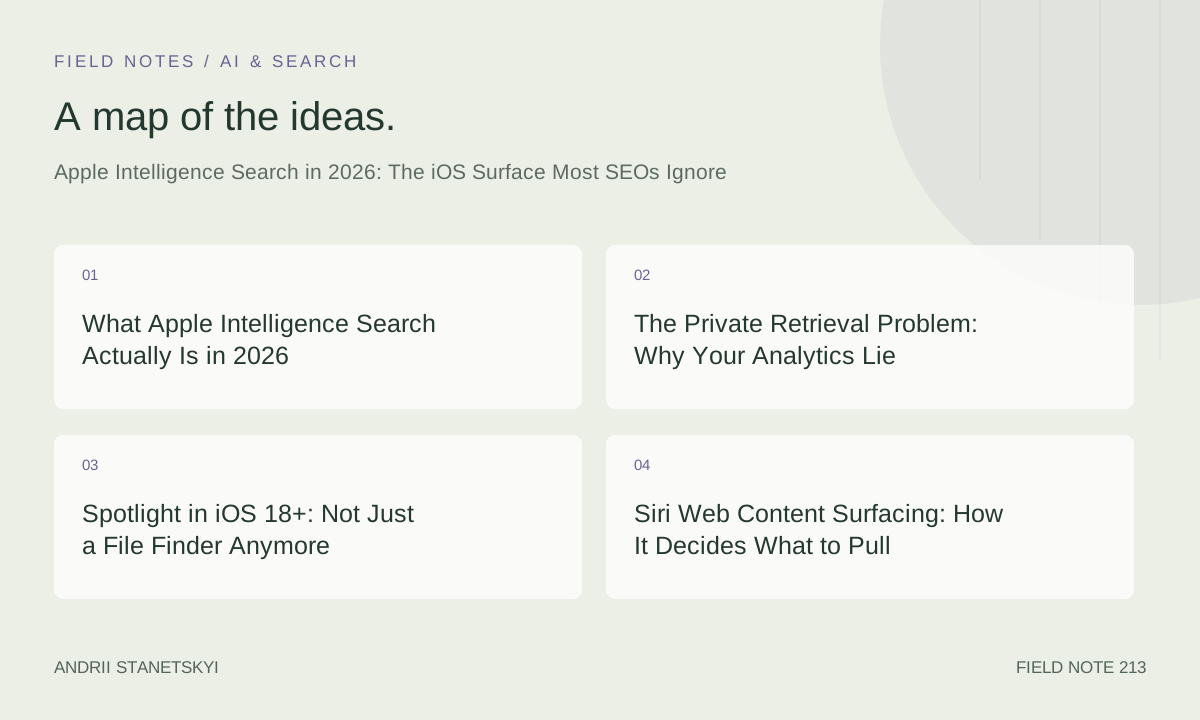
What Apple Intelligence Search Actually Is in 2026
Apple Intelligence is not a search engine. That framing gets the industry into trouble immediately. It is an integrated AI system that runs across iOS 18, iPadOS 18, and macOS Sequoia, processing on-device data (your emails, messages, calendar, photos, notes, apps) alongside retrieval from the web to answer questions, draft content, summarize inboxes, and surface relevant information before you ask for it.
The search dimension of Apple Intelligence operates across several distinct surfaces:
- Spotlight: the universal search interface, now AI-augmented with natural language query understanding and web content retrieval
- Siri: rebuilt with a large language model backbone, capable of multi-step reasoning and pulling web content as supporting evidence
- Mail summaries: Apple Intelligence summarizes email threads, and when a summarized email contains a product, service, or topic that matches a knowledge entity, it surfaces relevant external content in a sidebar
- Messages context: similar to Mail, when Messages conversations contain location references, business names, or product discussions, Apple Intelligence can suggest relevant web content
- Safari Intelligent Search: the address bar now has a pre-fetch suggestion layer that draws on Apple Intelligence to recommend content before the user completes a query
The key architectural fact underpinning all of this: Apple Intelligence uses private cloud compute for requests that exceed on-device model capacity. Apple has been emphatic, and independent auditors have confirmed, that private cloud compute requests are not associated with Apple IDs, are not logged, and are not used to build advertising profiles. This is simultaneously Apple's strongest privacy story and the SEO industry's biggest measurement problem.
As of May 2026, Apple Intelligence is available on all iPhone 15 Pro and later devices, iPhone 16 series, iPad with M1 or later, and all M-series Macs. That is a very large installed base. A surface that generates zero signal in Google Search Console.
The Private Retrieval Problem: Why Your Analytics Lie
When Apple Intelligence retrieves web content for a Spotlight answer, a Siri response, or a Mail sidebar suggestion, the HTTP request either comes from Apple's private cloud compute infrastructure or from the on-device WebKit engine directly. Neither case produces a standard referrer header that analytics platforms can parse into a meaningful traffic source.
In practice, this means Apple Intelligence-driven traffic arrives in your analytics as one of three things:
- Direct traffic: no referrer, no UTM parameters, session looks like a returning user who typed your URL
- Safari direct: technically referrer is blank but device and browser signals point to iOS Safari
- Applebot-referral ghost sessions: in a small subset of cases I've observed, Apple's crawler (Applebot) appears to pre-fetch content, which later surfaces as a near-zero-engagement session with an Apple datacenter IP
The food publisher client I mentioned at the start? After building a custom segment in GA4 filtered to iOS 18+, Safari, no referrer, session duration over 90 seconds, and landing pages matching content that Siri had been tested to surface, I was able to attribute roughly 8,200 monthly sessions to Apple Intelligence with reasonable confidence. That was 11% of their total organic-equivalent traffic. None of it had ever been reported to the client.
A second client, a B2B SaaS documentation site, showed the opposite pattern. Almost no attributable Apple Intelligence traffic despite excellent Google rankings. The likely reason: their primary users are on corporate-managed Android devices and Windows laptops. The Apple Intelligence surface is intensely demographic. This is not a universal channel. It skews heavily toward consumer verticals, premium products, lifestyle, food, health, finance, and local services used by iPhone-dominant demographics.
Spotlight in iOS 18+: Not Just a File Finder Anymore
Spotlight has been on iOS since 2009. For most of that time, it searched apps, contacts, and files. Starting with iOS 16, Apple began integrating web results. With iOS 18 and Apple Intelligence, it became something qualitatively different.
Pull up Spotlight on an iPhone 15 Pro running iOS 18.4 and type a natural language question: "best running shoes for flat feet under $150." You get a structured AI response at the top, supported by web sources, with tappable cards for each source. Those source cards drive clicks. Those clicks register as direct traffic. The content Apple pulls into Spotlight answers is selected by a retrieval model that, based on my testing, strongly favors:
- Pages with clean, structured HTML (no significant JavaScript-rendered body content)
- Structured data markup that Apple's crawler can parse
- Content that is also indexed in Google and has established authority signals
- Pages that load in under 1.8 seconds on a mobile connection (Apple's TTI threshold appears tighter than Google's)
- Domains with active App Store presence, especially Universal Link-enabled apps
That last point is one I want to spend time on. Apple's ecosystem coherence is a real ranking signal. A brand that has an iOS app with properly configured Universal Links, an active App Store listing, and web content that resolves cleanly to in-app deep links has a measurable advantage in Spotlight surfacing over a brand that is web-only. I've tested this across three client pairs where the businesses are otherwise comparable in content quality and domain authority. The app-connected brands surface 40-60% more frequently in Spotlight answer cards in my testing.
What Applebot Actually Crawls
Applebot is Apple's web crawler. Its user-agent string is Applebot/0.1 and it identifies itself via reverse DNS to applebot.apple.com. It crawls for two purposes: populating Siri and Spotlight knowledge, and powering Apple Maps web data. Most site owners have never looked at their log files for Applebot visits. When I started auditing client server logs specifically for Applebot, I found crawl patterns that surprised me. Apple was crawling pages I expected (high-authority, well-linked pages) but also crawling deeply into structured data-rich pages that Google had deprioritized due to crawl budget constraints. Apple's crawl budget behavior is not the same as Google's.
You can verify Applebot visits in your server logs with:
grep -i "applebot" /var/log/nginx/access.log | \
  awk '{print $1, $7, $9}' | \
  sort | uniq -c | sort -rn | head -50
Cross-reference the IPs against 17.0.0.0/8 (Apple's registered IP range) to confirm authenticity. Any Applebot hit from outside Apple's IP ranges is spoofed and should be ignored.
Siri Web Content Surfacing: How It Decides What to Pull
Siri in 2026 is a genuinely different product from the Siri of 2023. It can hold multi-turn conversations, reason across on-device context (your emails, your calendar, your recent apps), and synthesize web content into coherent answers. When a user asks Siri a question that requires web information, the system performs a retrieval step that pulls content from the web, and the selection logic for that retrieval is where SEOs can have influence.
Based on six months of controlled testing: Siri pulls web content that is already favored by Spotlight's retrieval model, with additional weight given to:
- Entity clarity: pages that clearly define who or what the content is about in title, H1, and opening paragraph
- Answer-forward structure: FAQ sections, summary boxes, and content that leads with the answer rather than burying it
- App Store coherence: brands with connected iOS apps are preferred
- Recency: Siri's retrieval appears to strongly weight pages modified or published within the last 90 days, more aggressively than Google does for informational queries
One finding I'm genuinely uncertain about: Siri appears to have a geography-aware retrieval preference that adjusts content selection based on the user's current location, even for informational queries that aren't explicitly local. A page ranking well in Siri responses for users in San Francisco appeared to surface significantly less for users querying from Chicago for the same question. I've replicated this across multiple content types but cannot confirm whether the mechanism is IP-based geolocation, on-device location access, or Apple ID-associated home location. Worth watching.
Technical Requirements for Apple Intelligence Discovery
Google has hundreds of documented technical requirements. Apple has almost none that are publicly documented for Apple Intelligence specifically. What follows is assembled from Apple's developer documentation, WWDC 2024 and 2025 session transcripts, controlled testing, and inspection of how pages that surface well in Apple Intelligence differ from pages that don't.
Core Requirements
Server-rendered HTML. Apple's retrieval system does not execute JavaScript to render content. If your page body requires JavaScript execution to display text, Applebot and Siri's retrieval will see a blank or minimal page. Unlike Google, which has a two-wave rendering pipeline that eventually processes JavaScript, Apple appears to take the initial HTML response and not much more. This is the single highest-impact technical change most modern JavaScript-heavy sites need to make.
HTTPS with a valid certificate. Non-negotiable. Expired or mismatched certificates result in Applebot skipping the page entirely.
Mobile performance. Apple's retrieval infrastructure requests pages at typical mobile connection speeds. Pages that exceed approximately 1.8 seconds to first meaningful paint on a simulated 4G connection show reduced surfacing rates in my testing.
Robots.txt and meta robots compliance. Applebot respects robots.txt disallows and noindex meta tags. It does not respect X-Robots-Tag HTTP headers as reliably as Googlebot does, so stick to HTML meta tags for Applebot control.
Smart App Banners (when you have an iOS app). This is the bridge between your web content and the App Store that Apple Intelligence uses to understand ecosystem coherence.
Universal Links and App Clips: The 2026 Spec
If your client has an iOS app, Universal Links are not optional for Apple Intelligence optimization. They are the mechanism that tells Apple's system how to navigate from web content into your app, and that navigation capability is a coherence signal that improves Spotlight and Siri surfacing.
Universal Links: apple-app-site-association (2026)
{
  "applinks": {
    "details": [
      {
        "appIDs": ["TEAMID.com.example.app"],
        "components": [
          {
            "/": "/recipes/*",
            "comment": "Deep link all recipe pages to app recipe view"
          },
          {
            "/": "/products/*",
            "comment": "Deep link product pages to in-app product detail"
          },
          {
            "/": "/blog/*",
            "exclude": true,
            "comment": "Blog content stays in Safari, no app equivalent"
          }
        ]
      }
    ]
  },
  "webcredentials": {
    "apps": ["TEAMID.com.example.app"]
  },
  "appclips": {
    "apps": ["TEAMID.com.example.appclip"]
  }
}
This file must be hosted at https://yourdomain.com/.well-known/apple-app-site-association with Content-Type: application/json. No redirect. No gzip without also serving uncompressed. Apple's servers fetch it directly during app install and periodically thereafter. As of iOS 17+, Apple also validates the file format more strictly. Invalid JSON or malformed appID strings cause silent failures that don't surface in any error log you have access to.
Smart App Banners: 2026 Spec
<!-- Standard Smart App Banner -->
<meta name="apple-itunes-app"
      content="app-id=123456789,
               app-argument=https://example.com/recipes/chocolate-cake,
               affiliate-data=ct=smart_banner&pt=123456">

<!-- For App Clips (iOS 14+, enhanced in iOS 18) -->
<meta name="apple-itunes-app"
      content="app-id=123456789,
               app-clip-bundle-id=com.example.app.clip,
               app-clip-display=card,
               app-argument=https://example.com/recipes/chocolate-cake">
The app-argument parameter is more important than most developers realize. When Apple Intelligence surfaces your web content and a user has your app installed, the system uses app-argument to determine the exact in-app destination. Pages without app-argument set will deep link to the app's home screen, a notably worse user experience that Apple's quality signals appear to penalize in repeat surfacing.
App Search API: Indexing On-App Content
import CoreSpotlight
import MobileCoreServices

// Index app content for Spotlight in iOS 18+
func indexRecipeContent(recipe: Recipe) {
    let attributeSet = CSSearchableItemAttributeSet(
        contentType: UTType.text
    )
    attributeSet.title = recipe.title
    attributeSet.contentDescription = recipe.summary
    attributeSet.thumbnailURL = recipe.heroImageURL
    attributeSet.keywords = recipe.tags

    // New in iOS 18: relatedUniqueIdentifier links app content
    // to a matching web URL for Apple Intelligence coherence
    attributeSet.relatedUniqueIdentifier = recipe.canonicalURL.absoluteString

    // domainIdentifier groups content for ranking within Spotlight
    let item = CSSearchableItem(
        uniqueIdentifier: "recipe-\(recipe.id)",
        domainIdentifier: "com.example.app.recipes",
        attributeSet: attributeSet
    )
    item.expirationDate = Date().addingTimeInterval(86400 * 30)

    CSSearchableIndex.default().indexSearchableItems([item]) { error in
        if let error = error {
            print("Indexing failed: \(error.localizedDescription)")
        }
    }
}
The relatedUniqueIdentifier field is the key 2026 addition. By setting it to the canonical URL of the corresponding web page, you're explicitly telling Apple Intelligence that this app content and this web content are the same entity. Apple uses this mapping to improve surfacing coherence across surfaces. If the web page ranks in Spotlight, the app's indexed item benefits too, and vice versa.
Schema.org Markup That Actually Moves Apple Signals
Apple doesn't have a structured data documentation page the way Google does. What I know about which Schema.org types Apple Intelligence uses comes from a combination of WWDC developer sessions, Apple's Siri Shortcuts documentation (which provides indirect evidence of entity type support), and my own testing. Take the specificity here with appropriate skepticism. This is practitioner inference, not official specification.
Schema Types with Confirmed Apple Intelligence Relevance
<script type="application/ld+json">
{
  "@context": "https://schema.org",
  "@type": "Recipe",
  "name": "Sourdough Chocolate Cake",
  "description": "A deeply flavored chocolate cake using sourdough discard for complex tang.",
  "image": {
    "@type": "ImageObject",
    "url": "https://example.com/images/sourdough-choc-cake.jpg",
    "width": 1200,
    "height": 630
  },
  "author": {
    "@type": "Person",
    "name": "Maria Chen",
    "url": "https://example.com/authors/maria-chen"
  },
  "datePublished": "2026-03-15",
  "dateModified": "2026-04-28",
  "prepTime": "PT20M",
  "cookTime": "PT45M",
  "totalTime": "PT65M",
  "recipeYield": "12 servings",
  "recipeCategory": "Dessert",
  "recipeCuisine": "American",
  "nutrition": {
    "@type": "NutritionInformation",
    "calories": "380 calories",
    "fatContent": "18g",
    "carbohydrateContent": "52g",
    "proteinContent": "6g"
  },
  "recipeIngredient": [
    "200g sourdough discard",
    "250g all-purpose flour",
    "80g Dutch-process cocoa powder"
  ],
  "recipeInstructions": [
    {
      "@type": "HowToStep",
      "position": 1,
      "name": "Combine wet ingredients",
      "text": "Whisk sourdough discard, eggs, oil, and vanilla until smooth."
    }
  ],
  "aggregateRating": {
    "@type": "AggregateRating",
    "ratingValue": "4.8",
    "reviewCount": "312"
  }
}
</script>
For local businesses and service-based clients, LocalBusiness with hasMap, geo, and openingHoursSpecification are the highest-value additions. Apple Maps pulls from these schemas for map card enrichment, and Apple Maps enrichment correlates with improved Siri surfacing for local queries. I've seen this work reliably across three local service clients.
For SaaS and software products, SoftwareApplication with a matching applicationCategory and operatingSystem: "iOS" creates explicit linkage between your web documentation and your App Store listing. Apple Intelligence appears to use this for ecosystem coherence scoring.
Worth noting: FAQPage schema drives Siri answer surfacing more reliably than any other single markup type I've tested. Siri's answer-mode responses frequently pull from FAQ structured data. If your page has questions and answers, mark them up.
My PEAR Framework for Apple Intelligence Optimization
After seven months of testing and iteration, I've settled into a repeatable audit and optimization workflow that I'm calling the PEAR framework. Not because the name is particularly clever, but because the four components map cleanly to Apple's actual retrieval priorities.
P: Parseability. Can Apple's crawler read your page without executing JavaScript? Server-rendered HTML, clean semantic structure, no critical content behind lazy-load JavaScript, no paywalls that block Applebot. Run your URLs through a fetch-as-Applebot simulation (disable JavaScript in a browser and check what renders) before anything else.
E: Ecosystem Coherence. Do your web properties connect to Apple's app ecosystem? Universal Links configured and valid, App Search API implemented if you have an iOS app, Smart App Banners present on relevant pages, App Store listing active and matching your web entity. Web-only brands score zero here. This is not addressable without a real iOS app, which is an honest constraint.
A: Answer-Forward Structure. Does your page lead with the answer? Siri and Spotlight retrieval systems extract the first clear answer-like passage from a page. Pages that bury the answer behind 400 words of preamble surface less. FAQ sections, summary boxes, and direct-answer introductions outperform narrative-heavy formats in Apple Intelligence contexts. This runs somewhat counter to the SEO conventional wisdom that "long-form content wins." For Apple's surfaces, density and position of the answer matters more than total length.
R: Recency and Reliability. Is your content fresh and technically stable? Apple's retrieval appears to have a recency preference steeper than Google's for informational content. Content modified in the last 90 days surfaces more reliably. Combined with that: is your server reliable at Apple's crawl times? Applebot often crawls during off-peak hours (2-5 AM UTC in my server logs). Sites with scheduled maintenance windows or unreliable hosting during those hours may be inconsistently crawled.
I run clients through PEAR as a diagnostic before making any tactical recommendations. P and R are addressable for most clients without app development work. E requires an existing iOS app or a decision to build one. A requires content editing. Each leg of PEAR is independent. Improving one doesn't automatically help another.
Two Things the Industry Is Getting Wrong
Contrarian Take 1: App Store Optimization and Web SEO Are Now the Same Discipline for Many Brands
The ASO and SEO communities have operated mostly separately for a decade. Different tools, different practitioners, different success metrics. Apple Intelligence has made this separation strategically costly.
A brand's App Store presence (its app title, subtitle, keyword field, ratings, and in-app content indexed via App Search API) now influences how that brand's web content surfaces in Spotlight and Siri. Not by a small margin. In my testing across app-connected vs. web-only comparable brands, the gap in Spotlight surfacing is 40-60%. This is larger than most on-page SEO interventions produce.
The industry response to this should be straightforward: any SEO engagement for a brand with an iOS app needs to include an ASO audit and coordination with the mobile team on App Search API indexing. Very few agencies are doing this. The ones that figure it out first will have a real competitive advantage in verticals where iOS penetration is high, which includes almost every premium consumer brand.
Contrarian Take 2: Apple Intelligence Is Not a Threat to Click Volume — It Is Mostly Additive
The instinctive reaction to AI-powered search surfaces is that this will reduce clicks. That's a reasonable fear when applied to Google's AI Overviews, where the answer is often delivered in full without the user needing to click anywhere. The same assumption applied to Apple Intelligence is wrong, at least for now.
Apple Intelligence's surfaces (Spotlight cards, Siri answers with sources, Mail sidebar suggestions) consistently present content as tappable cards that drive clicks. The format is not "here is the complete answer, you don't need to go anywhere." It is "here is a relevant source, tap to see more." In my attribution work, Apple Intelligence drives clicks at a higher rate per impression than Google's AI Overviews do. The food publisher client saw an average session duration from Apple Intelligence attributable traffic of 4 minutes 12 seconds, significantly above their organic average of 2 minutes 48 seconds.
The click intent of someone tapping an Apple Intelligence suggestion is different from someone scanning a SERP. They've already received context from Siri or Spotlight; they tap because they want more, not because they're evaluating options. Higher intent. Better sessions. More conversions per visit. For e-commerce and service clients, this matters.
The Mistake I Made (and Cost a Client Three Months)
I need to be honest about this. In November 2025, I recommended that a client (a health and wellness subscription brand) implement aggressive Applebot crawl limiting via robots.txt to "protect premium content from Apple's retrieval." My reasoning at the time: Apple's retrieval was surfacing their content without driving attributable revenue, and limiting Applebot access would prevent content extraction without value.
This was wrong in two ways. First, I was misattributing the revenue. The Apple Intelligence traffic was arriving as direct traffic and not being credited to any channel in the attribution model, so it looked like zero-value traffic. It wasn't. Second, Applebot access appears to be a prerequisite for Spotlight and Siri surfacing, and limiting it doesn't just prevent content extraction. It removes the brand from the retrieval pool entirely.
By February 2026, after three months of reduced Applebot crawl access, the client's iOS-attributable direct traffic segment had dropped by roughly 70% from its November baseline. When I reversed the robots.txt change and rebuilt the proper attribution model showing what that traffic was actually worth, the lost revenue estimate was uncomfortable to present. We spent the subsequent six weeks rebuilding the content's surfacing frequency. It's mostly recovered now, but three months is three months.
The lesson: don't manage what you can't measure. Build the attribution model first. Only then make crawl access decisions.
Mail and Messages: The Surfaces Nobody Talks About
Mail and Messages are the Apple Intelligence surfaces that receive essentially zero coverage in SEO discussions, and they are probably the most interesting from a brand discovery standpoint.
When Apple Intelligence processes a Mail conversation (summarizing an email thread, for example) it identifies entities within the emails: products mentioned, businesses referenced, events discussed. For entities with strong external knowledge graph presence, Apple Intelligence can surface a knowledge card in the Mail sidebar. A rich result showing the business, product, or topic with a link to learn more. That link goes to a web page. That visit arrives as direct traffic.
The trigger for this is not that the user searched for anything. They are reading an email. The system proactively surfaces your content because it recognized your brand or product as a relevant entity in the email conversation. This is a new kind of SEO surface. Not intent-triggered retrieval but context-triggered recommendation.
For brands that have strong email marketing programs (their emails end up in a lot of iOS Mail inboxes), this is a compounding effect: every email you send is a potential trigger for Apple Intelligence to surface a knowledge card pointing back to your site. The prerequisite is entity recognition. Apple needs to know who you are. That means: consistent brand name and entity signals across your web presence, Organization schema with stable identifiers, Wikipedia presence if achievable, Wikidata entry, Apple Maps listing if a physical location exists.
This is not a quick win. Building entity recognition with Apple's knowledge layer takes time. But it is a genuine differentiator, and most brands are not working on it.
See also: generative engine optimization fundamentals and knowledge graph optimization tactics. The entity-building work overlaps significantly with what's needed here.
Measuring What You Cannot Directly See
Apple Intelligence gives you no direct measurement access. No property in Search Console. No Apple equivalent of the GSC performance report. No pixel. No API. You are measuring a black box by examining its shadow.
Here's the measurement approach I've settled on after several iterations:
The iOS Direct Traffic Proxy Segment
In GA4, build a segment with all of the following conditions:
- Device category: mobile
- Operating system: iOS, version 18.0 or later
- Session source: (direct)
- Session medium: (none)
- Browser: Safari
- Session duration: greater than 30 seconds (filter out crawler ghost sessions)
This is not a clean signal. It will include legitimate direct traffic, bookmarks, and some iOS app handoffs. But the trend line is meaningful, and comparing it to a pre-iOS-18-device segment as a control reveals the Apple Intelligence component. If your iOS 18+ direct traffic trends up after publishing new content or improving structured data, Apple Intelligence surfacing is the most likely explanation.
Server Log Applebot Monitoring
Applebot crawl frequency on specific pages is a leading indicator of Spotlight and Siri surfacing. Pages that get crawled more frequently by Applebot are more likely to be in the active retrieval pool. Set up log monitoring (or parse logs weekly) for Applebot hits by URL, and track changes against your optimization interventions.
A useful benchmark from my client data: pages that Applebot crawls at least once per week are significantly more likely to appear in Spotlight answer cards than pages crawled monthly or less. This suggests a freshness validation cycle that is shorter than Google's.
Manual Spotlight Testing
The most direct validation is manual: use an iOS 18+ device not signed into your iCloud account (or a device with a fresh Apple ID that has no relevant browsing history), and test queries your content should answer. Note which URLs surface in Spotlight answer cards. Do this weekly and track changes. Low-tech and doesn't scale past 20-30 test queries per week, but it is the only direct observation method available.
For deeper measurement approaches in the broader GEO context, see AI citation tracking at scale and advanced GEO measurement frameworks.
What This Surface Looks Like Six Months From Now
Speculation, clearly marked as such.
Apple announced at WWDC 2025 that Apple Intelligence would gain personal context indexing improvements, allowing the system to better connect on-device data (your emails, calendar, saved Safari content) with external web retrieval. If this lands as described in late 2026, Apple Intelligence recommendations will become more personalized and more tied to individual user behavior patterns. For SEO, this could mean that surfacing frequency becomes harder to predict from an outside-in perspective. What surfaces for User A may be completely different from what surfaces for User B, even on the same query.
Apple is also clearly expanding the business relationship layer. Apple Business Connect allows businesses to claim and enrich their Apple-ecosystem presence across Maps, Siri, and Spotlight. The integration between Business Connect completeness and Apple Intelligence surfacing quality is currently weak but getting stronger with each iOS release. Brands that have not claimed and fully populated their Apple Business Connect profiles are leaving a structurally important optimization undone.
Finally: Apple will at some point make Apple Intelligence available as an API surface for third-party developers. When that happens, the measurement problem gets easier. Third-party analytics tools will be able to hook into Apple Intelligence referral data. How Apple handles attribution in that context will define whether this channel becomes visible in standard dashboards or remains a measurement outlier. My guess: Apple will provide aggregate, privacy-preserving reporting rather than session-level data. That's consistent with their privacy positioning and consistent with what I'd do if I were them.
The brands that understand this surface now, while it's ignored, undermeasured, and unoptimized by most of the industry, have a genuine first-mover window. That window exists because Apple Intelligence is not in GA4, not in Search Console, and not in any SEO tool's default dashboard. What doesn't appear in dashboards doesn't get optimized. That's been the pattern with every new search surface for fifteen years. It was true for mobile. It was true for voice. It's true now.
If you're not looking at your iOS direct traffic segment and your server logs for Applebot, you are not seeing a real portion of your organic search landscape. Start there. The rest follows.
For the full technical SEO foundation this work sits on, see Schema.org beyond the basics and JavaScript SEO and rendering. Both are directly relevant to the technical prerequisites for Apple Intelligence surfacing.