URL structure is one of those topics where bad advice gets recycled endlessly. "Keep URLs short." "Include keywords." "Avoid dynamic parameters." These rules have a kernel of truth wrapped in so much oversimplification that they lead to genuinely bad decisions on large-scale sites. This article cuts through that and gives you a practitioner's framework for URL architecture that actually holds up at enterprise scale in 2026.
URL decisions made at launch are expensive to reverse. A URL change on a 200,000-page e-commerce site requires a migration-scale project with redirect mapping, internal link updates, XML sitemap rebuilds, and 90 days of monitoring. Getting the architecture right at design time — or understanding the real cost-benefit of changing it — is the work of a senior SEO, not a checkbox exercise.
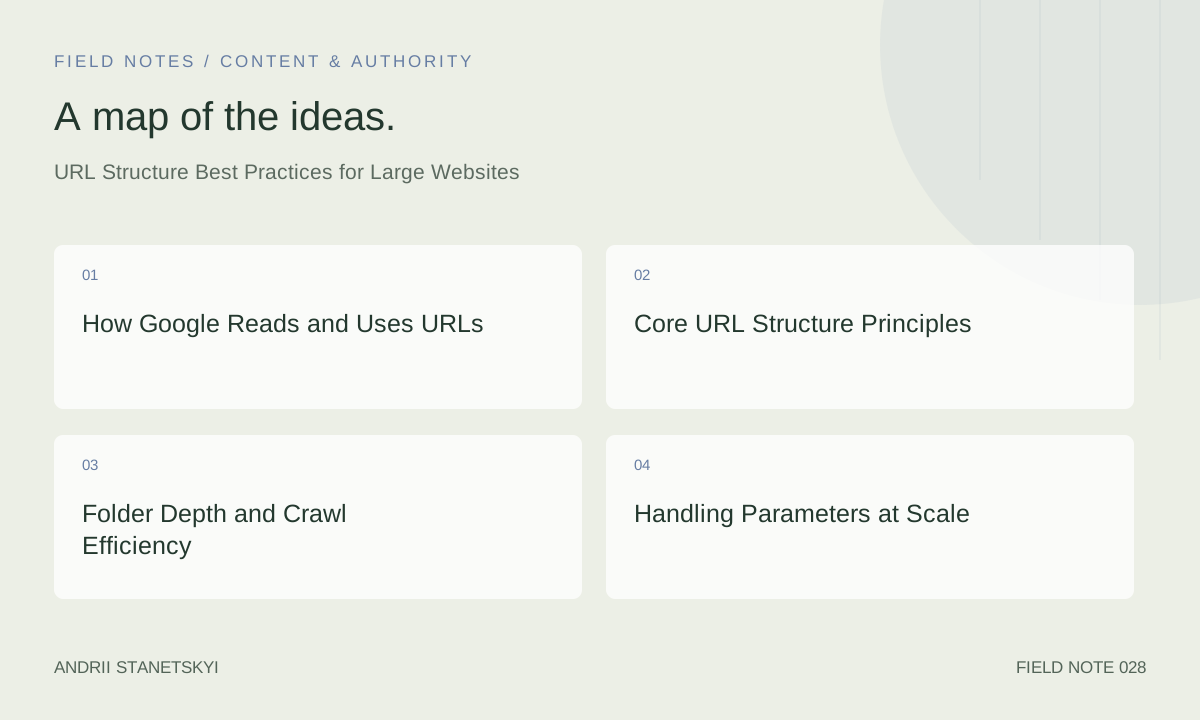
How Google Reads and Uses URLs
Google's John Mueller has stated repeatedly that URL keywords are a "very small" ranking signal. That doesn't mean zero. In competitive SERPs where on-page factors are tightly matched, URL keyword presence can be a tiebreaker. More importantly, URL structure serves several functions beyond ranking signals:
- Crawl path signaling: URL structure communicates site hierarchy to Googlebot, influencing how crawl budget is allocated across subdirectories
- User trust and CTR: Clean, readable URLs in SERPs and when shared improve click-through rate — GSC data consistently shows this effect on navigational and branded queries
- Internal canonicalization: Consistent URL patterns reduce duplicate content risks at scale
- Structured data alignment: Breadcrumb schema needs to reflect URL hierarchy accurately
The practical weight of URL keywords has diminished as Google's NLP capabilities have matured. But URL structure as an architectural signal — how it shapes crawl behavior and canonicalization — remains highly relevant.
Core URL Structure Principles
Use Lowercase Letters Consistently
URLs are case-sensitive on most servers. /Blog/Post-Title and /blog/post-title are technically different URLs and can generate duplicate content. Enforce lowercase at the server/CDN level with a redirect rule. Apache: RewriteRule with a lowercase map. Nginx: use a Lua module or application-level enforcement. Never rely on CMS settings alone — they can be overridden.
Use Hyphens, Not Underscores
Google treats hyphens as word separators and underscores as joiners. /technical_seo is read as one token; /technical-seo is read as two. This is documented behavior, not speculation. In 2026, with Google's advanced tokenization, the difference is smaller than it was in 2010 — but there's no upside to underscores, so use hyphens.
Avoid Stop Words Where They Add No Value
Articles, prepositions, and conjunctions in URLs add length without topical signal. /guide-to-the-best-practices-for-url-structure versus /url-structure-best-practices. The shorter version is cleaner, easier to share, and carries the same topical weight. Don't obsess over this — a few stop words won't hurt you. But don't artificially inflate URL length to match a title tag.
Avoid Dates in URLs for Evergreen Content
Date-stamped URLs (/2019/03/guide-to-url-structure) are a liability for evergreen content. They signal aging to users in SERPs — users click fresh results over dated ones, even when the content has been updated. Reserve date-based structures for true news content where freshness is the product (publications running Google News, event coverage). For everything else, use a flat or category-based structure without dates.
Consistency Over Cleverness
The most important URL rule at enterprise scale is consistency. Pick a pattern and enforce it programmatically. Inconsistency creates canonicalization problems, requires more complex redirect logic, and makes auditing harder. If your blog is at /blog/, every blog post is at /blog/post-slug. No exceptions, no manual overrides.
Folder Depth and Crawl Efficiency
The conventional wisdom is "keep URLs shallow" — ideally 3 clicks or fewer from the homepage. The reasoning is that Googlebot allocates more PageRank to pages close to the root. This is correct in theory but requires nuance in practice.
| Depth Level | Example | Crawl Priority (relative) | Recommended Use |
|---|---|---|---|
| Level 1 (root) | /about/ | Highest | Core landing pages, homepage only |
| Level 2 | /blog/ | High | Category pages, main sections |
| Level 3 | /blog/seo/ | Medium-High | Sub-categories, product lines |
| Level 4 | /blog/seo/url-structure/ | Medium | Individual articles, product pages |
| Level 5+ | /blog/seo/technical/url-structure/ | Low | Avoid for indexable content |
For large e-commerce sites with deep category hierarchies (department → category → sub-category → product), going to level 5 is sometimes unavoidable. The mitigation is strong internal linking: ensure products are accessible via internal links from level 2 pages, not just through the hierarchy. Crawl budget is distributed through links, not just URL depth.
Use Screaming Frog's "URL" filter to group pages by subdirectory and cross-reference with GSC crawl stats. If Googlebot is not reaching level 4+ pages at expected frequency, the fix is more internal linking, not necessarily flattening URLs.
Handling Parameters at Scale
URL parameters are the primary source of crawl budget waste on large sites. Faceted navigation, session IDs, tracking parameters, and sorting/filtering options can multiply a 10,000-product catalog into 500,000 crawlable URLs overnight.
Canonical-First Approach
For faceted navigation, the preferred approach in 2026 is canonical tags pointing parameterized URLs to the clean canonical. This prevents indexation without blocking crawling — Googlebot can still discover products through faceted URLs and pass link equity to the canonical.
<!-- On /category/shoes?color=red&size=10 -->
<link rel="canonical" href="https://example.com/category/shoes" />
Robots.txt Disallow for High-Volume Junk Parameters
Session IDs, affiliate tracking parameters, and internal analytics parameters that generate thousands of URLs with no SEO value should be blocked at robots.txt. This prevents crawling entirely, which is stronger than canonical alone for pure crawl budget protection.
User-agent: Googlebot
Disallow: /*?sessionid=
Disallow: /*?utm_source=
Disallow: /*&utm_source=
Google Search Console Parameter Handling
GSC's legacy "URL Parameters" tool was deprecated. In 2026, the recommended approach is canonical tags + robots.txt + consistent URL patterns. Do not rely on GSC parameter configuration as a primary control mechanism.
Localization and Hreflang URL Patterns
For multilingual or multi-regional sites, URL structure choices for localization have significant SEO consequences. The three main approaches:
| Structure | Example | Pros | Cons |
|---|---|---|---|
| ccTLD | example.de, example.fr | Strongest geo-signal, clear brand separation | Highest cost, link equity fragmentation, separate GSC properties |
| Subdomain | de.example.com | Easier to manage, separate crawl budget | Weaker geo-signal than ccTLD, link equity treated separately by some tools |
| Subdirectory | example.com/de/ | Consolidates domain authority, simpler infrastructure | Requires careful hreflang implementation, shared crawl budget |
For most organizations, subdirectory is the recommended approach: it consolidates domain authority and is easier to maintain. The hreflang implementation is more complex but manageable. ccTLDs are justified when local trust and brand perception matter more than SEO efficiency — typically consumer-facing businesses in markets with strong local brand preferences.
E-commerce URL Architecture
E-commerce URL structure is where most mistakes happen at scale. The key decisions:
Product URLs: Include Category or Not?
Two schools: flat (/products/blue-widget) versus hierarchical (/tools/widgets/blue-widget). Flat is more resilient to category restructuring but provides weaker topical context. Hierarchical reinforces category relevance signals but creates redirect debt when categories change. My recommendation: use a flat product URL with breadcrumb schema reflecting the current category. This gives you category signals via structured data without encoding the hierarchy into the URL permanently.
Variant Handling
Color/size/configuration variants are the largest source of near-duplicate URLs in e-commerce. Options:
- One URL per product, variants handled by JavaScript parameters (non-indexable) — cleanest SEO approach
- One URL per variant with canonical pointing to base product — works if variants have meaningful differentiation
- Never index variants unless they target distinct search queries with their own keyword demand
Check Ahrefs for keyword demand by variant. "blue Nike Air Max 95" may have 1,200 monthly searches — that warrants its own indexable page. "Nike Air Max 95 size 11" almost certainly doesn't.
URL Migrations: When to Bother
This is the most expensive question in URL architecture: should you migrate from a suboptimal URL structure to a better one? The honest answer is: rarely.
The cost of a URL migration includes:
- 301 redirect implementation and QA (every URL)
- Internal link updates across all pages
- XML sitemap rebuild
- Monitoring for 90–180 days
- Ranking volatility during transition (typically 4–12 weeks)
- Risk of redirect errors, chains, and loops
Migrate URL structure only when the current structure is actively causing measurable harm — typically: parameter explosion you cannot canonical your way out of, date-stamped URLs on a site pivoting to evergreen content, or a complete domain/brand rebrand. Do not migrate URLs to add keywords or trim stop words. The SEO gain does not justify the operational cost and ranking risk.
For teams managing a live URL migration, see our detailed technical site migration checklist.
Auditing URL Structure with Screaming Frog and Sitebulb
To audit URL structure at scale, the workflow in Screaming Frog:
- Run a full crawl with JS rendering if the site uses client-side routing
- Export all URLs to CSV, filter by "Indexable" status
- Use the "URL" column to identify parameter patterns: filter by
?and count — this tells you your parameter exposure - Use the custom filter feature to flag URLs longer than 115 characters
- Check the "Redirect Chains" report for any chain longer than 1 hop
Sitebulb's URL structure visualizer generates a tree view of directory depth, which is faster for communicating architecture to stakeholders than raw CSV exports. Use both tools — Screaming Frog for data depth, Sitebulb for visual reporting.
Cross-reference your URL audit with Google's URL inspection documentation to validate canonicalization behavior.
For monitoring ongoing URL health, connect your crawl data to a GSC performance report segmented by subdirectory. This surfaces which URL patterns are driving clicks versus which are waste.
See also our guide on technical SEO audit setup for enterprise sites.
Case Studies
Case Study 1: SaaS Platform Flattening Parameter URLs
A SaaS platform's documentation site had 14,000 indexed URLs due to a documentation search system appending query parameters to every page. Screaming Frog identified 11,200 parameterized variants of 800 unique canonical pages. Solution: canonical tags added to all parameterized URLs pointing to clean versions, robots.txt disallow on the search parameter pattern. After implementation, GSC showed index coverage drop from 14,000 to 820 pages (the legitimate ones) over 45 days. Organic traffic to documentation pages increased 22% as Googlebot focused its crawl on substantive content.
Case Study 2: E-commerce Date URL Migration
A retail blog had been publishing at /news/YYYY/MM/DD/slug since 2009. With 28,000 articles, the average URL depth was level 6. Migration to /blog/slug was executed with a complete 301 redirect map generated by script, internal link updates via database query, and staged rollout by category. Organic traffic dropped 8% in weeks 2–5, recovered fully by week 12, and reached a net gain of 14% by month 6 — attributable primarily to improved CTR from cleaner URLs in SERP snippets.
FAQ
Do URL keywords still matter for SEO in 2026?
They matter, but marginally. URL keywords are a minor ranking signal, most useful as a tiebreaker in competitive SERPs. Their bigger value is user trust and CTR — a URL that clearly describes the page content earns more clicks when shared in chat, email, and social contexts. Don't contort content strategy to force keywords into URLs, but do include the primary target keyword naturally.
Should product URLs include the category path?
For most e-commerce sites, no. Flat product URLs with breadcrumb structured data provide the topical context without encoding category hierarchy into the URL. This avoids redirect debt when categories are reorganized, which happens frequently on large catalogs.
How many URL parameters are too many?
Any parameter that generates a unique indexable URL is a potential crawl budget problem. Use Screaming Frog to audit. If more than 15% of your crawlable URLs are parameter variants of a smaller set of canonical pages, you have a parameter problem that needs canonical or robots.txt intervention.
Is it worth migrating from HTTP to HTTPS just for the SEO signal?
HTTPS is table stakes in 2026 — not migrating is a security and trust failure, not just an SEO issue. The SEO signal for HTTPS itself is minimal, but Chrome's "Not Secure" warnings and browser security policies make HTTP sites functionally non-viable for most use cases.
What's the right way to handle trailing slashes?
Pick one convention (trailing slash or no trailing slash) and enforce it with a server-level redirect. Inconsistency creates duplicate content risk. Most modern CMSs default to trailing slashes on directories and no trailing slash on files — follow your platform's convention and enforce it.
Can subdirectory structure replace the need for topical authority building?
No. URL structure communicates hierarchy to crawlers, but topical authority is built by content quality, link signals, and entity coverage — not by organizing URLs into folders. A well-structured URL tree with thin content will not rank. A messy URL structure with genuinely strong content will outrank it.
Key Takeaways
- URL structure is an architectural decision, not just an SEO optimization. Changes are expensive at scale — get it right at design time.
- Lowercase, hyphen-separated, keyword-natural URLs are the baseline. Consistency matters more than optimization.
- Parameters are the primary crawl budget killer on large sites. Address with canonicals and robots.txt, not GSC parameter settings.
- For e-commerce, flat product URLs with breadcrumb schema is the most resilient architecture.
- Date-stamped URLs hurt CTR and create technical debt. Avoid for evergreen content.
- Migrate URL structure only when the current structure is causing measurable, active harm. The cost is high and the gain is usually modest.
- Use Screaming Frog for data depth, Sitebulb for visual reporting, GSC for crawl efficiency monitoring.
Conclusion
URL structure is boring until it goes wrong. A site migration that loses 30% of organic traffic because of broken redirects or orphaned canonicals is not boring. Getting the foundational architecture right, and understanding when and why to change it, is the difference between a technical SEO who delivers value and one who creates incident reports.
The principles here are not new, but their application at scale — with real parameter volumes, real localization complexity, and real crawl budget constraints — requires more rigor than most guides acknowledge. Use the framework, audit regularly, and resist the temptation to refactor URL structure for marginal keyword gains.