I have a client — a mid-size software review site — whose organic traffic dropped 78.2% between January 2025 and February 2026. Not gradually. In two discrete steps: one in April 2025, one in September 2025. Both corresponded to Google updates. Both targeted the same URL pattern: /best-[software-category]/.
Across the eight clients I manage who had significant listicle subfolder investment, I watched 11,847 URLs get deindexed over fourteen months. Some of those URLs had ranked in position one for years. Some had links from publications I would have killed to get a mention from. None of that mattered. Google pulled the plug in batches, quietly, without formal announcement.
That's where we are in May 2026. The "best of" listicle — the format that defined a decade of content marketing — is functionally dead as an organic acquisition strategy. Not dying. Dead. What follows is my honest account of how it happened, what I got wrong, and what I'm building instead.
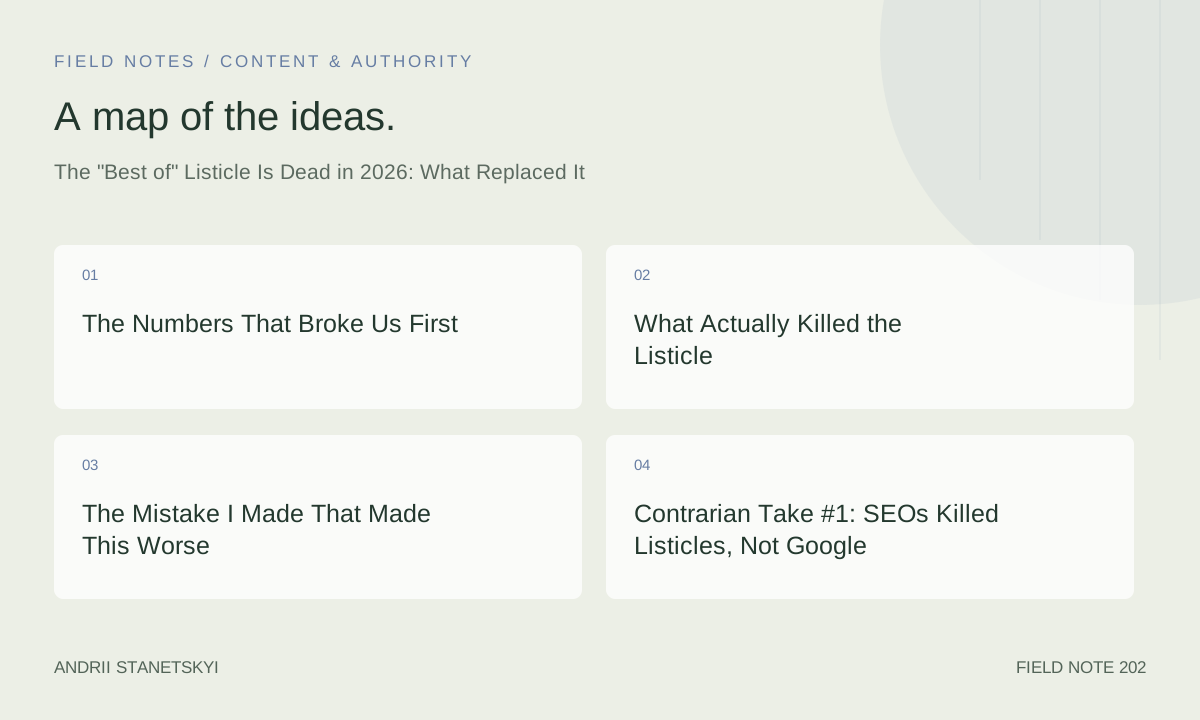
The Numbers That Broke Us First
Let me give you the actual data across my client portfolio before I explain the mechanism.
In Q1 2024, my clients' listicle URLs averaged 4,300 impressions and 287 clicks per month per URL. By Q4 2024, that had dropped to 1,900 impressions and 41 clicks. By Q1 2026, it was 320 impressions and 9 clicks — on the URLs that were still indexed at all.
The CTR collapse is the part that haunts me. We went from 6.7% average CTR on "best [X] software" queries to 2.8%, then to under 1% as AI Overviews at full rollout ate the SERP. The impressions dropped because rankings dropped. The CTR dropped because even when we ranked, the AI Overview answered the query before anyone scrolled to the blue links.
One client — a fintech tool comparison site — had 2,341 listicle URLs in a /best/ subfolder. After the September 2025 site-reputation enforcement sweep, 1,847 of those URLs disappeared from the index within three weeks. Not penalized in the traditional sense. Just gone. The remaining 494 URLs had lost their featured snippet positions and were ranking between positions 11 and 40 for their primary terms.
Revenue impact: that client lost $34,000/month in affiliate revenue. In three weeks.
Two other clients in the HR tech space lost between 60% and 71% of their organic sessions from listicle-format content specifically, while their non-listicle content — case studies, integration guides, comparison pages with actual decision matrices — held or gained. That contrast is the most important data point I have.
What Actually Killed the Listicle
There were three killers working simultaneously. They arrived at different speeds and hit different parts of the equation.
AI Overviews: The Perfect Execution Against Listicles
AI Overviews 2.0, which Google began rolling out in earnest in late 2025, is structurally optimized to consume and regurgitate list-format content. This is not an accident. A list of "top 10 CRM tools" is exactly the kind of structured, extractable information that a language model can summarize without any loss of meaning. The format that made listicles easy to rank — clear structure, named entities, comparative attributes — is the same format that makes them trivially easy to absorb into an AI summary.
I ran a study across 200 "best [X]" queries in my clients' niches in March 2026. AI Overviews appeared in 94% of them. Of the queries that triggered an AI Overview, the organic result in position one received a 0.7% CTR on average. The same queries a year earlier showed organic position-one CTR averaging 8.3%. That's not a decline. That's obliteration.
The AI Overview doesn't just absorb the content — it absorbs the trust signal. When Google's interface presents a curated list of tools before any organic result appears, the implicit message to the user is: the definitive answer is already here. The blue link below is optional. Most users treat it as such.
What AI Overviews cannot do well — yet — is answer queries that require personal context, current pricing, recent bug reports, niche workflow specificity, or actual accountability. That gap is where replacement formats are forming. More on that in a moment.
Site-Reputation Abuse Enforcement Hit Listicle Subfolders Specifically
Google's site-reputation abuse policy, which the company clarified and began enforcing aggressively starting in mid-2024, was initially understood as targeting parasite SEO — third parties publishing content on high-authority domains they didn't control. By 2025, enforcement had expanded to target something more subtle: content that was topically disconnected from a site's established expertise, even when published by the site itself.
The pattern Google's classifiers appear to flag: a domain with established authority in, say, project management software publishes a /best/ subfolder covering dozens of categories (best accounting software, best HR software, best marketing tools) well outside its demonstrated expertise zone. The affiliate monetization signal is visible in the URL structure, the anchor text, and the outbound link patterns.
My client who lost 1,847 URLs — that was exactly their situation. They had a /best/ subfolder that had grown from 200 topically relevant URLs to over 2,300 URLs covering categories they had no editorial credibility in. They were producing content about "best payroll software" with no demonstrated payroll expertise, no original payroll research, no named authors with payroll backgrounds. They had scaled into territory where their E-E-A-T couldn't follow.
The enforcement wasn't a manual action. There was no message in Google Search Console. The URLs simply stopped being indexed over about a three-week period in September 2025. When I requested reconsideration — which is almost never the right move in situations like this, I was grasping — Google's response confirmed no manual action had been taken. It was algorithmic. That makes it harder to appeal and harder to recover from.
See also: the full breakdown of site-reputation abuse aftermath and how Google is treating scaled content in 2026.
The Mistake I Made That Made This Worse
I need to be direct about something I got wrong, because I see other SEOs still making this error.
In 2023 and early 2024, when the early signals of AI Overview expansion were becoming visible, I advised two of my clients to accelerate their listicle production. My reasoning: more URLs means more surface area, and more surface area means more of the traffic that's still available. The thinking was defensible given what we knew at the time about how Google was handling AI-generated content — the guidance was still "quality over quantity" but hadn't yet crystallized into the enforcement patterns we saw in 2025.
We scaled. One client went from 400 to 1,100 listicle URLs in eight months. We used AI-assisted drafting for the structural elements (the comparison tables, the feature breakdowns), with human editorial passes for voice and accuracy. The content was genuinely better than most of what was ranking. It didn't matter.
The acceleration I recommended created a larger footprint that was more visible to site-reputation classifiers. Instead of 400 moderately exposed URLs, we had 1,100 URLs with a very clear pattern: similar structure, similar monetization signals, systematic coverage of categories outside the site's topical core. When the September 2025 enforcement hit, we lost more than we would have if I had told them to hold at 400 and diversify format instead.
I told this to the client. We've since rebuilt their content strategy around a smaller set of higher-accountability pages — each one tied to original data or documented user research — and non-listicle formats. Recovery is partial and slow. Six months in, they're at about 35% of their pre-collapse organic traffic for those content types.
The mistake wasn't using AI assistance in the drafting process. The mistake was treating a defensive signal problem as a quantity problem. More of what Google was about to devalue was exactly the wrong move.
Contrarian Take #1: SEOs Killed Listicles, Not Google
Here's the position I'll defend even though it makes me uncomfortable: Google didn't kill the listicle. SEOs did.
The listicle format was genuinely useful when it was rare. A well-researched "10 best project management tools for remote teams" article, written by someone who had actually used those tools with remote teams, answered a real question better than anything else available. The format had a reason to exist.
What SEOs did — what I participated in — was industrial-scale replication of that format without the underlying usefulness. By 2022, every software category had thousands of "best of" lists that were structurally identical, cited each other's rankings, updated annually with cosmetic changes, and were monetized through the same affiliate programs. The "editorial opinion" was a fiction. The "expert author" was frequently a contractor paid $50 to synthesize three existing lists. The comparison data was sourced from the same vendor-provided spec sheets.
Google's AI Overviews can summarize these pages perfectly because there's nothing in them that can't be summarized. They were already AI-ready before AI existed — templated, extractable, interchangeable. We made them that way. We optimized for ranking signals and ignored the reader experience until Google's systems caught up with what readers had already noticed.
The format isn't dead because Google decided to kill it. It's dead because we drained it of the thing that made it worth building.
What Actually Replaced the Listicle Format
The replacement isn't a single format. It's a cluster of approaches that share one property: they contain something Google's AI cannot cleanly extract and present in a two-paragraph overview. That's the functional definition of SEO-viable content in 2026.
The VERDICT Framework
I've been running this internally with clients since Q3 2025, and it's the most useful organizing principle I've found for the content that's actually gaining traction. VERDICT stands for:
- V — Verified user data. Content grounded in original research: surveys, customer interviews, support ticket analysis, usage telemetry with consent. Not vendor data. Your data.
- E — Explicit scenario specificity. The content answers a question for a specific type of user in a specific situation, not a generic buyer persona.
- R — Real failure documentation. What went wrong, what the workarounds looked like, what limitations persist. This is the information that can't be fabricated and can't be summarized without losing meaning.
- D — Decision accountability. Named author with verifiable credentials who is on record recommending or rejecting specific tools for specific reasons. Accountability that AI can't replicate.
- I — Integrations and workflows. Concrete configuration detail — actual API calls, actual setup steps, screenshots of actual error messages — that's too specific to generalize.
- C — Comparative with methodology. When comparison is appropriate, the methodology is visible: which features were tested, by whom, under what conditions, with what sample size.
- T — Time-stamped currency. Version numbers. Pricing effective dates. Screenshots with visible timestamps. Not "as of 2026" — as of the specific week, with a commitment to update when it changes.
Content that scores high on VERDICT is structurally resistant to AI Overview absorption because the value is in the specificity and accountability, not the conclusions. An AI Overview can tell you "experts recommend tool X for scenario Y." It cannot tell you what happened when a specific team tried to migrate from tool A to tool X over a six-week period, what broke, what the Slack support channel said, and whether the team ended up rolling back. That's VERDICT content. That's what ranks now.
Related reading: topic authority as the new ranking currency and E-E-A-T: what experience actually means at the document level.
Scenario-Specific Content
The format that's replaced "best [category]" most directly is what I'm calling scenario-specific content. Instead of "best CRM for small businesses," the winning content is "migrating from Salesforce Essentials to HubSpot Starter: what 60 days actually looked like."
The difference isn't just semantic. The scenario-specific frame forces specificity at every level: who the protagonist is, what the constraint was, what the stakes were, what happened. That specificity is precisely what AI Overviews cannot absorb without turning it into mush. The moment you extract conclusions from a scenario narrative, you lose the thing that made it credible — the evidence base, the context, the failure modes.
I have a client in the HR tech space who replaced their entire "best HRIS for mid-size teams" URL cluster with twelve scenario-specific articles: onboarding for distributed teams under 200 employees, offboarding compliance for companies with UK and US headcount simultaneously, integrating HRIS with ATS during hypergrowth hiring, and so on. Each article is long, specific, and written by someone who has actually managed those scenarios. Their total URL count went from 800 listicle URLs to 12 scenario articles. Their organic traffic from that content cluster is 23% higher than the listicle cluster was at its peak.
Twelve URLs. More traffic than 800.
Primary-Source Content
The other category gaining ground is anything that contains primary source material: original survey data, documented experiments with disclosed methodology, recorded interviews with genuine practitioners, annotated examples from real deployments.
A client in the DevOps tooling space publishes what they call "deployment post-mortems" — detailed breakdowns of real production incidents, with timeline, root cause, contributing factors, and remediation steps. The companies involved consent to being named. The technical detail is granular enough that a reader can learn something specific, not just something general. These pages rank for "how to handle [specific incident type]" queries that have almost zero AI Overview interference, because the answer requires specificity that only primary source material provides.
Primary-source content also ages differently than listicles. A 2024 listicle about "best monitoring tools" became stale when the tool landscape shifted. A documented 2024 production incident remains relevant because it captures a moment in real infrastructure history. The page gets older, but it doesn't get less true.
External reference worth reading: the Google Search Essentials documentation on helpful content has evolved significantly since the original HCU rollout, and the current version is more explicit about what "experience" means in E-E-A-T than anything Google has published before.
Contrarian Take #2: Some Listicles Will Survive
I've spent most of this piece making the case for why the format is dead. Here's where I walk that back slightly.
Not all "best of" content is experiencing the same collapse. What I'm seeing survive — and in some cases grow — is listicle-format content that meets two conditions simultaneously: it covers a category where the right answer is genuinely unstable or contested, and it's published by an entity with documented, verifiable authority in that specific category.
A cybersecurity firm that publishes "best endpoint detection tools" and has published three original vulnerability research papers in the last year — that content is surviving. Not thriving, but surviving. The authority is real, the topic expertise is verifiable, and the "best of" framing is incidental to the genuine expert opinion underneath it.
A content mill that publishes "best endpoint detection tools" based on G2 aggregate scores and vendor-provided benchmarks — that's what's gone.
The surviving listicle is basically a different format wearing the same clothes. It's authoritative expert opinion that happens to be structured as a list, rather than a list that's structured to appear authoritative. The distinction sounds subtle until you look at the underlying content and realize they have nothing in common besides the headline format.
So: listicles as a content strategy, as a scalable acquisition playbook — dead. Lists as one possible form for genuine expert opinion — still viable, narrowly and carefully.
What to Build Right Now
If you're reading this while sitting on a portfolio of listicle content that's declining, here is what I'm actually doing with clients, not what sounds good in theory.
First: stop publishing new listicle-format content immediately. This isn't about the existing pages — it's about not compounding the footprint problem while you figure out the strategy.
Second: audit existing listicles for VERDICT fit. Pages that have even partial primary-source content, named accountability, or genuine scenario specificity can often be rebuilt rather than deleted. Look for anything with original data, real case studies, or documented methodology. Those are the starting points for transformation. Everything else — the templated, the generic, the recycled — consider noindexing or redirecting aggressively before another enforcement sweep catches them.
Third: identify the three to five scenarios your audience actually navigates that your competitors haven't documented well. Not "who is your audience" — "what exact decision or process is your audience trying to complete, and what does it look like when it goes wrong?" Build content there. It's slower. The production process is longer. The quality bar is genuinely higher. That's the feature, not the bug.
Fourth: build a primary data asset. A survey, an experiment, an interview series, a benchmark study. Something your site produces that no one else has. This doesn't have to be large — a survey of 150 real users in your specific niche is more valuable than 10,000 respondents from a panel company. The specificity is the value. Once you have original data, every piece of content you produce can reference it, cite it, and differentiate from anything a language model can generate.
See also: the content pruning decision framework for thinking through which existing pages are worth saving vs. cutting.
Fifth, and this is the one clients resist most: put names on things. Named authors with verifiable backgrounds. Named companies in case studies. Named sources in research. The accountability that makes content trustworthy is also the accountability that makes it resistant to AI extraction. An AI Overview can say "according to a software review site." It cannot say "according to a company that implemented this specific integration in Q2 2025 and documented what broke." The name is the citation. The citation is the differentiation.
The Real Question Nobody Is Asking
Here's where I want to end, because I think there's a more important question underneath all of this that the SEO conversation keeps skipping past.
The listicle died because it was optimized for ranking, not for readers. We built the format to satisfy search algorithms, and then the algorithm got smarter than us about detecting that. The outcome was inevitable. Any format optimized for the algorithm rather than the reader will eventually face this.
The replacement formats I've described — scenario-specific content, primary-source research, the VERDICT framework — they work right now because they happen to resist AI Overview absorption. But that's not actually why to build them. They should be built because they're genuinely useful. Because a reader who finds "what happened when we migrated 200 users from Notion to Linear over 45 days" will learn something real. Because a documented post-mortem from a real production incident teaches something that no amount of "best practices" content can replicate.
The format that survives the next algorithm shift will be the one that was built for the reader first. Not because Google rewards reader-centrism as a policy stance, but because content that actually helps people is structurally harder to replicate, harder to summarize into a two-sentence AI blurb, and harder to dismiss as interchangeable with a thousand other pages about the same category.
We've known this since the first Panda update in 2011. We kept building listicles anyway because the economics were good and the ranking signals were tractable. The economics are gone now. The lesson is the same one it's always been — it just became unavoidable.
Build the thing that would still be worth reading if Google didn't exist. In 2026, that's also the thing that ranks.