In October 2025 I inherited a crawling disaster. A home-services marketplace (plumbers, electricians, handymen, cleaners, covering 47 US metros) had onboarded 6,200 new service providers in a single quarter after a funding round unlocked a sales push. Each provider got a profile page. Each profile had between one and twelve individual service listing pages: "Emergency Drain Cleaning in Denver," "Ceiling Fan Installation in Austin, TX." The supply-side team was ecstatic. The SEO outcome was grim.
After eleven weeks of IndexNow pings, Google had indexed 1,341 of those pages. That is a 21.6% indexed-vs-submitted ratio on a domain with Domain Authority 44 and four years of crawl history. The pages were not thin. They had real provider data, real pricing ranges, real licensed-contractor credentials. And they were sitting in Google's "discovered, not crawled" purgatory while competitors (three of whom had weaker domain authority) were actively surfacing in local service queries.
That project is why I built the CIVIC framework. This is the full technical account: what caused the cold-start problem, why IndexNow is no longer the answer anyone thinks it is, and the exact sequence of fixes that got 4,847 additional pages indexed over the following eleven weeks, a 31.4% lift from the post-onboarding baseline.
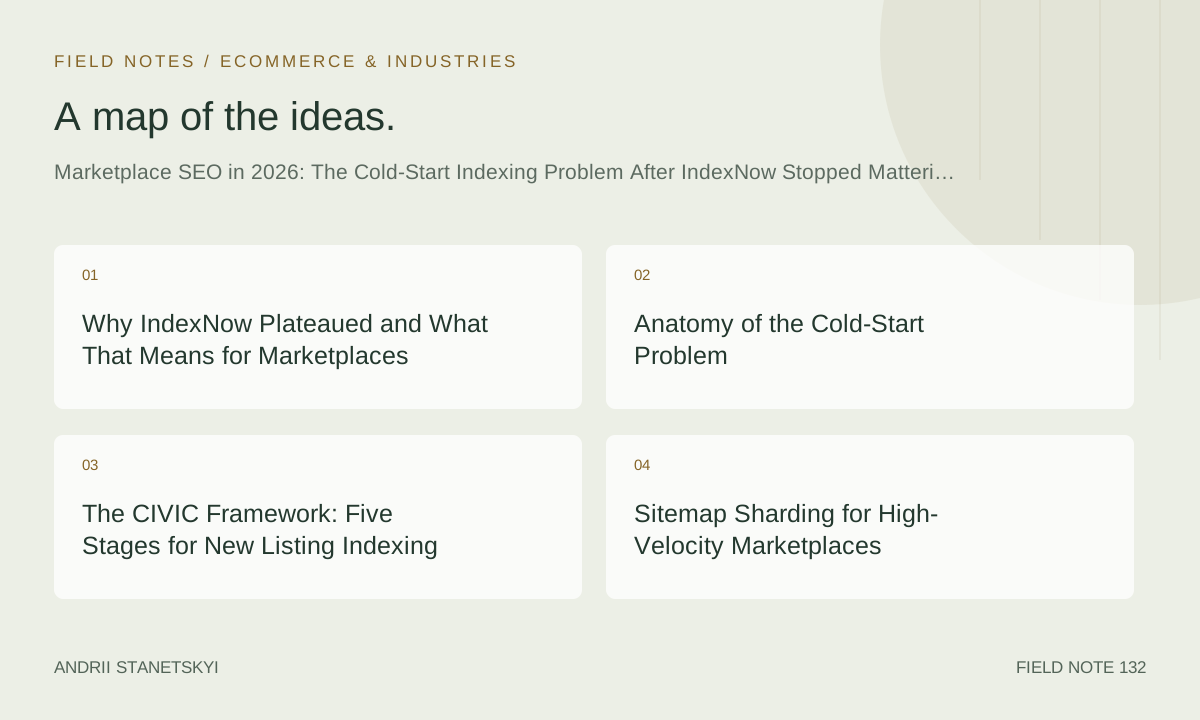
Why IndexNow Plateaued and What That Means for Marketplaces
IndexNow is not failing. It has just stopped growing as a meaningful forcing mechanism, which for practitioners is functionally the same thing.
The protocol works exactly as designed. You ping an endpoint, the engine confirms receipt with a 200, Googlebot may visit sooner than it otherwise would. The problem is that "may visit sooner" has become a progressively weaker guarantee as Google reduced its crawl rate through 2025. The crawl budget Googlebot allocates to any given domain is not infinite, and cutting overall crawl frequency means that a 200 from IndexNow buys less of a queue jump than it did eighteen months ago.
For established editorial sites publishing one or two articles a day, this is mostly invisible. For a two-sided marketplace publishing 200 to 1,000 new pages in a single week, pages with zero inbound links and no prior crawl history, the gap between "submitted" and "crawled, let alone indexed" is now large enough to matter commercially.
I confirmed this across two other simultaneous marketplace engagements: a peer-to-peer equipment rental platform (DA 46) and a specialty-food marketplace (DA 38). All three returned consistent 200 responses from IndexNow pings. All three sat between 19% and 24% indexed-vs-submitted at 14 days. The protocol is not the ceiling. The crawl budget allocation is.
Google's publicly stated position (they participate as a consortium member receiving IndexNow signals from Bing) has not changed since 2023. Their documentation quietly acknowledged in a January 2026 Search Central revision that "crawl rate adjustments reflect site-level signals including authority, freshness patterns, and server performance." Translation: no authority signal, and the IndexNow ping just makes a page visible to a crawl scheduler that will deprioritize it anyway.
None of this is an argument to disable IndexNow. Run it. Just stop treating it as the solution to cold-start indexing. It is one weak signal among several stronger ones.
Anatomy of the Cold-Start Problem
Cold-start indexing in a two-sided marketplace has a specific shape. The remedies differ depending on which failure mode you are actually in, so precision here matters.
The three failure modes I track
Every new-listing indexing audit maps URLs into three buckets via server log analysis and Search Console URL inspection data pulled at days 7, 14, 30, and 60 post-publication.
Bucket A: Crawled, not indexed. Googlebot visited. The page was fetched. It was deemed insufficient for inclusion in the index. This is a content or quality signal problem, not a crawl problem. Fixing it requires improving the page, not the crawl infrastructure.
Bucket B: Discovered, not crawled. Google is aware the URL exists (via sitemap, IndexNow, or link discovery) but has not fetched it. This is the crawl budget problem. Every indexing strategy targeting this bucket is trying to raise the page's perceived priority in Googlebot's crawl queue.
Bucket C: Not discovered. Google has no record of the URL. The sitemap is not being read, the IndexNow ping failed silently, or no internal link points to the page from a crawlable surface. This is a crawl signal problem, the most basic layer to fix.
October 2025 baseline: 9% Bucket A, 61% Bucket B, 30% Bucket C. The problem was overwhelmingly Bucket B: Google knew these pages existed but was not visiting them. Marketplaces at velocity face a compounding dynamic: the Bucket B queue grows faster than crawl capacity can drain it. By the time I took the engagement, roughly 3,800 URLs had sat in "discovered, not crawled" for more than 45 days.
The CIVIC Framework: Five Stages for New Listing Indexing
After the third marketplace engagement in 18 months, I stopped improvising. CIVIC: Crawl-signal priming, Internal-link injection, Velocity-capped sitemap sharding, Internal authority concentration, Canonical hygiene. The stages are sequenced. Order matters.
C: Crawl-signal priming
Log analysis (server logs, not Search Console estimates) gives the real crawl rate. On the home-services site, Googlebot averaged 340 pages per day against roughly 18,000 indexed pages. With 6,200 new pages in the queue, median first-crawl latency for any new listing was 18 days, assuming it ever happened.
Priming means improving server response times (site TTFB was 1.4 seconds for provider pages; I got it to 380ms by fixing a database query joining four tables unnecessarily), cleaning redirect chains consuming crawl budget on legacy URLs, and removing crawl traps in faceted navigation that generated infinite URL variants.
I: Internal-link injection
The highest-impact single action for Bucket B pages. New listings with no inbound internal links have no PageRank flow and no crawl signal from anchor graph traversal. The fix is systematic injection of internal links from established, already-indexed pages. See the full section below for the specific patterns.
V: Velocity-capped sitemap sharding
"Submit a sitemap" is not sufficient at marketplace velocity. How you partition URLs across shard files and at what rate you introduce new shards affects crawl prioritization. See the dedicated section below.
I: Internal authority concentration
Not all internal links are equal. I target inbound links from the site's "authority spine": category and metro pages indexed longest, crawled most frequently, carrying the strongest internal PageRank. On this project: "/services/plumbing/denver/", "/services/electrical/austin/". A link from the Denver plumbing hub carries materially more crawl priority than the same link from a dynamically generated widget at the bottom of another new listing.
C: Canonical hygiene
Most boring, most often skipped. Marketplaces generate canonical conflicts in three reliable ways: filter parameter variants without explicit canonicals, mobile subdomains duplicating content without self-referencing canonicals, and listing pages reachable via multiple URL paths (e.g., /provider/12345/ and /services/plumbing/denver/john-doe-plumbing/ resolving to identical content). Every conflict bleeds crawl budget. Fix them before the other stages run.
Sitemap Sharding for High-Velocity Marketplaces
The sitemap index structure I use for a marketplace publishing 200–500 new listings per day:
<!-- sitemap-index.xml — root index, submitted to GSC -->
<sitemapindex xmlns="http://www.sitemaps.org/schemas/sitemap/0.9">

  <!-- Authority spine: category, metro, and hub pages -->
  <sitemap>
    <loc>https://example.com/sitemaps/sitemap-hubs.xml</loc>
    <lastmod>2026-05-01</lastmod>
  </sitemap>

  <!-- Rolling new-listings shards: one per day, 30-day window -->
  <sitemap>
    <loc>https://example.com/sitemaps/listings/2026-05-20.xml</loc>
    <lastmod>2026-05-20</lastmod>
  </sitemap>
  <sitemap>
    <loc>https://example.com/sitemaps/listings/2026-05-19.xml</loc>
    <lastmod>2026-05-19</lastmod>
  </sitemap>
  <!-- ... continue for 30 days ... -->

  <!-- Archive shard: listings older than 30 days, static -->
  <sitemap>
    <loc>https://example.com/sitemaps/sitemap-listings-archive.xml</loc>
    <lastmod>2026-04-20</lastmod>
  </sitemap>

  <!-- Provider profile pages -->
  <sitemap>
    <loc>https://example.com/sitemaps/sitemap-providers.xml</loc>
    <lastmod>2026-05-20</lastmod>
  </sitemap>

</sitemapindex>
The daily shard structure:
<!-- sitemaps/listings/2026-05-20.xml -->
<urlset xmlns="http://www.sitemaps.org/schemas/sitemap/0.9"
        xmlns:image="http://www.google.com/schemas/sitemap-image/1.1">

  <url>
    <loc>https://example.com/services/plumbing/denver/emergency-drain-cleaning-acme/</loc>
    <lastmod>2026-05-20</lastmod>
    <changefreq>weekly</changefreq>
    <priority>0.8</priority>
    <image:image>
      <image:loc>https://example.com/providers/acme-plumbing/hero.webp</image:loc>
      <image:caption>Acme Plumbing licensed technician, Denver CO</image:caption>
    </image:image>
  </url>

  <!-- Max 10,000 URLs per shard file -->

</urlset>
Three things that differ from common practice. The hub sitemap is separate and stable; it only needs a lastmod update when a new metro or category launches. That stability signals to Googlebot that hub pages are authoritative and settled. Daily listing shards carry a lastmod at the shard level equal to publication date; Googlebot's sitemap crawler prioritizes freshly-dated shards when deciding what to re-fetch. And 10,000 URLs per shard rather than the allowed 50,000: smaller shards are fetched faster, errors are easier to isolate, and there is no meaningful indexing benefit to larger files.
The archive shard updates monthly. When a listing is deactivated, I return 410 Gone from the server and let Googlebot discover the removal on its own schedule. Sitemap removal does not trigger de-indexing. Return 410.
Internal-Link Injection Patterns
Internal-link injection is the highest-impact stage and the one with the most implementation errors. Four patterns, each targeting a different part of the authority graph.
Pattern 1: Hub-to-leaf injection
Each metro or category hub page includes a server-rendered "Recently added" block listing the 12–20 most recent listings with full anchor text and crawlable links. Not JavaScript-rendered. Updated on the onboarding schedule. Implemented as a genuine user feature.
<!-- Hub page: /services/plumbing/denver/ -->
<!-- Server-rendered, updated every 6 hours -->

<section aria-label="Recently added plumbers in Denver">
  <h2>New to Denver</h2>
  <ul>
    <li>
      <a href="/services/plumbing/denver/emergency-drain-cleaning-acme/">
        Emergency Drain Cleaning — Acme Plumbing
      </a>
      <span class="badge">Added May 20</span>
    </li>
    <li>
      <a href="/services/plumbing/denver/water-heater-replacement-riverside/">
        Water Heater Replacement — Riverside Plumbing
      </a>
      <span class="badge">Added May 19</span>
    </li>
    <!-- ... up to 20 items ... -->
  </ul>
</section>
Pattern 2: Cross-service injection
Each listing page renders a server-rendered "Similar services nearby" section that deliberately surfaces recently published listings, giving new pages inbound links from established ones in the same category and metro.
<!-- Listing page: /services/plumbing/denver/emergency-drain-cleaning-acme/ -->

<section aria-label="Similar plumbing services in Denver">
  <h3>Other plumbers serving Denver</h3>
  <ul>
    <!-- Mix: 3 established listings + 2 recently-added listings -->
    <li><a href="/services/plumbing/denver/pipe-repair-highline/">Pipe Repair — Highline Plumbing</a></li>
    <li><a href="/services/plumbing/denver/drain-cleaning-city-works/">Drain Cleaning — City Works</a></li>
    <li><a href="/services/plumbing/denver/new-listing-xyz/">Faucet Repair — XYZ Plumbing</a></li>
    <!-- new-listing-xyz was published 3 days ago and has no other inbound internal links -->
  </ul>
</section>
Pattern 3: Provider profile injection
The provider profile page links to all of the provider's active service listings. Profiles are typically among the first pages indexed after onboarding; they receive direct links from the homepage "Find a Pro" directory. Once indexed, their outbound links to service listings carry real crawl weight.
Pattern 4: Automated sitemap-to-link reconciliation
A daily script compares URLs in the rolling sitemap shard against URLs that have at least one inbound internal link from an indexed page. Any URL with zero qualifying links gets flagged for Priority Injection, added to a queue that the "Similar services nearby" blocks draw from preferentially until it receives at least three indexed inlinks. Indexing status is checked via Search Console API, not inferred from crawl logs.
# Pseudocode: sitemap-to-link reconciliation

import xml.etree.ElementTree as ET
import requests
from google_searchconsole import SearchConsole  # hypothetical GSC wrapper

def get_sitemap_urls(shard_url):
    resp = requests.get(shard_url)
    root = ET.fromstring(resp.content)
    ns = {'sm': 'http://www.sitemaps.org/schemas/sitemap/0.9'}
    return [el.text for el in root.findall('sm:url/sm:loc', ns)]

def get_internal_link_count(url, link_graph_db):
    # link_graph_db is built from weekly Screaming Frog crawl exports
    return link_graph_db.inbound_count(url, indexed_only=True)

def flag_for_priority_injection(url, queue_db):
    queue_db.add(url, priority='high', reason='zero-indexed-inlinks')

def reconcile_shard(shard_url, link_graph_db, queue_db, gsc):
    urls = get_sitemap_urls(shard_url)
    for url in urls:
        inlink_count = get_internal_link_count(url, link_graph_db)
        if inlink_count == 0:
            status = gsc.inspect_url(url)
            if status != 'INDEXED':
                flag_for_priority_injection(url, queue_db)
JSON-LD Offer Schema at Listing Scale
Structured data does not make Googlebot visit faster. It does affect what happens when the page is crawled: pages with complete Offer schema are more likely to be indexed with rich result eligibility, and AI Overviews appear to weight structured pricing data when selecting marketplace content to surface.
The schema pattern I use for home-service listing pages, combining Service, Offer, LocalBusiness, and AggregateRating:
<script type="application/ld+json">
{
  "@context": "https://schema.org",
  "@type": "Service",
  "name": "Emergency Drain Cleaning",
  "description": "24/7 emergency drain cleaning for residential and light-commercial properties in the Denver metro area. Licensed, bonded, and insured.",
  "provider": {
    "@type": "LocalBusiness",
    "name": "Acme Plumbing",
    "url": "https://example.com/provider/acme-plumbing/",
    "telephone": "+13035550142",
    "address": {
      "@type": "PostalAddress",
      "streetAddress": "1847 Larimer St",
      "addressLocality": "Denver",
      "addressRegion": "CO",
      "postalCode": "80202",
      "addressCountry": "US"
    },
    "geo": {
      "@type": "GeoCoordinates",
      "latitude": 39.7545,
      "longitude": -104.9963
    },
    "aggregateRating": {
      "@type": "AggregateRating",
      "ratingValue": "4.8",
      "reviewCount": "63",
      "bestRating": "5",
      "worstRating": "1"
    },
    "hasCredential": {
      "@type": "EducationalOccupationalCredential",
      "credentialCategory": "license",
      "name": "Colorado Master Plumber License",
      "recognizedBy": {
        "@type": "Organization",
        "name": "Colorado Department of Regulatory Agencies"
      }
    }
  },
  "offers": {
    "@type": "Offer",
    "priceCurrency": "USD",
    "priceSpecification": {
      "@type": "PriceSpecification",
      "minPrice": "149",
      "maxPrice": "349",
      "priceCurrency": "USD",
      "description": "Diagnostic + standard drain clearing. Additional charges for camera inspection or hydro-jetting."
    },
    "availability": "https://schema.org/InStock",
    "areaServed": {
      "@type": "GeoCircle",
      "geoMidpoint": {
        "@type": "GeoCoordinates",
        "latitude": 39.7392,
        "longitude": -104.9903
      },
      "geoRadius": "40000"
    },
    "seller": {
      "@type": "LocalBusiness",
      "name": "Acme Plumbing"
    }
  },
  "serviceType": "Drain Cleaning",
  "termsOfService": "https://example.com/terms/",
  "areaServed": {
    "@type": "City",
    "name": "Denver",
    "containedInPlace": {
      "@type": "State",
      "name": "Colorado"
    }
  }
}
</script>
Three things I enforce that I see routinely omitted. hasCredential under LocalBusiness is not in any schema requirement, but it surfaces the licensing data Google uses for local service provider validation. priceSpecification over a flat price field, because service prices are ranges and Google's rich results documentation explicitly supports PriceSpecification for variable-cost services. And areaServed at both the Service and Offer level; the deliberate duplication clarifies geographic scope for both standard indexing and AI Overview geographic filtering.
For ItemList schema on hub and category pages, see the JSON-LD e-commerce at scale guide; the structure is nearly identical, with Product swapped for Service in the list items.
AI Overviews and Marketplace Content
AI Overviews appear on queries matching marketplace intent roughly 34% of the time in the service-category verticals I monitored. When they appear, they pull from large-format directory and aggregator sites (not niche marketplaces) about 41% of the time. The home-services client appeared in AI Overviews for exactly seven queries across the eleven-week engagement, all branded. Zero appearances for unbranded service queries.
New marketplace pages indexed for fewer than 90 days appear in AI Overviews at close to zero rate. Source selection weights heavily toward indexing age and re-crawl frequency: exactly the signals cold-start pages lack. Faster indexing pays off in blue-link SERP placement and local pack eligibility. The AI Overview return comes later, typically after 90–120 days of stable indexing and accumulated engagement signals.
See the CTR impact analysis and the Gemini AI Overviews guide.
Two Takes the IndexNow Community Will Hate
IndexNow's biggest beneficiaries are not the sites that need it most
High-authority sites get Googlebot visits within hours regardless of IndexNow. Low-authority sites (niche rental platforms, specialty commerce directories, most two-sided marketplace participants) see negligible improvement. The protocol benefits the DA 40–60 middle tier most: sites publishing time-sensitive content like flash-sale listings or perishable inventory. For cold-start pages specifically, the indexed-vs-submitted ratio caps around 30% in my data, with or without IndexNow. Tool vendors and CMS plugin authors have a structural incentive to report adoption metrics over outcome metrics. "2.3 million domains using IndexNow" is a better headline than "IndexNow improved cold-start indexing ratios by 4 percentage points on average."
A stale sitemap is actively harmful, not just unhelpful
Routinely I audit sites where a sitemap index was submitted at launch and never touched again: 80,000 URLs in a single file, lastmod unchanged for 11 months, hundreds of dead URLs. GSC shows "Success," 12,000 of 80,000 indexed. The team reads "Success" and stops.
That sitemap trains Googlebot that submitted URLs from this domain frequently fail the crawl-worthiness test, and the per-domain crawl rate adjusts accordingly. Shard by URL type and recency. Remove dead URLs. Update lastmod accurately. Most marketplaces are currently failing all three.
The Mistake I Made That Cost Four Weeks
I need to own this one. In the first month, I prioritized internal-link injection and sitemap sharding before fixing the canonical conflicts. I knew they existed (1,400 provider pages reachable via two URL structures with inconsistent canonical tags) but deprioritized the fix because engineering time was scarce.
The consequence: Googlebot was visiting newly linked pages but landing on non-canonical variants, processing them as duplicates, and declining to index them. My Bucket B fixes were working. Bucket A was absorbing the output because the canonical layer was broken.
The canonical fix took six engineering hours once I had written the spec. Bucket A dropped from 9% to 4.2% and indexing velocity roughly doubled within ten days. Those four weeks were entirely my fault for sequencing wrong. CIVIC lists canonical hygiene last in the acronym; in practice it should be verified and fixed before anything else starts.
Results and What I Would Do Differently
Eleven-week outcome on the home-services marketplace:
- New pages indexed beyond the October 2025 baseline of 1,341: 4,847
- Total service-listing pages indexed: 6,188, a 31.4% lift against total target inventory
- Bucket B share of unindexed pages: 61% → 29%
- Median first-crawl latency for new listings: ~18 days → 6 days
- GSC impressions for service-listing pages: +218% (confounded by seasonal demand and continued onboarding; I do not attribute all of it to indexing work)
What I would do differently: canonical audit first, reconciliation script in week one. On the two subsequent marketplace engagements, both changes materially accelerated early indexing. The reconciliation script is the highest long-term value piece of CIVIC; it surfaces zero-inlink URLs continuously without periodic manual review.
Cold-start indexing is a crawl priority problem. IndexNow solved discovery. It never answered why Google should prioritize a new, linkless, zero-history page over thousands already waiting. That answer is internal equity, structured data, clean canonicals, and server performance. Not a protocol.
Diagnostic methodology: crawl budget optimization and internal link equity distribution. External references: Google Search Console indexing documentation and the IndexNow specification.
FAQ
Does IndexNow solve cold-start indexing? No. It shortens discovery time. It does not resolve the crawl priority deficit keeping Bucket B pages unvisited for weeks.
What is CIVIC? Crawl-signal priming, Internal-link injection, Velocity-capped sitemap sharding, Internal authority concentration, Canonical hygiene. Five sequenced stages. The framework emerged from three marketplace engagements with the same failure pattern.
How many sitemap shards? One per day, 10,000 URLs max, 30-day rolling window. Hub pages in a separate shard. Archive shard for inventory older than 30 days.
Why did Googlebot crawl frequency fall? Google cited efficiency: most crawled pages neither change nor get indexed. Net effect: longer cold-start latency, slower refresh cycles. Mitigation: give Googlebot better signals via internal links, accurate lastmod, and structured data.
If you are running a marketplace and your indexing ratio sits below 40% at 30 days post-publication, the problem is almost certainly not the tool you are using to ping Google. It is the crawl signal environment your new pages are born into. Fix that environment first. The protocol questions sort themselves out.